INR 96 Projection: Indian Rupee Plummets Amid Red Sea Instability and US Treasury Pivot
TL;DR
- INR 96 Projection: Rupee Plummets as FIIs Pivot to $646B US Treasury Sales. Will the Rupee hit 96 as capital flees to US Treasuries amid Red Sea instability?
- £9.8bn Gilt Surge: UK Bond Market Volatility Risks Growth as Burnham Administration Takes Office. Can the UK economy survive the 'gilt vigilantism' and rising debt costs under the new Burnham administration?
📉 The Rupee's Calculated Descent into Geopolitical Noise
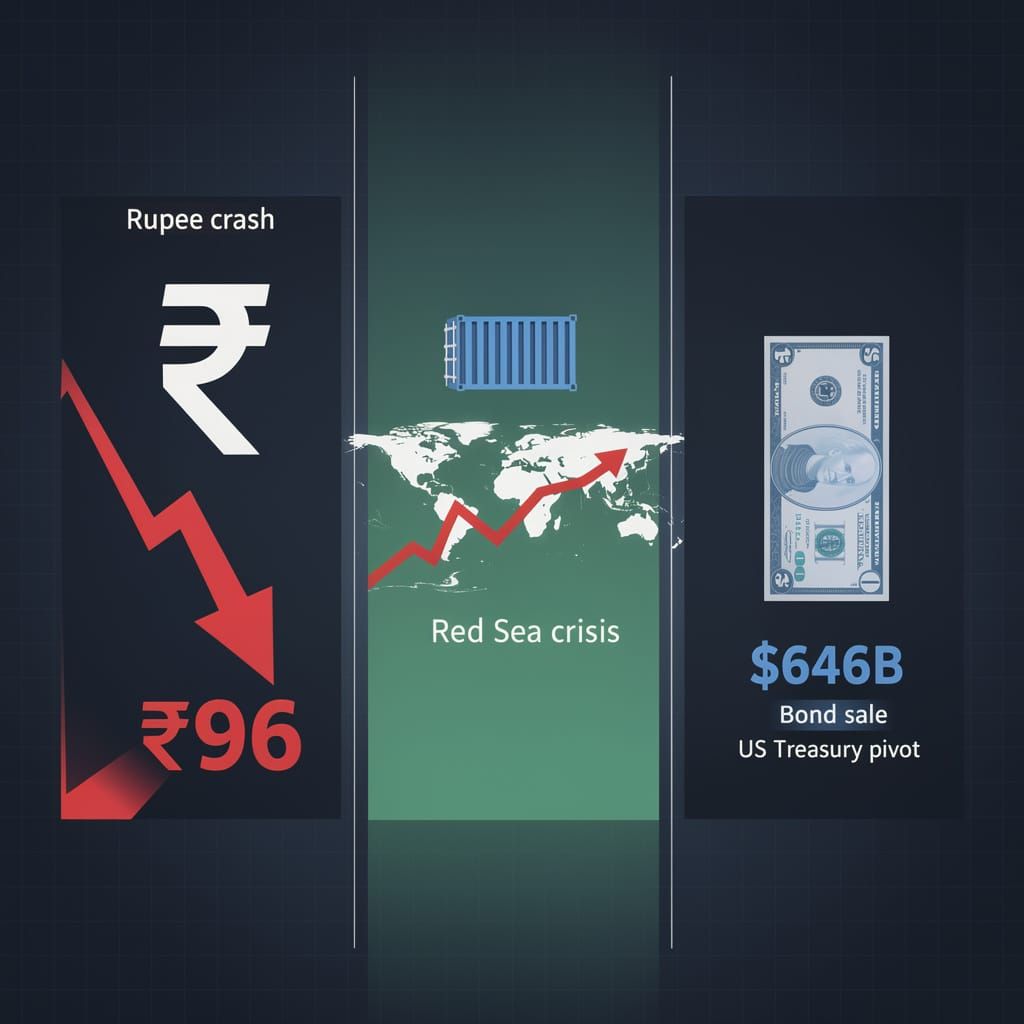
INR 96 projection is a brutal wake-up call, roughly a 5% erasure of value in weeks 📉. A textbook flight to safety as capital deserts emerging markets for US Treasuries. RBI's 'stability' is a myth while the USD reigns. Is your portfolio ready for the rout? 🇮🇳
Market optimists frame the Indian rupee’s volatility as a mere "adjustment." In reality, the currency is reacting to a predictable cycle of Middle Eastern instability. While officials highlight the end of the Iran War, the residue remains: U.S. and Saudi joint operations targeting Houthi funding on June 3, 2026, only heightened Red Sea maritime security risks. This instability enables a textbook flight to safety, where emerging market assets serve as the convenient exit door for nervous capital.
Who Profits from the Panic?
The causal chain is transparent: geopolitical tension in West Asia triggers systematic sell-offs. By early June 2026, FII liquidations and energy price shocks—driven by the Strait of Hormuz closure—triggered high-impact market corrections. Rather than reinvesting locally, these funds anchor themselves in American debt. The U.S. Treasury’s aggressive issuance, including a massive $646 billion sale on June 13, 2026, demonstrates a preference for USD liquidity over emerging market resilience.
Market Erosion Patterns
- Freight Disruption: Red Sea crisis → sharp rise in container spot rates and fuel surcharges → higher landed import costs.
- Capital Flight: Middle East escalation → heavy FII equity liquidations → direct downward pressure on the INR.
- Treasury Pivot: $518B Treasury sale (June 19) → 1-year yields spike to 4.0% → accelerated rupee depreciation toward the 95–96 range.
Sectoral Fallout
- Logistics: Fuel price hikes and port congestion → Maersk shares rise 13% → compressed margins for importers.
- Banking: Currency volatility → increased hedging costs for corporate borrowers.
- Equity: FII outflows → systemic suppression of Nifty and Sensex valuations.
Where is the Bottom?
The Reserve Bank of India (RBI) may signal stability, but the numbers reveal a fragile equilibrium. Even as Indian refineries scale up—with Russian crude volumes rising 14% by July 12, 2026—the systemic reliance on safe-haven USD persists. As long as Treasury yields remain elevated due to fiscal deficits and inflation, the rupee remains a sacrificial asset.
- Q3 2026: Continued INR volatility as RBI manages inflation (CPI >5%) and FIIs prioritize US liquidity.
- Q4 2026: Risk of deeper Sensex corrections if Houthi activity and Red Sea insecurity intensify.
- 2027 Projection: Stabilization requires sea freight routes to return to baseline and a resolution of US-Iran tensions.
📉 The Burnham Pivot: A Masterclass in Market Anxiety
£4.2 trillion in sovereign debt is now a playground for "gilt vigilantes." 🚩 That's like every UK citizen owing £60k to moody foreign investors. 📉 Ambiguous spending plans are spiking yields while households swallow a £4bn energy surge. Discipline or delusion? UK taxpayers — can you afford this "pivot"?
On July 19, 2026, Andy Burnham assumed leadership of the UK, succeeding a regime marked by severe gilt market turmoil. By July 21, the new administration attempted to navigate a paradox: claiming finances have "lessened" while inheriting a reactive environment where foreign investors dominate £4.2 trillion in sovereign debt. This linguistic gymnastics fails to obscure a fragile macrocycle where the Bank of England's high rates—compounded by Brexit-linked labor scarcity—stifle consumer spending and amplify energy-price sensitivity.
Why is the Bond Market Panicking?
Global investors prioritize clarity, yet the Burnham transition provided ambiguity regarding spending powers. This lack of fiscal discipline enables a sharp reaction in the bond markets; "gilt vigilantism" now drives rapid yield spikes whenever politicians propose borrowing. The administration's inability to define borrowing limits creates a systemic risk where the market reacts not to the person in office, but to the unpredictability of the purse strings.
- July 14, 2026: Record gilt sales of £9.8bn trigger a 5% yield spike, threatening existing liabilities.
- July 21, 2026: Burnham takes office; proposed modest tax increases on top earners project a GDP contraction of ~0.8%.
- Q3 2026: Projected yield climbs beyond target thresholds as foreign investors, responsible for 60–90% of yield variance, demand higher risk premiums.
Bond Yields: Ambiguous spending rhetoric → 5% spike in yields → elevated debt servicing costs. Consumer Pricing: BoE high rates + 13% energy price-cap lift → £4 billion surge in household energy costs → eroded purchasing power. Fiscal Policy: Minimal household assistance → stagnant consumer spending → OECD projected growth slowdown to 0.9% by 2027.
The administration's effort to provide "minimal assistance" to households demonstrates a disconnect between political rhetoric and economic necessity. By failing to offset rising borrowings and a cost-of-living crisis—where dual-fuel invoices hit a record £1,862 per year—the government effectively exports the cost of its transition to the consumer.
This sequence indicates a causal chain where political instability results in market turbulence. The transition to Burnham has introduced a volatility that manifests directly in the yield curve. As borrowing costs accelerate and the Market Confidence Index is projected to drop 15%, the gap between government ambition and fiscal reality widens, leaving the UK economy to absorb the shock.


Comments ()