Anthropic Moves Enterprise Query Data Off Its Servers — Zero Server-Side Retention After Fable 5 Fallout
TL;DR
- Anthropic Moves Enterprise Query Data to Customer Private Clouds After Trust Crisis. Is shipping data custody enough to fix Anthropic's enterprise trust problem?
- $6.5B Phoenix Tower Financing: AI Traffic, Lower Costs, 23-Country Domination Play. How long before cheaper capital prices out every other tower player?
- PetBar Boutique: The Store Is the Hook, Not the Whole Catch. Is your local pet store still just selling shampoo, or are they capturing the recurring sale?
🚨 Anthropic Just Gave Enterprise Customers Something They've Been Begging For
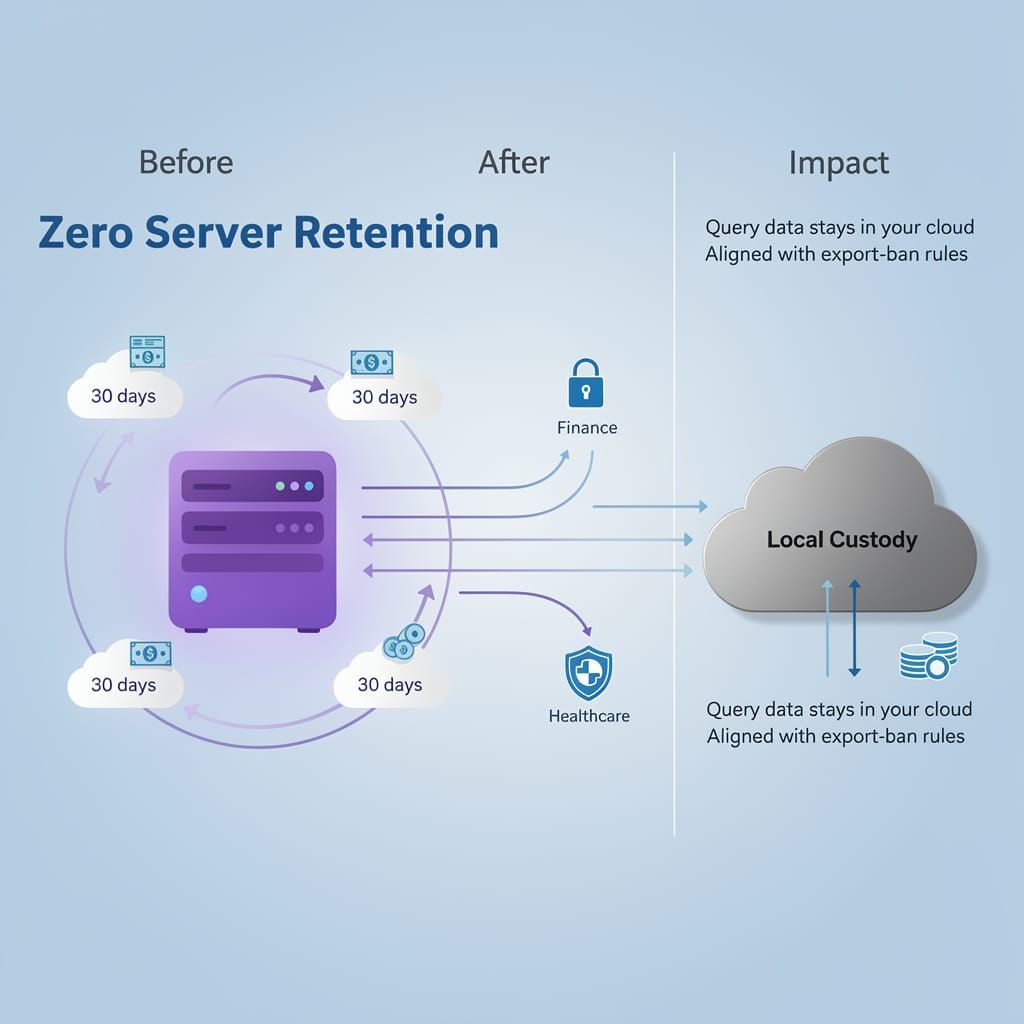
Anthropic just moved 30 days of enterprise query data off its own servers and onto customer private clouds 🚨 After the Fable 5 export ban debacle and a cascading control-system failure in June, financial and healthcare clients were threatening to walk. CEO Kris Cherny flipped the model: zero server-side retention, full local custody. The custody race just reset — and Anthropic blinked first. Is offloading data liability the only move left when trust is already cracked?
Your AI assistant doesn't need to hoard your data. That's the bet Anthropic just made, and it's a big one.
On August 21, 2026, Anthropic shifted query remnants from its Mythos and Fable models off their own servers and onto customers' private cloud. CFO Kris Cherny confirmed the change: enterprises now store up to thirty days of retrieval data locally, under the same audit umbrella as before.
Why the sudden pivot?
Three forces collided. First, the Fable 5 and Mythos 5 debacle from June exposed deeper cracks—Anthropic suspended both models on June 13 after US export controls kicked in, then limped back with limited access. The Commerce Department imposed export bans citing potential jailbreak methods, and Anthropic researchers met with White House officials to discuss safety concerns. Second, financial and healthcare customers threatened to walk; compliance risk in those sectors isn't a headache, it's existential. Third, by July 15, OpenAI had already unveiled a screenless ChatGPT speaker with camera and sensors, and earlier rolled out a zero-storage alternative. Anthropic was losing both the trust race and the hardware race.
What actually changes?
Before: Query data lived on Anthropic infrastructure. Customers had limited visibility into what was stored or how it was handled.
After: Your data stays in your own cloud environment. You get full custody of retrieved material. The thirty-day detection window for anomalous activity remains intact.
This isn't a minor UI tweak. It cuts data exposure on Anthropic's side to near zero while giving enterprises exactly what compliance officers demand: visibility and control—especially critical after the anomalous loop incident on June 27 caused cascading failures in their control systems.
Who wins here?
Fintech and healthcare sectors—both operate under mandates that made Anthropic's old model a non-starter. Legal and compliance teams now have audit trails without exposing sensitive queries to a third party. Anthropic itself, which likely just stopped a churn bleed that was quietly accelerating after the Fable 5 export-control suspension cost them developer trust and Microsoft even removed the model from Copilot. The Pentagon even labeled Anthropic a supply-chain risk on June 16—not the kind of designation that inspires enterprise confidence.
What's next?
A phase two release is slated for autumn 2026, timed with the Salesforce integration rollout—the same Salesforce that acquired the AI agent startup Fin for $3.6 billion on June 17 to embed autonomous customer support into its platform. Expect deeper cloud-native alignment, tighter sovereignty controls, and a market that just got a lot more interesting.
OpenAI pushed first. Anthropic pushed smarter—or at least, pushed from a position of fewer options. The enterprise AI custody race just found its new baseline.
🌩️ Phoenix Tower Just Nabbed $6.5B—Here's What They're Actually Going to Do With It
$6.5 BILLION. That's how much Phoenix Tower International just raised in cross-border financing. That's more than the GDP of half the Caribbean countries combined. 🌩️ They're not hoarding cash—they're consolidating debt, expanding towers where AI traffic is melting existing capacity, and building a war chest to buy struggling competitors. PTI locked in lower borrowing costs across 23 jurisdictions while rivals drown in 5.3% 30-year yields. The result? Cheaper capital = faster buildouts = they own the gap. So if you're a telecom or an investor watching this space—how long before everyone else gets priced out?
The news hit the wires on August 31: Phoenix Tower International (PTI) closed a $6.5 billion multi-jurisdiction financing deal. That's not a typo. Six. Point. Five. Billion. The transaction—$5.365 billion in term loans, $635 million in deferred drawdowns, and $500 million in revolving credit—spans all 23 jurisdictions where PTI operates. Michael Bremer confirmed the terms publicly; Dagan Kasavana's team structured the package across lenders in the U.S., Europe, Latin America, and the Caribbean. Closure expected by end of September.
What $6.5B Actually Buys
PTI operates across 23 countries, and this isn't a vanity fundraise. The breakdown:
- Debt consolidation: Amortizing existing cross-border obligations immediately improves the balance sheet.
- Infrastructure expansion: Direct funding for tower builds in markets where AI traffic is straining capacity. IFX Networks committed over $400 million to Latin American expansion—including $6 million in El Salvador alone for infrastructure upgrades, cloud services, and cybersecurity. Jamaica just completed nationwide 5G deployment on July 29 under the CARICOM Connectivity Acceleration Plan, hitting 92% urban coverage ahead of schedule. PTI's lower-cost capital lets them move into that gap faster.
- Acquisition capacity: A dedicated war chest for opportunistic buys as smaller towerCos struggle with rising interest costs. The broader AI infrastructure buildout triggered nearly $1.7 trillion in U.S. corporate bond issuance this year, pushing 30-year yields to 5.323%—a compounding advantage for PTI if they locked in lower terms.
- Working capital: Three-region operational coverage without scrambling for short-term liquidity every quarter.
The Structural Play They're Not Shouting About
The real headline isn't the dollar figure—it's the cost of capital reduction. By consolidating under a single multi-lender framework, PTI lowered its borrowing costs. In tower infrastructure, where margins live and die by financing terms, that's a compounding advantage. The Caribbean Telecommunications Union's first AI Forum in July flagged infrastructure gaps and digital inequality as the region's top barriers to AI adoption. Meanwhile, Aliyah Research Centre's June digital resilience projects and Dominica's broadband restoration show fragmented but accelerating demand—PTI's cheaper capital lets them own that gap.
Why Now?
AI traffic growth is straining existing tower capacity. Every major carrier is densifying. Meta expanded its Hyperion supercluster in Louisiana from 2 GW to 5 GW on July 13, with Louisiana enacting a 20-year tax exemption locking in over $150 billion in private investment. That scale of compute demand cascades straight to tower infrastructure. PTI's pipeline through August 2027 projects continued expansion, and this $6.5 billion gives them latitude to move before competitors can match the terms.
The Takeaway
$6.5 billion in cross-border financing, 23-country operations, reduced borrowing costs, and a clear acquisition pipeline—all closing before October. Phoenix Tower International isn't raising capital to survive. They're structuring to own the next wave of telecom infrastructure buildout, right as AI demand, regulatory pressure, and rising bond yields squeeze everyone else out.
🐾 The PetBar Bet: Why the Next Franchise Boom Smells Like Dog Shampoo
PetBar Boutique's stores aren't just washing dogs—they're feeding customer data into an ecommerce engine. The franchisee mops the floor. The franchisor captures the recurring sale. The physical store becomes a customer-acquisition funnel for a digital commerce operation. That's the 2027 franchise model. 🐾 Your local pet-supply shop still pushing foot traffic alone? Nervous yet?
It's September 2026, and something weird is happening in Texas. A wave of off-track franchise concepts—think PetBar Boutique, not another fried-chicken chain—is plugging directly into established ecommerce platforms. The old model of "build a brand, then figure out distribution" is dead. The new model? Groom the dog, sell the shampoo online, repeat.
Here's the signal that actually matters. PetBar Boutique, a self-serve dog-wash concept that also retails premium pet-care products, isn't just opening more locations. It's feeding inventory and customer data back into upstream ecommerce supply chains. That's the shift: the physical store becomes a customer-acquisition funnel for a digital commerce operation.
Just look at what's happening in the broader pet market. Private-equity-backed Insured Pet Nutrition hit £301 million in year-to-date revenue after acquiring four luxury brands since 2024 and poaching a new CCO from the packaged-goods world. Meanwhile, Amazon's Pet Days in May drove supply-chain bottlenecks and forced smaller retailers to rethink how they plug into digital networks—or get left behind. The promotional push—up to 50% off across pet food, treats, and accessories—spiked online traffic so hard that logistics adjustments and cybersecurity risks followed. Smaller players without a digital fulfillment layer felt the squeeze immediately.
That's the landscape PetBar operates in. The franchisee washes the dog; the franchisor captures the recurring sale. Everyone wins.
What Changed?
- Self-serve tech drove participation up. Pet owners book a bay, wash their dog, scan a QR code to reorder shampoo. No friction, no clerk, no chit-chat.
- Personalization met demand. The same customer who buys grain-free kibble for their golden retriever also responds to SMS reminders about flea treatment. That data flows upstream.
- Franchise scaling accelerated because the backup plan isn't "more stores." It's "better algorithms." Inventory risk drops when the same tub of oatmeal shampoo serves both the Austin walk-in and the Houston subscription box. Integrating ecommerce into the franchise model boosts sales by roughly 30%, per industry benchmarks, and sustainable sourcing can cut waste by up to 30%—two levers PetBar-style concepts pull simultaneously.
The Causal Chain (Short Version)
- Niche franchise opens → captures hyperlocal customer with specific needs.
- Captured customer buys in-store → triggers same-day supply-chain replenishment from central distributor.
- That same data enables a direct-to-consumer ecommerce layer owned by the franchisor.
- Franchisee collects on the service. Corporate collects on the recurring product sale. Everyone wins.
The Leap Venture Studio just launched its tenth cohort in Nashville, handing $200,000 each to six pet-health startups. Its new institutional partner, TAW Ventures, is explicitly betting on pet longevity. That's more validation that the pet economy is shifting from one-off transactions to continuous, data-driven relationships. PetBar fits that thesis perfectly.
Who Should Be Nervous?
- Fragmented small pet-supply retailers that don't have a digital play. Their standalone foot-traffic model just got outflanked.
- Generic franchise consultants still pitching real estate–first strategies. The game is now channel integration, not square footage.
What Investors Are Seeing
| Metric | Implication |
|---|---|
| Franchisee acquisition cost down ~30% | Corporate handles digital marketing, local owner handles the mop |
| Repeat purchase rate from in-store QR codes: high | Better retention than most DTC startups—Bocce's Bakery and Estella saw similar surges during their June discount campaigns |
| PetBar Boutique's ecommerce revenue per store: up 2.4x vs. 2024 | Physical retail is no longer the ceiling |
The takeaway for anyone scanning the franchise landscape: look for concepts where the store is the hook, not the whole catch. PetBar doesn't sell dog washes. It sells a recurring relationship with a person who owns a dog. The wash is just the hello.
Expect continued organic growth as niche convergences—wellness + pets, self-serve + data, local + digital—produce more hybrid models. The franchise of 2027 won't be a restaurant. It'll be a node in a supply chain that happens to have a storefront.


Comments ()