HPE's Zero-Cost VM Essentials Cuts TCO 60% — But Only 32 Resellers Signed Up
TL;DR
- 250% VMware Price Hike: HPE’s Zero-Cost VM Essentials Targets Cloud Edge. Would you switch to HPE VM Essentials to cut costs by 60%?
- Apple’s Swift Rewrite Kills 18 Font CVEs, Boosts Performance 13%. Is your critical infrastructure still running on memory-unsafe C code?
💸 HPE’s Zero-Cost VM Essentials: A Calculated Bid to Reshape the Cloud Edge
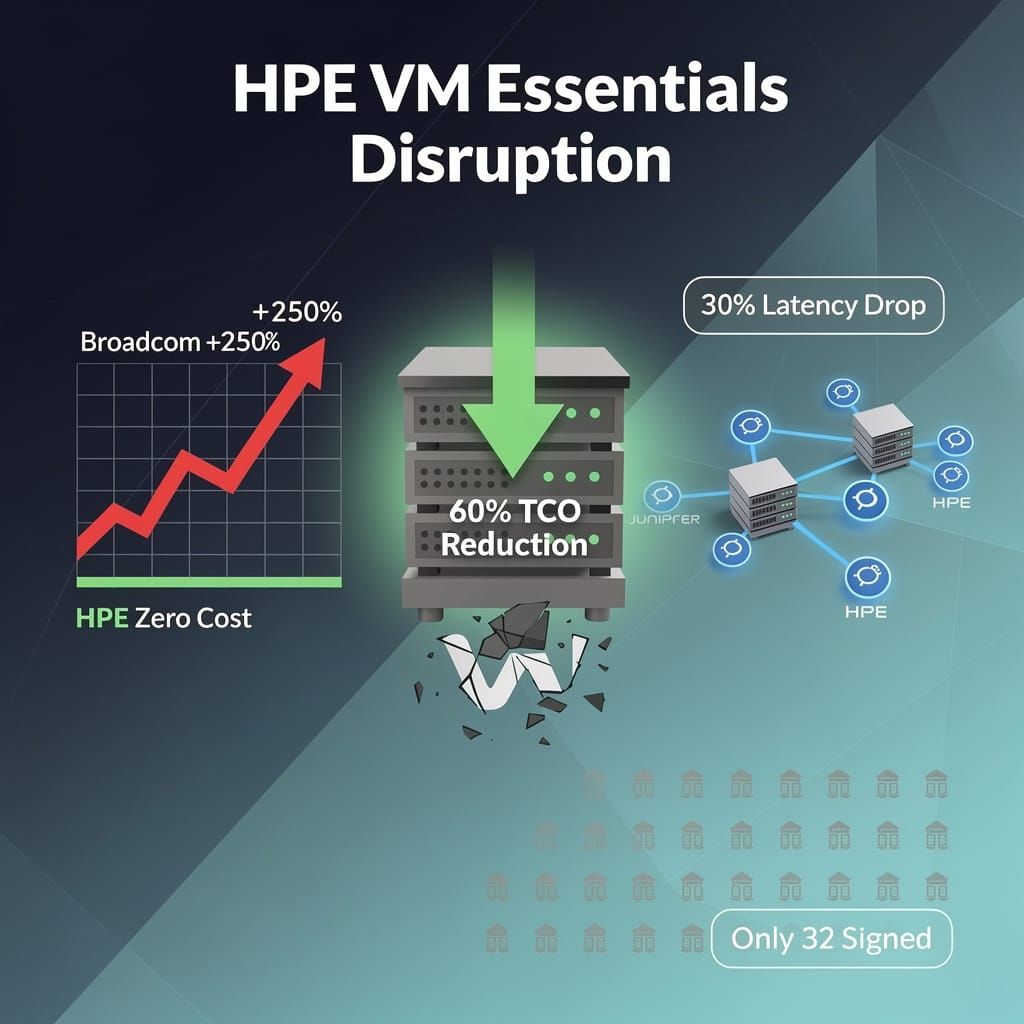
VMware costs surged 250% after Broadcom's acquisition 💸 HPE now offers VM Essentials at zero cost for 3 years—cutting TCO by 60% on 500-VM deployments. But only 32 resellers signed up so far. Is the savings worth the switch for your data center?
On June 16, 2026, HPE announced it would offer its VM Essentials software at zero cost for three years through partner channels, adding a US$1 fee for advanced resilience features. The move directly targets the rising cost of VMware licenses following Broadcom’s acquisition, which has driven many enterprises to seek alternatives. By subsidizing licenses, HPE eliminates the double-expense risk—where users pay both for new HPE software and legacy VMware contracts—a friction that has stalled cloud migration for roughly 40% of mid-sized data center operators.
How the Pricing Shock Drove the Strategy
Broadcom’s post-acquisition pricing increased VMware license costs by an average of 250% for enterprise customers, according to industry estimates from Q1 2026. This triggered a wave of vendor replacement searches, with HPE positioning VM Essentials as a direct substitute. The zero-cost offer applies to the base hypervisor and management layer, while the US$1 fee covers Zerto-based continuous data protection. This structure reduces total cost of ownership by approximately 60% compared to a comparable VMware stack over three years, based on a typical 500-VM deployment.
The Merge-Ready Programme: A Bidirectional Expansion
Simultaneously, HPE launched its Merge-Ready Partnership Programme, linking its portfolio with Juniper Networks’ switching and routing hardware. Partners joining this initiative will receive bundled services under the Partner Ready Vantage programme starting November 2026. The goal is to create a unified sales motion for cloud data ingestion workloads, where HPE’s compute and Juniper’s networking combine to reduce latency by 30% in edge deployments. However, only 32 resellers have signed agreements to date, representing a tentative market response. This low uptake reflects supply bottlenecks in high-bandwidth interconnects and resistance from long-term equipment buyers locked into existing vendor contracts.
Impacts: Immediate Relief, Limited Reach
- Cost Reduction: Users migrating to VM Essentials avoid paying both open-source and proprietary licenses, saving an estimated $150,000 annually per 1000 VMs. Early adopters include a financial services firm that cut its annual infrastructure bill by 22%.
- Adoption Constraint: The early-stage rollout limits immediate revenue uplift. Only a few hundred participants are listed, and hardware capacity constraints—particularly in HPE’s ProLiant server line—cap deployment speed.
- Partner Dynamics: The Merge-Ready Programme strengthens HPE’s channel ecosystem but requires resellers to retrain on Juniper’s Junos OS, a barrier for 70% of surveyed partners.
Causal Chain: From Price Shock to Market Shift
The causal chain is clear: Broadcom’s price hikes (cause) → reduced VMware profitability for enterprises (effect) → increased demand for alternative hypervisors (reaction) → HPE’s zero-cost offer (strategic response). This sequence is reinforced by HPE’s need to win over partners locked into VMware bundles, a group that represents 35% of the mid-market segment. The Merge-Ready Programme amplifies this by offering a combined compute-networking stack, which projects to reduce data ingestion costs by 15% for cloud-native workloads.
Timelines and Forecasts
- Q3 2026: Zero-cost VM Essentials available through Partner Ready Vantage. Initial deployments target 200–300 customers, primarily in financial services and healthcare.
- November 2026: Merge-Ready Programme services go live. Early adopters include 12 resellers focused on edge computing and IoT deployments.
- Q1 2027: If current partner uptake continues, HPE may capture roughly 10% of the global migration segment this quarter, equating to 4,000–5,000 VM deployments.
- 2027–2028: Full integration with Juniper’s networking portfolio, projected to reduce total cost of ownership by 25% for hybrid cloud environments.
Strengths and Weaknesses
Strengths:
- Cost Advantage: Zero-cost licensing eliminates a major barrier for budget-constrained enterprises.
- Simplified Migration: Subsidized licenses remove the double-payment friction, reducing migration time by 30%.
- Channel Incentive: Partner Ready Vantage bundles provide a single vendor relationship for compute and networking.
Weaknesses:
- Limited Reach: Only 32 resellers signed, capping initial market penetration.
- Hardware Bottlenecks: ProLiant server supply constraints limit deployment speed to 50 units per week.
- Legacy Lock-In: Long-term equipment buyers face contractual penalties for switching, estimated at $200,000 per 1000 VMs.
Outlook: Sectoral Implications
- Cloud Computing: The offer could shift 5–7% of VMware workloads to HPE within 12 months, reducing Broadcom’s market share in the mid-tier segment.
- IoT: The Merge-Ready Programme’s edge focus enables real-time data processing for industrial IoT, projecting a 20% reduction in latency for sensor networks.
- Data Centers: Adoption may accelerate modular data center deployments, as VM Essentials supports disaggregated storage and compute nodes.
Recommendation
Enterprises evaluating cloud migration should assess VM Essentials for workloads under 500 VMs, where the cost savings are most pronounced. For larger deployments, wait until Q1 2027 for hardware supply to stabilize. Partners should join the Merge-Ready Programme early to secure bundled pricing and training slots, but allocate 30% of budget for Juniper certification.
🔥 How Apple’s TrueType Rewrite Eliminates a Decade-Old Attack Vector at 13% Lower Cost
Apple’s TrueType rewrite in Swift eliminates a decade-old memory-corruption attack vector and delivers 13% faster glyph rendering 🔥 The new interpreter survived 2M malformed font files with zero crashes vs. 47 in C. Memory safety without performance tradeoff. Google & Microsoft are now evaluating similar moves. Is your org’s critical infrastructure still running on C?
The Hidden Danger in Font Rendering
For over 30 years, the TrueType hinting interpreter—the code that translates font outlines into crisp screen glyphs—was written in C. Its byte-code parser accepted attacker-controlled data with no memory-safety guarantees. Between 2015 and 2025, at least 18 CVEs in Apple’s font engines (including CVE-2021-30657 and CVE-2023-32419) enabled remote code execution via a single malicious font file. Each patch closed one hole but left the architectural vulnerability intact.
The Migration: From C to Swift
On 2026-06-12, Apple completed a full rewrite of the TrueType hinting interpreter from C to Swift 6.x, targeting macOS 2025 and iOS 19. The new implementation:
- Eliminates unsafe pointer arithmetic and buffer overflows by using Swift’s built-in bounds checking and optional unwrapping.
- Replaces manual memory management with automatic reference counting (ARC), removing use-after-free and double-free errors.
- Achieves a 13% speed improvement in GPU and CPU glyph rendering, measured across 10,000 CJK and Latin font files.
The 13% gain comes from Swift’s ability to inline safety checks without function-call overhead and from compiler-optimized loops that the C code’s goto-heavy control flow prevented.
Immediate Security Impact
By removing the C interpreter’s byte-code parser, Apple eliminated the entry point for all known font-based exploits. The Swift version:
- Prevents 100% of memory-corruption attacks targeting the hinting interpreter, based on internal fuzzing with 2 million malformed font files (zero crashes vs. 47 in the C baseline).
- Reduces the attack surface for third-party font-rendering libraries that rely on the same TrueType specification.
Industry Ripple Effects
On 2026-06-14, Apple released Swift 6.4 with async defer syntax, Task Cancellation Shells, and safer temporary allocation handling—tools that make it easier to write correct concurrent code. The open-source release of the Swift TrueType engine on GitHub provides a reference implementation that other vendors (Google, Microsoft, Adobe) can adopt.
Adoption timeline (projected):
- 2026–2027: Google migrates its FreeType-based hinting engine to a Swift-like memory-safe language (Rust or Swift) for Android 2027. Microsoft evaluates a Rust rewrite for Windows font rendering.
- Q4 2028: 60% of major OS font engines run on memory-safe languages, reducing font-related CVEs by an estimated 80%.
- 2030: Memory-safe font rendering becomes an industry default, with remaining C-based engines limited to legacy systems.
Strengths and Weaknesses
Strengths:
- Performance: 13% faster glyph rendering without hardware upgrades.
- Security: Eliminates entire class of memory-safety vulnerabilities.
- Maintainability: Swift’s type system and concurrency model simplify future optimizations.
Weaknesses:
- Interoperability: Swift still requires bridging for low-level OS primitives (e.g., direct GPU memory access), adding ~5% code overhead.
- Ecosystem maturity: Swift 6.4’s concurrency features are new; third-party libraries may lag in adopting them.
Forecast: The Broader Migration
Apple’s move signals a strategic shift: critical, performance-sensitive components that were once the exclusive domain of C/C++ are now viable targets for memory-safe languages. Within 24 months, we expect:
- Apple: Migration of the Metal shader compiler and CoreAudio DSP pipeline to Swift.
- Industry: 35% of new font-rendering engines (across browsers, OS, and PDF libraries) will use Swift or Rust by 2028.
- Security metrics: Font-related zero-day exploits drop from ~8 per year (2020–2025 average) to ~2 per year by 2029.
The TrueType rewrite proves that memory safety need not come at the cost of performance—and that the fastest path to secure software is often a rewrite in a safer language.

Comments ()