FAA Probing 737 MAX software flaw as Boeing delays operator notice by nearly two years
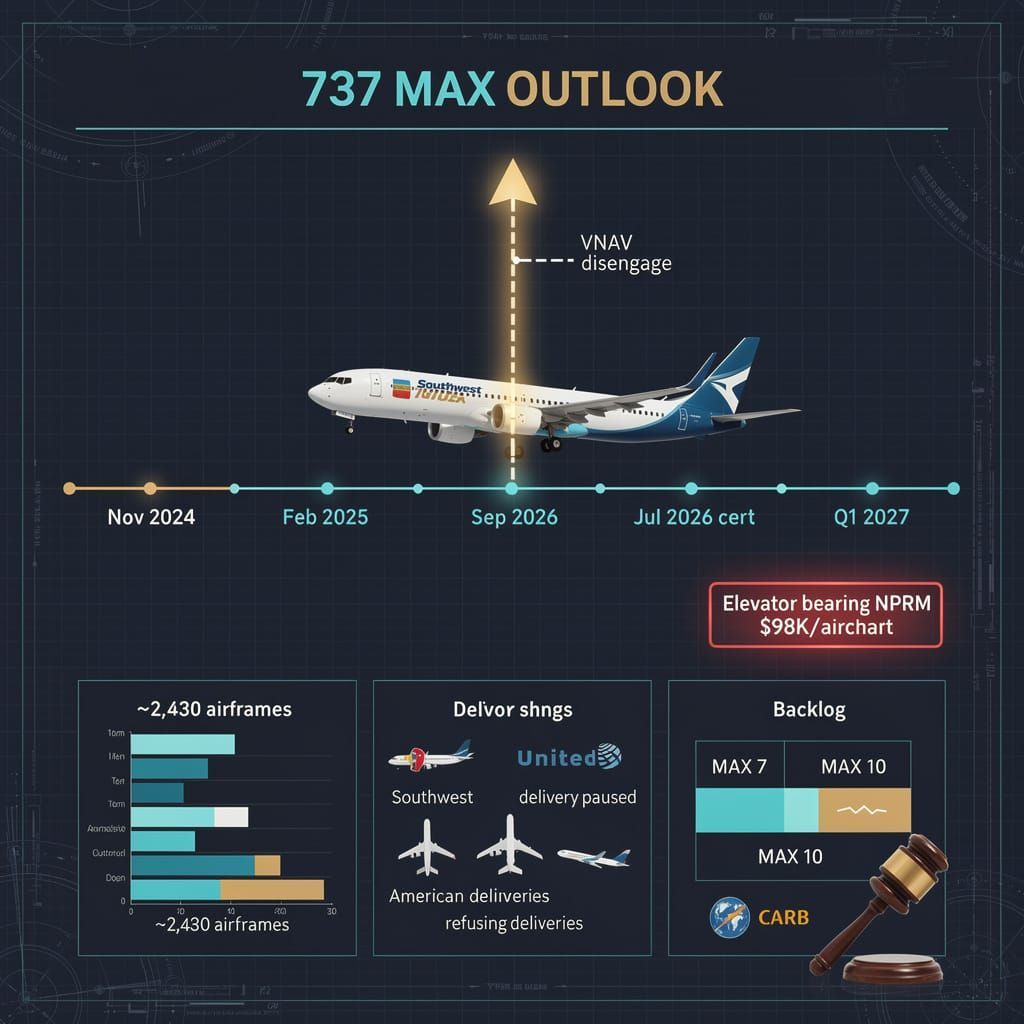
~2,430 Boeing 737 MAX jets in service face a software flaw that can silently disable vertical navigation during an aborted landing. ✈️ Boeing flagged the issue in Nov 2024 but says operators weren't meaningfully told until last month. Southwest and United have both refused affected deliveries — a crunch that sits directly on Boeing's delivery-driven cash flow. The FAA's review board now decides if the fix comes fast or with new conditions — and the MAX 10's clock won't restart until it's answered. Is transparency enough to rebuild trust, or does the timeline speak for itself?
For a company that spent the better part of six years trying to convince the world its most scrutinized airplane was fully rehabilitated, Boeing (NYSE: BA) is once again explaining what "fully" means. The Federal Aviation Administration is now formally investigating a software flaw in the 737 MAX's flight management computer that can silently strip vertical navigation (VNAV) from pilots at the exact moment they need it most — during an aborted landing.
The headline finding: in MAX airframes running software versions 14 and 14.1 (a variant dubbed U.14 within certain operator fleets), a go-around performed from a precision approach with autopilot engaged can cause VNAV to disengage. What's left is an automatic flight guidance system reduced to a less sophisticated pitch control — precisely the kind of degraded-automation scenario that turns a routine missed approach into a high-workload event at low altitude.
The Timeline Problem
Here's where the story gets uncomfortable. Boeing says it identified the glitch back in November 2024. It formally briefed the FAA in February 2025 — and, according to the company's own messaging at the time, deemed the issue "not an immediate safety concern." Operators say they weren't meaningfully notified until roughly a month before the issue went public to the industry on September 26, 2026.
The math is awkward for a manufacturer whose credibility rests on a hard-won safety comeback. Nearly two years elapsed between internal discovery and wide operator communication. That gap sits uncomfortably against the FAA's certification decisions this summer — which approved the MAX 7 in late July 2026 after more than 1,000 hours of flight testing and a redesigned engine anti-ice system, followed by an amended type certificate and revised Production Limitation Record on August 3, 2026, clearing the path for deliveries.
What the Airlines Are Doing
The market has already voted. Southwest Airlines and United Airlines — the two MAX operators with the largest combined narrowbody exposure — have both refused delivery of new MAX jets carrying the affected software. American Airlines has signaled similar caution across its MAX fleet.
The commercial logic is straightforward: an airline accepting an aircraft with a known, unresolved autopilot limitation accepts the operational risk and the pilot-training burden simultaneously. With roughly 2,430 MAX airframes in global service, that math multiplies fast.
The software problem lands on the worst possible schedule. Southwest has spent years building its single-aircraft strategy around the MAX family, having completed 314 firm MAX 7 orders and reached 80% flight testing of the aircraft ahead of certification in July 2026. It now has 27 MAX 7s produced and being readied for delivery, with first passenger service projected for Q1 2027 — a plan that rests on retirement of 334 aging 737-700s and an all-MAX fleet by 2031. The VNAV limitation now sits directly across that path.
The pain is not confined to software. On September 21, 2026, the FAA separately published a Notice of Proposed Rulemaking targeting elevator buss assembly bearings on roughly 95 U.S.-registered 737-8, 737-9, and 737-8200 aircraft, due to potential incorrect bearing installation and improper sealant application during production — a flaw that could accelerate crack development and risk elevator pitch control. Estimated inspection costs run $185,725 total, with potential repair bills up to $98,496 per aircraft. That announcement comes just days after the VNAV disclosure and roughly six weeks after the MAX 7 cleared certification — a sequence that keeps pushing "fully rehabilitated" further out of reach.
What's at Stake Now
The FAA's decision to convene a Corrective Action Review Board (CARB) converts an engineering problem into a regulatory one. That has direct consequences for Boeing's delivery pipeline:
- The MAX 7 — certified in July 2026 after nearly a decade of unresolved engineering fixes — runs version 14 software and now faces potential additional requirements.
- The MAX 10 — Boeing's long-delayed final certification milestone, with over 1,400 orders representing roughly 30% of backlog — was flying version 14.1 and was already the company's most significant revenue unlock.
- Boeing's original fix timeline stretched to 2028, a schedule the company now says it will compress, though no revised date is public.
The Deeper Math
Boeing's cash-flow problem is a delivery problem. Every MAX unit it cannot hand to Southwest or United is a unit that does not convert to payment on the anticipated schedule. The narrowbody order backlog — the financial engine that keeps the rest of the program solvent — is precisely where this issue lands.
The 2018 and 2019 MAX crashes were caused by a flight-control system (MCAS) that degraded automation without adequately informing pilots. This is a different failure mode — VNAV disengagement rather than autonomous pitch input — but the pattern it triggers will feel familiar: a capable crew inheriting an airplane that quietly stopped being as automated as it appears. The separate bearing-inspection NPRM runs on the same track: production-quality defects surfacing years after the lesson was supposedly learned.
Pilots are trained to operate without VNAV. The immediate safety risk is real but bounded. The institutional risk is less forgiving. Boeing has spent years fighting to rebuild regulatory and customer trust on a foundation of transparency. This timeline suggests the foundation has cracks.
The FAA's CARB will decide whether the fix comes with an expedited certification path or fresh conditions. Either way, the MAX 10's clock does not restart until this software question is answered — and Southwest's ramp, United's fleet plan, and Boeing's balance sheet are all waiting on the same answer.
Comments ()