Why another Congo crash signals governance failure, not geography
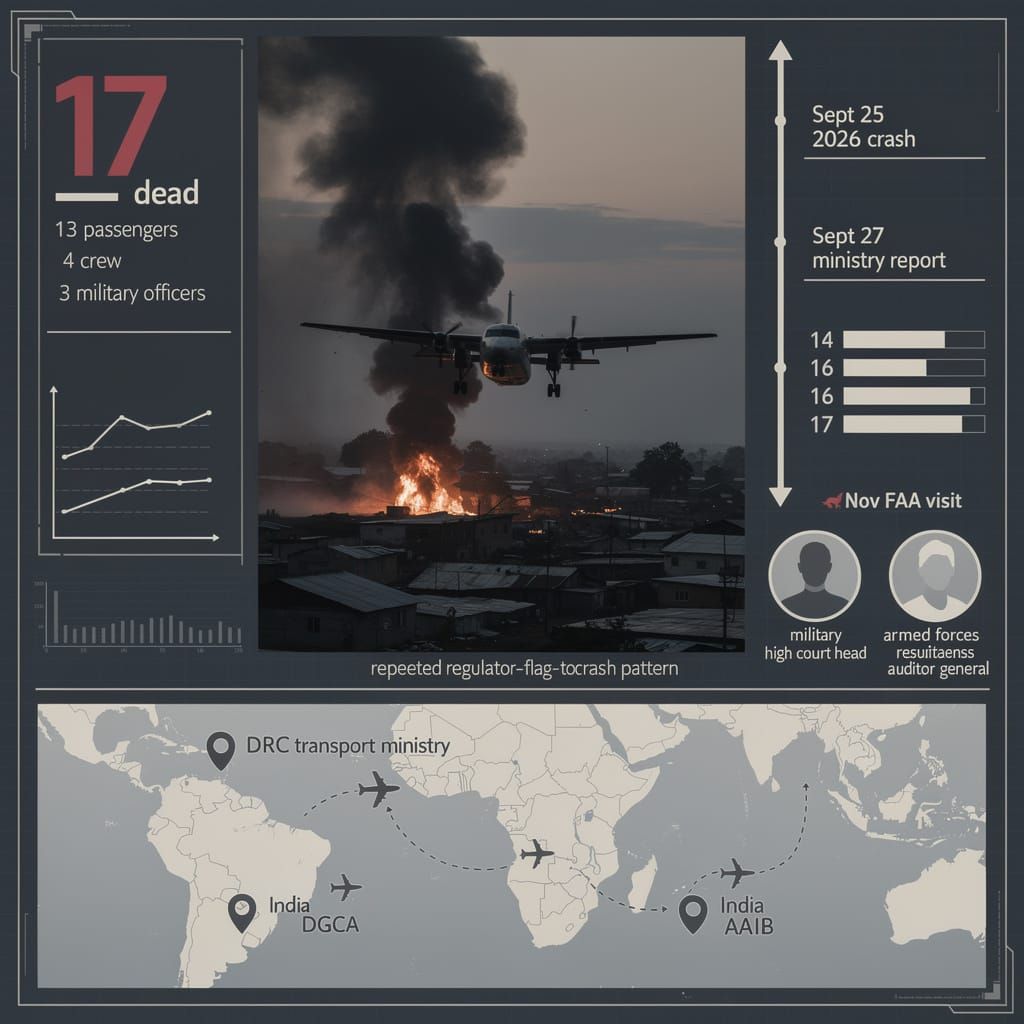
17 dead after a Let 410 went down in a residential district of Kenge, DRC on Sep 25 — equal to a full classroom lost. ✈️ Among them: the head of the military high court and the armed forces' top prosecutor, both anchoring the Kabila prosecution. The reflexive blame is bad airports and missing navigation aids. But the deeper issue is a regulator that couldn't even confirm who was aboard — inspectors flagging defects, then failing to act before rotation. Three military officers were among the casualties. The blow lands just as a politically volatile justice system faces its gravest credibility test. Is this a geography problem — or a systemic tolerance for risk no runway will fix? 👇
In the DRC, air travel is a gamble. On September 25, 2026, the odds came due again when a Let 410 UVP operated by Tracep Congo Aviation went down in a residential district of Kenge, Kwango province, roughly 200 kilometers east of Kinshasa. The confirmed toll: 17 dead, including 13 passengers and 4 crew. Among them were two of the country's most consequential legal figures—Joseph Mutombo, head of the military high court, and the armed forces auditor general, Lucien-Rene Likulia.
The reflexive response is to reach for the well-worn script: poor airports, absent navigation aids, a sprawling nation with inadequate roads. It is convenient. It is also incomplete.
The Pattern Behind the Platitudes
The official narrative leaning out of the transport ministry points to a familiar set of variables. The aircraft, en route from Kikwit to Kinshasa, developed a technical malfunction that forced it off course during approach, per September 27 reports. With no usable runway band at the origin alternative—the pilots' diversion options were thin—the crew attempted an emergency landing in the residential Manzao district of Kenge.
But here the accounting gets slippery, and that is where the standard framing collapses. The casualty count itself is contested. The ministry's latest figure of 17 conflicts with earlier army reports of 14 and local-media claims of 16 passengers aboard; indeed, local authorities say they lack complete flight information. Twelve of the dead were burned beyond recognition, and the pilot was found outside the wreckage. When a regulator cannot confirm who was on the aircraft, the pretense of a functioning oversight regime is already spent.
This was no ordinary flight. It carried the head of the military high court and the armed forces' top prosecutor—the two men anchoring the nation's most sensitive judicial matter, the prosecution of former President Joseph Kabila, a case Likulia had been driving since a September 2025 trial.
A Governance Failure, Not Just a Geography Problem
Reuters and local reporting note three military officers among the dead. President Tshisekedi has ordered an investigation—the standard response, one that will predictably generate recommendations about airstrips and navigation beacons. Those recommendations will be cheaper to issue than to fund.
The uncomfortable question is whether the crash reflects a systemic tolerance for risk that no amount of runway paving will fix. The L-410's operator, Tracep Congo Aviation, has not faced a transparent public accounting of maintenance logs, crew training, or dispatch decisions. The transport ministry's oversight lapses were cited in immediate reporting as a contributing factor—an admission, however veiled, that inspection and enforcement had failed before the aircraft rotated.
The skepticism deserves context that reaches well beyond Kinshasa. The pattern of regulators flagging defects and then failing to act before a crash is not unique to the Congo. India's DGCA, for instance, had flagged safety concerns over Tecnam aircraft for over a year—issuing July 2026 safety recommendations about checklists and emergency handling—before a Garg Aviation Tecnam P2006T still crashed near Kanpur on August 27, killing two. Weeks later, the same DGCA completed safety audits of IndiGo, Air India, Akasa Air, and SpiceJet, surfacing serious non-compliance findings that airlines must now answer, with an FAA visit looming in November. And when a hydraulics failure on an Air India flight sent 24 passengers to hospitals in August, the resulting drug tests on the captain came back positive for cannabis—an operator-level and crew-level failure the regulator had not caught in advance.
What the Numbers Actually Say
Seventeen dead. Two senior military justice officials. Three officers among the casualties. One regional security apparatus exposed. The institutional blow extends beyond the tarmac: Mutombo and Likulia were the pillars of a military justice system already straining under politically volatile prosecutions. Their loss lands at a moment when that system's credibility is under direct threat.
The Outlook Worth Watching
The investigation will run its course. The safer bet is that it concludes without a definitive cause, that document trails go missing behind incomplete flight records, and that the familiar closing report of "technical failure" seals the file. In India, the AAIB interim update on the Air India 787 crash is still wrestling with recurring electrical system failures flagged by outside experts; even with intact recorders and modern infrastructure, definitive causes remain elusive.
The less comfortable forecast: until the DRC's regulator can demonstrate it can inspect, ground, and hold accountable the operators it licenses—not merely that its airports have better lighting—another Kenge is a question of when, not whether. Condolences are warranted. So is skepticism of the explanation to come.

Comments ()