Etna Shuts Catania Airport, Cuts Landings From 12 to 4
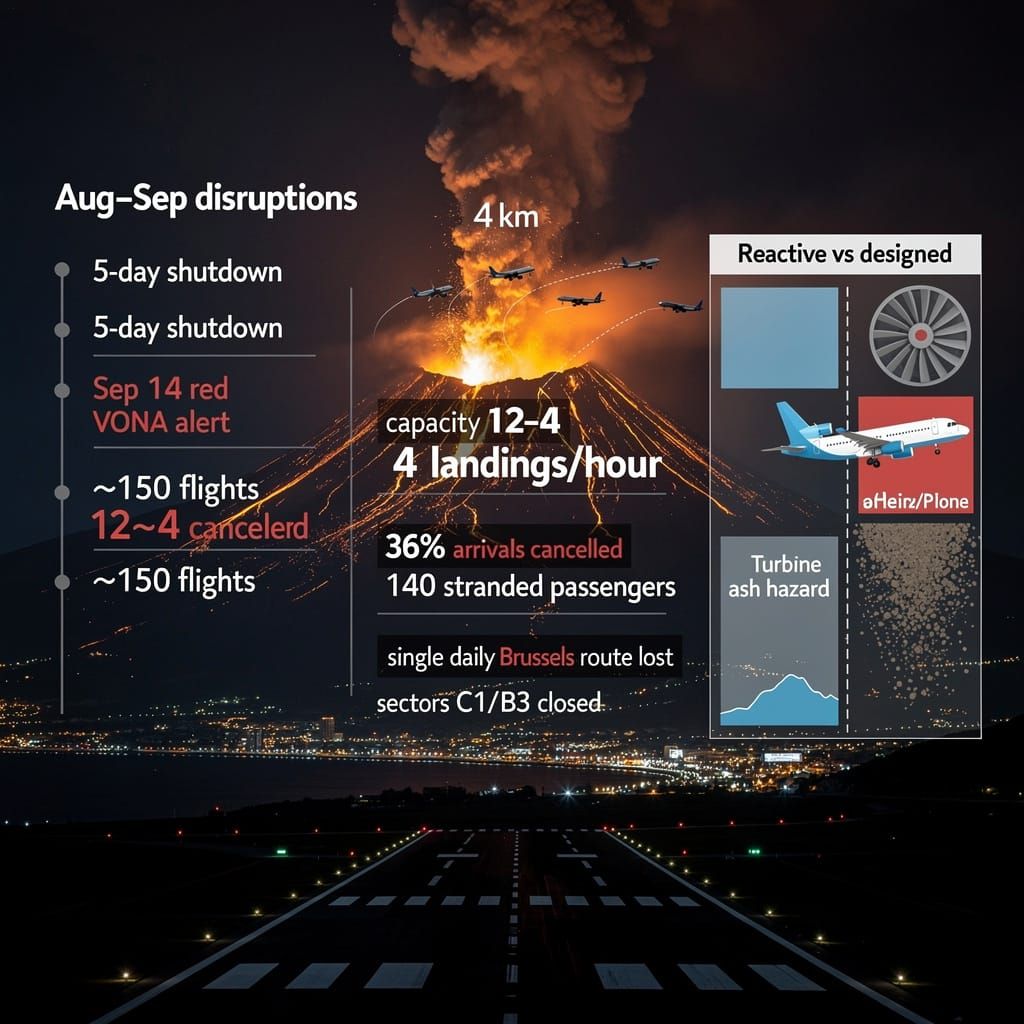
One volcano, a 4-kilometer ash plume, and Catania's airport cut its landings from 12 to 4 an hour — stranding 140 travelers on the only Brussels flight. 🌋✈️ Etna's latest eruption is the second shutdown of the year, a red alert from Italy's INGV, and a taste of a system built to survive ash, not plan around it. One single daily route, gone overnight. Sixteen years after Eyjafjallajökull, the next eruption is already overdue. Is your region's air connectivity resting on a single flight? ✈️
One volcano. A 4-kilometer plume of ash. A single airport on the eastern coast of Sicily. And suddenly, one of Europe's most heavily regulated, redundantly engineered systems of modern transportation ground to a halt.
For air travel, this is the recurring nightmare. On September 26–27, renewed activity at Mount Etna forced Catania-Fontanarossa Airport (CTA) to suspend all arrivals and departures, closed airspace sectors C1 and B3, and sent at least ten flights scattering to Palermo, Trapani, and Comiso. Capacity dropped from 12 landings per hour to 4. KM Malta Airlines shelved its KM642 and KM643 Malta–Catania rotations. Brussels Airlines' single daily direct link to the Belgian capital vanished, stranding roughly 140 passengers overnight.
It is a familiar pattern, and that is precisely the problem.
The Déjà Vu That Should Worry You
This is not a novel or freak occurrence. The current episode traces to a September 14 eruption that threw a 4-kilometer ash cloud over the volcano and triggered a red VONA flight alert from the INGV Etneo Observatory, cancelling roughly 150 flights across Sicily. On that day, aviation authorities formally raised alert levels from orange to red following INGV's report of sustained ash emissions, suspending all incoming flights at CTA and diverting Catania-bound services to Palermo. It marked the airport's second flight disruption of the year.
That event followed a five-day August shutdown—the region's longest since 2002—during which 36% of planned arrivals were cancelled, a toll tallied across the peak summer window. Earlier eruptions beginning August 7 produced a string of cancellations and diversions. Now a fresh "red" alert from Italy's National Institute of Geophysics and Volcanology (INGV) froze operations until at least noon Sunday—with the real reopening timetable dependent on wind, ash concentration, and airspace restrictions that nobody could yet forecast with confidence.
Every single time, the aviation system responds reactively. It doses ash into the atmosphere, waits for the plume to drift, closes sectors, diverts aircraft, and then scrambles to reassemble a disrupted network while hundreds of travelers sit in terminals or sleep in airport hotels.
A System That Hasn't Outgrown a 2010 Problem
The uncomfortable truth: the industry has had more than a decade—since the 2010 Eyjafjallajökull crisis stranded millions—to harden its operations against volcanic ash. What has materially changed for the passenger stuck in Catania when Etna rumbles?
Let's trace the actual mechanics. Ash is not just smoke; it is fine, abrasive silicate that can sandblast turbine blades and melt inside engine cores. That is a genuine, physics-based hazard, and aviation authorities are right to respect it. But sixteen years after the last major ash disruption reshaped European procedures, the response stack remains: monitor plume, close airspace, wait, recalculate.
Consider what did not happen here. No agreement produced a meaningful rerouting network among competing airlines to protect high-value single-route links like Brussels–Catania. On September 27, flight SN3131 simply could not complete its Brussels–Catania service, forcing roughly 140 travelers onto rebookings through Rome, Milan, or mainland Italy—or onto a bus transfer from Palermo. TUI diverted through Palermo as well. No mechanism protected passengers when one regional airport's closure meant the only direct service to a capital city disappeared.
A Capacity Problem Disguised as a Weather Event
Note also the operational math. The airport throttled from 12 to 4 hourly landings before fully closing. That is not a wind forecast; that is a decision to degrade capacity. Fine. But across the August–September window, the recurring sector closures and airport-level shutdowns compound into something larger: eastern Sicily's tourism-dependent economy stops, its air connectivity fraying at the exact moment travelers need flexibility.
The most telling detail may be the single daily service. Brussels Airlines' Catania–Brussels link failed not because of a systemic margin collapse across carriers, but because one airline's one flight was the entire route. When your regional connectivity rests in a single daily frequency, one volcano in Sicily does the work of a macro-scale disruption.
What Reopening Actually Means
The INGV will keep watching the plume; the wind will do its part; sectors C1 and B3 will reopen when ash disperses. But schedule restoration is rarely instant. Stranded passengers, missed connections, and repositioned aircraft ripple through networks for days. With the eruption cycle continuing—the September 14 event itself followed months of near-continuous ash emission from the Northeast Crater and sporadic bursts from Bocca Nuova—the red alert likely delayed, not solved, the problem.
So this latest Etna episode is less a headline about Sicily and more a pointed reminder. Sixteen years of practice, and Europe's aviation system still treats volcanic ash as a crisis to be survived, not a recurring weather condition to be designed around. For 140 passengers on a Brussels-bound flight, survival meant a long wait and a detour. For the rest of the industry, the lesson is unchanged: the next eruption is already overdue.
Comments ()