Airbus confirms corrosion defect across roughly 500 A321neos
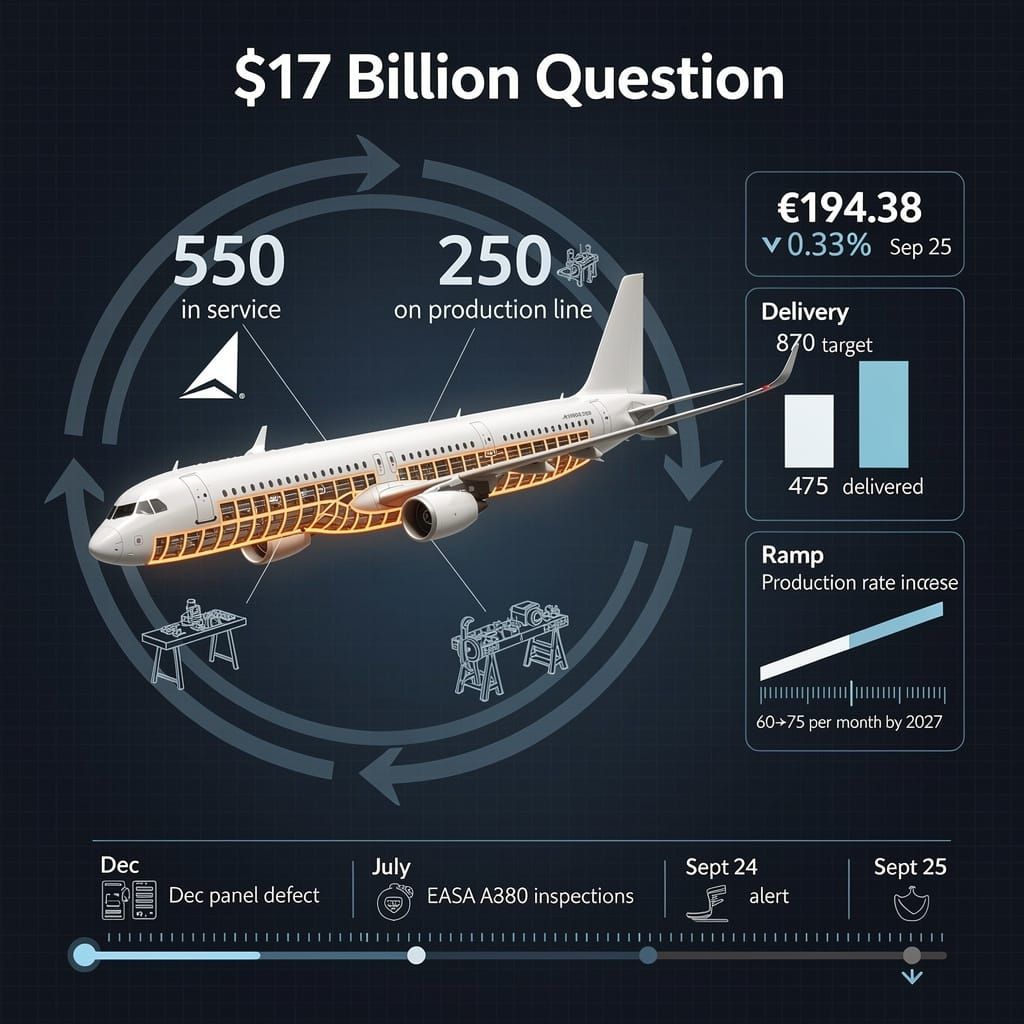
~500 A321neos — 250 already flying, incl. at Delta — have a fuselage stringer corrosion defect 🔧 Airbus calls it a quality issue, not a safety issue. Its shares slipped 0.33% in Paris. But EASA's July A380 wing order proves regulators act on their own schedule. If an airworthiness directive drops, repairs may queue behind a busy rework line. 🔍 Is the reassurance worth trusting? 🛫
Every manufacturer ships a few imperfect parts now and then. But when the company building them is Airbus, the flaw touches roughly 500 aircraft, and the affected model is one of the most popular jets in the sky, "minor" has a way of becoming "the only story anyone wants to ask about."
That is the situation playing out in Toulouse this week, where Airbus has confirmed a corrosion-protection defect in the fuselage stringers of its A321neo fleet. The numbers demand a pause: roughly 250 aircraft are already in airline service, including with Delta Air Lines, and another 250 are still rolling down production lines. Wall Street answered with a share-price dip on September 25 to €194.38 in Paris, down 0.33%—a modest move, but an unmistakable signal of nerves.
What actually went wrong
The defect traces to a specific link in the supply chain. Airbus alerted airline customers on September 24 after discovering a surface protection deviation on stringers—the skeletal frames running along the lower forward fuselage—during production-line rework. The company attributes the deviation to an undisclosed Tier 2 supplier whose primer application leaves the coating with less corrosion resistance than specification demands. Crucially, Airbus has stated repeatedly and on the record that this is a quality issue, not a safety issue. The affected aircraft remain airworthy and can continue flying without immediate repair.
That distinction matters, and it is worth being skeptical about it. Airbus is, after all, the party making the call that no urgent action is needed, and it has a commercial incentive to keep hundreds of jets aloft and its delivery pipeline moving. The reassuring framing is convenient. But the company has also already named the remedy—rework that does not require disassembly—and identified and contained the source. Newly coated stringers meet spec. That procedural transparency is harder to fake than a press release.
And yet the regulatory backdrop does not inspire confidence. Just weeks before this disclosure, in early July, EASA ordered emergency inspections of 16 A380 wings over structural material-fatigue concerns—a reminder that the agency is not shy about intervening on previously certified models. That same week saw Airbus extend cross-crew qualification timelines. The lesson from July is that when EASA does move, it moves in broad strokes; operators planning to wait out this A321neo issue may discover the authority has its own schedule.
The delivery math gets uncomfortable
What should unsettle observers is not today's airworthiness but tomorrow's production schedule. The timing is brutal. Airbus maintains its target of roughly 870 deliveries this year, with 475 already handed over through August, and it is signaling it wants to push A320-family output to 75 aircraft per month by the end of 2027—up from around 60. Every A321neo touched by this defect now needs remediation work before handover. That is extra labor, extra inspection hours, and extra risk of slippage on a timetable the company has already struggled to protect.
The pattern is worth noting. This is not the first quality stumble in this corner of the program—and the second fuselage issue in nine months, following a December 2025 panel defect. Earlier this year, a stray tool embedded in the horizontal tailplane of an A330neo during pre-delivery inspection forced Airbus to halt A330neo handovers for three months; production slowed to zero deliveries in June and July, with only a single airframe going to Starlux Airlines in August. A Spanish supplier caused prior delivery delays. The repetition suggests the problem is not a single bad batch of primer but a production system straining under volume targets—a system where the incentive to count jets may at times outweigh the incentive to double-check them.
Delta and the waiting lines
For operators like Delta, the immediate calculus is manageable: keep flying, plan for mandated repairs if regulators act. European authorities have the option—and, on this year's evidence, the demonstrated willingness—to issue an airworthiness directive requiring repairs within a set window. If that comes, expect the work to queue up behind an already busy rework schedule.
The honest verdict is that this looks containable. The defect is known, bounded, and remediable, and the flight-safety case for grounding appears weak. But Airbus is asking the market to take a 500-aircraft quality lapse in stride while simultaneously promising to build more planes, faster, with the same stretched supply base. July's A380 wing order shows this regulator does not defer to the manufacturer's judgment. History suggests skepticism, not credulity, is the correct posture when a manufacturer's production ambition and its quality assurance find themselves in the same room.
Comments ()