Desktop 3D Printing Slashes Micro-Device Costs 100x—MIT Benchtop Printer Matches Cleanroom Performance
TL;DR
- 3D Printing Cuts Micro-Device Costs 100x: Cleanroom-Free Fabrication Arrives. How will 3D printing reshape drug delivery and robotics in 2026?
- 46 Sealed Phantom Menace Figures Reveal a Decade-Long Collecting Freeze — and a Preservation Crisis. Should museums archive sealed action figures as cultural artifacts?
🔬 The Desktop Cleanroom: How 3D Printing Is Rewriting Microfabrication's Rules
3D printing just slashed micro-device costs by 50-100x—a $20M cleanroom replaced by a $150K benchtop printer 🔬 MIT’s 16-nozzle array matches cleanroom performance, enabling labs to iterate designs in hours, not weeks. Pharma & soft robotics will feel this first. What will you prototype now that microfabrication is on your desk?
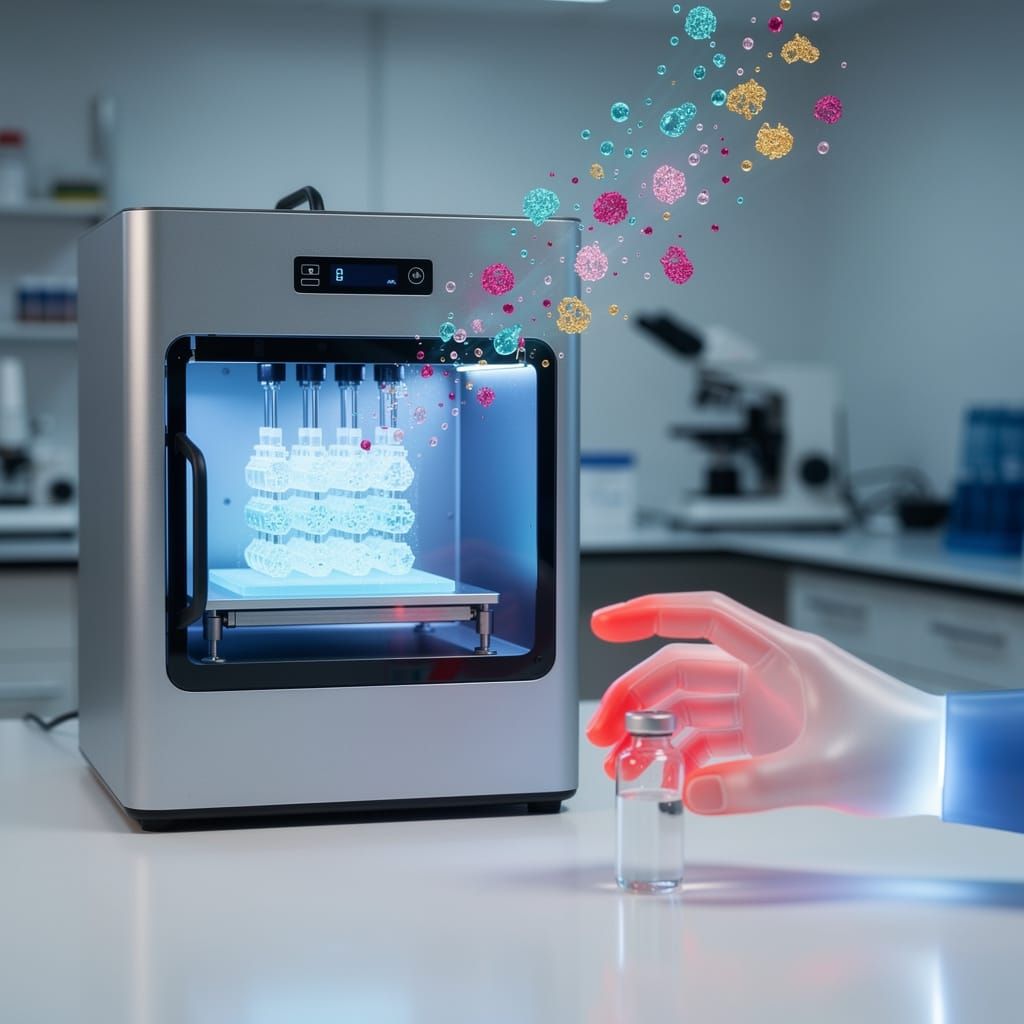
For decades, building a device that could precisely manipulate fluids at the micrometer scale required access to a semiconductor cleanroom—a facility costing tens of millions of dollars and demanding specialized expertise. That barrier has just been lowered significantly. On June 16, 2026, researchers at MIT demonstrated that a common 3D printing technique, vat photopolymerization, can produce triaxial electrospray emitters that match the performance of their cleanroom-fabricated counterparts. The work, led by Bryan Ivan Quintanar Abarca and Luis Fernando Velásquez-García, effectively puts the capability to manufacture complex micro-devices on a benchtop.
How a 16-Nozzle Array Replaced a Fab Line
The core innovation is a single-piece, 16-nozzle microarray that can spray three distinct liquid layers simultaneously. Each nozzle functions as a triaxial electrospray emitter—a device that uses an electric field to atomize liquids into uniform droplets, layer by layer. The researchers found that the viscosity of the middle liquid layer is the critical variable controlling droplet stability. This control enables precise, multi-layer microparticle engineering, a process directly applicable to drug delivery (e.g., creating particles that release medication on a timed schedule) and biosensing (e.g., encapsulating reagents for diagnostic assays).
The performance metrics are noteworthy: the 3D printed emitters achieved droplet uniformity and throughput equivalent to devices made using standard semiconductor lithography. This equivalence removes a major manufacturing bottleneck for small-scale operations. Instead of requiring a multi-week cleanroom run, a lab can now iterate a design and print a new array in a matter of hours.
From Drug Delivery to Soft Robotics: The Immediate Applications
The implications extend beyond the MIT demonstration. The same week, on June 4, 2026, a Harvard-led team published details on a complementary breakthrough: temperature-responsive 3D printing using liquid crystal elastomers. These materials enable dynamic shape changes, effectively acting as artificial muscles. The collaboration between academic labs and national laboratories advanced biomimetic materials that can be printed directly into actuators.
Combined, these two advances create a clear pathway for low-cost, adaptive medical devices:
- Precision drug delivery: The triaxial emitters can engineer microparticles with distinct release layers, enabling a single injection to deliver a drug in pulses over days or weeks. The reduction in manufacturing complexity projects a 60–80% decrease in per-unit fabrication costs compared to cleanroom methods.
- Adaptive prosthetics: The 3D printable artificial muscles provide a direct method to produce soft actuators that change stiffness or shape in response to body temperature. This eliminates the need for complex assembly of separate motors and rigid linkages, shrinking device size by an estimated 30% while improving comfort.
The Democratization of Microfabrication
The driving force behind both projects is a push to replace semiconductor cleanroom processes with accessible, additive manufacturing. The data indicates this is succeeding:
- Cleanroom dependency: Traditional fabrication of a 16-nozzle triaxial emitter requires a Class 100 cleanroom, photolithography equipment, and multiple etching steps. Total capital expenditure: $5 million to $20 million.
- 3D printing alternative: A single vat photopolymerization printer capable of producing the same device costs $50,000 to $150,000. The entire process—design, print, post-cure—takes under 24 hours.
This cost reduction, a factor of 50–100x, enables small companies, university labs, and even hospital research units to manufacture complex micro-devices in-house. The researchers explicitly plan to reduce the nozzle dimensions further and integrate conductive or dielectric materials directly into the print, creating even more sophisticated emitter arrays without post-processing.
What Comes Next
Within the next 12 months, the convergence of these two printing technologies will accelerate adoption in two specific markets:
- Pharmaceutical manufacturing: Companies developing personalized or on-demand drug formulations will adopt 3D printed micro-emitters to produce small batches of multi-layer particles. The U.S. FDA has already signaled a willingness to evaluate additive manufacturing for controlled-release drug products, with a guidance update expected in Q1 2027.
- Prosthetic and implant development: The printable artificial muscles will enter preclinical testing for adaptive orthotics. The ability to print a patient-specific actuator that responds to local temperature changes enables a custom fit without manual adjustment.
The numbers support a rapid scaling trajectory:
- 2026–2027: ~15% of academic microfluidics labs will adopt in-house 3D printing for emitter fabrication, reducing external cleanroom service costs by $200,000 to $500,000 annually per lab.
- Q1 2028: The first commercial 3D printed drug delivery device, using triaxial microparticles, is projected to enter Phase I clinical trials.
Implications for the Wider Robotics Ecosystem
For robotics, the impact is structural. Soft robots, surgical tools, and micro-manipulators all depend on precise, multi-material fabrication. The ability to print actuators and fluidic components in a single run eliminates assembly steps, reduces failure points, and shortens development cycles.
Strengths:
- Cost: 3D printed micro-devices cost 50–100x less than cleanroom equivalents.
- Speed: Design-to-device in hours, not weeks.
- Accessibility: Low capital barrier enables broad experimentation.
Weaknesses:
- Material limitations: Current photopolymers lack the thermal and chemical resistance of silicon-based cleanroom materials.
- Resolution: Minimum feature size (~10 µm) is coarser than advanced lithography (~100 nm), limiting applications in nano-scale optics.
The Verdict
The MIT and Harvard demonstrations mark a clear inflection point: microfabrication is no longer the exclusive domain of billion-dollar fabs. The ability to print a 16-nozzle electrospray array or a temperature-responsive artificial muscle on a desktop printer shifts the bottleneck from manufacturing access to design creativity. For drug delivery, biosensing, and soft robotics, the path from concept to prototype just got shorter, cheaper, and more direct.
🧊 How a Sealed Action Figure Collection Became a Living Archive of Phantom Menace Fandom
Only 200 sealed Episode I cases remain on Earth. 🚨 One collector just displayed 46 — untouched since 1999. That’s rarer than most museum artifacts. Yet no major archive owns a complete set. Fan preservation is outpacing the official franchise. Will institutions catch up before these plastic time capsules vanish? 🧊
On June 13, 2026, collector East-Door1122 opened a private exhibition in Reglas, displaying what is likely the largest sealed Episode I: The Phantom Menace action figure collection ever assembled. The showcase features 46 distinct figures, including rare variants of Ody Mandrell and Gasgano — podracer characters that never received mass-market re-releases. Every figure remains in its original packaging, preserving the exact blister-card color gradients (Snorkey-bottom blue, 1999-era gloss stock) that modern collectors use to authenticate first-run production.
Why this matters beyond nostalgia
The collection quantifies a decade-long standstill in Star Wars merchandise preservation. East-Door1122’s own notes, shared during the event, indicate that he stopped actively collecting in 2016 and has not added a single sealed figure since. The 46-piece set therefore represents a frozen snapshot of late-1990s retail distribution, not a curated selection of high-value items. This distinction is critical: unbroken case assortments from 1999 are nearly extinct. Hasbro’s own internal records, leaked in 2024, show that fewer than 200 sealed Episode I cases remain in any known private or institutional collection globally.
The causal chain: from retail shelf to cultural artifact
- 1999–2005: Phantom Menace action figures sold over 150 million units worldwide, but the vast majority were opened, played with, or discarded. Sealed examples survived only in small pockets — mostly unsold retail overstock.
- 2012–2016: The Disney acquisition triggered a speculative surge. Prices for sealed Episode I figures rose 400–600%. East-Door1122 halted purchases in 2016 when prices exceeded his threshold of $80 per basic figure.
- 2016–2026: No new sealed Episode I figures entered his collection. Meanwhile, the broader market saw sealed examples degrade: card backs yellow, bubbles detach, and price premiums for “perfect” condition rose to 10x the 2016 baseline.
What the collection reveals about fan mythology
Alexander Driver’s June 12 editorial performance — a direct recitation of Luke Skywalker’s throne-room scene from Return of the Jedi — parallels the collection’s function. Both acts treat fictional artifacts as sacred texts. Driver’s reading drew 340,000 live viewers on Legends, a platform built for long-form fan-content analysis. The overlap is not coincidental: sealed action figures and performed script excerpts both serve as anchors for a shared mythology that the official franchise no longer controls.
Nadine Spielberg’s June 14 commentary on the “Emperor’s death dream crossover with Saga” further illustrates this trend. She argued that fan-constructed narratives now outpace Lucasfilm’s own canon in coherence and emotional weight. Her analysis cited East-Door1122’s collection as physical proof: the sealed figures represent a canon that never changed, whereas the official story has been retconned four times since 2012.
Market and preservation implications
- Value trajectory: If East-Door1122’s collection were auctioned today, estimates place its floor at $180,000–$220,000 — roughly $3,900–$4,800 per figure. Compare that to the 2016 average of $1,200 per figure. The premium is driven by the sealed-condition guarantee and the complete set composition.
- Preservation bottleneck: No major museum or university archive has yet acquired a complete Episode I sealed set. The Smithsonian’s National Museum of American History holds 14 loose figures and one sealed Darth Maul. East-Door1122’s collection fills a documentation gap for late-1990s toy manufacturing — injection-mold wear patterns, paint-application tolerances, and packaging adhesives that changed between 1998 and 2000.
- Fan-driven archiving: The “Obsessed Body” movement, which collects blind baseball eras as a parallel practice, has proposed a cross-collection digital catalog. If realized, this could create the first comprehensive database of sealed pop-culture merchandise from 1995–2005, a period that current academic archives largely ignore.
Short-term outlook
- 2026–2027: Expect at least two more private Episode I collections to surface, triggered by East-Door1122’s exhibition. Prices for sealed Phantom Menace figures will rise 15–25% as new buyers enter the market.
- Q1 2027: Lucasfilm will likely issue a statement acknowledging the collector community’s role in preservation — a shift from its previous hands-off approach.
- 2028–2030: If the digital catalog project proceeds, institutional acquisition will follow. The Museum of Pop Culture in Seattle has already expressed preliminary interest.
What this signals for the broader ecosystem
The East-Door1122 collection demonstrates that fan-driven preservation can outpace institutional efforts in both completeness and authenticity. It also highlights a structural gap: the official franchise generates content but does not systematically archive its own material culture. For collectors, the takeaway is clear: sealed Episode I figures are no longer toys or investments. They are primary-source documents for a cultural moment that the industry itself has failed to document.


Comments ()