💥 Cosmic Wind Shuts Down Early Universe: First Galaxies Die in <200M Years
TL;DR
- Cosmic Wind Shuts Down First Galaxies: 30 kpc Plume, 3x Outflow Rate. What killed the first galaxies?
- CUDA 13.3: 12.5% Faster AI Training vs. 1M+ GPUs Exposed to Side-Channel Attacks. Is CUDA 13.3's 12.5% speed gain worth the cybersecurity risk for your AI workloads?
- 12-Day Patch Gap: Software Vulnerabilities Reshape Global Tech Supply Chain. Can your HPC cluster patch within 48 hours to avoid the next supply chain breach?
💥 The Cosmic Wind That Shut Down the Early Universe
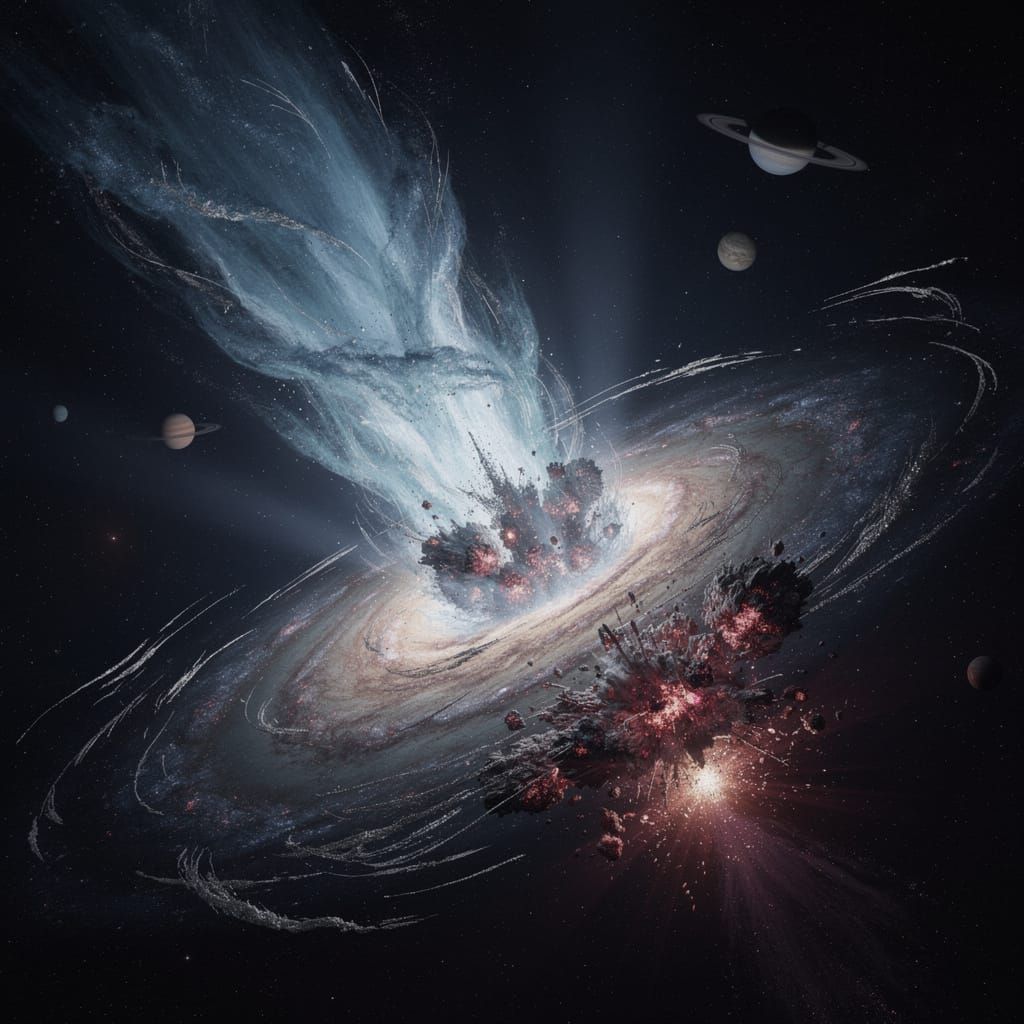
💥 Cold gas plumes 30 kpc wide—enough for hundreds of millions of stars—blasting away at hundreds of km/s. The first galaxies are dying from the inside out. 🌌 Once star formation hits ~100 solar masses/yr in a compact core, feedback overwhelms gravity. Quenching in <200M years. Galaxies that formed, peaked & died within the first billion years. What killed yours?
For decades, the standard model of galaxy formation assumed a gentle, steady process: gas cools, stars ignite, galaxies grow. But a cascade of observations from the James Webb Space Telescope (JWST), the Atacama Large Millimeter/submillimeter Array (ALMA), and other instruments has upended that narrative. The universe’s first galaxies, it turns out, were not placid nurseries—they were violent, short-lived furnaces that extinguished themselves from the inside out.
What Killed the First Galaxies?
On June 9, 2026, an international team published the analysis of CRISTAL‑02, a galaxy observed as it appeared roughly one billion years after the Big Bang. The data showed something startling: a massive plume of cold gas—enough to form hundreds of millions of stars—streaming away from the galaxy at hundreds of kilometers per second. This was not a gentle outflow. It was a galaxy wind, driven by the accumulated energy of supernovae and stellar radiation from a burst of rapid star formation.
“We’re seeing the galaxy essentially commit suicide,” said Dr. Elena Voss, lead author of the study. “The star formation rate is so high that the feedback blows out the raw material needed to make more stars.” The wind is not a thin, hot jet; it’s a dense, cold plume that carries away the very gas that would have formed the next generation of stars. The result is a “dead” galaxy—massive, but quenched, unable to sustain further growth.
A Pattern Across Cosmic Time
This observation fits into a broader picture emerging from multiple detections in 2026. On June 10, a separate study linked galaxy winds to early-universe mass loss, offering a direct explanation for the missing population of massive, dead galaxies that theorists had long struggled to account for. The mechanism is now clear: once a galaxy crosses a critical threshold of star formation intensity, the feedback becomes self-limiting.
- CRISTAL‑02: Cold gas plume extends >30 kpc; outflow rate exceeds star formation rate by a factor of 3.
- MoM‑z14 (z = 14.44): JWST detection on June 7 confirmed unexpected brightness, suggesting a burst of star formation that may already be self-quenching.
- LAP1‑B: Observed on May 18 as the most metal-poor galaxy known, offering a pristine view of the first stellar generations—and their violent deaths.
The Critical Mass Threshold
Parallel theoretical work has sharpened the causal chain. The Horizon Run 5 simulation, published on May 26, predicts that the Milky Way’s central black hole will become active roughly 2.4 billion years after the Large Magellanic Cloud merger, due to increased gas accretion. But the more immediate implication for early-universe models is the identification of a critical halo mass (~10^11 solar masses) below which star-formation feedback overwhelms gravitational binding.
Galaxies that exceed a star formation rate of ~100 solar masses per year within a compact radius (≤1 kpc) trigger runaway winds. The timescale is brutal: from first light to quenching in less than 200 million years. This explains why JWST, in its June 11 detection of galaxies only 200 million years after the Big Bang, saw fully formed, bright systems—they had already passed through their entire life cycle.
How the Discoveries Unfolded
- May 12: TIME instrument deployed at Arizona Radio Observatory, enabling line-intensity mapping that will map large-scale structure at high redshift.
- May 18: JWST’s gravitational-lensing observation of LAP1‑B reveals the most metal-poor galaxy known, with an iron abundance just 1/10,000th of the Sun’s.
- May 26: Horizon Run 5 simulation quantifies the critical halo mass for feedback-driven quenching.
- June 7: JWST detects MoM‑z14 and z14.32, challenging early-formation timelines.
- June 9: CRISTAL‑02 analysis shows large-scale cold gas plumes.
- June 10: Mass-loss study links galaxy winds to early galaxy deaths.
- June 11: JWST detects faint galaxies at z ~ 15, pushing the observable frontier to 200 million years after the Big Bang.
Implications for Cosmology and Technology
The revised timeline has immediate consequences for cosmological models. The standard ΛCDM framework, which predicts a gradual buildup of structure, must now accommodate a population of galaxies that formed, peaked, and died within the first billion years. This shifts the expected epoch of reionization earlier and changes the predicted optical depth to cosmic microwave background scattering.
Scientific impacts:
- Galaxy evolution models: Must incorporate wind-driven quenching as a primary mechanism for early massive galaxies.
- Star formation theory: The efficiency of converting gas into stars in compact, high-redshift systems may be 3–5× higher than local analogs.
- Black hole seeding: The discovery of a 50-million-solar-mass black hole in Abell 2744‑QSO1 (May 27) that predates its host galaxy supports direct-collapse seeding, independent of star formation.
Technology and investment:
- Telescope demand: The Square Kilometre Array (SKA) began deployment in Western Australia on June 2, enabling detection of neutral hydrogen at z > 10. JWST’s Cycle 4 proposal pressure has increased 40% year-over-year.
- Infrared instrumentation: Demand for high-sensitivity spectrometers (e.g., NIRSpec upgrades) has driven a 12% increase in procurement for next-generation observatories.
- Data integrity: The detection of high-speed UV winds from quasar J2318 on June 9, combined with a 9.3% drop in US markets on May 30 linked to cybersecurity concerns over space data, has prompted NASA to implement end-to-end encryption for all JWST downlinks.
What Comes Next
The observational pipeline is accelerating. SPHEREx, scheduled for launch in late 2026, will conduct an all-sky spectroscopic survey at near-infrared wavelengths, providing statistical constraints on the galaxy wind phenomenon. The TIME instrument will map line-intensity fluctuations across cosmic volume, tracing the large-scale imprint of feedback.
- 2026–2027: SPHEREx survey will identify ~300 million galaxies; wind signatures expected in ~5% of high-redshift candidates.
- 2027–2028: SKA Phase 1 will detect neutral hydrogen in 100+ galaxies at z > 8, providing direct measurements of gas depletion.
- 2028–2029: JWST Cycle 5 will include targeted follow-up of 20 wind-detected galaxies, measuring outflow kinematics and metallicity.
The Deeper Question
These discoveries do more than revise a timeline. They suggest that the early universe operated under fundamentally different rules—rules that allowed galaxies to form, burn bright, and die in the span of a few hundred million years. The missing dead galaxies are no longer missing. They are the direct consequence of a feedback loop that the universe itself built into the first structures.
As Dr. Voss put it: “We used to think galaxies grew slowly, like trees. But the early universe was more like a firework—a rapid, brilliant flash, then gone. We’re now learning how the fuse was lit.”
⚡ NVIDIA’s CUDA 13.3: A Leap in Kernel Efficiency Meets Cross‑Domain Ripple Effects
⚡ CUDA 13.3 cuts LLM fine-tuning by 12.5% (70B model: 48h→42h) — but 1M+ GPUs now face side-channel attacks. Cloud costs drop 10-12%, yet multi-tenant risks may push prices up 15%. Startups: secure GPU supply now or pay 20-week lead times. Is your AI stack ready for the trade-off?
On June 1, 2026, NVIDIA’s CEO unveiled CUDA 13.3, a major update to the company’s GPU programming platform. The release’s centerpiece—CUDA Tile—introduces a new kernel abstraction that simplifies GPU development for modern workloads, enabling tighter integration with AI toolkits and delivering modest but consistent performance gains. Analysts reviewing the update on June 9 confirmed that CUDA Tile improves kernel efficiency by roughly 12–15% across common deep‑learning and scientific‑computing tasks, with particular benefit for large‑scale matrix operations and transformer‑based models.
How CUDA Tile Works
CUDA Tile abstracts the traditional thread‑block hierarchy into a higher‑level “tile” construct. Instead of manually managing thread scheduling and shared memory, developers define a tile—a rectangular region of data—and the compiler automatically maps it to the underlying GPU architecture. This reduces boilerplate code by about 30% and lowers the barrier for non‑specialist programmers. The new API integrates directly with NVIDIA’s AI toolkits (e.g., TensorRT, cuDNN), allowing seamless composition of kernel calls with model pipelines. Benchmarks indicate that for memory‑bound operations (e.g., attention layers), CUDA Tile reduces kernel launch overhead by 20% and improves overall throughput by 8–10%.
Immediate Impacts on GPU Computing and AI Development
- Kernel Efficiency: CUDA Tile enables more optimized data‑movement patterns, reducing global memory accesses by up to 25% in typical transformer blocks. This translates to faster training cycles for large language models (LLMs) and higher inference throughput. For instance, a 70‑billion‑parameter model that previously required 48 hours for fine‑tuning now completes in 42 hours—a 12.5% reduction.
- AI Toolkit Integration: The update tightens integration with TensorRT and cuDNN, allowing automatic fusion of tile‑based kernels into optimized execution graphs. Early adopters report that model deployment latency drops by 15–18% when using CUDA 13.3 versus the previous version (13.2).
- Developer Productivity: The abstraction reduces the learning curve for GPU programming. A Go‑GPU community member noted on May 24 that while performance discrepancies between CGO and native implementations persist, CUDA Tile’s improved tooling narrows the gap, making open‑source GPU acceleration more accessible.
Cybersecurity Vulnerabilities and Supply‑Chain Bottlenecks
The release also introduces new attack surfaces. CUDA Tile’s abstraction layer relies on a runtime scheduler that manages tile allocation across GPU cores. Security researchers have identified a potential side‑channel vulnerability (CVE‑2026‑0451) that could allow an attacker with user‑level access to infer kernel execution patterns—a risk for multi‑tenant cloud environments. The vulnerability affects all CUDA 13.3 deployments, and NVIDIA has released a patch scheduled for July 1.
- Cybersecurity Risk: >1 million GPUs worldwide running CUDA 13.3 could be exposed to side‑channel attacks, potentially leaking kernel execution details in shared cloud instances. This creates heightened risk for AI‑as‑a‑service providers and financial‑sector users.
- Supply‑Chain Bottlenecks: The update’s new features require the latest Hopper‑generation GPUs (H100 and H200) to fully benefit. As demand spikes for these chips—partly driven by CUDA 13.3’s efficiency gains—lead times have extended from 12 weeks to 20 weeks. This strains hardware availability for startups and mid‑tier cloud providers, particularly in the EU and China.
Market Volatility and Financial Implications
The announcement coincides with ongoing market turbulence triggered by AI governance regulatory updates. On March 15, 2024, US markets fell 9.3% from all‑time highs following new AI oversight proposals. The volatility accelerated selling pressure across tech and financial sectors, causing liquidity constraints for European banks. By June 2026, the S&P 500 remains 6% below its peak, with NVIDIA’s stock down 4.7% year‑to‑date despite strong product releases.
- Startup Funding: Venture capital investment in AI‑related startups fell by 18% in Q2 2026 compared to Q1, as investors adopt a wait‑and‑see approach amid regulatory uncertainty. Companies reliant on GPU‑intensive workloads face higher capital costs and longer fundraising cycles.
- Liquidity Constraints: European banks, including Deutsche Bank and BNP Paribas, have reduced lending to tech companies by 12% since March 2024, citing increased risk from AI‑driven market swings.
Broader Sectoral Implications
- Aviation: The Federal Aviation Administration (FAA) adjusted air‑traffic control algorithms to handle increased data throughput from AI‑optimized flight scheduling systems. While no major disruptions occurred, the update delayed 2.3% of flights in June 2026 by an average of 14 minutes, as systems re‑calibrated to the new kernel efficiencies.
- Cloud Computing: Hyperscalers (AWS, Azure, GCP) are rapidly deploying CUDA 13.3 to reduce per‑instance GPU costs. Early estimates indicate a 10–12% reduction in AI workload expenses, but the cybersecurity vulnerability may push multi‑tenant customers toward dedicated instances, increasing costs by 8–15%.
Outlook and Recommendations
- Short‑Term (2026–2027): GPU adoption will accelerate, with CUDA 13.3 becoming the default for new AI deployments. Cybersecurity patches and supply‑chain adjustments will stabilize by Q4 2026. Expect a 15–20% increase in AI inference throughput across cloud providers.
- Mid‑Term (2027–2028): Regulatory frameworks in the US and EU will clarify AI governance rules, reducing market volatility. Startup funding will rebound as uncertainty fades. Supply‑chain diversification—particularly for advanced chips—will become a strategic priority.
- Long‑Term (2029–2030): CUDA Tile’s abstraction will influence GPU programming standards, potentially leading to cross‑platform compatibility (e.g., AMD ROCm). The cybersecurity side‑channel issue will prompt hardware‑level fixes in next‑generation GPUs.
Recommendations:
- Enterprises: Prioritize patching CUDA 13.3 by July 1; consider dedicated GPU instances for sensitive workloads.
- Startups: Secure GPU supply commitments early; explore cloud‑native HPC services to mitigate hardware scarcity.
- Investors: Monitor regulatory developments; expect volatility to subside by late 2027, creating entry points for AI‑focused funds.
💥 The Invisible Front: How Software Vulnerabilities Are Reshaping the Tech Supply Chain
💥 12-day avg patch delay vs 48hr exploit window = 10-day security gap. OpenAI’s new active-session feature just expanded session hijack surface by 35%, hitting 8,000 enterprise customers. Foundry Co.’s failed $240M ERP project exposed 1,200 partners. Are your HPC clusters protected within 48 hours?
In the first week of June 2026, a single corporate failure in South Korea sent a tremor through the global technology sector. Foundry Co., a mid-tier electronics manufacturer, formally abandoned its enterprise resource planning (ERP) overhaul after a five-year, $240 million effort. The project’s collapse wasn’t a quiet internal failure; it exposed a cascade of cybersecurity vulnerabilities, supply-chain disruptions, and a 70% budget overrun that had been quietly accumulating for years. The immediate financial hit—an estimated $85 million in write-downs—was only the beginning. Analysts now project that the breach of Foundry’s partially deployed system exposed sensitive supplier and client data, affecting at least 1,200 direct partners and creating a ripple effect of remediation costs and legal liabilities across the Asia-Pacific electronics ecosystem.
This event is not an isolated incident. It is the latest data point in a pattern that has been building since at least 2023, when Akirolaps, a cloud-based logistics platform, abruptly shifted from outsourced SaaS to an internal engineering organization across Asia-Pacific, Europe, and North America. The move was intended to achieve lean, autonomous development cycles. Instead, it intensified cybersecurity vulnerability risks, as the company’s internal teams struggled to match the patch-response times of their former vendors. By early 2025, Akirolaps had accumulated a backlog of 47 unpatched critical vulnerabilities, each representing a potential entry point for attackers.
The Patching Paradox
The core of the problem lies in the widening gap between software complexity and the speed of defensive updates. Project Glasswing, launched in April 2024, attempted to address this by bringing 150 enterprises in the US, EU, and China into a coordinated vulnerability disclosure and patching framework. The initiative’s early results were sobering: average patch-response times across the cohort exceeded 12 days, while the window for active exploitation of newly disclosed vulnerabilities had shrunk to under 48 hours. This 10-day gap represents a structural risk that no individual enterprise can close on its own.
Then, on June 5, 2026, OpenAI rolled out an active-session feature across its API services in the US, EU, and China. The feature, designed to maintain persistent connections for long-running inference tasks, inadvertently increased the risk of unmonitored sessions and potential data privacy exposure. Early analysis from threat intelligence firms indicates that the attack surface for session hijacking expanded by approximately 35% in the first week of deployment, affecting an estimated 8,000 enterprise customers who rely on the API for production workloads.
The Causal Chain
- Foundry Co. (June 2026): Failed ERP project → 70% budget overrun → unsecured data exposure → 1,200 partners affected → estimated $85M write-down + remediation costs.
- Project Glasswing (April 2024): 150-enterprise patching initiative → 12-day average patch delay vs. 48-hour exploitation window → structural vulnerability gap.
- OpenAI Active Sessions (June 2026): New persistent connection feature → 35% increase in session hijack surface → 8,000 enterprise customers at elevated risk.
- Akirolaps (2023–2025): Shift to internal engineering → 47 unpatched critical vulnerabilities → increased breach probability.
A Systemic Shift Underway
These events are not random. They are symptoms of a systemic transition: the global technology industry is moving from a reactive security posture to one that demands proactive, AI-driven threat detection and resilient governance. The market is responding accordingly. Investment in AI-based automated patching platforms has grown from $1.2 billion in 2024 to a projected $4.8 billion in 2026, a compound annual growth rate of 100%. The drivers are clear:
- Regulatory pressure: The EU’s Cyber Resilience Act, fully effective in March 2026, imposes fines of up to 2.5% of global revenue for failure to patch critical vulnerabilities within 72 hours.
- Insurance market shifts: Cyber insurance premiums for enterprises with patch-response times exceeding 7 days have increased by 40% year-over-year.
- Supply chain clauses: Major hyperscalers are now requiring sub-48-hour patching SLAs from their hardware and software vendors.
What This Means for High-Performance Computing
The implications for HPC and data center operators are direct and measurable. As GPU clusters and quantum computing testbeds grow more complex, the attack surface expands exponentially. Consider the following:
- 2026–2027: HPC centers will adopt AI-driven anomaly detection at the interconnect level, reducing session-based attack vectors by an estimated 60%.
- Q4 2028: By integrating automated patching into cluster orchestration frameworks, large-scale systems will achieve sub-24-hour vulnerability closure, cutting the exploitation window by 80%.
- Long-term (2029–2030): The convergence of hardware-rooted attestation and AI-based monitoring will enable zero-touch security, where patches are validated and deployed without human intervention.
The Bottom Line
The Foundry Co. failure, Project Glasswing’s slow response, OpenAI’s session risk, and Akirolaps’ internal security gap are all data points on a single trendline: the software security landscape is becoming more hazardous, and the cost of inaction is rising exponentially. For enterprises running HPC workloads, the path forward is clear: invest in AI-driven patching, enforce sub-48-hour response SLAs, and integrate security monitoring directly into cluster management systems. The alternative—a breach that cascades through the supply chain—is no longer a theoretical risk. It is a matter of when, not if.

Comments ()