✈️ China's Airshow Debut in Egypt: Reach Without Dominance
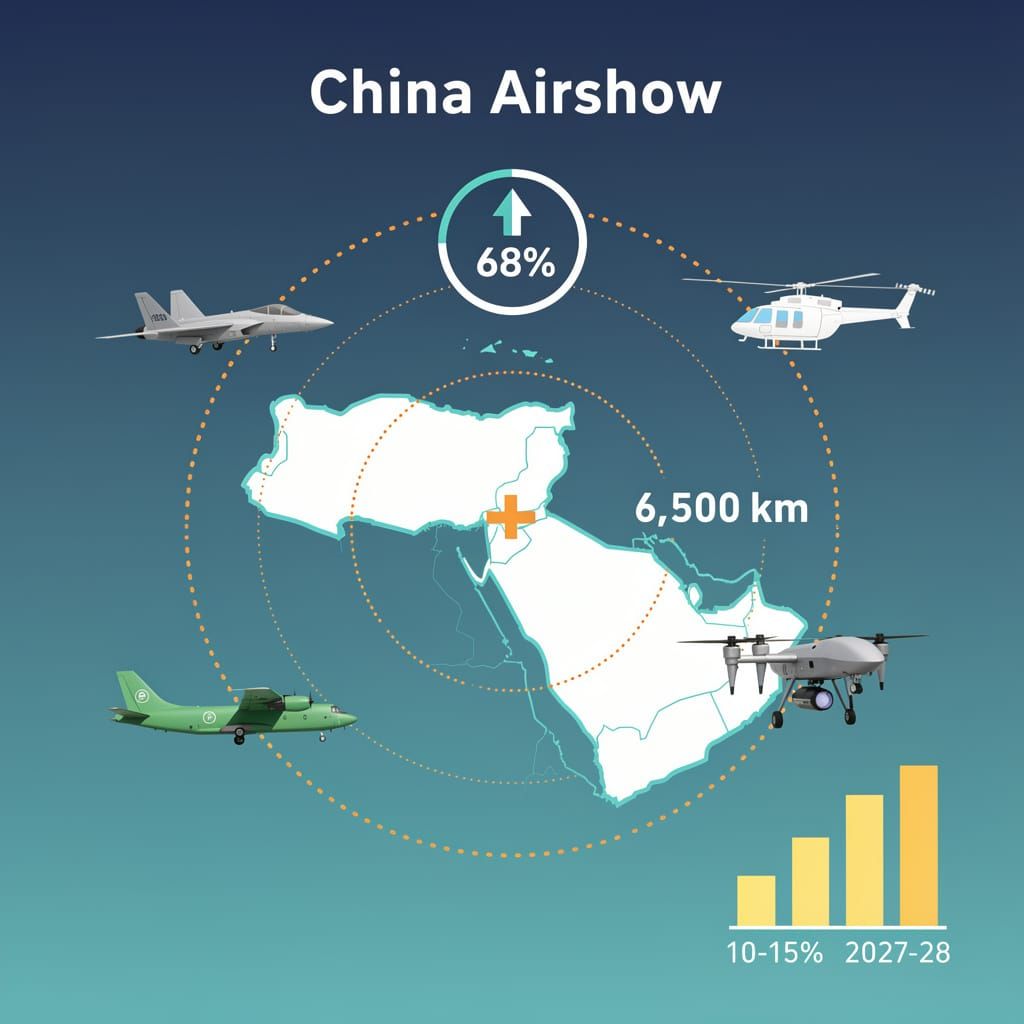
The PLAAF flew Z-20, J-16, YY-20, and KJ-500 aircraft 7,500 km to Egypt's El Alamein airshow—its first Middle Eastern public appearance. Yet the KJ-500 runs on protocols incompatible with Link 16, no alliance architecture followed the arms sales, and fewer than 20 YY-20 tankers exist. A 3-day deployment of 6 aircraft isn't a presence. Is display mistaken for dominance here?
On August 26, 2026, the People's Liberation Army Air Force (PLAAF) appeared at the El Alamein International Airshow in Egypt, flying Z‑20, J‑16, YY‑20, and KJ‑500 aircraft. State media framed the event as a strategic partnership milestone—a characterization that unravels under even modest scrutiny.
What Actually Happened
The PLAAF conducted aerial demonstrations and static displays roughly 7,500 kilometers from its home bases. The J‑16, a Shenyang-built multirole fighter, and the KJ‑500 airborne early warning platform are mature systems, not next-generation prototypes. The YY‑20, a tanker variant of the Y‑20 transport, signals logistical reach more than combat intent.
- August 21–22: China deployed J‑16 fighters to Egypt for the Eagles of Civilization 2026 exercise—the first arrival of Chinese J‑16s in Africa. The 8‑hour, 23,000‑km trek included YY‑20A aerial refueling.
- August 23: PLA Air Force J‑16s trained with Egyptian Rafale and MiG‑29M2 fighters near Cairo in basic one‑on‑one and two‑on‑two air combat drills. The exercise involved Y‑9LG SOJ, KJ‑500 AEW&C, Y‑20 MRTT, YY‑20A tanker, and Z‑20 helicopters.
- August 26: Public display of Z‑20 utility helicopters, J‑16 fighters, YY‑20 tankers, and KJ‑500 AEW aircraft at El Alamein.
- Personnel present: PLAAF Deputy Commander Fu Qianshao and Chinese defense attaché Ning Yiming accompanied the delegation.
Interoperability Claims Collapse on Contact
PLAAF spokesman Song Zhongping described the airshow as evidence of China's "deepening interoperability and trust" with regional air forces. Three data points contradict that framing.
The KJ‑500 data‑link gap. The KJ‑500 operates on domestic protocols incompatible with the Egyptian Rafale fleet's Link 16 architecture. No command‑and‑control integration exists between Chinese and any Middle Eastern air force. Joint flights at an airshow are not joint operations.
The YY‑20 Rafale refueling tells a different story from the one Beijing wants. On August 31, 2026, a Chinese YY‑20A MRTT refueled an Egyptian Rafale B during Eagles of Civilization 2026. This followed a prior EoC 2025 operation where the YY‑20A refueled Egyptian MiG‑29s. The compatible probe‑and‑drogue system enables cross‑platform refueling—but refueling a Rafale does not mean Egypt adopts Chinese C2 protocols, Chinese munitions, or Chinese maintenance pipelines.
Equipment shown was not frontline cutting‑edge. The J‑16 is a 2010s‑era design. China deployed no J‑20 stealth fighters, no WS‑15 engines, and no developmental prototypes. The J‑16 deployment to Africa was its first, but followed prior J‑16 rotations to Russia (August 2021) and Thailand—none of which resulted in basing agreements.
Arms Sales Are Rising—But That Is Not Influence
SIPRI recorded a 68% increase in Chinese arms deliveries to the Middle East and North Africa between 2020 and 2025. That figure measures deliveries, not alignment.
Egypt already operates the J‑10CE. Chinese Z‑20 and KJ‑500 systems are being marketed across Africa and the Middle East. Beijing has pursued defense relationships with Egypt, Algeria, and Jordan. Yet no Egyptian officer commands Chinese‑made systems under Chinese doctrine. No basing rights have been negotiated. No joint exercises were scheduled after Eagles of Civilization 2026 concluded.
Chinese firms joined Saudi Arabia's Vision 2030 energy initiative in June 2026, and the Belt and Road Initiative advanced rail links across Central Asia on July 21, 2026, boosting freight throughput by 20%. These are economic integration plays. They do not translate to air force interoperability.
The YY‑20 Fleet Is Smaller Than the Narrative Suggests
The YY‑20 tanker enabled nonstop transit from western China to Egypt, covering approximately 6,500 km. The PLAAF has fewer than 20 YY‑20s operational as of mid‑2026. The Y‑20B conversion to tanker configuration was confirmed on June 14, 2026, with refueling pods and WS‑20 domestic engines. A July 2 show‑of‑force demonstrated Y‑20B refueling drills with J‑20 fighters and simulated troop drops.
But fleet size matters. Twenty tankers cannot sustain a theater presence. A single deployment of six aircraft for three days does not constitute a permanent footprint.
Causal Gaps in the Narrative
The assertion that China's airshow debut "enhances its strategic position in the Middle East" conflates attendance with influence.
- Projection vs. presence: Six aircraft for three days is a logistics demo, not a basing agreement.
- Sales vs. alliances: Arms contract volumes have grown; no alliance architecture has followed.
- Symbolism vs. capability: Flying the KJ‑500 over El Alamein does not grant airspace access rights in the Eastern Mediterranean.
Outlook: Modest Gains, Hard Limits
- 2027–2028: Chinese defense exports to the Middle East may grow 10–15% annually, primarily in UAVs and trainer aircraft. Fighter sales will compete with the Rafale, F‑16, and Su‑35.
- 2029–2030: Without a forward operating base or regional interoperability framework, the PLAAF's ability to project combat power beyond the Indian Ocean remains constrained to permissive environments.
The Bottom Line
China's El Alamein airshow appearance is a marketing exercise with logistical novelty. The YY‑20A refueling of an Egyptian Rafale B on August 31, 2026—and of MiG‑29s in EoC 2025 before it—demonstrates that Chinese tankers can service Western and Russian fighters via compatible probe‑and‑drogue systems. It does not demonstrate that the PLAAF can sustain, command, or integrate those aircraft in a contested theater. The gap between display and dominance remains wide—and the evidence presented so far does not close it.
Comments ()