🤖 BigLaw First-Year Hiring Drops 7.5% as AI Reshapes Talent Pipeline
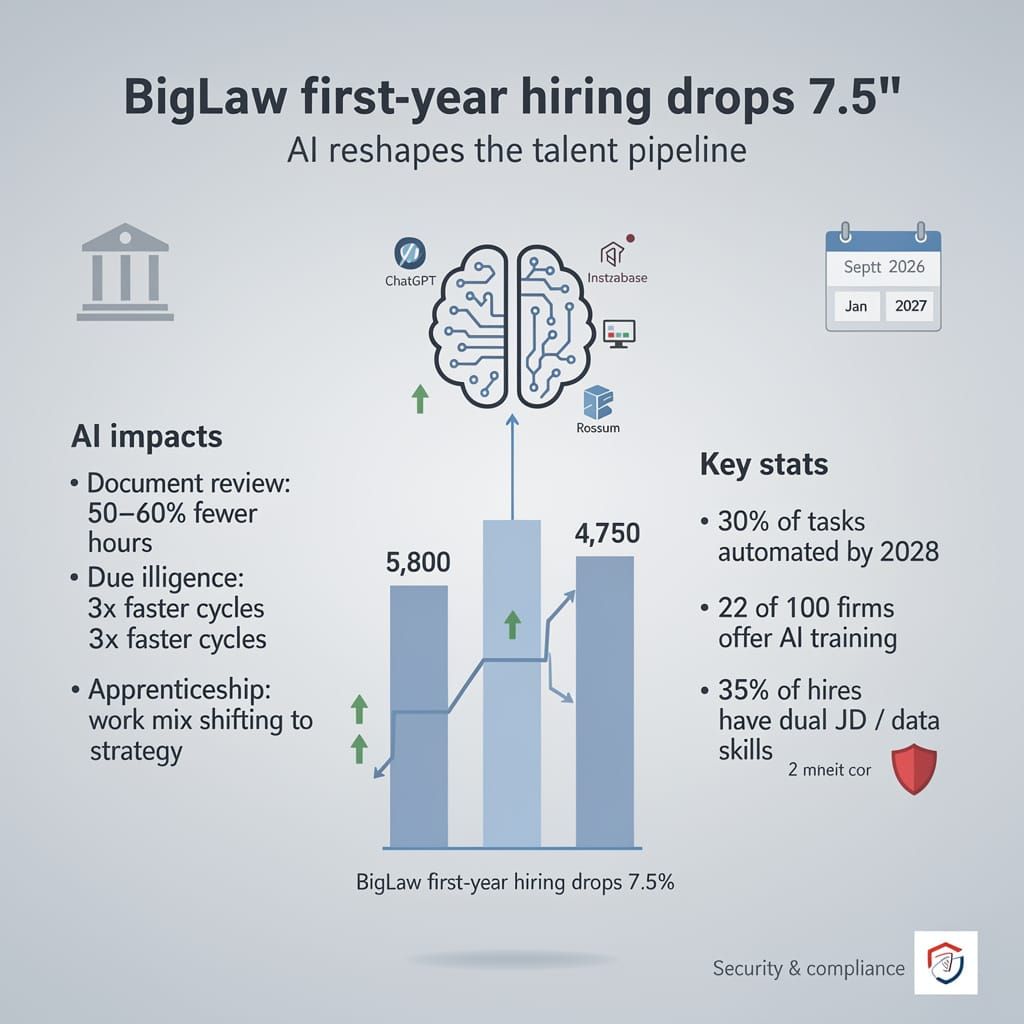
BigLaw first-year hiring dropped 7.5% in 2025 — about 400 fewer positions across the top 50 US law firms. AI tools now handle document review and contract analysis, work that once filled 30–40% of a junior associate's billable hours. Two-thirds of surveyed firms expect further cuts by 2028. Mid-level lateral hiring and AI-skilled candidates are gaining. Are you adjusting your career strategy for an AI-shaped legal market? 🤖⚖️
Citi's Wealth at Work Law Firm Group reported a 7.5% decline in Class of 2025 first-year associate hiring across large firms—roughly 400 fewer positions at the 50 largest US law firms compared to the Class of 2024 cohort. Citi law firm group head Gretta Rusanow attributed the reduction to AI tools handling document review, due-diligence drafting, and contract analysis—tasks that historically occupied 30–40% of a first-year associate's billable hours. Two-thirds of BigLaw firms surveyed by Citi expect even fewer first-year hires by 2028.
What Changed
How AI drove the shift:
- Document review automation: Generative AI platforms reduced manual review needs by 50–60% in corporate transactions. Enterprise document intelligence tools from Microsoft, Google Cloud, and AWS now move beyond OCR toward semantic interpretation, classifying layouts, extracting information, and validating against rules—work that law firms historically assigned to first-year classes.
- Due-diligence efficiency: Firms deploying AI reported 3× faster contract analysis, enabling smaller teams to close matters that previously required 5–7 first-year hires. Platforms like Instabase AI Hub and Rossum Aurora handle complex document structures spanning multiple files, reducing the need for junior-level document sorting.
- Training model disruption: Several Am Law 100 firms restructured their apprenticeship models, shifting from pipeline hiring to rotational roles with fewer permanent entry slots. TermScout founder Olga V. Mack noted that legal tech innovation is accelerating toward dynamic partnership structures, moving away from static contract management that junior associates traditionally staffed.
- OpenAI's legal push: The company hired Jason Boehmig to lead a new strategy embedding ChatGPT directly into legal workflows—contract negotiation, document review, and database searches—competing with Anthropic and Google for enterprise legal software sales.
Competitive Pressures
Staci Zaretsky, senior editor at Above the Law, noted the decline does not reflect a weak legal market. Instead, large law firms are "competing for a different kind of talent—one with technical fluency that traditional JD programs rarely provide."
Parallel trends driving the labor squeeze:
- Alternative provider growth: Non-traditional legal service providers absorbed 12% of the tasks previously routed to first-year associates, per the 2026 Altman Weil survey. AI-driven outsourcing now shifts from static contracts to adaptively managed partnerships with embedded AI validation layers.
- Boutique and startup pull: Smaller firms and legal-tech startups recruited 18% more 2025 graduates than the prior year, offering equity stakes and AI tool ownership.
- Salary compression: First-year associate base pay held flat at $225,000 for the fourth consecutive year, while signing bonuses for AI-skilled candidates rose 22%.
- Client-demand gap: A June 2026 Thomson Reuters survey found 78% of clients wanted AI-enhanced legal services, but only 6% received them. Sixty percent of surveyed firms reported they would lose at least 30 customers if AI tools do not improve quickly—a figure that aligns with broader enterprise document intelligence adoption trends where 58% of US small businesses already use generative AI tools.
Institutional Responses
Firms are reacting unevenly. Citi's report indicated that roughly 60% of surveyed firms maintained their 2024 hiring targets; 40% reduced them.
How firms are adapting:
- Reskilling pipelines: 22 of the top 100 firms launched in-house AI training programs, aiming to upskill second- and third-year associates rather than hire new classes.
- Late-hire adjustments: Several firms pushed first-year start dates from September 2026 to January 2027, buying time to reassess staffing models. Gartner's 2026 projection adds a caution: 30% of employees laid off via AI-driven cuts will need rehiring by 2029, a pattern already visible in customer service where companies like Klarna rehired representatives after claiming AI chatbots could replace them entirely.
- Specialized recruiting: Corporate practices now prioritize candidates with dual JD/computational data science degrees; hiring of such profiles rose 35% year-over-year.
- Security investments: The American Bar Association reported a 29% average attack frequency among midsize firms, driving adoption of SSO solutions—SSOJet ($99/month flat), WorkOS ($125/connection), Auth0 ($150/month bundled)—to comply with external counsel security questionnaires.
Outlook
- 2026–2027: First-year hiring will likely stabilize around 5,800 positions industry-wide, 12% below the 2023 peak, as firms refine AI integration. However, enterprise document intelligence platforms continue advancing toward autonomous decision-making, which may further compress entry-level needs.
- By 2028: Citi projects that 20–25% of current first-year tasks will be fully automated, pushing firms toward lateral hiring at the mid-level (3–5 year associates) rather than building from entry. Legal governance technology is expected to expand beyond siloed IT projects before Q4 2026.
- Curriculum shifts: Law schools are expected to embed AI ethics, prompt engineering, and computational reasoning into first-year curricula by Fall 2027—a lag firms describe as "two years too late."
- Venture inflows: AI infrastructure and legal-tech companies raised significant capital through mid-2026—Baseten ($1.75B), Together AI ($800M Series C at $8.3B valuation)—signaling continued investment in automation tools that will further reshape legal hiring.
What This Means for Job Seekers
The 7.5% hiring decline signals a structural realignment, not a recessionary cut. Graduates entering BigLaw face three shifts: lower entry volumes, higher expectations for technical fluency, and stronger demand for mid-level lateral mobility. The rehiring patterns Gartner projects for 2029 indicate that firms pushing too aggressively on AI cuts may reverse course, but the window for traditional first-year roles will remain compressed. Candidates who develop AI competency alongside traditional legal skills will hold the advantage in a market where the associate count is shrinking but the value of each hire is rising.


Comments ()