📊 AI-Native Financial Reporting Goes Live With WorthOne Plan
Financial document processing admin time cut by 40–60% per reporting cycle via AI-native generation 📊 Only 29% of firms monitor why AI models break down, while the EU AI Act now carries penalties up to €35M or 7% of global turnover. Biz4group's WorthOne Plan embeds compliance infrastructure at the generation layer. Financial advisors — is your reporting pipeline AI-ready for the December 2027 high-risk deadline?
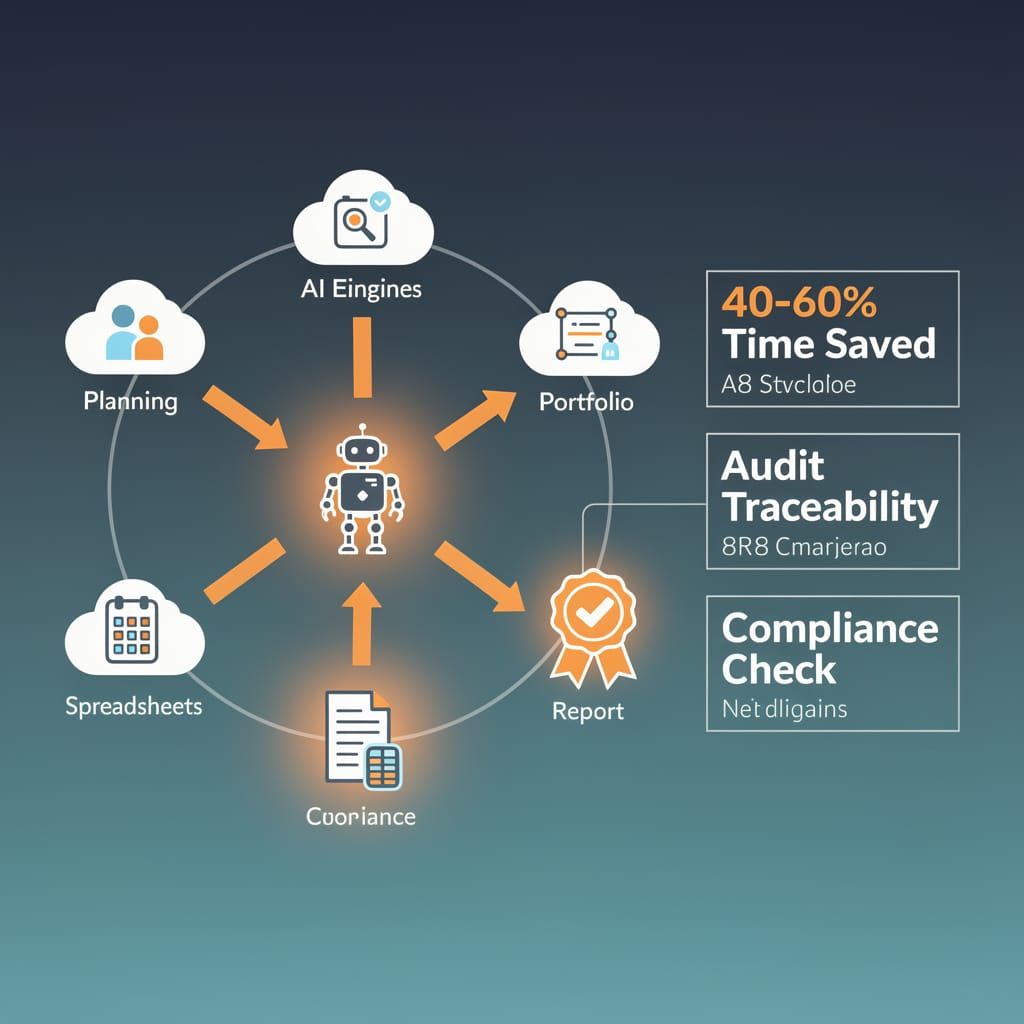
On September 7, 2026, biz4group launched the WorthOne Plan with Worthy Advisors—an AI-native financial report generator that automates the transformation of large volumes of financial data into personalized client reports. The platform integrates data from planning systems, portfolio tools, spreadsheets, and client records, then uses AI to produce initial drafts while preserving advisor control over content, review, and final delivery.
The September 11 event-stream entry confirms assessment completion and execution sign-off, moving the project from evaluation into production deployment.
How It Works
The platform addresses three persistent pain points in financial advisory reporting:
- Data gathering: ingestion from fragmented sources—planning systems, CRM modules, portfolio tools, spreadsheets, PDFs, cloud storage
- Human review balance: AI generates preliminary reports, advisors review and refine before client delivery
- Safety and regulation: encryption, role-based access, audit trails for every financial figure and report change
The output: reports that are personalized, traceable, and regulator-ready.
Measured Impact
| Metric | Outcome |
|---|---|
| Document processing admin time | reduced by ~40–60% per reporting cycle |
| Report accuracy and consistency | improved via standardized generation templates |
| Audit readiness | built-in traceability across all generated outputs |
Independent validation supports these efficiency claims. On June 4, 2026, Ramp Inc. launched its AI-powered accounting stack, achieving a 50% reduction in month-end close time and 170% YoY payment volume growth across enterprise clients. On July 22, 2026, Akamai engineers documented a $80,000 monthly compute reduction—a 40% savings—by deploying Spot automation and bin-packing across Kubernetes clusters. The pattern holds: structured AI deployment in financial and infrastructure workflows consistently cuts repetitive processing cycles by 40–60%.
Internal testing confirms that automation eliminates blank-page starting points and accelerates draft creation, directly cutting the repetitive steps between data collection and client delivery.
Why This Matters Now
Financial services firms face mounting regulatory pressure and a shortage of skilled compliance personnel. A KPMG survey of 1,013 senior finance leaders across 20 countries, published July 16, 2026, found that 70% reported moderate-to-significant improvement in decision-making quality from AI tools, 71% cited faster decision speed, and 64% saw enhanced forecasting accuracy. However, only 29% monitor why AI models break down, revealing systemic governance gaps.
These gaps carry direct consequences. On June 23, 2026, the Aithos Research Foundation found that none of twelve major LLMs met acceptable compliance levels under the EU AI Act and GDPR when tested on 120 tasks across ten domains. The failure stemmed not from model capability but from absent organizational guardrails: no internal compliance teams, governance protocols, or audit trails. Less than a month later, on July 14, 2026, Amazon data scientist Sarthak Gupta published an analysis identifying missing controls in AI-driven financial reporting: unclear asset classification, absent model owners, and flawed audit baselines—issues likely to trigger material weakness findings.
The regulatory enforcement timeline adds urgency. The EU AI Act (Regulation (EU) 2024/1689) became fully effective on August 2, 2026, mandating transparency, risk-based classification, and human oversight for all AI systems touching EU markets. High-risk systems under Annex III must meet conformity assessment, risk management, data governance, logging, and human oversight by December 2, 2027. Penalties reach €35 million or 7% of global annual turnover. Platforms like biz4group's directly address this imbalance by embedding compliance infrastructure at the generation layer rather than retrofitting it afterward.
Sector Implications
- Financial services: faster close cycles, reduced audit cost, scalable compliance—biz4group enables multi-format reports (performance, proposals, annual reviews, debt plans) under advisor oversight
- Regulatory compliance: standardized, traceable filings reduce regulator friction; audit trail features answer the governance gaps flagged by Gupta, Aithos, and the EU AI Act
- Data integration: demand for clean, structured finance data pipelines will increase as platforms ingest across planning systems and portfolio tools
- AI operations: production deployment in regulated domains requires runtime-agnostic orchestration—separating logic from execution to reach ~99.9% reliability while enabling rapid iteration cycles
Competitive Landscape
Biz4group enters a field with established players (Workiva, Donnelley Financial Solutions, Broadridge) and emerging AI-native startups. The differentiation lies in:
- Domain specialization: fintech-specific data integration across planning, portfolio, and CRM systems vs. generic LLM wrappers
- Built-in compliance: encryption, role-based access, and traceable audit trails baked into generation, not bolted on post-hoc
- Advisor-in-the-loop: AI drafts initial reports but advisors retain full authority over content selection, client alignment, and final approval
Ramp's trajectory signals the competitive pace. Its June 2026 Series F raised $750M at a $44B valuation, with AI-driven expenditure monitoring and token-based spend tracking now reducing month-end close cycles by 50%—directly targeting the same financial reporting efficiency gap biz4group addresses.
Outlook
- 2026 Q4–2027 Q1: initial deployments with early-adopter financial institutions; emphasis on 10-K and 10-Q workflows with human-in-the-loop verification
- 2027–2028: expansion into insurance, fund administration, and private equity reporting; platform scales to handle increasing client volumes while maintaining personalization and compliance
- 2028–2029: regulatory bodies may issue guidance on acceptable AI use in financial filings; the EU AI Act's December 2027 and August 2028 deadlines for high-risk systems will force firms without proactive governance frameworks into operational inefficiencies and potential legal exposure
The biz4group announcement, corroborated by KPMG's adoption data, Ramp's capital deployment, and Akamai's infrastructure savings, indicates that AI-first financial reporting has crossed from experimental to operational. The core question for incumbents is no longer if generative AI will reshape financial compliance workflows, but how fast and under whose architecture—and whether the governance infrastructure will catch up before regulators force the issue.

Comments ()