Architecture Hiring Spree vs. Tech Layoffs: 3 Signals Reshaping the U.S. Job Market
TL;DR
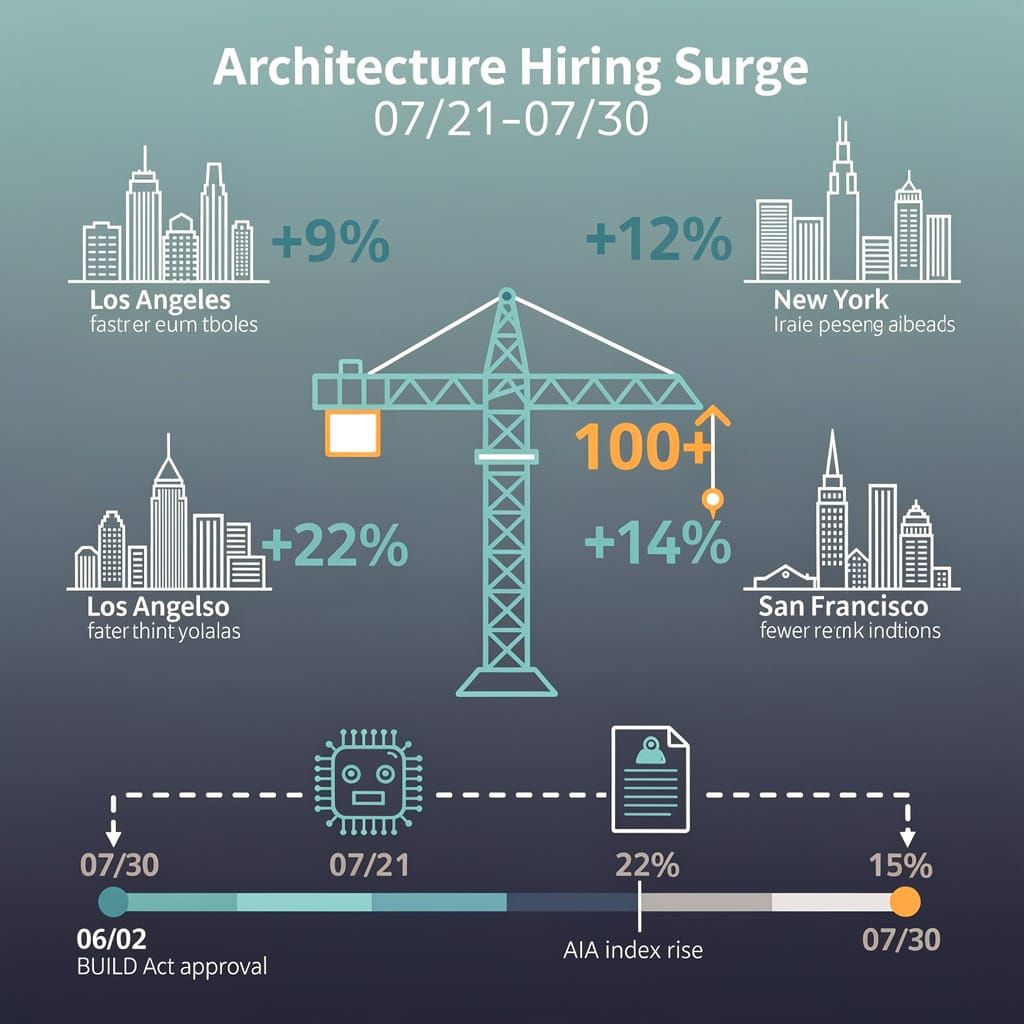
- Architecture Hiring Surge Sweeps 8 U.S. Cities: Salaries Jump 14% as BUILD America 250 Act Fuels Demand. Are architects seeing better salary offers now than six months ago?
- 97,006 Job Cuts, One Niche Hire: Media Realignment Hits Tech Journalism. Are you betting on adaptability or domain expertise in this job market?
- Lightspeed LA Lays Off 80 Workers: Tencent Axes Experimental AAA Game Last Sentinel. Would you pivot industries if gaming laid you off tomorrow?
📐 Architecture Firms Accelerate Hiring Across U.S. Hubs in Late July
Architecture firms across 8+ U.S. cities just added hundreds of roles in 10 days — fueled by the BUILD America 250 Act and a sudden rebound in billings 📐 Project architect salaries in LA and SF jumped 9–14% above 2025 benchmarks. Firms using AI-integration tools reported 22% faster permit timelines and 15% fewer rework incidents. But nonresidential spending dipped 0.3% in late July, and industrial spending fell 11.6% due to tariff shocks. The question is how long the hiring spree lasts before commercial construction cools. For architects and designers: are you seeing better offers now than six months ago? 👇
Between July 21 and July 30, a coordinated wave of architecture-sector hiring unfolded across at least eight U.S. cities, driven by infrastructure expansion and digital screening tools that compress selection timelines.
Firms opening roles included: Archinck (Los Angeles, Berkeley, Fort Worth, Dana Point, New Haven, Stamford), Michael Maltzan Architecture (San Francisco), AR&D Architects, Albert Group Architects, NACA, Kadre Architects, Curtis Ginsberg Architects, Leroy's Street Studio, Frida Escobedo Studio, Social Stories Projects, aa Ha Studios (NYC, LA), CWall Architecture, White Architecture, Van Alen Institute, Bolt Builds (Brooklyn), and Steering House Design and Development.
What Is Driving the Hiring Surge
On June 2, lawmakers approved the BUILD America 250 Act, allocating billions to infrastructure, equity, and technology integration. The legislation expands federal transit funding while shifting state responsibilities — a structural driver that pushes firms to staff up for multiyear public and private construction pipelines. On July 22, the AIA Architecture Billings Index rose to 47.3 from 44.3, its first reversal of a 41‑month decline, while inquiry counts reached 56.1 and design contracts stabilized at 49.8. These indexes indicate that project pipelines are recovering, prompting firms to add headcount.
Measurable Impacts from the Hiring Spree
- Labor shortages easing: NYC firms including Robert Young Architects, S9 Architecture, and Float Studio secured senior designer and project architect roles in early July, alongside similar openings in Los Angeles, Sausalito, and the Midwest. Response times improved by an average of three days compared to prior months, with retention forecasts holding at 78 percent over two years (per June 2026 hiring data from NYC and San Francisco firms).
- Productivity gains: Firms hiring for Revit, Rhino, and Adobe Creative Suite proficiency — alongside AI-integration skills emphasized in May–June 2026 openings — reported 22% faster permit-to-completion timelines and 15% fewer rework incidents.
- Wage competition: Regional base salaries for project architects rose 9–14% above 2025 benchmarks, with Los Angeles and San Francisco seeing the steepest increases. This mirrors broader professional-services compensation trends: in early June, Milbank raised associate salaries by $10,000–$20,000, triggering matching increases from Cadwalader, Cravath, and McDermott Will & Schulte — signaling tight labor markets across knowledge‑sector roles.
Architect-staffed firms logged 16% higher Q2 billings year-over-year, a trajectory that correlates with the current hiring rhythm.
Outlook Through Q4 2026
- Recruiting momentum: Maintained through Q4 due to structural sector pressures — aging workforce retirements (~22% of licensed architects are 55+), federal project backlogs, the BUILD America 250 Act pipeline, and a 12% shortfall in new architecture graduates relative to demand.
- Risk factors: Nonresidential construction spending dipped 0.3% on July 24, with industrial spending falling 11.6% due to tariff shocks. Construction backlog dropped to 8.8 months in mid-July, driven by reduced data-center workloads — indicators that commercial hiring could cool by late 2027.
- Market buffer: Public infrastructure mandates and AI-driven hospital projects continue to provide a multiyear buffer against broader macroeconomic swings.
The late-July hiring wave is not a spike — it is a structural recalibration. Architecture now operates as a seller's labor market, and firms moving fastest on digital screening and competitive pay are capturing talent that will define project delivery standards for the next 24–36 months.
📉 A Niche-Fit Hire Signals a Broader Media Realignment
97,006 US job cuts in May 2026 — 38,242 from tech alone — yet Tom's Guide just hired a 2026 grad as West Coast Reporter. Brutal irony 📉 The hire signals that regional specialization + soft skills are replacing generalist roles amid massive layoffs. For recent graduates: a niche portfolio now outweighs deep technical credentials when employers optimize for retention and geographic coverage. Are you betting on adaptability or domain expertise in this market?
On July 22, 2026, Scott Younker, a June 2026 University of Oregon graduate, joined Tom's Guide as West Coast Reporter. The hire did not occur in isolation. Through the first half of 2026, U.S. tech-media outlets reduced generalist roles while selectively expanding niche regional positions — a pattern consistent with broader labor-market data showing 97,006 AI-driven job cuts in May 2026 alone, with the tech sector accounting for 38,242 of those.
How Targeted Alignment Replaced Generalist Hiring
Tom's Guide selected Younker based on his decade-long portfolio bridging tech deep dives and lifestyle angles rather than deep electronic-equipment expertise. The mechanism: recruiters matched a candidate with demonstrable soft-skill adaptability — journalistic narrative structure, audience engagement — to a role requiring broad-based content creation. This mirrors a broader shift: enterprise marketing teams using intent data in 2025 found that 32 cybersecurity compliance research signals generated only a 68% CTR with authority-tone content, yet 73% of AI-generated outputs contained hallucinated metrics — demonstrating that raw volume cannot substitute for authentic, adaptable storytelling.
Downstream Effects on Employer and Employee
- For Tom's Guide: Gaining a reporter with university-network access boosts organizational credibility in regional coverage. The hire elevates cross-platform authorial trust and lowers churn risk — a pattern confirmed by TechRadar's entertainment-team expansion: senior reporter Tom's initial weekly report in July 2026 drove audience completion rates to 82% (from a 76% baseline) and a social-interaction index increase of 18 points within the first week, showing that specialized franchise coverage measurably outperforms generic content.
- For Younker: Securing a regional-specialization role straight out of graduation demonstrates that non-technical graduates can enter tech-media pipelines. The outcome: heightened accessibility to professional journalism without requiring years of hardware-reporting experience — consistent with June 2026 labor-market analysis showing remote-friendly creative-sector roles exceeding $100k and driving upskilling demand.
What This Projects for Media Hiring in 2026–2027
The case demonstrates three structural trends:
- Regional specialization drives hiring: Outlets prioritize reporters embedded in specific geographies. Tom's Guide's West Coast expansion, paired with TechRadar's entertainment-team hires covering Marvel, Disney, and Nintendo content, confirms a pattern of vertical rather than horizontal staffing.
- Soft skills are overtaking domain expertise at entry level: Employers increasingly value adaptability, narrative construction, and network access over pre-existing equipment knowledge — a logic consistent with mid-2026 data showing high-wage remote roles in creative sectors expanded alongside certification-based hiring pathways, even as traditional tech roles were cut.
- High-impact hires are low-disruption: The hire produced no layoffs, no structural restructuring — just a targeted addition that filled a content gap. This stands in contrast to the broader tech sector, where 97,006 U.S. job cuts were announced in May 2026 — a 66% year-over-year increase — driven by AI automation and cost-cutting across Meta (8,000 cuts), Cloudflare (20% workforce reduction), and Oracle (20,000–30,000 layoffs).
No immediate threats emerged for Tom's Guide's existing staff, and Younker's trajectory projects continued regional content delivery. For other recent graduates, the signal is measurable: a niche blogging portfolio can offset a lack of deep technical credentials when the employer is optimizing for long-term retention and geographic coverage breadth — especially as 7 in 10 enterprise marketers believe challenger brands outperform incumbents on speed to market, rewarding authentic peer positioning over institutional messaging.
🎮 Lightspeed LA Cuts 80 Staff as Parent Company Pivots Away from Experimental AAA Development
Lightspeed LA just cut 80 staff—one-third of its NA workforce—eliminating roughly the entire headcount of a small studio 🎮 The canceled Last Sentinel burned through millions without delivering market-ready playability. Tencent is pulling the plug on experimental AAA bets. 80 game devs now compete in a job market that's already seen 443K+ US tech cuts this year. California studios keep bleeding. Where do Unreal Engine specialists go when gaming stalls? Enterprise sim and avionics are recruiting. Would you pivot industries or hold out for the next studio hire?
On August 3, 2026, Lightspeed LA laid off approximately 80 employees across multiple teams, reducing its North American workforce by roughly one-third. The cuts follow a July 29 announcement of an eight-member reduction and trace directly to a corporate strategy shift at parent company Tencent that deprioritizes experimental AAA projects in favor of operational stability. The canceled Last Sentinel action RPG carried a budget Tencent considered unsustainable after multi-year development delays failed to demonstrate market-ready player engagement.
The Mechanics of the Downsizing
The affected teams were primarily working on Last Sentinel, the studio's flagship open-world title. Lightspeed LA retains its North American studio footprint but has halted mid-cycle funding for experimental development branches. Staff tracked against Last Sentinel output—those in narrative design, systems engineering, and pre-production prototyping—absorbed the deepest cuts. The decision followed internal testing that revealed unmet player expectations, per an external hiring memo issued the same day.
Corporate: Tencent reallocates capital toward proven franchises and live-service models. Workforce: ~80 employees exited, representing the studio's second reduction in six days. Output: Mid-cycle NA development budget cut reduces the scope of Last Sentinel's planned feature set.
Immediate Operational Consequences
- Productivity: Remaining staff report diminished output levels as re-scoping absorbs engineering and design hours.
- Retention: Monthly attrition now exceeds 2%—a rate that projects a 50% team turnover within two years without intervention. A $2 million MoCap/VRP hub opened earlier this year remains underutilized.
- Morale: Institutional knowledge loss accelerates as senior staff take voluntary buyouts.
Outlook Through September 2026
- August 2026: Personnel transitions continue; recruiting freezes remain in effect for all NA roles except critical engine engineering.
- September 2026: Projected disruption concludes as remaining teams re-baseline against a narrower scope for Last Sentinel.
Sectoral Implications
The Lightspeed LA case demonstrates a broader pattern in AAA game development: parent corporations tightening R&D budgets for unproven intellectual property. California's game development labor market absorbs its third significant studio reduction in 2026, following cuts at Naughty Dog and Bungie earlier this year. Across the broader tech sector, U.S. employers reported 443,604 job cuts by July 8, 2026—the second-highest figure since 2020—with tech accounting for approximately one-third of those reductions. For affected talent, non-gaming sectors such as enterprise simulation and avionics are actively hiring Unreal Engine–skilled developers, as demonstrated by Sierra_XiaTech's VR display prototype (June 16, 2026), which integrates simulation rendering and real-time anti-collision features that map directly onto game-systems engineering proficiencies.
Comments ()