⚡ AI Gridlock: Power Shortage Stalls Data Centre Build-Out
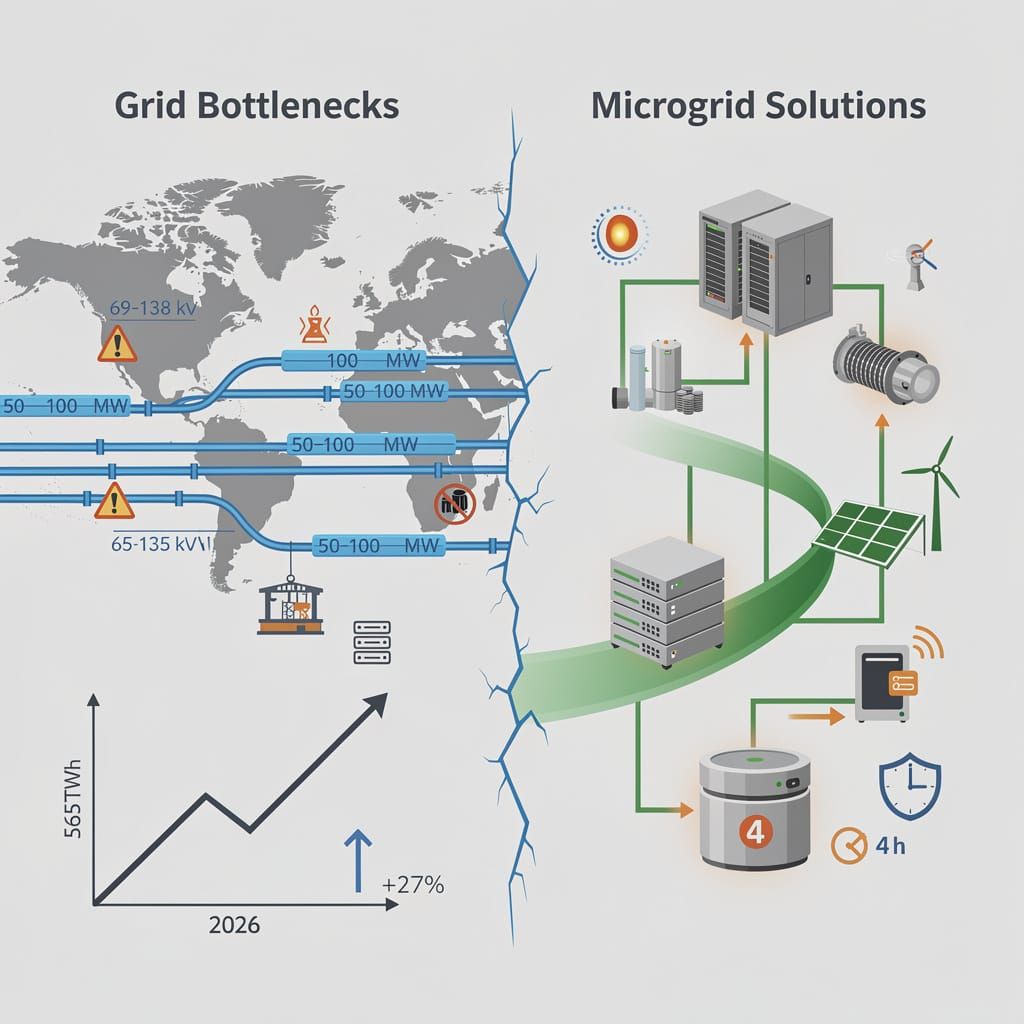
AI data centres now draw 50–100 MW per facility, with global power consumption hitting 565 TWh in 2026 — a 27% year-over-year surge. Grid infrastructure built for incremental growth can't handle the load. Six North American and four European facilities have paused construction. Hyperscalers are turning to private microgrids at $35–55 million per 100 MW build. Is the AI build-out shifting from a compute problem to a power delivery problem?
A cross-regional assessment on September 7, 2026, confirmed what grid operators had warned for months: AI data centres in Europe and North America face build-out delays directly caused by insufficient subtransmission capacity. Existing electrical infrastructure, designed for incremental load growth, cannot absorb the exponential power demands of next-generation AI clusters. The result is not a hypothetical constraint but an active brake on hyperscale expansion.
How the Grid Became the Chokepoint
AI data centres draw 50–100 MW per facility during training phases, with some projected to exceed 200 MW by 2028. Gartner analyst Linglan Wang reported on June 12 that global data centre power consumption reached 565 TWh in 2026 — a 27% year-over-year surge — with AI workloads alone consuming 31% of total power. By July 9, Apple's AI server farms were on track to surpass total conventional data centre power usage globally, driven by a 26% increase in overall data centre electricity demand. The US accounts for 204 TWh (36% of the global total), and AI-optimised servers within the US draw 68 TWh, roughly one-third of domestic data centre usage.
Standard subtransmission lines (69–138 kV) serving industrial zones were never engineered for this density. The September 7 report identifies four European and six North American facilities where construction has paused because local substations lack transformer capacity and interconnection queues run 3–5 years. By late June 2026, British enterprises confronted severe digital lag as planned data-centre farms stalled, prompting clients to retreat to sovereign edge sites. On July 23, PJM Interconnection — the grid operator serving 13 US states — reported grid strain and began pausing new connection requests.
The causal chain is straightforward: high-power GPU clusters require continuous, stable draw. Utilities cannot guarantee supply without upgrading feeder lines, installing transformers, or adding on-site redundancy. Each upgrade triggers permitting cycles, supply-chain delays for switchgear, and utility coordination that hyperscalers cannot bypass.
Financial and Operational Repercussions
Capital expenditure for data centre developers has risen 18–25% where on-site substation work is required, pushing per-MW build costs above $12 million in constrained regions. Operational risk compounds the cost: facilities connected to weak subtransmission grids face voltage sag events that can interrupt training runs lasting weeks, destroying compute progress and wasting $200,000–$500,000 per interruption. On June 18, researchers quantified US data centre electricity use at 224 TWh in 2025 — the highest since records began — and noted that each GPT-4 training session consumes roughly 50 GWh, dwarfing typical server loads.
- Capital impact: $4–6 million per facility for dedicated transformer banks and switchgear upgrades.
- Operational risk: 3–8 voltage sag events annually per weak-grid site, each risking partial or total workload loss.
- Timeline slippage: Average 14–22 months added to projects requiring subtransmission reinforcement. Microsoft, for example, cancelled or postponed multiple US and European data centre projects by June 12, deferring roughly 2 GW of AI hardware deployment.
Vertiv's September Signal
On September 2, Vertiv announced the acquisition of Utility Innovation Holdings (UIG) for approximately $1.45 billion in cash, with up to $1.15 billion in additional earnouts tied to EBITDA — a total potential payout of $2.6 billion. UIG specialises in microgrid controls, onsite generation, and energy storage orchestration. The acquisition, closing Q4 2026, confirms the market sees grid adaptation as a structural constraint. Vertiv now offers integrated power infrastructure that can decouple data centres from weak public grids, effectively selling insurance against interconnection delays. The $2.6 billion ceiling suggests the market projects at least 8–12 GW of data centre capacity will need partial grid independence by 2029.
Private Microgrids as the Emerging Solution
Hyperscalers including Microsoft, Google, and Amazon are now co-investing in dedicated microgrids — combining on-site gas turbines, battery storage, and renewable generation — to bypass public subtransmission bottlenecks. On June 22, Consellion invested in a private microgrid solution, while June 16 saw gas turbine builds filling the void left by delayed grid connections. A 100 MW microgrid with 4-hour battery backup adds $35–55 million in capital cost but eliminates interconnection queues entirely. By June 26, Nextpower had finalised three acquisitions — ZGR Apex, Prevalon Energy, and Zimmerman PV Steel — accelerating North American battery storage pipelines by $35 billion in value. On August 25, Giga Energy launched its GigaBase integrated model, reducing data centre site construction from 18 months to roughly 9 months by overlapping power infrastructure, manufacturing, and compute facility deployment.
The International Energy Agency projects that private on-site generation for data centres will grow from 2 GW in 2025 to 18 GW by 2030 if grid upgrades lag. Global data centre energy demand is projected to exceed 1,200 TWh by 2030, up from 565 TWh in 2026, requiring infrastructure upgrades that current permitting cycles cannot deliver within the same window.
Short- and Mid-Term Outlook
- 2026–2027: 15–20% of announced hyperscale projects in Europe and North America face ≥12-month delays. Microgrid adoption rises to 30% of new builds. US consumers face power price increases of up to 76% from data centre-driven demand.
- 2028–2029: Subtransmission reinforcement programs in Germany, Virginia, and Ontario may ease 25% of current bottlenecks. Vertiv and competitors scale microgrid packages, reducing per-MW premium to 12–15%.
- 2030: If interconnection reform and private microgrids converge, data centre capacity growth stabilises at 12–14 GW annually. Without reform, allocation conflicts between data centres, residential, and industrial users intensify. Spain has proposed an €4 billion AI gigafactory with an 80% renewable-energy target, signalling that governments are beginning to embed power constraints into AI infrastructure planning.
The grid constraint confirmed in the September 7 report is not a temporary bottleneck. It reflects a structural misalignment between AI's exponential power trajectory and linear utility infrastructure cycles. The resolution will come not from efficiency gains inside data centres but from re-engineering the power delivery systems that feed them.


Comments ()