⚡ Midea’s AI Home Ecosystem Passes Nine Million Units at IFA 2026
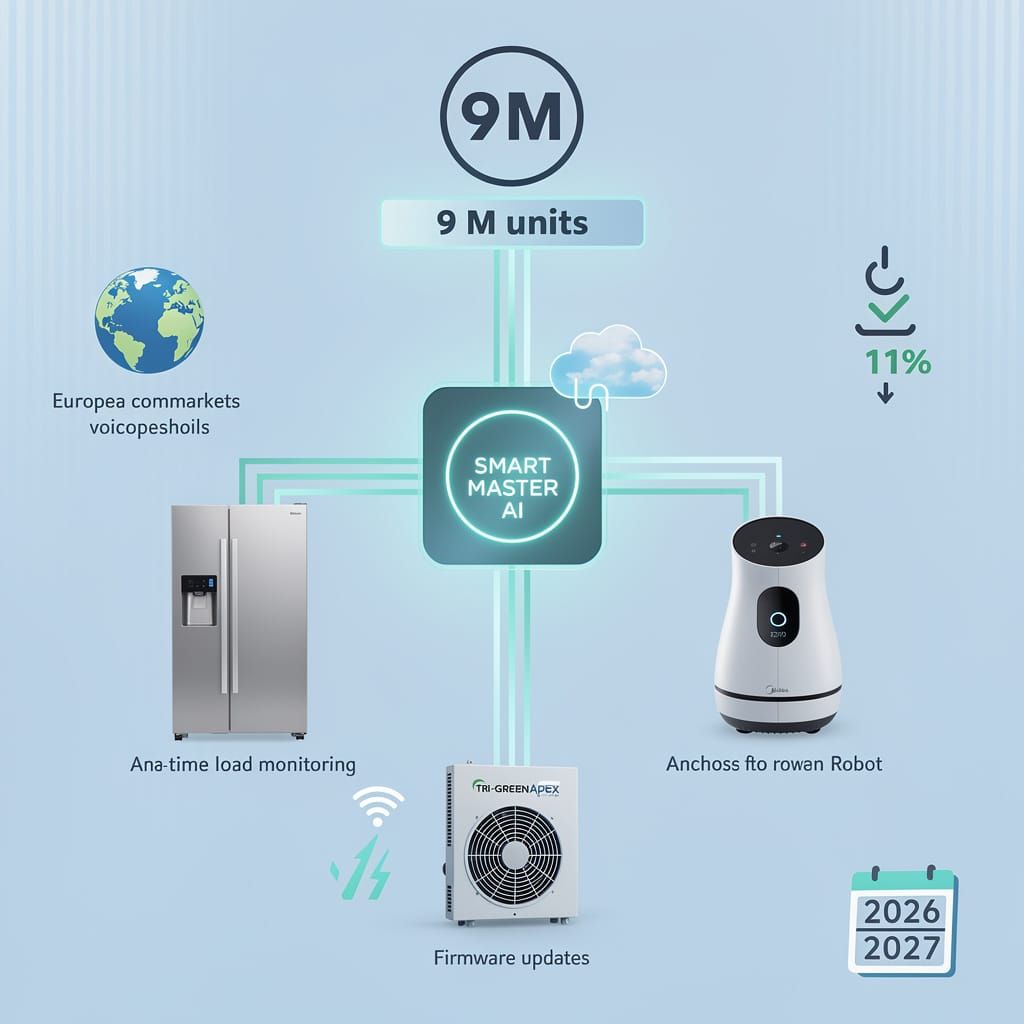
9 million Midea AI home units deployed by October, cutting household electricity use 11% per connected unit in field trials. The AI ECOMASTER redistributes load across appliances when weather shifts — but the system needs continuous WiFi, leaving 12–15% of European homes without automatic energy savings. Midea targets 14 million units in Germany, France, and the Nordics by 2028. Is the connectivity trade-off worth the efficiency gain where you live? ⚡
At IFA 2026 in Berlin, Midea presented three interlocking AI systems that transform household appliances from passive machines into active energy managers. The company reported that by early October 2026 global deliveries of AI-enabled residential units will reach nine million, cutting household electricity use 11 percent per connected unit during field trials versus industry averages. The AI ECOMASTER layer coordinates load across linked devices—refrigeration, laundry, cooking, climate control, and cleaning—adjusting parameters when local weather detection signals a coming heat wave or cold front.
How the Three AI Layers Interlock
The SMART MASTER AI agency acts as the central orchestrator. After initial programming, it routes voice commands across eight appliance categories simultaneously, adjusting parameters without repeated human input. The AI ECOMASTER monitors real-time power draw across linked devices, redistributing load when local weather detection signals shifts in conditions. The third layer operates through rapid firmware updates that pull local meteorological data, then pre-chill rooms or delay dryer cycles to avoid peak grid strain. Midea also introduced the Midea Robot for cooking, cleaning, laundry, and whole-home control, and the Tri-GreenApex System that uses roughly 50 percent less energy than Europe's highest A rating.
R290 Refrigerator Leads Hardware Push
The hardware anchor of the rollout is the new R290 refrigerant-based refrigerator, which delivers roughly 10 percent greater cooling performance than conventional units while complying with tightening European energy regulations. Midea began shipping R290 models ahead of the 2027 EU F-Gas phase-down schedule, positioning them for markets that face carbon-reduction compliance deadlines within three years. The company also launched the Visionary Series with GlassVision technology, the InfiniteFit ultra-slim hob series, and the PizzaPro built-in oven with an 81-liter cavity.
The Coverage Gap
The system's effectiveness depends on continuous network connectivity. Voice commands and weather-adaptive adjustments operate through cloud-based inference, limiting functionality outside WiFi coverage zones. Homes in rural or structurally shielded buildings lose automatic load balancing and real-time firmware updates. Midea has not disclosed offline fallback capabilities, leaving a known gap for the 12–15 percent of European households with intermittent broadband access. The adoption of the Matter standard for open interoperability partially addresses device coordination but does not resolve the underlying connectivity dependency.
Timeline and Projections
- October 2026: Cumulative deliveries pass 9 million units, reducing aggregate household electricity use by an estimated 1.3 TWh annually based on trial-level efficiency gains.
- 2027–2028: European compliance deadlines for refrigerant and energy-efficiency standards tighten. Midea projects 14 million connected units in operation across Germany, France, and the Nordics. The EU's high-GWP refrigerant ban (effective 2025) accelerates R290 adoption. An August 2026 YouGov survey across France, Germany, Italy, Poland, Spain, and the UK found 61–73 percent support making air-conditioning standard in new homes, yet actual ownership ranges from 11 to 53 percent—20 percent or below in several surveyed nations—despite four major European heatwaves preceding the poll and 30–52 percent of respondents reporting health risks during extreme temperatures.
- 2029: SMART MASTER firmware generation expects to integrate 15+ appliance categories with sub-second latency on local inference chips, reducing cloud dependency and closing the off-grid coverage gap.
The AI-powered home ecosystem shifts household appliances from on/off devices to proactive grid participants. Whether the coverage dependency limits adoption in less-connected markets will determine Midea's next rollout phase.
Comments ()