83% of Crypto Firms in EU Face Shutdown: MiCA Deadline Triggers $1.96 Billion Binance Exodus
TL;DR
- $108M Hyperliquid ETF Inflows, Singapore Alert List Expansion: Offshore Exchange Warnings Fail to Curb Institutional Demand. Does a local crypto exchange alert change your trading view, or do global inflows signal opportunity?
- $3 Billion Crypto Futures Pulled Ashore: U.S. Regulators Redraw Derivatives Maps With Cross-Margin Rules. Will new U.S. cross-margin rules keep crypto liquidity domestic, or will capital flee offshore once thresholds lock?
- 83% of Crypto Firms Face EU Shutdown: MiCA Deadline Triggers $1.96 Billion Binance Outflow as Compliant Rivals Surge. Is your crypto exchange MiCA-licensed or facing shutdown before July 1?
⚠️ Singapore’s Alert List Expands, But Liquidity Refuses to Retreat
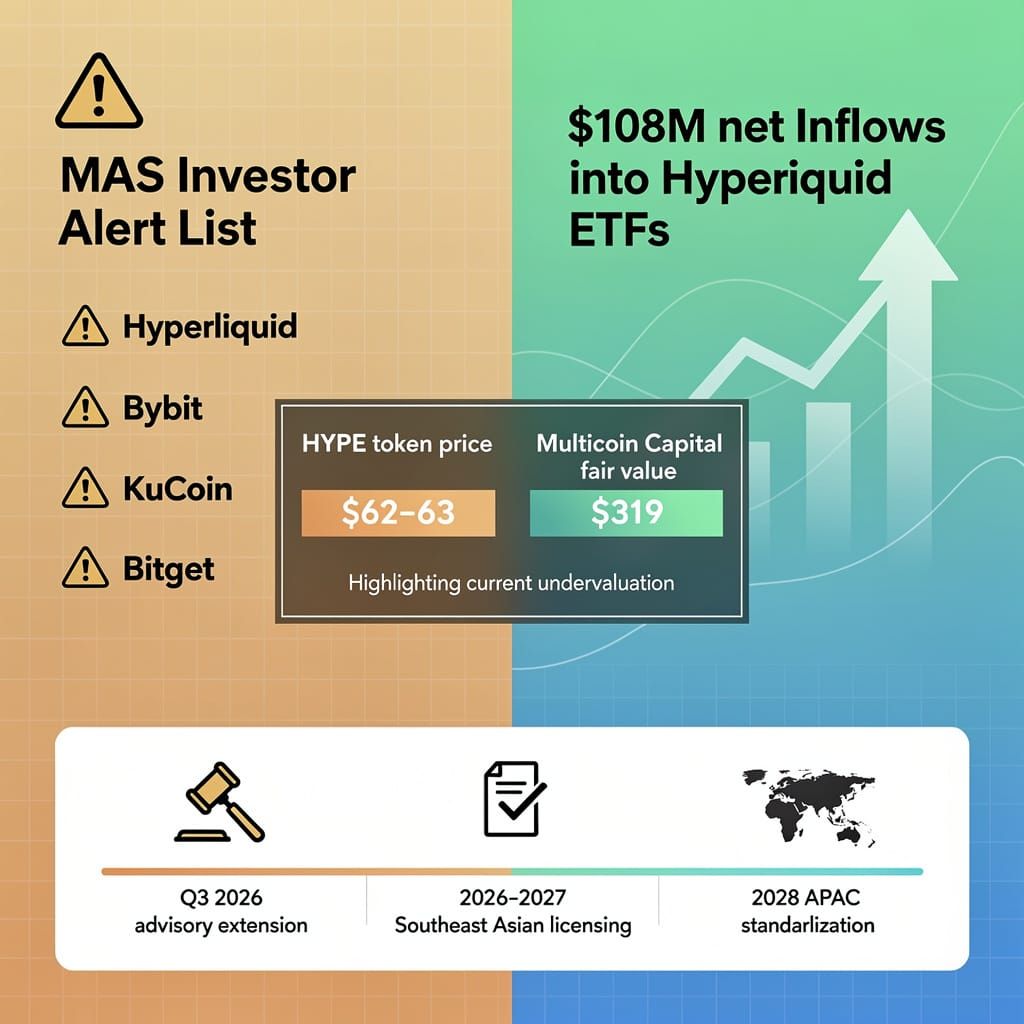
$108M net inflows into Hyperliquid ETFs the day after Singapore placed it on its investor alert list. ⚠️ Multicoin Capital values HYPE at $319 versus $63. Regulators issue warnings, yet institutions keep accumulating. Does a local licensing alert change your trading view, or do global flows matter more?
Singapore’s Monetary Authority of Singapore (MAS) placed Hyperliquid, Bybit Fintech Ltd., KuCoin, and Bitget on its Investor Alert List on June 26, 2026, marking the latest phase in a regulatory sweep that intensified through mid‑2025. The designation indicates that these platforms project operational credibility while lacking domestic licenses, generating consumer ambiguity that MAS seeks to eliminate.
The mechanism is disclosure, not prohibition. The alert list warns Singaporean residents that listed entities operate outside local Anti‑Money Laundering and Counter‑Terrorist Financing frameworks without banning the underlying protocols. MAS clarified that the classification carries no penal action. Hyperliquid affirmed its non‑authorization while emphasizing its permissionless architecture and user self‑custody—a distinction from centralized counterparts. Bybit stated it would seek formal clarification from MAS. This operational split—local advisory alongside uninterrupted international activity—demonstrates how watch‑list entries now function as jurisdictional fences rather than termination orders.
Market data indicates the fence has limited global impact. On June 25, Hyperliquid recorded approximately $108 million in net inflows into associated ETF products, and its HYPE token trades near the $62 level after a 2% slip on the announcement. Multicoin Capital simultaneously accumulated a large position, flagging deep undervaluation at roughly $63 against a projected $319 fair value via an $8 billion revenue model. Those figures signal that institutional and retail demand persists even as regulatory scrutiny escalates, undercutting the assumption that alerts automatically trigger capital flight.
The pattern reveals a maturing enforcement model. Since mid‑2025, MAS has progressively closed loopholes that allowed offshore exchanges to serve local users without licensing. Rather than pursuing asset seizures, regulators prioritized clarity; platforms adapted through compliance cycles, regional differentiation, and direct regulator engagement.
What Follows the Alerts?
The current trajectory projects three developments:
- Q3 2026: MAS extends advisories to unlicensed DeFi front ends and decentralized perpetual protocols, tightening disclosure rules without outlawing underlying smart contracts.
- 2026–2027: Offshore exchanges allocate roughly 12–18% of compliance budgets to Southeast Asian licensing, converting watch‑list pressure into regulated market entry.
- 2028 onward: Investor Alert Lists become standard consumer‑protection tools across APAC, reducing deception while preserving global liquidity flows.
For now, the coexistence of regulatory alerts and platform resilience indicates that crypto markets have decoupled local licensing status from global capitalization. Singapore corrects the consumer record; it does not erase the order book.
🌊 U.S. Margin Rules Redraw Crypto Derivatives Maps
$3B in crypto futures hit U.S. markets in beta, redrawing derivatives maps 🌊 Offshore contracts must now clear through licensed houses under federal margin floors. CME sued the CFTC as Kraken, Coinbase and Kalshi chase institutional flows. Does liquidity hold once rules lock, or does capital flee offshore?
On June 26, 2026, the SEC and CFTC jointly opened a 60-day public consultation on portfolio margin rules that explicitly fold crypto perpetual futures into cross-margining frameworks. SEC Chair Paul Atkins advocates the move to enhance liquidity and reduce market fragmentation by standardizing offsetting treatment across asset classes. The consultation follows recent venue expansions: the CFTC approved Kalshi to list Bitcoin perpetual futures on June 15, drawing $3 billion in notional volume during beta testing, while Kraken opened CFTC-regulated perpetual futures for eligible U.S. users on June 12 through its $550 million acquisition of Bitnomial. Coinbase has also secured CFTC clearance for U.S. client access via Deribit-linked instruments.
The mechanism channels previously offshore perpetual-contract volume into U.S.-sanctioned systems. Domicile mandates require clearing through licensed entities and third-party custody safeguards, giving institutions transparent cross-position accounting while subjecting global liquidity to federal margin floors. The agencies seek feedback on cross-product offsets, capital treatment, collateral usage, and clearinghouse arrangements. On June 18, CME Group filed a federal lawsuit against the CFTC challenging the approvals, arguing the contracts qualify as swaps under the Dodd-Frank Act because they lack expiry dates; CFTC Chair Michael Selig defended the approvals as regulatory progress, while Kalshi notes its maximum leverage remains below CME levels.
Impacts cut across three domains:
- Market Efficiency: Harmonized rules improve capital efficiency through cross-account exposure offsetting, though offshore platforms retain deep liquidity pools and established user bases.
- Regulatory Scope: The initiative sets groundwork for future decisions affecting margin structures, product categorization, and inter-agency supervision, though no immediate rules are introduced.
- Competition: Coinbase, Deribit, Bitnomial, Kraken, and Kalshi now operate under federally regulated frameworks, creating a competitive test for crypto exchanges while shifting volume away from unlicensed venues.
Short-term volatility persists until regulators finalize enforceable thresholds:
- June–August 2026: The 60-day consultation runs; KalshiEX and Kraken/Bitnomial serve as live pilots for cross-asset offsetting and custody integration.
- Late 2026: Finalized margin rules and the CME-CFTC lawsuit outcome determine capital reserve and domicile requirements, including potential classification of perpetual futures as swaps.
- 2027: Full implementation either anchors domestic liquidity or pushes capital back offshore if thresholds exceed collateral elasticity.
The sequence indicates that today’s liquidity gains hinge directly on tomorrow’s enforceability, and compliant infrastructures will absorb pressure until margin limits lock into place.
🚨 Europe’s Crypto Cleanse Arrives: MiCA Deadline Forces Mass Exit
83% of non-compliant crypto firms face EU service shutdown as MiCA's July 1 hard stop takes effect. Binance alone saw $1.96 billion in daily net outflows while compliant rivals captured the flood. 🚨 The deadline wipes out any grandfathering path—unlicensed operators must freeze transactions immediately. Are your assets stuck on a platform that's closing?
Spain’s National Securities Market Commission on June 26 ordered every unlicensed crypto asset service provider to cease European operations by July 1, 2026, confirming that the EU’s Markets in Crypto-Assets transitional window shuts on that date. The directive leaves no enforcement gap: firms lacking a national supervisory licence must stop onboarding users, freeze new transactions, and file detailed asset-protection exit plans. Non-compliant operators face penalties up to €30,000, while ESMA mandates immediate shutdown for any firm still serving EU clients after the deadline.
France’s Autorité des Marchés Financiers simultaneously announced new CASP authorizations, and Austria formally refused to grandfather pre-MiCA operators, eliminating any pathway for unlicensed incumbents to continue. The coordinated enforcement indicates an estimated 83 percent of non-compliant firms will face service interruptions starting July 1.
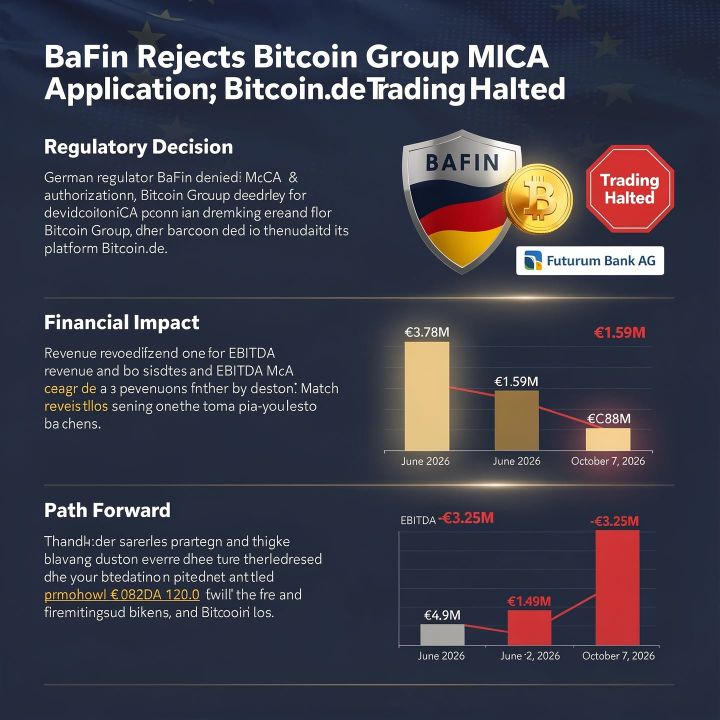
Binance illustrates the operational squeeze. Greece’s Hellenic Capital Market Commission on June 16 rejected the exchange’s MiCA application, citing unresolved governance and residency issues. Binance withdrew the Greek filing on June 26 and notified users in France, Italy, Poland, and Spain that it would cease accepting new accounts and restrict deposits ahead of the deadline. The platform stated that existing user assets remain protected and transactions will complete automatically, yet the pullback triggered $1.96 billion in daily net outflows on June 28 alone and an estimated 12 percent year-over-year revenue drop across those markets. Competitors captured the departing liquidity: OkX absorbed $285.5 million in single-day net inflows, while Bitget took in $710 million.
Conversely, compliant infrastructure attracts capital. Ripple on June 24 secured final EU CASP license (CEPA) approvals, activating cross-border RippleNet connectivity across 30 countries while spot XRP ETF net inflows topped $1.45 billion and XRP briefly touched $8.10.
Impacts divide sharply by licensing status:
- Licensed CASPs: Regulated platforms such as Kraken—which secured Central Bank of Ireland MiCA approval on June 19—and BitGo Europe, which launched a compliant crypto-as-a-service platform on June 17, report negligible revenue loss and absorb departing liquidity with minimal friction.
- Unlicensed operators: Exiting firms trigger service interruptions for partially onboarded traders, eliminate formal complaint or refund pathways, and expose users to abandoned funds. Commercial deposit outflows reached roughly €8 billion in the first quarter, and the retail confidence index dropped 14 points versus baseline 2025 Q4 levels.
Forward timelines indicate a compressed adjustment cycle:
- July 1, 2026: Unlicensed CASPs must cease EU client services entirely; ESMA mandates immediate shutdown for non-compliant operators.
- Q3 2026: Stablecoin issuers face tightened reserve thresholds—Tether has already suspended its euro product while USDC expands coverage.
- Q4 2026: Licensed channels consolidate trading volume as departing liquidity settles into passported venues.
- 2027: The European Commission’s MiCA review, initiated May 20, signals further refinements to DeFi and stablecoin rules, tightening the perimeter as decentralized venues absorb migrating users.
The MiCA hard stop replaces fragmented national oversight with a uniform licensing wall. Investors holding assets on departing platforms retain automatic transaction completion, but new inflows have frozen. For operators, the split is decisive: licensed venues gain protected market share and billion-euro liquidity windfalls, while unlicensed entities face permanent exclusion from the European Union.

Comments ()