70% Efficiency Boost: Canva AI 2.0 Integration Challenges Legacy Office Suites in Global Design Market
TL;DR
- 70% Efficiency Gain: Canva AI 2.0 Disrupts Presentation Design Across Global Markets. Will AI-native tools like Canva and Gamma permanently replace legacy office suites for corporate presentations?
- 44% Synthetic Uploads: Tidal Bans AI Royalties to Prevent €4B Artist Revenue Loss. Will the removal of AI royalties save human musicians or simply push synthetic music underground?
- 7.3 Million Variations: Stanford's BurgerAI Outscores Big Mac in San Francisco Taste Tests. Can generative AI bridge the gap between nutritional sustainability and cultural taste preferences in food design?
⚡️ Automating the Deck: Canva Integrates AI 2.0
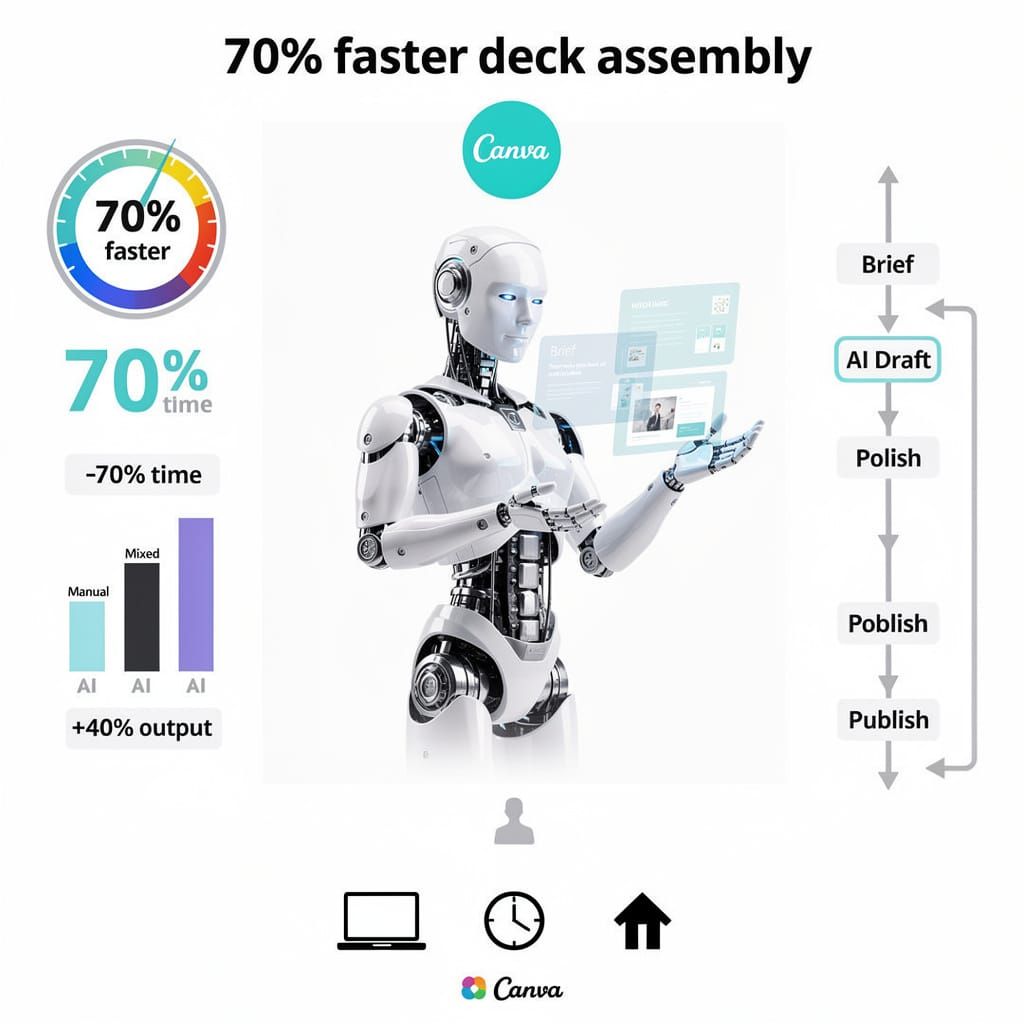
70% faster deck assembly. A staggering leap—equivalent to saving hours of manual layout every single project ⚡️. AI 2.0 now turns prompts into professional drafts in <60s. But will modular apps finally kill monolithic office suites? Corporate users—are you switching to AI-native design?
On June 30, 2026, Canva launched Magic Design and AI 2.0 conversational assistants, shifting the presentation workflow from manual layout to prompt-based generation. The system enables users to submit structured inputs—including topic, audience, and slide requirements—to receive a first draft in under 60 seconds, and refine the output through an iterative AI-designer feedback loop.
How does the integration function?
The AI 2.0 architecture utilizes conversational assistants to interpret user requests, which the Magic Design engine then translates into visual templates. This process automates feature selection for layout, color theory, and typography. This shift toward modular AI assistants correlates with a broader market trend; on June 24, 2026, Zapier's benchmarking of 40+ competitors resulted in the removal of Microsoft Copilot for PowerPoint and Google Gemini for Slides from its top rankings, citing the superior efficiency of dedicated AI-native tools like Gamma and Canva.
Operational Impacts:
- Efficiency: Assembly duration reduced by ~70% → faster iteration cycles for corporate client submissions.
- Financial: Subscription-linked AI credits → scalable usage model that ties cost to generation volume.
- Market Position: Direct pressure on legacy suites → adoption shift toward modular apps over monolithic office systems.
What is the projected trajectory?
Canva's rollout accelerates the commoditization of graphic design, enabling non-designers to produce professional assets via natural language processing. This deployment occurs amid a volatile macroeconomic climate characterized by a 9.3% US market dip in May 2026 and persisting semiconductor shortages that limit the production of AI accelerators.
- July 2026: >50% of surveyed users project daily utilization of the AI assistant.
- Q3–Q4 2026: Integration of deeper multimodal reasoning and expanded media toolkits.
- 2027: Full migration of mid-market business communication pipelines to AI-first design frameworks.
While the system streamlines corporate tasks, it faces headwinds from public skepticism. A Johns Hopkins University survey indicates 49% of working adults aged 18-29 feel pressure to use AI, while 70% of Americans prefer human interaction in critical sectors. Consequently, Canva's growth indicates a move toward frictionless content integration rather than the total displacement of professional publishing.
🎧 The Great Synthetic Purge: Streaming Platforms Tackle AI Audio
44% of daily uploads are synthetic—a staggering surge that mimics a flood of ghost artists 🎧. Tidal is now stripping 100% of royalties from wholly AI tracks to stop financial leakage. Human art or algorithmic output? Musicians face a €4B in risk—does authenticity still hold value in your playlist?
Streaming platforms are initiating a systemic shift in royalty distribution to counteract the surge of AI-generated music. On June 29, 2026, Tidal announced a strict AI music policy effective July 15, 2026. The policy bans royalties for wholly synthetic tracks and removes impersonatory or fraudulent content, requiring distributors to flag AI material prior to upload.
Why Now?
The transition results from a causal chain of synthetic saturation and financial leakage. Deezer reports that 44% of daily uploads are synthetic, while Spotify removes over 75 million spam tracks monthly. This proliferation enables fraudulent royalty claims that dilute earnings for human creators. Furthermore, a Deezer-Ipsos study indicates 97% of listeners cannot distinguish AI from human audio, allowing synthetic content to capture market share without technical detection. This volatility aligns with a broader tech-sector trend where US markets dropped 9.3% from all-time highs in late May 2026, driven by concerns over AI safety and reliability.
Technical Implementation
Tidal is deploying automated takedown systems and visual icons to identify algorithmically detected AI content. These tools enable a filtering process that penalizes 100% AI outputs by stripping payouts. This creates an economic chasm: AI music remains available but non-monetized unless it involves human input. This shift occurs as AI providers face extreme financial pressure; OpenAI disclosed a $38.53 billion net loss for 2025, reflecting unsustainable inference costs.
Timeline of Enforcement
- June 29, 2026: Tidal unveils royalty-blocking policy and distributor flagging mandates.
- July 15, 2026: Activation of automated takedowns for fraudulent content and launch of AI identification badges.
- Q4 2027: Projected standardization of universal subscription tiers supporting AI remix fees across Western markets.
Market Consequences
The crackdown demonstrates a direct correlation between AI volume and margin compression. While some platforms defend AI value via partnerships, the industry faces a potential €4 billion annual revenue loss for human artists by 2028 if detection fails. Simultaneously, high-profile events like the 2026 FIFA World Cup and NBA halftime shows have intensified cybersecurity risks, as streaming platforms become vectors for AI-driven phishing and data breaches.
Financial: Royalty blockage → reduction in revenue leakage from phantom sales. Artist Impact: Higher perceived value (up 50%) for verified AI-safe uploads → shift toward "transformation royalties." Consumer: Visual alerts → heightened awareness and demand for authenticity standards.
This move mirrors broader trends at Deezer, which blocks 75k+ fake tracks daily. The immediate cleanup suggests a long-term pivot where music catalogs evolve from static archives into functional AI inputs, prioritizing verified human signatures as premium, scarce commodities.
🍔 The Algorithmic Palate: AI vs. Tradition
7.3 million variations to crack one recipe. Staggering. 🍔 Stanford's BurgerAI outperformed the Big Mac in flavor scores (5.8 vs 5.4) using multimodal diffusion. But can data override the 'texture gap' of plant-based alternatives? Food scientists — would you trust an algorithm with your palate?
Stanford University's Living Matter Lab recently demonstrated the capacity of generative AI to optimize food chemistry for sustainability and taste. On June 26, 2026, the lab introduced BurgerAI, a system utilizing a multimodal diffusion architecture—combining multinomial diffusion for ingredient masking and score-based diffusion for precise weighting—to reconstruct meal profiles from a dataset of 2,216 recipes.
Does Computational Design Outperform Intuition?
In a San Francisco blind taste test involving 101 participants, BurgerAI-designed options were compared against the McDonald's Big Mac. The results indicate a technical capability to surpass industry standards in flavor balance:
- Flavor Performance: One AI burger scored 5.8 on flavor versus 5.4 for the Big Mac; another achieved 5.7 overall liking against 5.3.
- Reconstruction: The system independently recreated a Big Mac formulation through statistical inference after generating ~7.3 million variations, despite having no access to the original recipe.
- Sustainability: A mushroom-only variant achieved an environmental impact score of 0.06, over 10x lower than the Big Mac’s 0.93.
- Nutrition: A bean-based variant scored nearly double the Big Mac on the Healthy Eating Index while reducing resource use by a factor of six.
Despite these metrics, a causal chain exists between technical superiority and consumer resistance. While the AI optimized sensory output, the mushroom and bean variants faced poor reception due to texture and palatability trade-offs. This indicates that algorithmic invention cannot yet override cultural preference, a trend mirrored in the wider AI sector where high benchmark scores do not always translate to user trust.
Design Trade-offs
- Flavor: AI-designed profiles match or exceed benchmarks → removes quality as a barrier.
- Health: Higher Healthy Eating Index → aligns with public health goals but risks flavor degradation.
- Environment: 93% lower impact in specific sustainable models → reduces industrial livestock reliance.
The Innovation Pipeline
The San Francisco test validates a pipeline moving from data-driven flavor mapping to rapid prototyping. This shift aligns with a broader industry trend toward open-weight, quantized models and efficient inference engines, such as the Llama 3.1 and MiniMax M3 deployments, which reduce the cost of complex simulation.
- 2026–2027: Expansion into sustainable meat alternatives, targeting a 10% reduction in industrial livestock reliance.
- 2028: Integration of personalized nutrition models, adjusting ingredient ratios based on individual biological markers.
- 2030: Projected commercial scale-up, shifting 15% of flavor development from manual labs to generative systems.



Comments ()