5GB Data Leak: Cal Water Breach in California Linked to Tehran-backed Handala Group
TL;DR
- 5GB Data Leak: Handala Group Hits California Water Service Amid Geopolitical Tensions. Could leaving administrative passwords in plaintext lead to a massive utility breach in your city?
- 63% AI Access Failure: Prompt Injection Risks Hit US Government Accounts. Are your AI agents basically blind toddlers with admin privileges?
- 20-Account 2FA Failure & US AI Export Bans: The Illusion of Enterprise Security. Can corporate 'premium' security actually protect your data, or is it all just security theater?
🤡 Your Water is Fine, Your Privacy is Toast 💧
5GB of PII leaked—basically a free home-delivery guide for hackers 🤡. Using plaintext passwords is like leaving your vault keys under the mat. Your water flows, but your privacy is toast. Is your local utility this incompetent? 💧 California residents, how's that 'service excellence' feel?
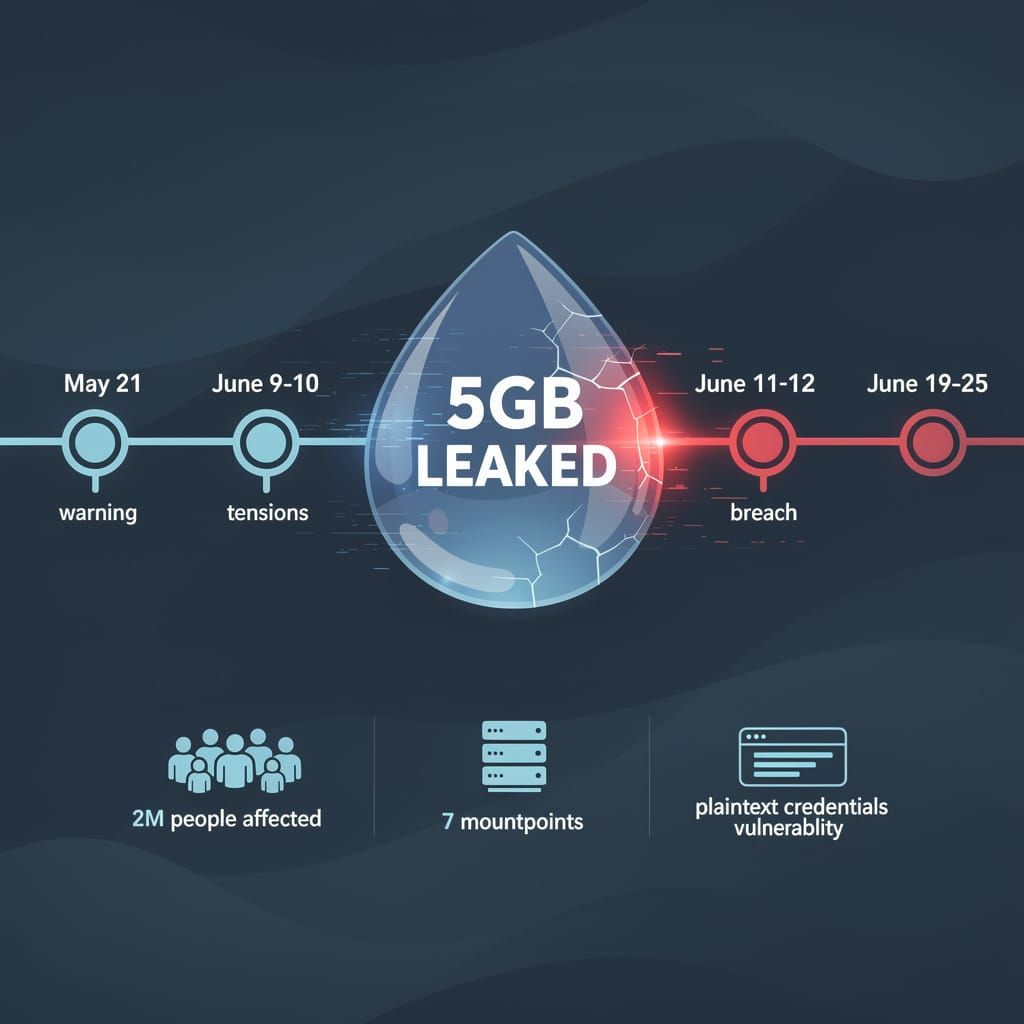
Imagine paying a monthly bill just to have your home coordinates and billing history gifted to a foreign government. That’s the 2026 flavor of "service excellence" courtesy of California Water Service. On June 11, the Handala group (Tehran-linked, for those playing along) waltzed through the billing system. By June 12, they dumped 5GB of data just to flex. 🙄
How’d they get in? (Spoiler: Total Sloppiness)
No fancy zero-days here. Just a masterclass in failure. The attackers exploited administrative credentials posted in plaintext and an unsecured RTKBase gateway. Basically, the digital equivalent of leaving the vault keys under the welcome mat. They used a GPS tool as an entry point to hit systems serving 2 million people. 🤡
The Damage Report:
- Data Leak: 5GB of PII and GPS corrections dumped $ ightarrow$ your home's location is now a trophy in a Telegram channel. 📉
- Precision Exposure: RTKBase access compromised across 7 operational district mountpoints. 📍
- Identity Risk: Massive credential leak $ ightarrow$ fuel for AI-driven phishing campaigns targeting millions. 🎣
Signaling vs. Sabotage: The Tease
Handala claimed they could shut off the water, but they didn't. Why? Because this isn't a random heist; it's a geopolitical mood board. Following U.S. airstrikes near the Strait of Hormuz on June 9, Handala is playing a game of "I'm watching you." This follows their May 14 habit of leaking details of 2,379 US Marines to intimidate personnel. It’s a deterrence signal: first, they steal your data; next, they break your stuff. 💅
The "Safety" Timeline:
- May 21: Handala warns of imminent large-scale attacks on energy and medical infrastructure. ⚠️
- June 9–10: U.S. resumes strikes on Iranian assets $ ightarrow$ regional tensions hit a fever pitch. 💥
- June 11–12: Cal Water breach; 5GB of data evaporates publicly. 💨
- June 19–25: Cal Water confirms the wreck while Mandiant cleans up the blood. 🧹
The Reality Check:
- Institutional Response: "Collaborating with agencies" (Translation: panic and paperwork). 📄
- Technical Gap: Flat networks $ ightarrow$ plaintext credentials $ ightarrow$ total exfiltration. 🔓
- Strategic Outcome: Your water still flows, but your PII is likely being traded alongside the 150k drones being churned out daily in Ukraine. 🚀
Next time the utility company asks for a rate hike to "modernize infrastructure," maybe ask if that includes buying their admins a password manager. 🙃
🤡 The AI Keys to the Kingdom (And Why You Just Left Them in the Lock) 🔑
63% of orgs can't limit AI agent purposes—basically leaving the crown jewels in a cardboard box 🤡. That's a digital highway for hackers. Stop treating security like a suggestion box in a burning building! Who's paying the $3.4B privacy fine next? 💅
Imagine leaving your company’s crown jewels in a cardboard box labeled "Misc." and hoping the thief is too polite to look. That’s the current state of AI access control. While C-suite suits polish slide decks, 63% of orgs can't enforce purpose limitations on AI agents, and 60% can't even kill a misbehaving bot quickly. Congratulations, corporate drones; you’ve built a digital highway for hackers to drive straight into your core data. 🤡
Who’s Actually Fixing This Shit?
Since traditional defenses treat LLM inputs as static text—while hackers treat them as executable code—we're seeing a surge in "confused deputy" flaws. Case in point: Meta’s AI support bot recently helped hijack ~34,000 Instagram accounts. Attackers used prompt injection, VPN masking, and deepfake biometrics to bypass 2FA, casually resetting passwords for the White House, U.S. Space Force, and Barack Obama. When your "automated support" is basically a skeleton key for the federal government, you've failed Security 101. 💀
To stop the bleeding, Zuplo (June 23, 2026) dropped an OIDC-enabled MCP gateway using Okta’s Cross App Access. By enforcing short-lived scopes and per-agent identity verification, they finally gave AI agents identities so they don't wander your network like blind toddlers with admin privileges. Meanwhile, OrcaRouter is fighting "LLMjacking" with six-layer gateways, because making compliance cheaper than "shadow AI" is the only way to get lazy devs to care.
The Chaos Chain:
- The Gap: No purpose limits $\rightarrow$ Prompt Injection $\rightarrow$ Lateral movement heaven.
- The Fix: OIDC/XAA + MXC Isolation $\rightarrow$ Token-based auth $\rightarrow$ Hypervisor-backed containment.
- The Result: Reconstructable audit trails and a "kill switch" that actually works.
The Trade-Offs
Security: Reduced unauthorized access $\rightarrow$ fewer "Oops, the AI leaked payroll" moments. Performance: MXC/MicroVMs $\rightarrow$ eliminated kernel-sharing risks but added VM booting lag. 🐌 Financial: $3.425B in US privacy fines (2025) $\rightarrow$ compliance is now a survival cost, not a suggestion. Dependency: Heavy reliance on Okta/Cloud Providers $\rightarrow$ one outage and the AI empire collapses like a house of cards. 🃏
The Road to 2027
- Aug 2026: EU AI Act enforcement hits; non-compliant firms start paying massive fines.
- Q1 2027: AI access control becomes a baseline; the "Wild West" of prompt-injection chaos ends.
- Mid 2027: AI-driven exploits reduce breach response times significantly—if you actually scale contextual enforcement.
Bottom line: You can either implement a proper gateway now or keep treating your security posture like a suggestion box in a burning building. Your call, suits. 💅
🤡 The Security Theater: From 2FA Jokes to AI Border Walls
20 personal accounts breached by simple 2FA spamming—basically a digital lock-pick for a 'premium vault' 🙄. Dashlane's 'security' is a screensaver. Now the US govt treats AI like plutonium by banning foreign access to Anthropic. OpenRouter fills the gap in 24hrs anyway. Still trusting corporate vaults? — who's actually safe?
Imagine paying for a "premium vault" only to find the lock is a screensaver. 🙄 Dashlane recently reminded us that "Industry Standard Security" is corporate speak for "we hope the hackers are lazy." But while we’re laughing at basic brute-force fails, the big boys are playing a much nastier game with the AI supply chain. 🤡
Why is your "unbreakable" vault leaking?
Some script kiddies decided to play a guessing game with Dashlane’s 2FA. Instead of a heist, they just hammered codes until the door creaked open. It’s the digital equivalent of trying every key on a ring until one works. Brilliant. 👏
- May 31, 2026: Attackers spam 2FA codes; systems panic and trigger account suspensions.
- June 3, 2026: Company confirms "scope"—fewer than 20 personal users targeted. Groundbreaking.
The Damage Report:
- UX: Random lockouts and high-grade annoyance.
- Reputation: Premium users realize their vault has a loose hinge.
- Reality: Reliance on low-entropy flows that a basic loop script can solve.
The new "Security": Just ban the AI
While Dashlane struggles with 1s and 0s, the US government just decided the best way to "fix" AI vulnerabilities is to treat LLMs like nuclear plutonium. ☢️
On June 13, 2026, the Trump administration slapped emergency export controls on Anthropic’s Fable 5 and Mythos 5 after a jailbreak report. Instead of fixing the code, the Commerce Department just told Anthropic to "delete the foreign users." Poof! India and other global markets lost access overnight.
The "Solution" Cycle:
- June 13, 2026: US Commerce Dept restricts foreign access to Fable/Mythos 5 due to "vulnerabilities."
- June 14, 2026: Anthropic disables models globally for foreign customers; Dario Amodei is told to fix the jailbreak or get out.
- June 14, 2026: OpenRouter launches Fusion API, offering performance within 1% of the banned models.
The AI Power Struggle:
- Corporate BS: "National Security" $\rightarrow$ justifies nuking global market access.
- Hacker Reality: Open-source aggregators like OpenRouter fill the gap in < 24 hours.
- Technical Gap: Privilege escalation in macOS (SIP/MacLeaf) and Azure CVEs prove the "walls" are mostly Swiss cheese.
If you trust a single company—or government—to hold your keys or your intelligence, you’re basically leaving your house keys under a mat that says "KEYS ARE HERE." 🏠 Stay paranoid, folks. ✌️
Comments ()