$540 Gap to $69.97: Unified AI Dashboard Collapses Vendor Pricing
TL;DR
- The $540 Gap: How a Single Dashboard Is Killing Five AI Subscriptions. Would you pay $540/year for separate AI tools or $70 for one dashboard?
- $5,299 GPUs, $10B Korea Deal, Texas Permit Freeze: AI's Physical Ceiling Arrives. Is AI hitting a physical ceiling—or just a geopolitical one?
- $9,000 Monthly AI Bills Per Employee: Inside Microsoft's Tokenmaxxing Ban and the Global Spending Crackdown. Are you tracking token spend per employee in your AI pipelines?
💸 The $540 Gap: Why One Dashboard Is Replacing Five AI Subscriptions
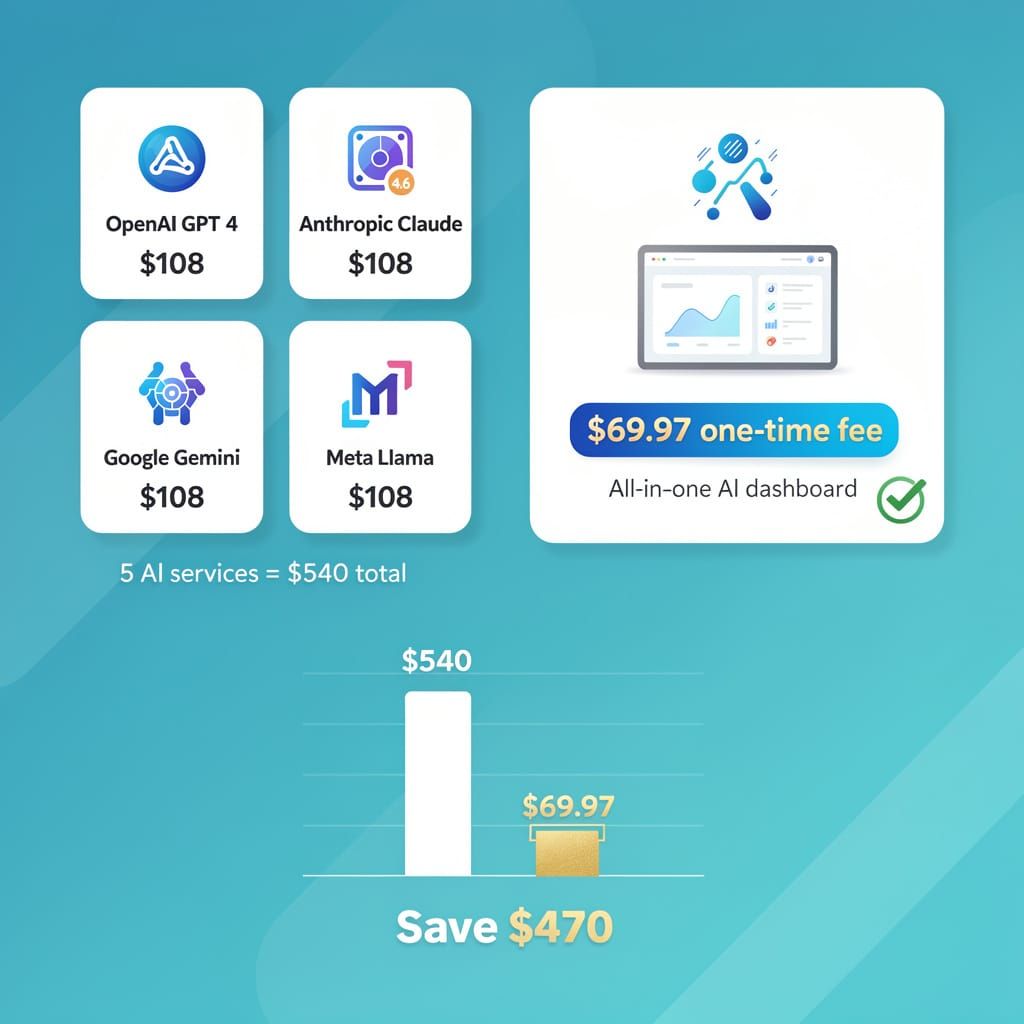
The average knowledge worker now spends $540/year on five separate AI subscriptions. One dashboard bundles GPT‑4, Claude 4.6 Sonnet, Gemini 3.1 Pro, Llama 3, and Mistral for a flat $69.97 one‑time fee — an 87% cut. Users burn 4 million monthly credits — ~1.1M words, 1,186 images, 37 videos — inside a single console. No logins, no per‑query fees. That $540 gap is collapsing vendor loyalty overnight. If a competitor can't offer cross‑model coherence by next quarter, who gets displaced first — the model or the middleman?
By mid-2026, the average knowledge worker juggling five distinct AI vendors faced recurring per‑query charges averaging more than $20. On July 21, OpenAI raised ChatGPT to $20/month; combined with Claude ($20), Gemini ($20), and other premium tiers, monthly AI spend exceeded $60. On July 25, 1min.AI's Advanced Business Plan restructured that equation by bundling GPT‑4, Anthropic Claude 4.6 Sonnet, Google Gemini 3.1 Pro, Meta Llama 3, and Mistral tools under a single $69.97 one‑time fee—versus a combined $540 annual MSRP. StackSocial Deal Days on June 24 logged over 100,000 purchases at a 4.7/5 rating, and the same bundle sold again during an August 4 limited‑time window ending August 9.
What the Bundle Eliminates
The consolidated console handles speech, vision, code, math, data transformation, and conversation without requiring separate logins or incremental API fees. Users measuring 4 million monthly credits—supporting ~1.1 million words, 1,186 images, and 37 videos—convert rapidly. The system processes writing, coding, image editing, and file parsing in a single workstation, dropping mental effort below conscious threshold. A July 20 promotion at $79.97 (MSRP reduced by $460) extended sales via StackSocial referrals, and StackSocial product managers report that unified access triggers rapid upgrade intent rather than trial hesitation.
Measurable Cash‑Flow Impact
- Per‑worker savings: ~$180/year minimum, translating to measurable daily cash‑flow improvement across retail units that discontinued incremental fees. CFO surveys from December 2025 forecasted >3% price inflation into 2026, making fixed‑fee bundling more attractive.
- Cognitive load: Reduced to near‑zero switching friction; users report completing tasks that previously required five interfaces inside one session.
- Adoption trajectory: Stable uptake through early August, with a discount‑expiration cliff on August 9 that did not reverse retention. GitHub's May 2026 shift to token‑based Copilot billing—driving higher subscription costs and forcing cost‑aware workflows—reinforces the appeal of flat‑fee aggregation.
The Structural Shift
The signal here is not discounting. AI model access is converging toward platform‑level aggregation, mirroring how cloud APIs consolidated compute. The $540 gap between unbundled vendor pricing and a flat $69.97 fee demonstrates that willingness to pay for individual model subscriptions collapses when a unified alternative exists. Meanwhile, Zhipu's July 1 pricing announcement—GLM‑5.2 at $1.40/$4.40 per million tokens, roughly six times cheaper than GPT‑5.5—intensifies downward price pressure and accelerates the bundling trend. Long‑term, life‑cycle value—not per‑model capability—drives adoption. Competitors failing to offer cross‑vendor coherence will lose incremental revenue to dashboards that make the vendor choice invisible to the user.
🚨 Silicon and Circuits: Three Signals from a Constrained Frontier
RTX 5090 hit $5,299—double MSRP from VRAM shortages. And now Anthropic just locked a $10B GPU deal with Korea, tightening supply further 🚨 Texas suspended all new data center permits after AI training clusters pushed grid utilization to 90%. Model scaling consumes kilowatts—not just FLOPS. Hyperscalers and startups alike face the same reality: GPU allocation thins, grid capacity freezes, and compute expansion stalls. Are we hitting the physical ceiling of AI—or just the geopolitical one? ⚡
Three events on August 5, 2026, reveal a single pattern: AI's trajectory now bends not around breakthroughs but bottlenecks.
NVIDIA Unlocks the Driver—Not the Engine
On August 5, NVIDIA released the AMDW-1.1 licensed AI driver model. The open driver enables cross-brand GPU compatibility—allowing AMD or Intel hardware to interface with NVIDIA's software stack. The move reduces vendor lock-in for inference workloads and simplifies deployment.
It does not replace CUDA cores or NVLink fabric. The GPU silicon itself remains proprietary. The result is marginal routing efficiency for robotaxi fleets—better software orchestration, same physical compute.
Anthropic's $10B Play Shifts the Supply Chain
The same day, Anthropic signed a $10 billion, six-year GPU agreement with Volta, a Korea-based supplier using Samsung Electronics' advanced Vera Rubin chips. The deal displaces traditional Western GPU vendors and deepens semiconductor concentration in a geopolitically sensitive region.
South Korea's share of high-bandwidth memory and advanced logic fabrication rises accordingly. Western hyperscalers face a tightening corridor: access to cutting-edge silicon increasingly passes through East Asian foundries. By June 2026, RTX 5090 prices had already reached $5,299—nearly double MSRP—driven by VRAM shortages from fleet-scale AI demand. The Anthropic-Volta deal tightens that allocation further.
Texas Pulls the Plug on Data Centers
Texas suspended all new data center permits after grid utilization hit 90%. Direct cause: cumulative cloud workload draw from AI training clusters. The halt triggers immediate project cancellations across Dallas, Houston, and Austin, with construction and operations roles eliminated.
The causal chain is direct: model scaling consumes kilowatts. Without grid relief, permit pipelines close. No new substations or transmission lines funded means no new compute brought online—regardless of chip supply or software maturity.
The Common Signal
| Layer | Constraint | Consequence |
|---|---|---|
| Software | NVIDIA's AMDW-1.1 | Marginal fleet efficiency, no relief on silicon dependency |
| Hardware | Anthropic-Volta deal | GPU supply consolidates around Korea, Western supply chains thin |
| Energy | Texas permit freeze | Data center construction halts, jobs lost, compute expansion blocked |
Each signal demonstrates physical limits overtaking algorithmic gains. Model architecture improves. Chip yields advance. But grid capacity, geopolitical concentration, and resource dependencies form a harder ceiling than any benchmark.
- 2026–2027: Texas permit freeze spreads to other grid-constrained states (California, Arizona). GPU pricing rises 15–20% as Korea tightens allocation—on top of the 100% premium already seen on RTX 5090 cards by mid-2026.
- 2028–2029: Federally funded grid modernization begins, adding ~8 GW capacity in high-demand corridors. Anthropic's Volta deal expires; renegotiation hinges on Korean fab expansion.
- 2030+: Energy-aware model routing and on-device inference gain adoption. Data center site selection prioritizes transmission access over latency.
Innovation now competes with infrastructure. The next frontier is not algorithmic—it is concrete, copper, and coolant.
💸 The Token Shock: How $9,000 Monthly AI Bills Per Employee Forced a Global Spending Crackdown
$9,000/month per employee in AI bills 💸 Microsoft's internal token crisis got so bad that Satya Nadella personally banned "tokenmaxxing" on August 4. Unchecked inference loops were racking up charges like runaway microservice logs—six-hour alert cycles generating fresh billing events. Uber cut a $12K/month pipeline that delivered almost nothing. The fix? 25.2 percentage points better ROI once cost controls kicked in. The Tokenomics Foundation now unites 30 firms to treat tokens as liabilities. Your engineering team is burning cash in 3 anti-patterns. Are you tracking token spend per deploy?
On August 4, 2026, Satya Nadella issued an internal order restricting frontier model deployment across product teams. Hours later, Microsoft's Jay Parikh defined a new prohibited practice: tokenmaxxing—the systematic exploitation of excessive token generation that inflates inferencing costs. The directives arrived not as speculation but as a fire response to actual damage.
What Broke, and How
The mechanism behind the crisis is precise. Unchecked auto-generated pipelines began triggering rerouting loops—each cycle consuming tokens and incurring charges. By July 2026, Microsoft had implemented centralized token budget tracking with fixed daily prompt caps per team, after observing monthly infrastructure invoices surpassing $9,000 per employee unit. The numbers scaled relentlessly:
- Six-hour alert loops across microservice logs, each restart generating fresh billing events.
- Uber's $12,000 monthly inference bill for a pipeline that delivered negligible functional benefit—prompting an AI budget cut on May 23, 2026 and reallocation of engineering resources to higher-ROI projects.
- Shadow AI incidents rising as teams deployed unapproved models without cost monitoring—Microsoft's July 2026 token governance rollout explicitly targeted this leakage.
The problem was not AI adoption. It was unmetered AI use inside architectures that treated token consumption as frictionless.
The Emergency Response
Nadella's August 4 order halted frontier model access for all non-critical workloads. Parikh's tokenmaxxing ban defined a hard behavioral boundary: developers must design token-minimized pipelines or forfeit deployment rights. Microsoft simultaneously defaulted engineering teams to GPT-5.6 and its internal MAI models—building on its second-gen Maia AI chip announced May 24, 2026, and its $5 billion Anthropic investment, which also supplied custom chips to the firm. The May 23, 2026 cancellation of Claude Code licenses further reduced reliance on costly third-party APIs.
Within days, hybrid contract trials demonstrated 25.2 percentage points improvement in ROI after implementing cost containment measures—proving the waste was structural, not necessary.
Serverless platforms enforced new 30-minute microspending thresholds to prevent overage fees from runaway inference jobs. FinOps teams inserted real-time burn dashboards into every product squad's workflow.
The Tokenomics Foundation
On August 10, 2026, the Linux Foundation formally established the Tokenomics Foundation—a vendor-neutral governance body uniting 30 firms including JPMorgan, Oracle, AWS, IBM, and Broadcom. Its charter targets 2.4× cumulative growth by 2030, a projection exceeding annual reporting cadences and demanding discipline now. The foundation delivers unified token-cost definitions, full-cost AI models, service-level cost-per-call metrics, and API-ready telemetry (FINOPSC v1.5).
The foundation also set a public timetable: baseline token-cost benchmarks will be published by mid-2027, with near-monthly framework releases culminating in a June 2027 summit.
Key implications:
- CISO budget strain: Rising token costs force trade-offs between security tooling and inference capacity.
- Vendor pricing opacity: Sumo Logic, Google, and Anthropic shifted pricing structures in early August, creating variable subscription tiers that complicate forecasting. Anthropic's Claude 3.0 launch on May 30, 2026 brought enhanced capabilities but also higher token consumption, while Opus 4.8's May 30 release demonstrated improved efficiency—a split that underscores market uncertainty.
- Low GPU utilization (~5%): The foundation's immediate finding—that most deployed GPUs deliver minimal ROI—drives urgency for standardized measurement.
The Outlook
By Q4 2027, dedicated FinOps teams will mandate weekly token burn dashboards across all product squads, eliminating unapproved inference bursts. The Tokenomics Foundation will deliver its baseline cost benchmarks by mid-2027. The LeadDev AI Impact Report 2026 already confirms that only 19% of organizations rate tokenmaxxing as effective—signaling a broader shift toward outcome-based metrics. Meta's own internal "Claudeonomics" leaderboard, launched and shut down on May 24, 2026 after public data disclosure, illustrates the volatility of token-based performance evaluation.
The lesson is not that AI is expensive. It is that architectural discipline determines cost structure. Microsoft's internal audit traced 68% of excessive token spend to three anti-patterns: recursive pipeline loops, unmetered agent chains, and unbounded context windows. Each is fixable. Each requires enforceable governance.
The $9,000-per-head bill was the signal. The Tokenomics Foundation is the response. What follows is a market that treats tokens not as free resources but as accounted liabilities—with all the cost engineering rigor that implies.

Comments ()