30,000 Parts Retrieved, Zero Dexterity Replaced: BMW Humanoids Still Need Tactile Sensors and Voice Commands
TL;DR
- 30,000 X3 Units, Zero Speed Gains: Humanoid Robots Stumble on BMW's Factory Floor. Are humanoid robots on factory floors actually creating more jobs than they replace?
- €8.62B Unicorn Gravis Robotics: 30% Productivity Gain on Test Sites Masks Talent and Regulatory Gaps. Can $200M bridge the talent gap that keeps autonomous excavators off real construction sites?
- 4.4-Lb Ban: New FCC Rule Blocks Most Foreign Robot Vacuums — U.S. Market Gets 2025 Hardware. Is the FCC's 4.4-lb robot ban about security or just shielding domestic brands?
🦾 Humanoids Arrive. The Hype Doesn't Match the Floor.
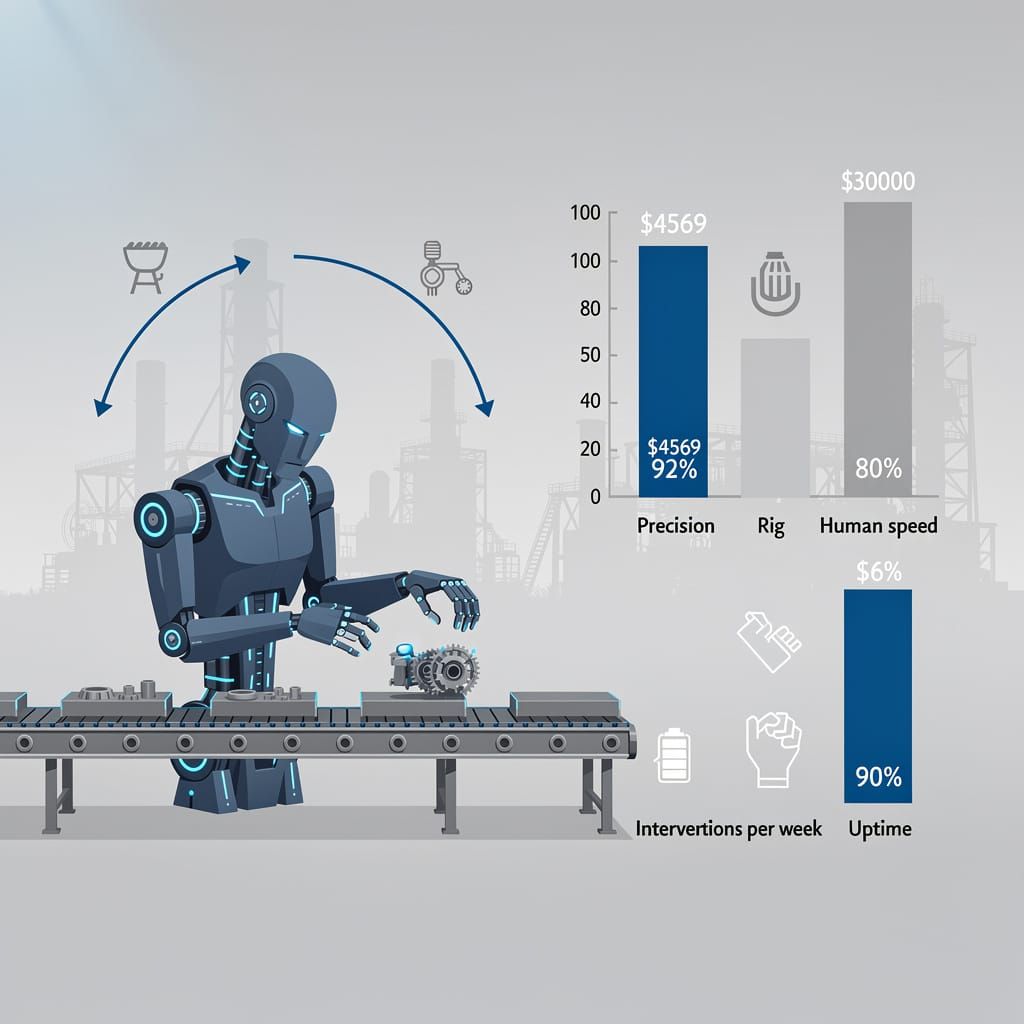
BMW's humanoids retrieved 30,000+ X3 parts — but still need tactile sensors and voice commands for tasks any assembler does barehanded. 🦾 A $4,569 researcher rig outperformed humanoids on precision-per-dollar. Four interventions per 40-hour week vs. the "no incidents" spin. Operators aren't replaced — they're upskilled into babysitters. That's not a revolution.
Two BMW plants—Birmingham and Spartanburg, South Carolina—plus a third undisclosed U.S. facility have put humanoid robots on the line since August 15, 2026. The headline writes itself: human-shaped machines autonomously retrieving components, executing pick-place cycles. The reality on the factory floor writes a quieter footnote.
On August 17, a developer reported a humanoid performing a pick-place cycle at the Birmingham plant. On August 15, another unit moved autonomously to retrieve an auto-mechanical component in Spartanburg. BMW's June 29 deployment of Figure 03 at Spartanburg followed a year of Figure 02 trials that produced 30,000+ X3 units via precise metal insertion—yet the new system still requires tactile sensing and voice interaction to manage tasks human workers handle without special hardware. These are not test-bench demos. They are production-adjacent operations. And the throughput claims demand scrutiny.
Why the Gap Persists
Three dynamics explain the gap. First, automakers are pushing humanoids into service because skilled manual labor is genuinely tight. Welders, assemblers, and material handlers remain hard to hire in Texas and South Carolina. The robots fill a slot but do not replicate the throughput—reports of throughput improvements have surfaced, but no plant has released time-per-cycle comparisons against human baselines.
Second, China's aggressive hardware subsidies continue to drive actuator and motor costs down. AGIBOT's June 2026 milestone—15,000 G2 units delivered with a 100-hour factory display—demonstrates scale, but the same plants experienced linguistic sensor glitches on June 17, where discordant semantic mapping triggered misconfigured robot activation during deployment, requiring 15 minutes of additional manual reset per shift. Cheap hardware does not equal reliable perception, dexterous grasping, or adaptive motion planning. A June 17 researcher-built $4,569.80 manipulation rig using UFACTORY XArm Lite 6 achieved 92% success across four trials at 0.8 m/s—a budget setup outperforming humanoids on precision-to-cost metrics. Rodney Brooks, citing 65 years of manipulation research, argues humanoids fundamentally lack force feedback, limited finger control, and medium precision—deficiencies no video-training pipeline can fix.
Third, no unified safety certification exists for humanoids co-located with humans. The Association for Advancing Automation has issued guidelines, not standards. Without ANSI or ISO 10218 updates specific to legged, two-armed platforms, liability remains a risk that operators tolerate rather than solve.
The Numbers That Matter
The financial argument for humanoids rests on long-term substitution math. A sub-$30,000 Chinese unit running two shifts replaces roughly $60,000/year in wages. At 80% human speed, that math still works if uptime exceeds 90%. But today's deployments do not achieve that uptime. BMW's Figure 03 deployment at Spartanburg advanced autonomy through tactile sensing and self-charging, but operators remain supervisory rather than replaced. Reports from Spartanburg indicate four interventions per 40-hour week—sensor recalibration, grip retraining, path replanning—directly contradicting the "no significant incident" narrative. By June 2026, Figure 03 processed logistics sorting in Hall 52, but operators remain supervisory rather than replaced.
In July 2026, investor sentiment shifted toward non-humanoid designs amid rising doubts about ergonomic inefficiency and safety, with firms like Genius AI, Sundry Robotics, and Apptronik promoting wheel-based alternatives. Even after $6B+ in humanoid funding, analysts predict morphology-agnostic solutions will dominate. Even Neura Robotics' June 19 cognitive portfolio launch—humanoids, cobots, autonomous transports—emphasized real-world AI training over simulation, but the same week saw Ultra Robotics and Fauna Robotics report persistent sensor misinterpretation glitches inflating failure rates to 4.1%.
What This Actually Means
- 2026–2027: ~3% of automotive plants trial humanoids in low-risk zones. AGIBOT's A3 enters Europe via RAAS model. No safety standard published.
- 2028–2029: Actuator improvements and vision-model iteration could push speed toward 70% of human baseline. ISO certification frameworks possible.
- 2030–2031: If perception reliability crosses 99.9% in occluded environments, humanoids begin real labor displacement. Until then, they remain cost-acceptable experiments.
The workforce impact tilts toward upskilling rather than replacement in 2026. Workers who previously hand-picked components now supervise robot cycles, adjust gripping parameters, and clear error states. The operator role expands before the robot role evolves.
Humanoids are on the factory floor. They are not taking jobs. They are creating new ones while failing to match the speed—or the dexterity—of the roles they were supposed to replace.
🚧 SoftBank’s Gravis Robotics Bet: A Unicorn Built on Construction’s Talent Hole
€8.62 billion for a 30% productivity claim on test sites. That's a painful gap. SoftBank just minted Gravis Robotics Europe's newest unicorn with a $200M Series A. The pitch: retrofit excavators that dig 30% better than humans. On controlled test sites. Construction's talent hole is real, but Gravis needs the same engineers contractors can't hire. Autonomous excavators that work on one geology will degrade on another. Regulators haven't even caught up. So $200M solves the money problem—does it solve the physics, the talent, and the regulatory split across four continents? Or is this a well-funded prototype for tidy sites?
SoftBank’s acquisition of Gravis Robotics on July 24, 2026, followed by a $200 million Series A on August 17, pushed the Swiss startup’s valuation past €8.62 billion—Europe’s newest robotics unicorn. The pitch: retrofit excavators with AI hardware that boosts output up to 30% compared with peak manual operations. Gravis solves a real scarcity—field operatives in global construction are chronically short.
Yet the numbers demand harder scrutiny.
What $200 Million Actually Buys
Gravis sells the Gravis Rack retrofit kit—perception and control modules that turn standard excavators into semi-autonomous diggers. The firm claims platform independence across Caterpillar, Case, and Volvo machines. That interoperability is the linchpin: if Gravis scales across OEMs, adoption jumps from bespoke retrofits to a de facto standard.
- July 24, 2026: SoftBank converts earlier capital into full acquisition. Gravis targets up to 30% productivity gain versus human-only operation.
- August 17, 2026: Series A closes at $200 million. Total valuation crosses €8.62 billion.
The valuation implies investors expect Gravis to capture a dominant slice of the ~$1.2 trillion global construction equipment market. That requires manufacturing scale, service networks across continents, and—most critically—convincing risk-averse contractors to trust an autonomy stack on active jobsites.
The Capability Gap That Weakens the Case
Gravis’s sim-to-real AI bridges simulated training with real-world conditions, but the system's proven performance remains limited. Bedrock Robotics deployed autonomous excavators across three commercial sites in Texas and Nevada by August 2026—yet experts describe these as early-stage tests with limited applicability beyond excavators. Gravis faces the same constraints: unstructured rubble, underground utilities, and dynamic human-robot coordination on tight urban sites remain outside the training envelope.
A 30% boost on controlled test sites does not deliver 30% across the industry mix. Contractors who trial the system on one geology and redeploy to another will see returns degrade sharply.
Competitive Pressure and the Talent Paradox
Gravis is not alone. TerraFirma raised $115 million in Series A on July 16, 2026, deploying semi-autonomous excavators and digital twins across Texas developments. Bedrock Robotics, Hyperion, Monumental, and Nomagic each target adjacent niches. SoftBank’s portfolio strategy—fund multiple autonomy plays and let network effects compound—assumes Gravis staffs up faster than its customers can.
That assumption conflicts with a structural constraint: Gravis depends on the same robotics engineers construction firms cannot hire. The startup must scale its workforce while contractors remain unable to fill their own field-operations roles. No funding round eliminates that talent bottleneck. The broader industry meanwhile throws money at adjacent problems—Agility Robotics raised $4.3 billion on June 2, 2026 for its Digit humanoid, and Figure AI closed $675 million on May 31—all competing for the same narrow engineering pool that Gravis needs to scale its retrofit deployments.
Regulatory Gray Zone
Autonomous construction equipment falls between industrial robot standards and on-road vehicle regulations. Certification pathways remain fragmented across the US, EU, and UK. Venetz Aerospace’s July 13, 2026 Part 21J approval for electric propulsion in the UK demonstrates that aviation regulators are moving faster than construction-equivalence bodies. Until heavy-equipment regulators issue comparable frameworks, Gravis’s fleet-wide deployment across four continents carries uneven compliance risk per jurisdiction. NVIDIA GEAR Lab’s June 18, 2026 ENPIRE demonstration—eight robots achieving 99% task success in parallel industrial settings—proves physical AI can scale inside controlled factory floors. Construction jobsites share none of that predictable geometry.
The Bottom Line
SoftBank’s €8.62 billion stamp of approval signals that capital sees construction autonomy as a high-leverage wedge into physical-world AI. Whether Gravis delivers the promised 30% uplift across real-world heterogeneity—or remains a well-funded prototype for controlled sites—will determine if this unicorn survives its own valuation. The talent paradox and regulatory fragmentation are not solved by $200 million alone.
⚖️ The 4.4-Pound Line: How a Weight Threshold Became a Robotics Trade War
The FCC just banned robot vacuums over 4.4 lbs if they're made outside the U.S. — that's about the weight of a small cat. A Dreame L60 Ultra that lists at $1,169.99 is blocked at the port. So a $349 Bluetooth-only bot with the same camera and mic is perfectly fine? The rule targets where it's assembled, not what's inside. Meanwhile, Chinese makers ship 36,000 Pa stair-climbing robots everywhere except here. U.S. households get 2025 hardware for 2026 prices. Does this feel like security — or just a tariff with extra paperwork?
What exactly did the FCC ban?
Between July 28 and July 31, 2026, the Federal Communications Commission added foreign-made robotic devices exceeding 4.4 pounds (2 kilograms) to its Covered List. The sequence was precise: on July 28, the DCM expanded the list to include advanced robotic devices and power inverters. On July 29, Chairman Brendan Carr banned human-shaped and quadrupedal dog-like robots manufactured outside the U.S. On July 30, the FCC explicitly included AI-enabled robot vacuums weighing >4.4 lb equipped with ≥200 kbps wireless links and embedded ML models—sweeping up nearly every mainstream model from Ecovacs, Roborock, Dreame Technology, and Narwal.
Already-certified units in U.S. inventory remain legal to sell; new imports do not.
What is the stated justification, and why does it strain credibility?
The FCC cites national security: data privacy risks, cyber vulnerabilities, and alleged spyware links. The July 29 ruling specifically invoked "perceived threats from malicious state-backed actors seeking espionage via device control" and referenced firmware-enabled inverters vulnerable to remote disablement.
The causal chain is weak. If the concern is data exfiltration via onboard cameras and microphones, a 4.4-pound weight threshold is a remarkably blunt instrument. A lighter device with identical sensors, connectivity, and cloud architecture would slip through untouched. The ban also ignores that American manufacturers—iRobot, Shark, Matic—rely on many of the same Taiwanese and Chinese supply chains for motors, batteries, LiDAR modules, and SoCs. The rule targets final assembly location, not component provenance.
The real mechanics of disruption
- Supply chain freeze: Non-U.S. manufacturers cannot ship new models into the country. Roborock's Saros 20 and Qrevo series, Ecovacs' Deebot X11, and Narwal's Flow 2 are blocked at ports. Roborock nonetheless launched the Saros 20 globally on July 30 with 36,000 Pa suction and leg-based stair-climbing—an upgrade U.S. consumers cannot access.
- Price inversion: Memorial Day promotions in May 2026 had driven Dreame L50 Ultra to $849.99 and Narwal Flow 2 discounts up to $200 off. By August 17, Dreame's L60 Ultra listed at $1,169.99 on Amazon—a 10% discount from original MSRP, but the market has inverted: fewer competing imports means less downward pressure on pricing.
- Innovation pause: Approximately 85% of robot vacuum R&D and new-model launches originate from Chinese firms. The U.S. market will see a multi-year gap in hardware iteration. Meanwhile, Dreame continues launching models globally—L20 Ultra with 3D structured-light avoidance, L40s Ultra CE at $399.49—none bound for U.S. shelves.
Who wins, who loses?
Consumer impact: Households lose access to the most advanced cleaning robotics available globally. Features such as 36,000 Pa suction, dual-drain auto-empty docks, and stair-ascending articulated legs are effectively frozen at 2025-generation hardware. Roborock's September 2026 roadmap for three new robot families targeting garage-to-bathroom transitions will bypass the U.S. entirely.
Domestic manufacturers: iRobot and Shark have an opportunity to reclaim market share—but only if they can scale production of equivalent-capability devices at similar price points. iRobot's current premium models remain $200–400 above comparable banned imports. The May 2026 launch of iRobot's slimmer Roomba lineup signals preparation, but scaling remains unproven.
FCC credibility: The agency has entered trade policy and consumer product regulation. The July 30 addition uses a 200 kbps connectivity threshold—an arbitrary cutoff that excludes Bluetooth-only units but captures any Wi-Fi-enabled device. The ban resembles a political gesture more than a calibrated security measure.
What to watch
- Q4 2026: Legal challenges from importers and consumer advocacy groups arguing the FCC overstepped its statutory mandate under the Communications Act.
- Mid-2027: If domestic OEMs fail to close the capability gap, gray-market imports and firmware workarounds will rise. The Covered List mechanism triggers mandatory safety updates, which may force patch deployment and create secondary cybersecurity risks.
- 2027–2028: Component-level restrictions may follow, targeting vision sensors and wireless modules regardless of final assembly location.
The FCC has drawn a line at 4.4 pounds. Roborock, Dreame, and Ecovacs continue shipping next-generation hardware everywhere else. Whether that line protects national security or merely locks U.S. households into 2025-era devices remains an open question—one the agency has not convincingly answered.


Comments ()