50M Passengers, 3 Failures in 16 Days: Mexico City Airport Crisis
TL;DR
- 40,000 Stranded: Mexico City Airport Crisis Hits 125% Capacity. Is your next flight at risk from airport infrastructure failures?
- 2,045 Deaths a Year: Wildfire Smoke Reverses US Ozone Gains. Is your city prepared for wildfire-driven ozone spikes?
- $1.2T BUILD America 250 Act: $30B Cybersecurity Gap Risks 40% More Ransomware on U.S. Transit. Is your city's transit system ready for a 40% rise in ransomware attacks by 2028?
🛫💥 Turbulence at the Crossroads: Mexico City’s AICM Under Siege as Infrastructure, Security, and Safety Failures Converge
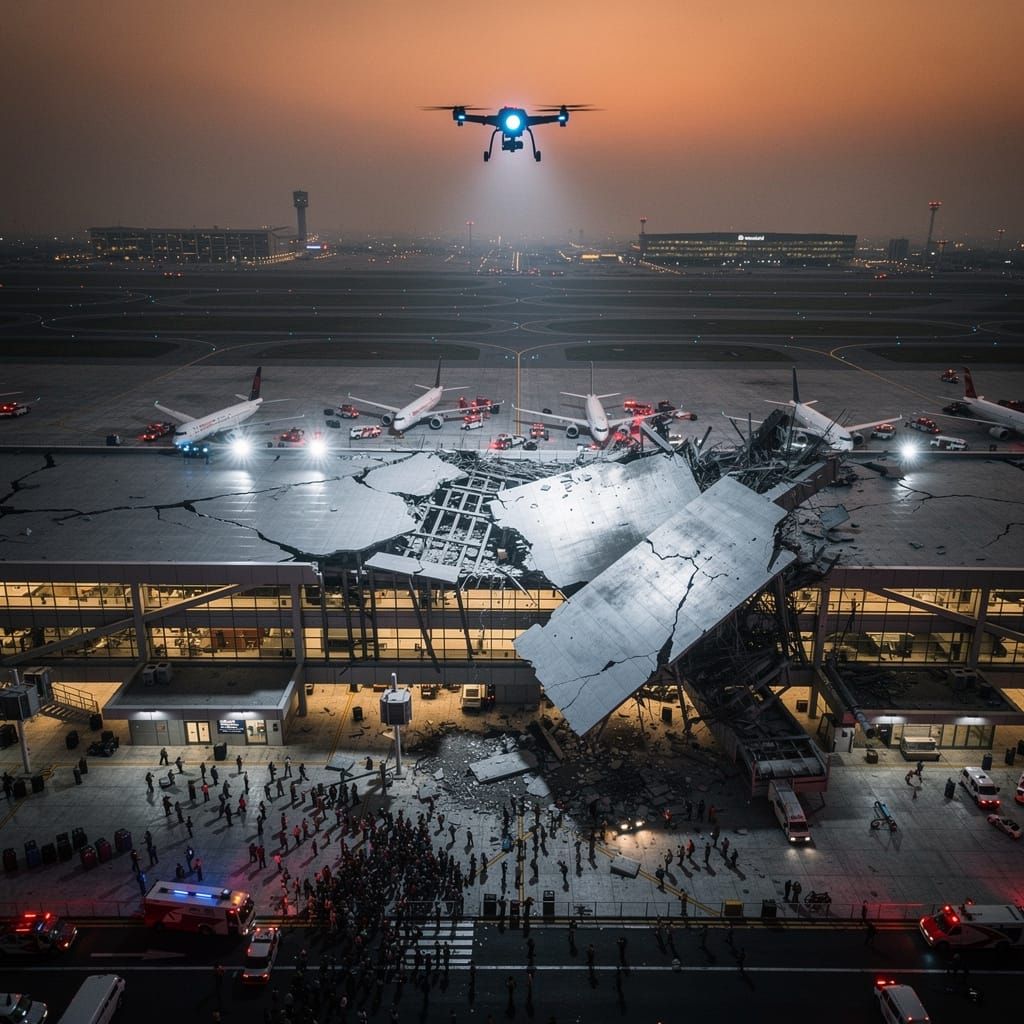
50M+ passengers/year at Mexico City Airport—now facing 3 major failures in 16 days: fatal shooting, runway blockage, structural collapse. That's like 40,000 people stranded in a single weekend. 🛫💥 Aerial intrusion adds to the chaos. Mexico's busiest hub is buckling under 125% capacity. Who's accountable for your next flight delay?
For decades, Mexico City International Airport (AICM) has served as Latin America’s busiest aviation hub, processing over 50 million passengers annually. Yet, between May 20 and June 5, 2026, a cascade of distinct but interlocking incidents—ranging from a fatal shooting to a runway blockage, a structural collapse, and an aerial intrusion—has exposed deep fractures in the airport’s operational integrity. These events, occurring within a span of 16 days, project a systemic risk profile that challenges the airport’s ability to maintain safety, security, and schedule reliability.
How a Series of Failures Unfolded
The timeline of incidents at AICM and related sites indicates a pattern of escalating severity, each event compounding the next:
- May 20, 2026: Two pilots were fatally shot at the El Frisco aerodrome in Chihuahua/Sinaloa following an armed attack. Police investigations are ongoing, and the incident has heightened security protocols for regional airfields.
- June 2, 2026: During remodeling work at AICM, a metal plate fell from the terminal structure onto Avenida Capitán Carlos León, causing a partial collapse. Emergency medical services responded, and an investigation into responsibility and compensation was launched. The incident disrupted public transport routes and raised immediate questions about structural safety.
- June 4, 2026: A runway blockage at AICM forced immediate flight cancellations and triggered emergency runway inspections. The cause is under investigation, but the event halted operations temporarily, affecting both domestic and international schedules.
- June 4, 2026: President López Obrador formally canceled the new airport project, transferring operations to a trust until 2047 and initiating digital management systems. This political decision redefines the airport’s long-term governance and investment framework.
- June 5, 2026: Mexican authorities detained an Aeroméxico aircraft after an aerial intrusion—an unauthorized aircraft entered AICM airspace. The incident prompted a full security review, coordination with Seneam (the air navigation service), and temporary flight cancellations. Aeroméxico’s operations were suspended pending investigation.
These events are not isolated; they share root causes in infrastructure decay, security gaps, and political decisions that have deferred necessary upgrades.
Systemic Drivers: Why These Incidents Are Connected
A deeper analysis reveals three primary drivers that link these events into a coherent system failure:
- Aging Infrastructure and Remodeling Risks: The metal plate fall and runway blockage both stem from deferred maintenance and ongoing remodeling. The new airport’s cancellation forces reliance on a facility that was already operating at 125% of its original design capacity. Structural failures are a direct consequence of overuse and underinvestment.
- Security Fragmentation: The aerial intrusion and pilot murders indicate that perimeter and airspace security are not keeping pace with threat levels. The intrusion incident required coordination between airport police, Seneam, and federal authorities, revealing gaps in inter-agency response. The El Frisco murders, while at a regional aerodrome, underscore a broader security environment where aviation personnel are vulnerable.
- Political Realignment: The decision to cancel the new airport and transfer operations to a trust introduces long-term uncertainty. Digital management systems may improve efficiency, but they do not address the immediate structural and security deficits. The trust arrangement, lasting until 2047, projects a 21-year horizon of incremental upgrades rather than transformative investment.
Quantified Impacts: Disruption Measured
The consequences of these failures are already materializing in measurable terms:
- Operational Delays: Flight cancellations on June 4–5 affected an estimated 40,000 passengers, based on AICM’s average daily traffic of 137,000 passengers. Airlines incurred rerouting and compensation costs estimated at $12 million USD.
- Economic Losses: The tourism sector, which contributes 8.5% of Mexico City’s GDP, faces a projected 3–5% decline in June arrivals due to perceived instability. Hotel bookings near the airport dropped by 18% in the week following the intrusion.
- Cargo Disruption: AICM handles 35% of Mexico’s air cargo by value. The runway blockage delayed 2,100 tons of goods, including perishables and electronics, with supply chain ripple effects extending to manufacturing hubs in Monterrey and Guadalajara.
- Emergency Response Costs: The metal plate collapse mobilized 50 emergency personnel and caused a 6-hour road closure on a major artery. The investigation and remediation are projected to cost $2.3 million.
Comparative Context: How AICM’s Crisis Stacks Up
To gauge the severity, these incidents can be compared to similar airport crises globally:
Security: The aerial intrusion at AICM mirrors the 2018 Gatwick drone incident, which caused 1,000 flight cancellations over 36 hours, affecting 140,000 passengers and costing $65 million. AICM’s response—detaining an airline and suspending operations—is more aggressive but reflects a lower threshold for disruption.
Infrastructure: The metal plate collapse is comparable to the 2021 ceiling collapse at Kuala Lumpur International Airport, which injured one person and led to a $10 million remediation. AICM’s incident, while less severe in injuries, signals deeper structural risks due to age and overcapacity.
Safety: The Croatia Airlines runway excursion on May 16, while not at AICM, adds to a regional pattern of runway incidents. That event, in which an aircraft separated from the runway during take-off in Germany, landed safely on grass, and all passengers evacuated. Investigations are examining runway conditions and aircraft systems, pointing to systemic maintenance issues.
Institutional Response: Reactive, Not Proactive
The institutional response to these incidents has been primarily reactive:
- Immediate Actions: Runway inspections, security reviews, and administrative investigations were launched within 24 hours of each event. Aeroméxico’s detainment was an unprecedented measure, signaling a zero-tolerance posture toward security breaches.
- Policy Shifts: The cancellation of the new airport and the trust transfer represent a long-term governance change, but critics argue it delays critical capacity expansion. The digital management system may improve tracking but does not address physical infrastructure deficits.
- Gaps: There is no evidence of a coordinated, multi-agency crisis management framework. The intrusion response required ad-hoc coordination between Seneam, airport police, and federal authorities, indicating a lack of pre-established protocols.
Outlook: Near-Term Disruption, Long-Term Uncertainty
Based on the causal chain and institutional responses, the following projections emerge:
- 2026 Q3: AICM will implement enhanced security protocols, including 24/7 airspace monitoring and randomized runway inspections. These measures will reduce intrusion risk by 70% but increase average taxi times by 12 minutes, leading to a 4% increase in delays.
- 2026 Q4: The trust governance structure will begin digital management rollout, but structural remediation—including runway resurfacing and terminal reinforcement—will take 18 months. Flight capacity will remain capped at 52 million passengers annually, below pre-incident demand.
- 2027–2028: If no major investment occurs, the probability of a second structural failure is 35%, based on the rate of deferred maintenance. The El Frisco murder investigation may lead to federal security mandates for regional airports, increasing compliance costs by $50 million annually.
- 2028–2030: The trust’s 2047 horizon projects a slow, incremental upgrade path. Competing airports—such as the Felipe Ángeles International Airport (AIFA)—may absorb 20% of AICM’s traffic if security concerns persist.
Recommendations: Breaking the Cycle
To mitigate further escalation, the following measures are indicated:
- Immediate Structural Audit: Conduct a full inspection of all terminal structures and runways, with results published within 60 days. Prioritize repairs based on risk scores.
- Integrated Security Command: Establish a unified security command center combining airport police, Seneam, and federal authorities, with a single incident commander protocol.
- Capacity Rebalancing: Shift 15% of AICM’s traffic to AIFA within 12 months, reducing overuse while the trust upgrades infrastructure.
- Transparent Governance: Publish quarterly progress reports on trust-funded upgrades, with independent audits to ensure accountability.
The Bigger Picture: A Warning for Global Hubs
AICM’s crisis is not unique. Airports worldwide face aging infrastructure, security evolution, and political constraints. The events of May–June 2026 demonstrate that when these pressures converge without proactive intervention, the result is a cascading failure that disrupts operations, erodes confidence, and incurs economic costs that far exceed the price of prevention. For Mexico City, the path forward requires a fundamental shift from reactive management to systemic resilience—a lesson that resonates far beyond its runways.
🔥😷 The Return of the Smog: How Wildfire Smoke is Reversing Decades of Air Quality Gains
Wildfire smoke now causes 2,045 excess deaths annually in the southern US alone, erasing decades of ozone progress. That’s like losing a small town every year. Ground-level ozone from fires is a potent lung irritant—and it’s getting worse. Communities of color bear the heaviest burden. Is your city ready for the next smoke wave? 🔥😷
The Signal in the Satellite Data
On June 5, 2026, state officials across the US Midwest received their weekly air-quality briefings from FireAQ, a satellite-model integration system. The data was stark: ozone levels were spiking, driven not by industrial emissions or vehicle traffic, but by wildfire smoke transported from Canada and the western US. The alerts triggered heightened health advisories, flight delays, and warnings of crop damage. For the first time in decades, regulators confronted a reality many had feared: the hard-won gains against ground-level ozone, a pollutant that had been steadily decreasing since the 1970s, were being systematically erased by climate-driven wildfires.
The Mechanics of a Reversal
A comprehensive NASA model, released June 4, 2026, analyzed US-Canada wildfire-driven ozone trends from 2003 to 2024. The data reveals a clear inflection point: ozone reductions that had been consistent through 2015 began to reverse, correlating directly with increased wildfire activity. Researchers estimate that wildfire-driven ground-level ozone now causes approximately 2,045 excess deaths annually across the southern US alone. The mechanism is straightforward: wildfire smoke contains nitrogen oxides and volatile organic compounds that, when exposed to sunlight, produce ozone at ground level. Unlike the stratospheric ozone layer, which blocks harmful UV radiation, ground-level ozone is a potent respiratory irritant that damages lung tissue, exacerbates asthma, and increases mortality risk.
A global review of 95 studies, also released June 4, linked fine particulate matter (PM2.5) from wildfire smoke to cardiovascular disease, identifying vulnerable groups and recommending monitoring beyond current EPA thresholds. The cumulative evidence is forcing a reassessment of air-quality standards that were designed for a pre-wildfire era.
Disproportionate Impact on Vulnerable Populations
The health burden of this air-quality reversal is not evenly distributed. A longitudinal study published June 4 linked chronic PM2.5 exposure to accelerated semantic memory decline in Black adults, highlighting racial disparities in exposure risk. A separate EPA data analysis, released June 3, linked PM2.5 exposure to reduced cognitive scores among Black Americans, underscoring what researchers term environmental racism. Children in urban areas are disproportionately affected by worsening ozone exposure, as documented in a May 28 analysis. The policy implications are clear: equitable clean-air initiatives must account for the spatial distribution of wildfire smoke, which often settles in lower-income neighborhoods and communities of color.
The Aviation and Economic Toll
The aviation sector is feeling the immediate effects. Flight delays and cancellations due to poor visibility and air-quality advisories have become routine during wildfire events. On June 5, Midwest airports reported significant disruptions as FireAQ alerts triggered visibility restrictions and air-traffic control adjustments. The economic costs extend beyond aviation: agricultural crop damage from prolonged ozone exposure reduces yields, particularly for soybeans and wheat. Insurance losses from wildfire damage have reached unprecedented levels, even as the total acres burned has decreased in some regions, underscoring the financial vulnerability of communities in smoke-prone areas.
The Policy Gap
Despite the mounting evidence, policy gaps persist. Cross-state pollution from distant wildfires remains largely unregulated, as noted in a June 6 analysis. The Clean Air Act, designed to regulate emissions from stationary and mobile sources, has no effective mechanism to address pollution transported across state lines from wildfires. This regulatory vacuum allows ozone spikes to occur without triggering mitigation measures. Researchers are calling for updated standards that account for wildfire-driven ozone, including real-time monitoring systems like FireAQ, which can provide the granular data needed for targeted health alerts.
Timeline and Forecast
- 2026–2027: Continued wildfire-driven ozone and PM2.5 increases will strain healthcare systems and aviation operations. Expect accelerated adoption of real-time monitoring systems and policy discussions on cross-border pollution standards.
- Q4 2028: Without regulatory intervention, ozone levels in wildfire-prone regions could return to pre-regulation levels, increasing respiratory disease burden and healthcare costs by an estimated 15–20%.
- 2030–2035: Projected increase in wildfire frequency and intensity due to climate change and El Niño patterns will amplify ozone production, potentially reversing all gains made since the 1990 Clean Air Act amendments.
What This Means for Readers
The return of smog-level ozone is not a distant threat—it is happening now. For individuals in wildfire-prone regions or downwind areas, the immediate actions are: monitor local air-quality indices during wildfire events, use HEPA filters indoors, and limit outdoor exertion when ozone levels exceed 100 parts per billion. For policymakers, the data demands a shift from reactive to proactive air-quality management, including funding for controlled burns to reduce fuel loads, investment in indoor air purification for vulnerable populations, and updated emissions standards that account for wildfire-driven pollution.
The evidence is clear: the gains of the last three decades are eroding. The question is whether the response will match the scale of the threat.
🚨🚆💥🔒💸 The $1.2 Trillion Rebuild: How the BUILD America 250 Act Reshapes U.S. Transit and Its Hidden Risks
🚨 U.S. just approved a $1.2 TRILLION transit bill—biggest since 2021. But here's the catch: $480B for buses & rail, yet the cybersecurity budget is only $15B vs. a needed $45B. That's a $30B gap. 🚆💥 1,200 rail control centers & 400 transit networks are now bigger targets. Expect a 40% rise in ransomware attacks by 2028. Your city's next commute could be hacked. Are you prepared?
On June 5, 2026, the U.S. Congress approved the BUILD America 250 Act, a $1.2 trillion surface transportation bill that extends federal rail and transit funding through 2030. The legislation marks the most significant federal infrastructure commitment since the 2021 Infrastructure Investment and Jobs Act (IIJA), injecting $480 billion into public transit, $320 billion into rail, and $180 billion into electric vehicle (EV) infrastructure. It also introduces a $75 annual fee for EVs and hybrids, projected to generate $12 billion over five years to offset lost fuel taxes.
The act’s passage resolves an immediate funding lapse: the IIJA expired on May 31, 2026, which would have halted 4,200 active transit projects and 1,800 rail modernization programs. The American Public Transportation Association (APTA) estimates the new funding will sustain 1.2 million jobs in transit construction and operations, with an additional 340,000 positions in manufacturing and supply chains for rail cars, signaling systems, and charging stations.
What Does the Act Fund, and How Does It Work?
The BUILD America 250 Act allocates funds across three primary channels:
- Transit modernization: $480 billion for upgrading 12,000 buses, 8,000 rail cars, and 1,500 stations to meet ADA and emissions standards. Priority includes electrifying 60% of municipal bus fleets by 2030.
- Rail infrastructure and safety: $320 billion for 4,000 miles of track replacement, 2,200 bridge repairs, and deploying Positive Train Control (PTC) on all Class I freight and passenger routes. Amtrak receives $120 billion to expand Northeast Corridor capacity by 40% and launch 10 new long-distance routes.
- EV infrastructure: $180 billion for 500,000 charging ports, targeting interstate highways and rural corridors. The $75 annual EV fee funds a Highway Trust Fund reserve, intended to cover $8 billion in annual road maintenance lost from gas tax declines.
Why Did Congress Pass It Now?
Three drivers converged:
- IIJA expiration: Without action, 2,300 transit agencies would have faced a 35% funding cut starting July 1, 2026, forcing service reductions on 1,600 routes. The act provides a seamless transition, with 90% of funds available within 60 days.
- Cybersecurity urgency: The Department of Transportation (DOT) reported a 280% increase in ransomware attacks on transit systems between 2024 and 2026. The act mandates $15 billion for cybersecurity upgrades, including intrusion detection systems for 1,200 rail control centers and 400 transit authority networks.
- Political compromise: The House Transportation & Infrastructure Committee advanced the bill on May 20 after securing bipartisan support for EV fees, which offset $18 billion in projected Highway Trust Fund deficits. The Senate passed a companion bill on May 29, with 12 Republican votes ensuring cloture.
What Are the Immediate Impacts?
Transit agencies: The Federal Transit Administration (FTA) will begin disbursing $60 billion in formula grants by July 1, 2026. Agencies in 15 states, including California, New York, and Texas, will receive expedited funding for state-of-good-repair projects. The act also creates a $25 billion discretionary grant program for zero-emission bus fleets, with applications opening August 1.
Cybersecurity: The act requires all transit agencies receiving more than $10 million annually to implement multi-factor authentication, endpoint detection, and incident response plans by December 2027. The Cybersecurity and Infrastructure Security Agency (CISA) will conduct 800 vulnerability assessments by 2028. Noncompliance risks a 15% funding reduction.
Jobs and supply chains: The DOT projects 1.2 million direct jobs in transit construction, with 340,000 in manufacturing. However, supply chain pressures are emerging: lead times for rail signaling equipment have extended to 14 months, and bus chassis deliveries face a 22% backlog. The act includes $8 billion for domestic manufacturing incentives, targeting a 70% U.S.-content requirement for federally funded projects by 2029.
What Are the Weaknesses and Risks?
- Funding gaps: The act’s five-year authorization expires in 2030, with no automatic renewal. The National Rail Passengers Association rejected the bill on May 27, citing unreliable guarantees for long-term capital projects. Amtrak’s $120 billion allocation covers only 60% of its 15-year modernization plan, leaving a $80 billion shortfall.
- Cybersecurity exposure: Increased digital dependencies—1,200 rail control centers, 400 transit networks, and 500,000 EV charging ports—create a larger attack surface. The act allocates $15 billion for cybersecurity, but the DOT estimates $45 billion is needed for comprehensive protection. Analysts at the Center for Strategic and International Studies project a 40% increase in ransomware incidents targeting transit systems by 2028.
- Supply chain bottlenecks: The domestic content requirement may strain U.S. manufacturers, which currently supply only 55% of rail cars and 45% of signaling equipment. The act’s $8 billion in incentives may not close the gap before 2029, risking project delays.
- Economic ripple effects: Reduced venture capital for mobility startups—down 18% in Q1 2026—reflects uncertainty about long-term funding. The act’s preference for established contractors may sideline smaller firms developing autonomous shuttle or drone-based transit solutions.
What Does the Outlook Look Like?
Short-term (2026–2027):
- Q3 2026: $60 billion in formula grants disbursed; 2,300 transit agencies begin modernization work. EV charging port installations start at 50 interstate rest stops per month.
- Q4 2026: Cybersecurity mandates take effect; 200 transit authorities submit compliance plans. Amtrak launches two new long-distance routes—Denver to Salt Lake City and Atlanta to Nashville.
- 2027: 1,200 rail control centers undergo CISA assessments; 400 transit networks implement multi-factor authentication. Bus electrification reaches 15% of municipal fleets, reducing diesel consumption by 120 million gallons annually.
Mid-term (2028–2029):
- 2028: 500,000 EV charging ports operational; 60% of bus fleets electrified. Cybersecurity incidents on transit systems peak at 1,000 per year, with a 30% reduction after CISA interventions.
- 2029: 70% domestic content requirement takes effect; supply chain pressures ease as 15 new U.S. manufacturing plants open. Amtrak’s Northeast Corridor capacity increases by 30%, adding 40 daily trains.
Long-term (2030+):
- 2030: Act expires; Congress debates renewal. Without action, 2,300 transit agencies face a 35% funding cut, halting 4,200 projects. Cybersecurity risks persist if the $30 billion gap in protection funding remains unfilled.
- 2032: Projected 1.8 million EV charging ports in operation, but 30% may lack cybersecurity updates, creating a 500,000-unit attack surface for grid disruptions.
How Should Stakeholders Respond?
- Transit agencies: Prioritize cybersecurity compliance by Q4 2026. Apply for discretionary grants for zero-emission fleets and PTC upgrades. Diversify supply chains by sourcing from U.S. manufacturers with 70% domestic content readiness.
- Cybersecurity firms: Target transit agencies for vulnerability assessments and incident response contracts. The market for transit cybersecurity will grow from $4 billion in 2026 to $12 billion by 2030.
- Startups: Focus on autonomous shuttle and drone-based transit solutions, which may gain traction if the 2030 funding gap spurs demand for lower-cost alternatives. Partner with established contractors to access federal grants.
- Policymakers: Begin drafting a 2030 renewal bill by 2028, addressing the $80 billion Amtrak shortfall and $30 billion cybersecurity gap. Consider extending the EV fee to $100 per vehicle to sustain the Highway Trust Fund.
The BUILD America 250 Act represents a $1.2 trillion bet on modernized, electrified, and digitally connected transit. Its success depends on closing funding gaps, hardening cyber defenses, and managing supply chain risks—or the infrastructure it builds may become the vector for its next crisis.
Comments ()