49% Power Drop vs. 2028 Memory Shortage: Samsung's PCIe 5.0 Storage Mirage in HPC
TL;DR
- 14,700 MB/s vs. Supply Crisis: Samsung 9100 PRO Efficiency Fails to Solve HPC Hardware Scarcity. Can marginal power efficiency and speed gains offset a global memory shortage lasting until 2028?
- 40-50% Memory Price Surge: Scavenged Storage Risks Triggering Data Crisis. Are marginal savings from repurposed legacy storage worth the catastrophic risk of total data loss in high-compute environments?
📉 The Mirage of Efficiency in PCIe 5.0 Storage
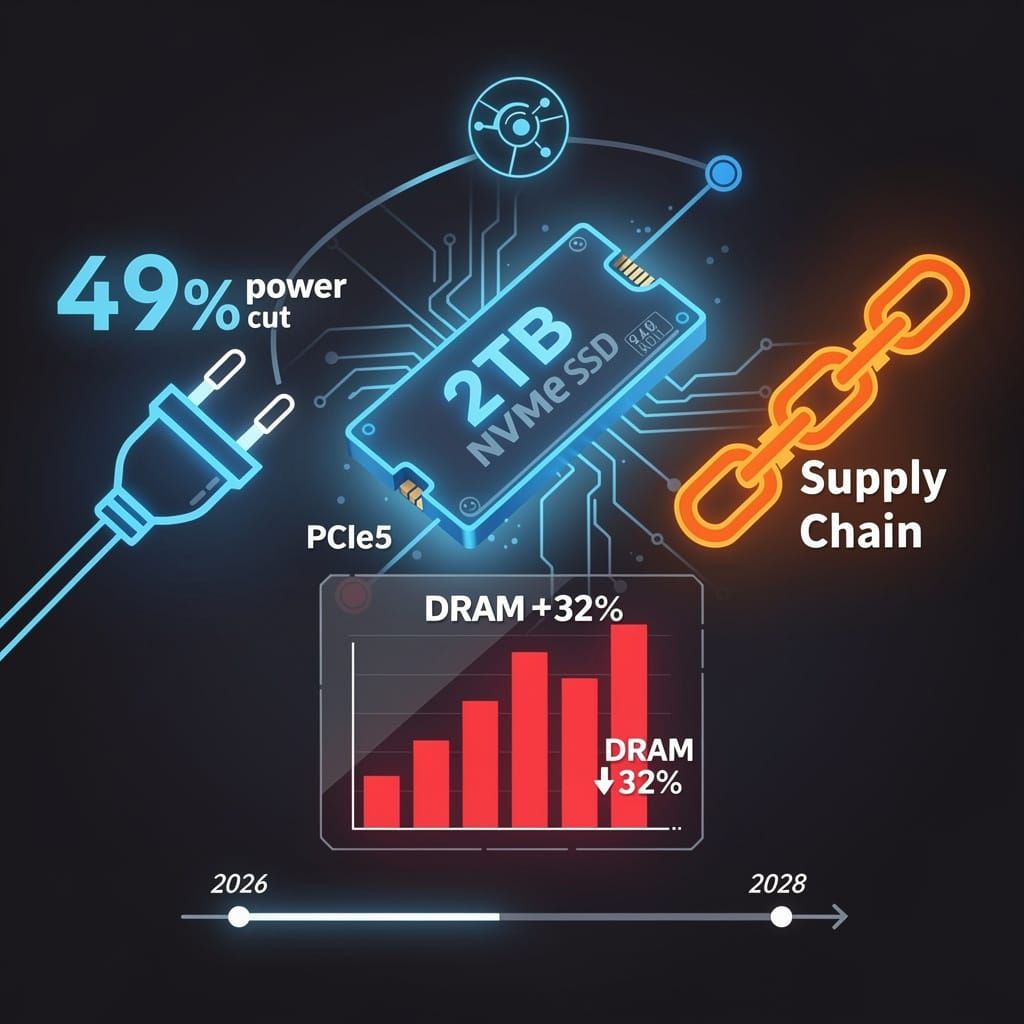
49% power reduction is a tactical mask for a systemic crisis 📉. It's like putting a fuel-efficient engine in a car with no tires. While throughput rises, memory shortages persist until 2028. Samsung's pricing cannot fix a broken supply chain. HPC admins—is speed useless without scale?
Samsung's promotional pricing for the 2TB MZ-VAP2T0B/AM 9100 PRO NVMe SSD, recently dropped below $444.99, appears less as a market stimulus and more as a strategic maneuver within a volatile semiconductor landscape. While Samsung reports a 49% reduction in power consumption compared to prior-gen controllers, this efficiency gain is a tactical necessity. In an environment where AI infrastructure consumes high-bandwidth memory and drives systemic scarcity, lower power draw merely mitigates thermal overhead without resolving the underlying availability crisis.
Can Efficiency Overcome Yield Constraints?
The 9100 PRO leverages 5nm NAND and a new controller to deliver sequential reads of 14,700 MB/s and 2.6 million IOPS writes. However, these technical refinements are decoupled from macroeconomic realities. Global supply chains remain constrained by manufacturing bottlenecks, and industry data indicates that memory shortages are expected to persist into 2028. Consequently, high-performance storage remains a critical bottleneck for HPC workloads, regardless of improved throughput.
Performance vs. Availability
- Power Consumption: 49% decrease → lowers thermal overhead per rack.
- Memory Supply: DRAM prices rising sharply (Q3 +32%, Q4 +18%) → restricts hardware scaling through 2028.
- GPU Availability: RTX 50 Super launches delayed beyond 2026 → limits integrated system deployments.
Short-Term Gains, Structural Stagnation
The current pricing strategy attempts to accelerate adoption, yet it lacks a structural foundation. As AI-driven compute demand diverts memory away from consumer and mid-market electronics, the ability to scale PCIe 5.0 devices across hyper-scale data centers diminishes. The gap between theoretical throughput and deployable hardware demonstrates that marginal controller optimizations cannot bypass a supply chain where NVIDIA has already locked in early memory supplies via strategic contracts, leaving others to face heightened procurement pressure.
Projected Market Stability
- July 2026: Demand stabilizes as promotional pricing bottoms out amid global SSD shortages.
- Q4 2026: Manufacturers may expand production capacity, though enterprise deployments remain capped.
- 2028: Expected normalization of DRAM/DDR5 pricing, providing the first viable window for wide-scale architectural transition.
Ultimately, the 9100 PRO is a tactical optimization in a stagnant environment. While it enables faster dataset processing—potentially accelerating model training cycles by ~15%—it fails to solve the fundamental scarcity of silicon. Marginal speed increases cannot substitute for the systemic lack of available hardware required to sustain a transition to Exascale-ready storage architectures.
⚠️ The Mirage of Storage Cost Optimization
40% price hikes in memory are driving users back to legacy HDDs. A desperate move saving a mere $40/year while risking total data loss ⚠️. With high-compute speeds hitting 14,900 MB/s, scavenging old disks is a performance suicide mission. Is budget-driven recycling killing your data integrity?
Recent shifts in storage procurement indicate a regression toward hardware scavenging. Between June 18 and July 10, 2026, a trend emerged where consumers and small-scale operators transitioned from cloud dependencies to self-built external storage. While proponents frame this as capital expenditure optimization, the technical trade-offs demonstrate a precarious reliance on aging hardware amid a volatile semiconductor market.
Does Scavenged Storage Scale?
The logic driving this shift relies on converting internal HDDs to external enclosures to bypass cloud subscription fees. Data from July 10, 2026, indicates that utilizing SATA-compatible enclosures costing under $20 enables the reuse of legacy 500GB drives, yielding an annualized saving of approximately $40 per user. However, this marginal gain conflicts with a decisive market pivot toward high-performance flash.
On June 18, 2026, SanDisk launched the Optimus GX PRO 850P series, specifically targeting PlayStation 5 and Pro requirements. With the 8TB variant priced up to $2,960—nearly five times the cost of a console—the market is bifurcating. The insistence on mechanical drives in an era where premium SSDs reach 14,900 MB/s read speeds makes scavenged HDD solutions functionally obsolete for active, high-compute workloads.
Storage Trade-offs
- Reliability: Recovered HDDs → higher failure probability → increased downtime risk.
- Performance: HDD latency → bottleneck in high-compute workloads → reduced throughput.
- Financial: $40/year saving → potential total data loss → catastrophic recovery costs.
The Infrastructure Gap
This trend is a symptom of an affordability crisis rather than a strategic choice. AI-driven demand for high-performance memory has crowded out the consumer supply chain. By June 22, 2026, extreme price increases forced users to repurpose old SSDs and HDDs via affordable USB enclosures from vendors like Orico and UGreen just to maintain basic capacity.
This scarcity is projected to intensify. Jefferies reports from June 29, 2026, project memory prices to rise 40–50% in Q3, with an additional 30–40% jump in Q4. This creates a causal chain where hyperscaler contracts for AI servers deplete available NAND/DRAM, forcing the general market into suboptimal, recovered storage solutions.
Adoption Forecast
- 2026–2027: Recovered HDD/SSD adoption maintains a 5% annual penetration as memory prices sustain 40–45% YoY growth.
- FY 2027: Reliance on modular, repairable storage peaks as new capacity lags demand.
- 2028: Production expansion yields a 15–20% price reduction, potentially stabilizing the market.
These shifts demonstrate a failure to integrate scalable archival strategies. The reliance on refurbishing mechanical drives amid Exascale requirements indicates a misalignment between user behavior and the actual performance requirements of modern computing frameworks.


Comments ()