$450K on the 737: Southwest Pilots Match Wide-Body Pay — Without Leaving the Narrow Body
✈️💰🔥 Southwest Pilots Break the Wide-Body Pay Ceiling—Without Leaving the Narrow Body
Southwest pilots just cracked $450K/year flying the 737 — matching wide-body pay at Delta & United without leaving the narrow body ✈️💰 Under the TFP system, a transcon leg earns 16% more per hour than block-hour rivals. The gap: $50K–$60K above base rates alone. Labor scarcity forced the hand. With 13K–14K pilots needed yearly through 2028, Southwest couldn't offer wide-body routes — so it weaponized pay structure instead. But here's the tension: same week, Southwest axed free bags ($35–$45), added premium seats, and rolled out Starlink. Higher revenue sustains $450K — but customer friction could suppress the long-haul demand that makes TFP most valuable. Southwest's narrow-body captains now earn more than some wide-body peers overseas. If you're a 737 pilot at a legacy carrier, are you staying for the international routes — or taking $450K and staying home?
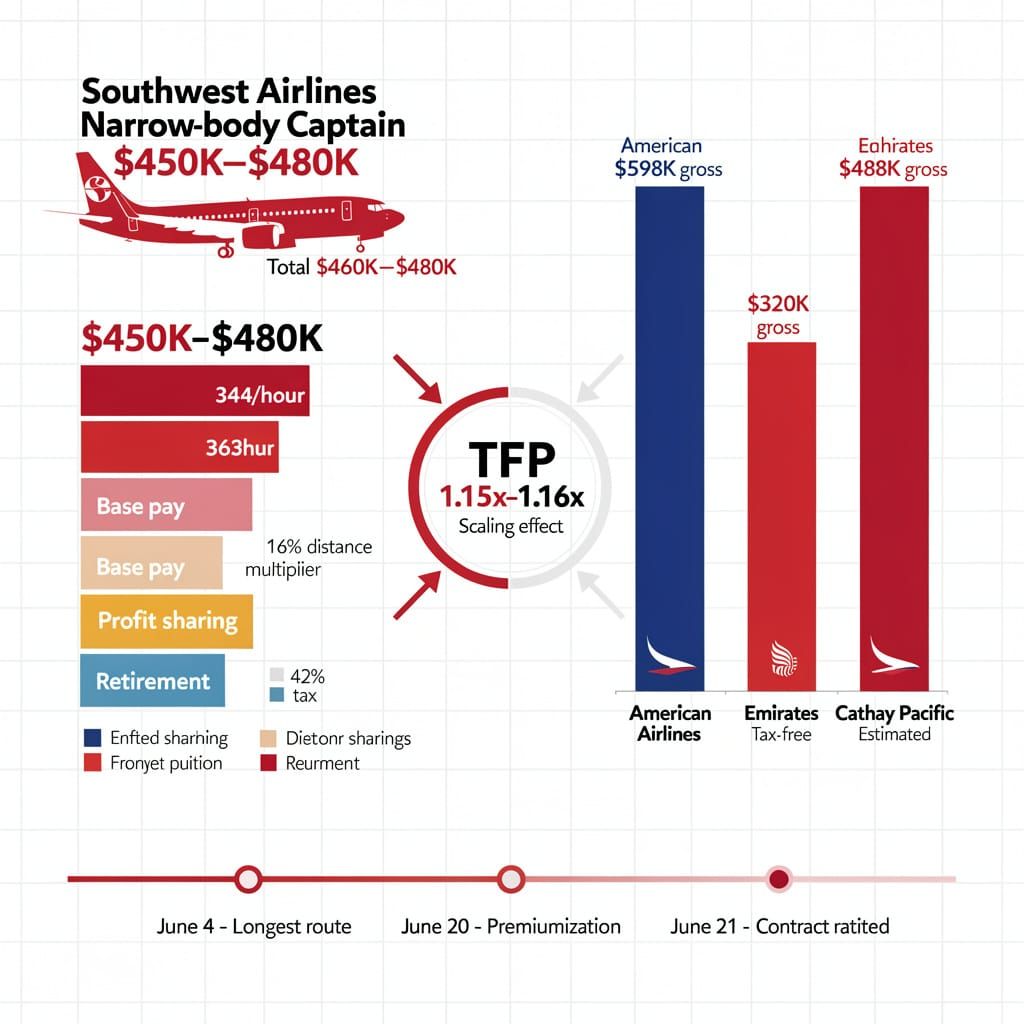
On June 21, 2026, Southwest Airlines pilots began receiving compensation under a freshly ratified 2024 SWAPA contract that pushes annual total pay past $450,000—a figure that, until recently, was the exclusive domain of wide-body captains flying international routes for legacy carriers. First officers now earn $255/hour; senior captains command $364/hour. Combined with an 18% non-elective retirement contribution and a 2% cash balance plan, the total package matches elite wide-body earnings at Delta, United, and American.
But the structural story runs deeper—and it is unfolding against a parallel transformation in Southwest's business model that is redefining what it means to fly the 737.
The TWP Multiplier: How Distance Transforms Pay
Southwest operates under a Trip For Pay (TFP) compensation system—distinct from the standard block-hour models used by Delta, United, and American. Under TFP, pilot pay is not purely a function of hours flown—it scales with flight distance. A longer leg from Las Vegas to Baltimore generates meaningfully more compensation per hour than a short hop between Dallas and Houston, even if both flights occupy the same block of duty time.
The current contract yields a conversion advantage of 1.15x to 1.16x versus block-hour equivalents. This means a Southwest captain flying a typical transcontinental route effectively earns 16% more per duty hour than a peer at a block-hour carrier flying the same schedule. Over a year of 900–1,000 flight hours, that differential alone accounts for $50,000–$60,000 above the base rate. The TFP system creates a hidden premium absent in dominant U.S. block-hour contracts—and it is now drawing industry-wide scrutiny.
How $450k Becomes Real
To reach the $450k threshold, the math requires stacking multiple components:
| Component | Estimated Annual Value |
|---|---|
| Base pay at $364/hr × ~950 flight hours | $345,800 |
| TFP distance premium (~15% conversion advantage) | +$51,900 |
| Profit sharing (Southwest historically pays 8–12% of eligible earnings) | +$35,000–$45,000 |
| 401(k) company match and retirement contributions | +$18,000–$22,000 |
| Per diem, overtime, and premium trips | +$10,000–$15,000 |
| Total estimated package | $460,000–$480,000 |
This places Southwest captains in direct competition with Delta and United wide-body captains flying Boeing 777 or Airbus A350 equipment on transpacific routes. The implication is unambiguous: narrow-body and wide-body compensation tiers are converging.
Labor Scarcity Forced the Hand
The 2024 contract is not a unilateral concession from management. It reflects a post-pandemic labor market where pilot supply remains constrained. Industry data shows that U.S. airlines collectively need to hire roughly 13,000–14,000 pilots per year through 2028 to cover attrition and growth. The regional pipeline, traditionally the source of mainline pilots, has narrowed: fewer military separations, higher age-65 retirements, and a persistent bottleneck at the 1,500-hour ATP requirement. By May 2026, Delta had already raised pilot wages 40% relative to late-2010s levels to retain talent amid the same shortage—confirming that the scarcity is systemic, not carrier-specific.
Southwest, which operates an all-Boeing 737 fleet, cannot offer wide-body flying as a retention tool. The TFP system and aggressive base rates became the only lever to prevent experienced captains from defecting to legacy carriers offering international routes and higher-status progression.
The Global Compensation Lens
The $450k figure must be weighed against international benchmarks. A June 2026 cross-industry assessment of Boeing 777 pilot compensation revealed that American Airlines offers up to $598K gross annually—the highest headline number—but pilots face tax burdens of up to 42%, reducing net take-home pay to $195K–$347K. By contrast, Emirates pays up to $320K gross (tax-free) and Cathay Pacific up to $485K gross (retaining 80–85% via low Hong Kong tax rates). Lufthansa captains face German taxes up to 45%, resulting in severe net erosion despite gross earnings up to $330K.
Southwest's TFP-based $450k sits in a middle band: lower gross than American's top figure, but with a more predictable tax structure and the advantage of domestic basing. For pilots weighing international migration, the net-pay calculus increasingly favors carriers like Emirates and Cathay Pacific—pressure that U.S. carriers must offset through structural compensation advantages like TFP.
Southwest's Long-Haul Ambitions Add Context
On June 4, 2026, Southwest announced its longest international route: Las Vegas to San José, Costa Rica, using the Boeing 737 MAX 7. By June 21, the airline had operationalized three milestones: the BOS-SAN transcontinental route, PHX-HNL Hawaii service, and the SJO-LAS intercontinental link—all leveraging the MAX 8's extended range. These longer sectors, under the TFP system, generate even higher per-hour compensation for pilots. The convergence is strategic: longer routes amplify the TFP advantage, making Southwest more competitive for pilot talent precisely as it extends its network reach.
The Premiumization Parallel
On June 20, 2026—one day before the pay scale took effect—Southwest announced three structural changes that signal a broader repositioning:
- Removal of free checked bags: Passengers now pay $35–$45 per bag, aligning with legacy carrier fee structures.
- Conversion of one-third of seats to "Extra Legroom" premium seating: A direct challenge to United's Economy Plus and Delta's Comfort+.
- Starlink Wi-Fi deployment across 300+ aircraft: Partnering with SpaceX to deliver in-flight connectivity, a capability previously absent from Southwest's cabin.
These moves mark Southwest's aggressive transition from low-cost carrier to premium competitor against United, American, and Delta. The mechanism is twofold: cost control (baggage fee revenue) and revenue diversification (premium seating, tech partnerships). Load factors remain high despite customer backlash, but the brand evolution risks loyalty erosion—a tension that directly affects pilot compensation sustainability. Higher ancillary revenue per passenger strengthens the airline's ability to sustain the $450k pay scale, but customer friction could suppress demand on the very long-haul routes that make TFP most valuable.
Bargaining Power Shifts
The new contract strengthens SWAPA's hand in two measurable ways:
- Direct wage competition: Southwest now matches or exceeds legacy narrow-body rates. Any future legacy carrier attempt to narrow the gap will require proportionate increases, raising industry-wide labor costs.
- Retention leverage: A Southwest captain earning $450k+ has less financial incentive to bid for a wide-body slot at a competitor, especially when factoring in seniority loss and base relocation. This stabilizes Southwest's crew planning and reduces training costs from turnover.
The union's position going into the next negotiation cycle will be anchored to this contract. The floor has moved up.
Sectoral Implications
Legacy carriers face pressure to accelerate narrow-body wage increases or risk losing pilots to Southwest's superior TFP structure. Delta's narrow-body captains currently earn approximately $310–$340/hour on the A320 and 737 fleets—a gap of $24–$54/hour translating to $22,000–$50,000 annually before the TFP multiplier is considered. Delta's 40% wage increase since the late 2010s, announced in May 2026, indicates the pressure is already being felt. United's June 2026 flight attendant contract ratification—offering substantial wage hikes and improved profit-sharing—confirms that labor costs across all employee groups are rising systemically.
Regional airlines are further disadvantaged. A regional captain flying an E175 for Endeavor or SkyWest earns roughly $120–$160/hour. The differential between regional and Southwest first officer pay has widened to nearly 2:1, making the regional-to-mainline flow-through agreements—where they exist—more critical than ever for retention.
Cargo carriers (FedEx, UPS) operate under separate contracts but will likely reference this settlement during their own bargaining. Their wide-body fleets and different duty structures may limit direct comparison, but the headline $450k figure sets a psychological benchmark.
Global talent competition intensifies: with Emirates and Cathay Pacific offering tax-free alternatives, U.S. carriers cannot rely solely on gross pay to attract internationally mobile pilots. The TFP model may become a differentiator in retaining pilots who might otherwise consider overseas postings.
Award mile valuations face parallel pressure: on June 19, 2026, airlines globally intensified dynamic pricing of award miles, with business-class awards at Emirates, United, and Cathay Pacific increasingly tied to unsold inventory. As labor costs drive up ticket prices, the value of loyalty points erodes—creating a compounding effect where passengers pay more in cash and get less from miles.
Outlook
The 2024 SWAPA contract is not an outlier—it is a signal. Labor scarcity, union leverage, Southwest's unique TFP compensation architecture, and expanding long-haul ambitions have combined to produce a new compensation standard for U.S. narrow-body pilots. The premiumization of Southwest's cabin—baggage fees, extra-legroom seats, and Starlink connectivity—generates the ancillary revenue needed to sustain that standard, but introduces customer friction that could limit the network growth on which TFP depends.
Expect:
- 2026–2027: Legacy carriers match or exceed Southwest's base rates in their next contract cycles, driving industry-wide narrow-body pay above $350/hour. Delta's 40% wage increase and United's flight attendant contract already demonstrate the trajectory.
- 2027–2028: Regional pilot wage pressure intensifies, potentially forcing consolidation or restructuring of flow-through programs. Southwest's premiumization may accelerate if ancillary revenue sustains the pay scale.
- 2028–2029: The TFP system may be adopted or adapted by other carriers seeking differentiation in pilot recruitment, particularly as Southwest's long-haul 737 MAX routes amplify the model's advantages. Global tax arbitrage (Emirates, Cathay Pacific) will continue to pull internationally mobile pilots unless U.S. carriers develop net-pay-equivalent structures.
Southwest's pilots just proved that the narrow body can pay like the wide body—and that the TFP system, paired with strategic route expansion and a premiumized cabin, creates a structural advantage that block-hour competitors will struggle to match without fundamentally rethinking their own compensation architecture.
Comments ()