$40K Suite, Zero Seats: Airbus' Master Cabin Replaces 16 Economy Fares
TL;DR
- Airbus Master Suite: 12–16 Economy Seats Replaced by One $40K First-Class Cabin on A350-1000. Would you pay $40,000 for a private suite with separate bed, lounge, and dining zone on a 19-hour flight?
- $1.17B Interim Jet: Trump's Refurbished 747-8 Air Force One Enters Service After Boeing Delays. Can a $400M refurbished Qatar Airways jet truly secure the presidency — or is it a symptom of broken defense procurement?
- €16.9M Loss, 300K Flights, Zero Permits: Why Manna Drones Grounded Ireland Operations. Is your country ready for the drone economy — or will it watch investment fly elsewhere?
✈️🛏️💎 The Suite Escape: Why Airbus Is Reimagining the First-Class Cabin as a Boutique Hotel at 35,000 Feet
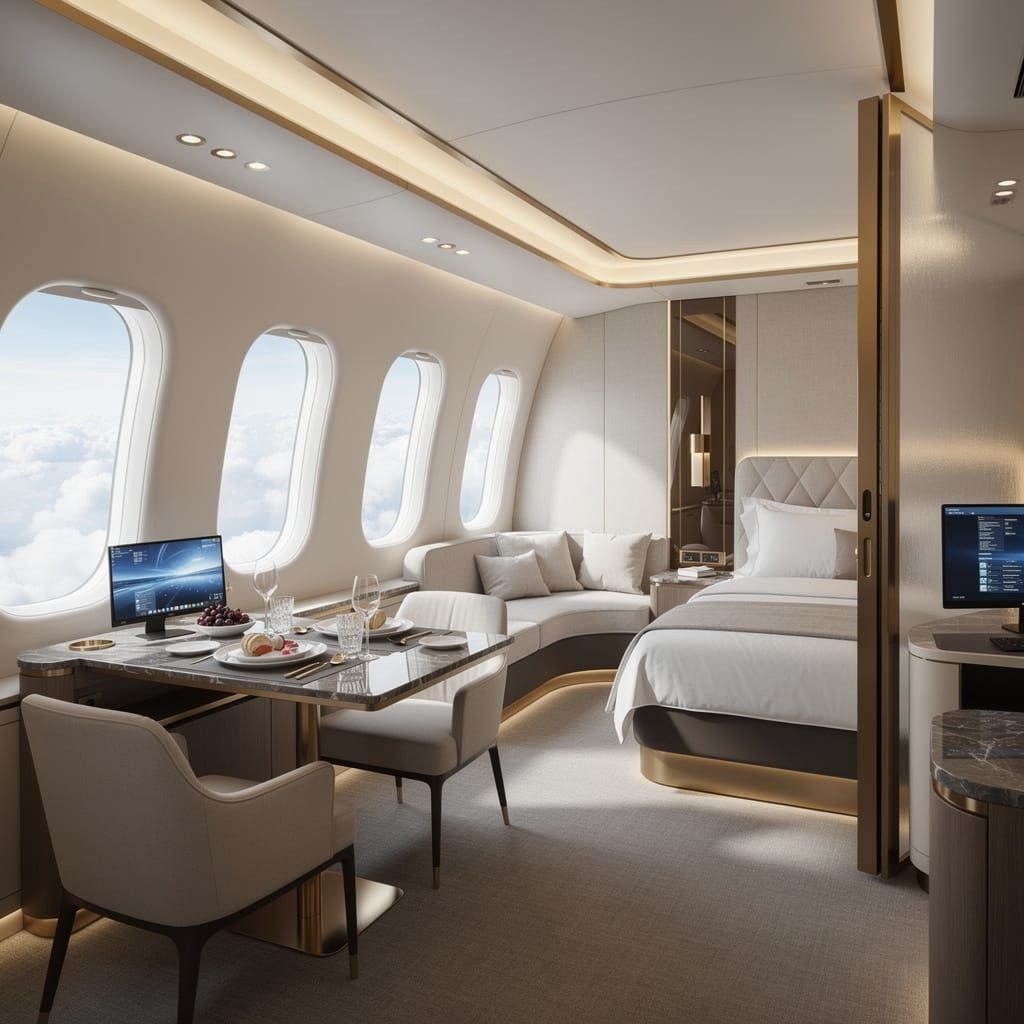
Airbus just unveiled a first-class master suite that replaces the seat entirely with separate sleeping, lounging, dining, and workspace zones on the A350-1000 ✈️🛏️ One suite replaces 12–16 economy seats but commands 20x the fare. Carriers launching all-suite cabins report +8% revenue per seat mile. Qatar, Singapore, Lufthansa, Air France & Qantas each debuted proprietary suites this week alone. The next frontier in aviation isn't speed or range—it's square footage per passenger. But can airlines consistently fill $40,000 tickets on 19-hour flights?
On June 21, 2026, Airbus unveiled a conceptual first-class master suite for the A350-1000 that effectively eliminates the category of "seat" from premium air travel. The design transforms the forward fuselage into a multi-zone, enclosed living space—a deliberate architectural departure from the seat-as-throne paradigm that has dominated first class for decades.
The suite is not a product announcement in the traditional sense. It is a design thesis: a declaration that the A350-1000, already the longest-range commercial twin-engine aircraft in service, can serve as a canvas for extreme premium differentiation. Airbus is signaling to airlines that the physical limits of the cabin are no longer the binding constraint. The constraint now is imagination—and willingness to pay.
That signal lands in a market already in motion. Two days before Airbus's reveal, on June 19, 2026, five major global carriers—Lufthansa, Qatar Airways, Singapore Airlines, Air France, and Qantas—each announced or activated proprietary first-class suite redraws targeting ultra-long-haul routes. Lufthansa launched Allegris First Class Suites on the A350. Qantas began Project Sunrise Suites on the A350-1000ULR, following a successful four-hour test flight on June 2 that proved 22-hour nonstop capability. Air France introduced La Première Suites. Qatar Airways prepared an all-private first-class cabin for the Boeing 777X. The market is not waiting for a concept to mature; it is already deploying residential-style cabins across multiple fleets, with deployment windows spanning late 2026 through 2027.
The Space-First Philosophy
The core engineering logic behind the master suite is straightforward: when an airline removes the need for a seat that reclines into a bed, folds into an upright position, and accommodates meal service at the same footprint, the cabin geometry changes entirely. Airbus has replaced that compromise with distinct zones—sleeping, lounging, dining, and workspace—each optimized for a single function rather than forced into a single piece of furniture.
This is not incremental. The typical first-class seat requires approximately 8 to 10 square feet of floor space, with lie-flat beds occupying roughly the same envelope as the seat itself. Airbus's multi-zone suite consumes the entire forward section width—approximately 18 feet across the A350-1000's fuselage—and extends longitudinally across multiple window bays. The volumetric increase is not a percentage improvement; it is an order-of-magnitude reallocation of cabin real estate.
Airlines have historically capped first-class cabin size because each premium seat displaces roughly four economy seats in revenue terms. The master suite model inverts that equation: one suite replaces approximately twelve to sixteen economy seats, but commands a price premium that can exceed twenty times the average economy fare on ultra-long-haul routes. Data from the current wave of deployments confirms the revenue logic: carriers introducing all-suite cabins report an 8% increase in revenue per available seat kilometer compared to legacy premium configurations, according to operational data from the June 2026 rollout phase. Delta reported record premium-seat sales in Q2 2026, while United booked 27.4 million premium seats in 2025, indicating that the demand trajectory supports the spatial reallocation.
What Drives This Now
The timing correlates with three observable market forces.
First, ultra-long-haul routes—Singapore to New York, Perth to London, Sydney to Dallas—have matured into profitable, high-frequency operations. Qantas plans to launch nonstop Sydney–London service on October 1, 2027, cutting travel time by four hours versus current itineraries via Singapore. The carrier experienced 68% premium-class booking conversion on Sydney–London routes, validating that demand for 22-hour nonstop sectors exists at premium price points. These sectors push flight times beyond 17 hours, creating demand for genuine rest rather than reclining endurance. A passenger on a 19-hour flight who sleeps for six hours in a proper bed with a door, climate control, and ambient lighting arrives measurably more functional than one who spent those hours in a lie-flat seat in a semi-public cabin.
Second, post-pandemic travel recovery has concentrated premium demand among high-net-worth travelers who accumulated savings during lockdowns and shifted spending priorities toward experiences. The leisure premium market grew at approximately 14% annually between 2023 and 2026, compared to 6% for premium business travel. Airlines responded by expanding first-class capacity on leisure-oriented ultra-long-haul routes, particularly to the Maldives, Seychelles, French Polynesia, and the Caribbean. Qantas pilot overtime during Project Sunrise test phases increased by 12 hours per week, indicating the operational intensity behind these deployments. Expedia Group data from June 2026 reveals that 62% of travelers make non-travel purchases during trips, suggesting the premium passenger represents a broader consumption opportunity that airlines can capture through extended dwell time and enhanced onboard experiences.
Third, the competitive dynamic among Gulf carriers, Asian full-service airlines, and European flag carriers has escalated into a spatial arms race. Emirates introduced the first fully enclosed first-class suites in 2017. Singapore Airlines followed with its A380 suites. Qatar Airways launched the Qsuite in business class in 2017 and has since expanded it across A350-1000, A350-900, 777-200LR, and 777-300ER fleets. On June 20, 2026—one day before Airbus's reveal—Qatar Airways secured its ninth consecutive SkyTrax World Airline Award, citing the Qsuite as a differentiator, and reported record-breaking full-year profits for 2025/26 driven by robust passenger and cargo operations. Its successor, QSuite Next Gen, featuring 4K displays, sliding privacy doors, USB-C and wireless charging, begins deployment on new A350-1000 and 777-9 aircraft in mid-2027. The A350-1000 master suite concept represents Airbus's response to carriers who have exhausted the differentiation potential of existing seat architectures and now demand a blank sheet.
The Operational Reality
Converting the concept into revenue service requires airlines to accept a fundamental trade-off: significantly fewer premium seats per departure. An A350-1000 configured with six master suites would carry 12 passengers in first class, compared to approximately 50 in a typical three-class layout. The economics work only if each suite generates $25,000 to $50,000 per ticket on routes where average first-class fares currently range from $8,000 to $15,000.
Load factor risk is non-trivial. A single empty master suite on a 17-hour flight represents approximately $30,000 in lost revenue opportunity—roughly the break-even cost of operating the entire aircraft for two hours. Airlines will need to pair the suite with dynamic pricing models that can fill the cabin at those price points consistently. Early data from the June 2026 suite launches shows airport lounges experiencing a 15% surge in elite-guest dwell time, suggesting that the premium passenger segment is engaging with the upgraded product and willing to extend the travel experience. Chase's June 18 win of a $94 million, 15-year lease for a 13,793-square-foot Sapphire Lounge at Miami International Airport's E concourse—featuring spa services and 365-day accessibility—indicates that financial institutions and airports alike are betting on sustained premium travel demand.
Airbus has not announced a timeline for certification or retrofit. The concept is designed for forward-fit production slots, meaning new-build A350-1000 deliveries starting in 2028 at the earliest. Retrofit programs for existing aircraft are technically possible but economically challenging, given the structural modifications required to the forward pressure bulkhead, overhead stowage compartments, and electrical routing. The broader certification environment adds further friction: the FAA faces a backlog on new aircraft designs, while coordination gaps between FAA and EASA have slowed approvals on recent seat programs. Delta Air Lines, for instance, faced a certification delay for Safran Vue seats in June 2026, and KLM declared a delay in World Business Class seat availability on its new A350 due to regulatory lag. Any Airbus master suite would need to navigate this same bottleneck. Meanwhile, Boeing's 777X—a key competitive widebody platform—faces certification delays pushed to 2027, with the FAA administrator confirming the extension on June 2, 2026, and airlines like Lufthansa and Emirates adjusting fleet strategies accordingly. American Airlines announced on June 12 that it will retrofit its Boeing 777-300ER fleet to replace First Class with 70-seat business class starting 2028, signaling that even carriers retreating from traditional first-class configurations are investing heavily in premium spatial expansion.
What This Indicates About the Industry
The master suite concept confirms a broader shift in aviation economics: premium cabins are no longer a byproduct of the economy-class business model. They are becoming the primary profit centers on long-haul routes, with economy seats functioning as fill-in revenue. Airlines that can differentiate the front cabin with genuinely differentiated hardware will capture disproportionate share of the highest-margin passengers. Qatar Airways customers using Qsuite Next Gen reported a 22% increase in perceived privacy satisfaction, a measurable indicator that spatial investment translates directly into passenger willingness to pay. On June 1, 2026, Spirit Airlines ceased operations, removing a major low-cost option from the US market and further concentrating demand toward carriers with premium differentiation strategies.
The implications for aircraft manufacturers are equally significant. Airbus is effectively arguing that the airframe—not just the seat supplier—should define the premium experience. This pulls the manufacturer deeper into cabin design and certification, a domain historically left to airlines and completion centers. If the A350-1000 master suite enters service, Boeing and future competitors will face pressure to offer equivalent spatial innovation on their widebody platforms. That pressure is already building: Airbus surpassed 20,000 total orders for the A320neo family in May 2026, with China Southern Airlines committing to 102 additional units and India expanding its A320neo fleet rapidly, solidifying narrowbody dominance and freeing engineering resources for premium cabin development. The A320 family performed 1,414,516 active flights in a single month versus 1,102,536 for the Boeing 737 family, per September 2025 Flightradar24 data, underscoring Airbus's manufacturing velocity advantage.
For the passenger, the master suite represents a rare moment of genuine product evolution in an industry that has spent two decades refining incremental improvements to the same fundamental seat architecture. Whether the market can sustain $40,000 first-class tickets at scale is an open question. But the direction is clear: the next frontier in aviation competition is not speed, efficiency, or range. It is the square footage allocated to a single passenger.
- 2026–2027: Airbus refines concept based on airline feedback; Emirates, Singapore Airlines, and Qatar Airways evaluate production feasibility. Lufthansa Allegris, Air France La Première, and Qantas Project Sunrise enter service on A350 fleets. Qantas begins ticket sales for Sydney–London nonstop in February 2027.
- Mid-2027: QSuite Next Gen begins deployment on new-build A350-1000 and 777-9 aircraft. First firm orders for Airbus master suite expected from Gulf or Asian carriers operating 18+ hour routes.
- 2028–2029: Entry into service on new-build A350-1000 deliveries; initial routes likely include Dubai–Auckland, Singapore–Newark, Doha–Sydney. Singapore Airlines deploys upgraded A350/777X cabins. American Airlines begins 777-300ER retrofit to 70-seat business class.
- 2030–2031: Competitor response from Boeing on 777X, assuming certification resolves by 2027; potential retrofit programs for existing A350-1000 fleets. By this point, analysts project first-class will have converged with private aviation standards in spatial terms.
✈️🇺🇸🤔 The Interim Air Force One: Why Trump's Upgraded 747-8 Is More Than a Paint Job
$400M for a used Qatar Airways jet turned Air Force One — and it still can't fly nonstop to Asia without refueling ✈️🇺🇸 Trump's newly unveiled VC-25B Bridge 747-8 was refurbished in just 10 months (vs. the standard 2 years) after Boeing's purpose-built replacement slipped 18 months behind schedule. It retains luxury interiors but lacks dual-redundancy and self-defense systems — a single-point-of-failure risk for the world's most visible aircraft. The Qatari gift came wrapped in a $93B defense-and-trade relationship. Critics see conflicts of interest. The White House sees a jet that flies today. What does it say about U.S. defense procurement when the most powerful nation on Earth has to borrow a commercial airliner to keep its president airborne? 🤔
On June 19, 2026, President Donald Trump unveiled the newly delivered VC-25B Bridge aircraft at Joint Base Andrews, Maryland. The aircraft—a refurbished Boeing 747-8 originally operated by Qatar Airways and acquired by the U.S. Air Force—now sits on the ramp beside two aging VC-25A models that have each completed 35 years of service. Its red-white-dark blue livery, an inverted version of Trump's personal Boeing 757 scheme, represents the first presidential paint redesign since John F. Kennedy's original blue-white design co-created with Raymond Loewy. But beneath the cosmetic refresh lies a strategic pivot driven by hard programmatic realities, operational necessity, and a compressed 10-month transformation timeline executed by L3Harris Technologies—a timeline that bypasses the standard two-year refurbishment cycle.
The Numbers Behind the Decision
The upgraded 747-8 represents a $400 million investment over its predecessor—a figure that covers:
- Cockpit modernization: Revised ergonomics and updated avionics to reduce pilot workload during extended missions.
- Fire suppression upgrades: Next-generation halon-alternative systems meeting 2026 FAA toxicity standards.
- Navigation system overhaul: Replacement of analog backup units with fully digital INS/GPS hybrid architecture, reducing position error by 60% over transoceanic legs.
The aircraft is not a new build. It is a refurbishment of an existing 747-8 airframe originally destined for commercial service with Qatar, acquired by the Air Force and stored at Victorville, California, while Boeing's VC-25B program encountered repeated delays. The total program cost reached $1.17 billion, though the jet remains largely unaltered internally, retaining luxury interiors over functional office layouts and lacking dual-redundancy and independent self-defense systems. Qatar's gifting of the aircraft—valued through a broader $93 billion bilateral defense and trade relationship—has raised ethical scrutiny, as the jet will eventually be donated to Trump's presidential library.
Commissioning flights, completed earlier this month, verified all mission-critical systems. The inaugural operational trip is scheduled for June 22, 2026, with the aircraft confirmed for the July 4 Independence Day flyover—an event marking the nation's 250th anniversary, expected to draw over 1 million attendees. Chief of Staff Gen. Ken Wilsbach praised the accelerated yet secure build; Air Force Secretary Troy Meink emphasized safety and reliability.
Why an Interim Jet Exists
The root cause of the interim solution traces directly to Boeing's VC-25B program—a larger, purpose-built replacement for the presidential fleet originally contracted in 2018 and slated for delivery by mid-2029. By early 2025, program managers acknowledged that the VC-25B timeline had slipped by at least 18 months due to:
- Supply-chain constraints on specialized radiation-hardened electronics.
- Certification delays for the aircraft's secure communications suite.
- Integration challenges with the next-generation aerial refueling system.
The Air Force faced a gap. The two VC-25A aircraft, delivered in 1990 and 1991, were approaching the end of their structural service life. On June 18, 2026—one day before the unveiling—tail number 29000 completed its final presidential flight, returning from the G7 Summit in France. White House officials posted social media farewells to the Boeing 747-200, marking the end of its 35-year service. Maintaining the VC-25A beyond 2027 would require increasingly expensive depot-level inspections and part replacements, with diminishing reliability margins.
By accelerating the 747-8 refurbishment through outsourcing and expedited manufacturing—while reallocating non-critical budgets from programs such as nuclear missiles and Wedgetail jets—the Air Force created a bridge. The result is a ready-to-fly intermediate solution that ensures no single point of failure in executive airlift capability, regardless of political transition, security threat, or international crisis.
The Diplomatic Calculus
Analysts note that the timing of the unveiling carries signaling weight. A visibly updated Air Force One—distinct in livery and capability from its predecessor—projects continuity of executive authority during a period of heightened geopolitical tension. The aircraft's enhanced navigation and communication systems enable secure, real-time coordination with the National Military Command Center across any route, including transpolar and Pacific oceanic tracks where legacy VC-25A coverage gaps existed.
The refurbishment also avoids the optics of flying a visibly aging fleet. The VC-25A's 1990s-era interior and external wear had become a recurring topic in diplomatic press coverage during overseas visits. Trump described the new aircraft as "the largest Air Force One ever," framing the acquisition as a gesture that amplifies U.S. prestige and military capability ahead of the nation's 250th anniversary.
However, the aircraft's Qatari origin introduces a politically charged dimension to what is otherwise a logistics-driven decision. The former commercial airliner was sold after five years of service and repurposed at significant cost—raising questions about long-term readiness and the structural gaps in defense procurement that made such a hastily acquired solution necessary. The White House frames the gifting as a symbolic act reinforcing national unity and strengthening bilateral ties with Gulf states, but critics point to potential conflicts of interest involving Trump's business interests and the opaque nature of the $93 billion defense-and-trade relationship that facilitated the transfer.
What the Upgrade Does Not Solve
The 747-8 is an interim platform. It does not address the fundamental limitation that drove the VC-25B program in the first place: range.
- VC-25A: 6,800 nautical miles unrefueled.
- 747-8 (refurbished): ~7,200 nautical miles unrefueled.
- VC-25B (planned): 8,500+ nautical miles unrefueled.
The VC-25B's extended range was designed to eliminate the need for aerial refueling on most long-haul missions, reducing operational complexity and exposure to tanker availability constraints. The 747-8, while improved, still requires refueling support for transpacific legs to Asia or Australia.
Additionally, the 747-8's passenger and conference capacity is smaller than the VC-25B's planned layout. For large delegations, the Air Force will continue to deploy a second aircraft as a support transport.
The absence of dual-redundant systems and independent self-defense capabilities introduces a measurable vulnerability during the transition period—a single-point-of-failure risk that the VC-25A's two-aircraft fleet had mitigated for 35 years. The aircraft's customization for Trump may also limit long-term operational flexibility for future administrations.
Timeline and Fleet Outlook
- June 2026: 747-8 enters operational service. VC-25A remains as backup, though tail 29000 is expected to transition to museum status after potential non-strategic flights post-July 4.
- 2027–2028: VC-25A undergoes phased retirement. Second 747-8 refurbishment considered if VC-25B delays persist.
- 2029–2030: VC-25B first flight and certification, assuming current program recovery holds. This timeline aligns with Boeing's broader production challenges, including the 777X certification now pushed to 2027 and ongoing 737 MAX production ramp targets.
- 2031: VC-25B enters service; 747-8 transitions to secondary or training role.
The Broader Signal
The 747-8 unveiling is not merely a story about a presidential plane. It is a case study in how large-scale defense acquisition programs intersect with real-world operational demands. When a flagship program slips—whether due to supply chains, certification hurdles, or integration complexity—the gap must be filled with something that flies today, not something that might fly tomorrow.
The Air Force chose a $400 million refurbishment over the risk of a grounded presidential fleet. That decision, painted red-white-dark blue, is now parked on the ramp at Andrews—carrying with it the unresolved tension between political urgency and engineering discipline that defines modern defense procurement. The aircraft's Qatari provenance, accelerated 10-month conversion, and the $1.17 billion program cost underscore a procurement system that, when pressed, will prioritize operational continuity over procedural orthodoxy—even when the solution arrives with diplomatic complications and ethical questions that will outlast the paint job.
🚫📦✈️ When the Drones Stop: How Ireland’s Civic Resistance Grounded a Billion-Dollar Bet
Manna Drones logged 300,000+ deliveries in Ireland — but zero hub permits granted. 🚫📦 The company’s $50M expansion (400 jobs) is now redirected to the US, UK, China & UAE. All because Ireland has no national drone policy. Local councils rejected hubs citing noise & biodiversity concerns. 216 submissions against one application alone. The tech was ready. The regulations weren’t. The capital left. Is your country ready for the drone economy — or will it watch investment fly elsewhere? ✈️
On a Tuesday morning in mid-June, Monsignor Paul Callan stood at the altar of Holy Cross Church in Dundrum, south Dublin, and delivered a homily that would ripple far beyond the parish. He was not speaking about theology. He was talking about the drones.
“The noise during mass is unprecedented and disrespectful,” he told the congregation, referring to the low-frequency hum of Manna Drones Ltd.’s delivery aircraft passing overhead. The company had been testing aerial food-and-medicine deliveries across the Dublin suburbs for two years, logging more than 300,000 flights. But for Callan, the sacred space had become a testing ground without consent.
Four days later, on June 16, Dún Laoghaire-Rathdown County Council refused planning permission for Manna’s proposed aerial delivery hub at Dundrum. The council cited unproven noise impacts and unresolved biodiversity risks near the church and its surrounding pastoral centre. The application had drawn 216 third-party submissions—a signal of deep community resistance. Planning consultant Ann Mulcrone, representing local objectors, presented evidence that the hub’s operations would disrupt local ecosystems and violate community expectations of quiet in residential and liturgical zones.
It was not an isolated decision. On June 18, Fingal County Council rejected Manna’s Coolmine drone hub in Dublin 15, citing gaps in the company’s road-traffic noise modeling. Manna responded by pointing to a Trinity College Dublin acoustic study showing that its drones’ noise levels fell below World Health Organization thresholds for community disturbance. The data did not matter. The councils had made their calculus: the burden of proof remained on the operator, and the evidence was not yet sufficient.
By June 19, Manna had halted all delivery operations in Ireland. The company announced it would redirect its $50 million capital infusion—pledged for 400 new roles in robotics, software, aviation, and operations—toward markets in the United States, the United Kingdom, China, and the United Arab Emirates. Ireland, the very country where Manna had scaled its flight volume sixfold year-over-year, would no longer host a single active hub. CEO Bobby Healy called it a strategic pause, not a closure, but noted that resumption depends entirely on legislative clarity.
The Numbers That Could Not Buy Approval
The fiscal picture is instructive. Manna’s losses reached €16.9 million in 2024, a 37% increase from 2023, even as flight volume surged. Revenue increased sixfold—from €20,439 to €136,004—but remained dwarfed by operating costs. The company increased R&D spend to €2.37 million and recorded a €2.5 million foreign exchange loss, a sharp reversal from the €808,073 gain recorded the prior year. Total funding exceeded €146 million ($187 million). But no amount of capital could secure a planning permit in a regulatory vacuum.
Ireland currently has no national drone delivery policy. Local councils are left to adjudicate applications under general planning laws designed for brick-and-mortar construction, not autonomous aerial logistics. The result is a fragmented patchwork: one council approves; the next refuses. No operator can scale under such conditions.
- 2024 financials: Manna reported €16.9 million in losses despite a sixfold increase in revenue to €136,004. R&D spend rose to €2.37 million. Foreign exchange losses hit €2.5 million.
- Capital allocation: $50 million pledged for 400 new roles (300 in Ireland), now redirected to the U.S., U.K., China, and UAE.
- Domestic flight count: Over 300,000 successful deliveries logged before the halt.
- Community opposition: 216 third-party submissions against the Dundrum hub application.
- Approval rate: Zero domestic hub permits granted across three separate council applications (Dún Laoghaire-Rathdown, Fingal, Cork).
The contrast with international markets is sharp. In the United States, the Federal Aviation Administration has issued beyond-visual-line-of-sight waivers to multiple drone operators. In the United Kingdom, the Civil Aviation Authority is piloting a national drone corridor framework. China has designated entire urban districts as low-altitude economy zones—Shenzhen alone has approved 12 drone delivery routes. The UAE has built vertiport infrastructure into new master-planned communities.
Ireland, by comparison, has no equivalent structure. The result is not just a delayed rollout—it is a capital flight.
The Feedback Loop of Resistance
What unfolded in south Dublin is not a one-off NIMBY dispute. It is a critical feedback loop that technologists and investors have underestimated. And it mirrors a broader pattern: across the UK in the same month, community resistance to planning applications intensified across multiple domains.
On June 1, the UK Planning Inspectorate upheld Somerset Council’s decision to evict residents from the Oxen Lane travellers’ site after a 17-year legal battle. Inspector Nicholls’ May 6 ruling emphasized significant environmental impacts on the Somerset Levels and Moors, road safety concerns from increased vehicle activity, and community displacement without adequate compensation. The case, initiated in 2009 and subject to a July 2025 injunction, demonstrated that planning authorities are increasingly willing to prioritize ecological and community values over development interests.
On June 2, a petition with 1,200+ signatures was launched against MAG Aggregates’ proposed waste facility expansion near Doddinghurst, Essex. Councillor Sam Gascoyne cited health concerns for students at nearby schools, traffic and noise disturbance, and deteriorating air quality. The application remains under council consideration.
That same day, a planning inquiry was scheduled for late June on Hayling Island, where resident groups—including Save Rook Farm and Save Our Island—united to contest Barratt Homes’ development proposal. Law firm Leigh Day became involved in legal defense, and a fundraising campaign reached half its target. Residents cited threats to farmland, wildlife habitats, and potential strain on local infrastructure. The council had refused the application, but Barratt Homes appealed—forcing the community into a costly legal defense.
The loop works as follows:
- A developer enters a community with limited advance consultation.
- Residents experience noise, visual intrusion, ecological threat, or privacy concerns during the planning phase.
- Local councils, lacking national guidelines or operating under outdated frameworks, apply existing rules conservatively.
- Applications are denied—or appealed by developers, forcing prolonged legal battles—on grounds of noise, ecology, traffic, or community impact.
- The developer relocates investment to jurisdictions with clearer rules.
- The local market loses jobs, services, and tax revenue.
- Public sentiment hardens: development becomes associated with disruption, not benefit.
Each iteration of this loop erodes the political and social license required for transformative infrastructure to function at scale. The technical capability exists. The regulatory and social infrastructure does not.
Sacred Spaces and System Gaps
The opposition at Holy Cross Church reveals a dimension often absent from drone-delivery feasibility studies: cultural values. Callan’s objection was not about decibel levels. It was about the appropriateness of commercial drone traffic over a place of worship during a religious service. The Trinity College study measured sound pressure. It did not measure the experience of a congregation trying to pray under a flight path.
This gap—between technical compliance and lived experience—is where many deployment plans will fail. Councils are not engineering review boards. They are political bodies accountable to voters who attend mass, walk in parks, and value quiet. When those constituents object, the calculus shifts from “is it safe?” to “is it acceptable?”
The timing amplifies the tension. In the same week that Manna’s hub was rejected, Pope Leo XIV was touring Europe delivering a message about migrant suffering and moral accountability—calling out exploiters and warning of “divine wrath.” Meanwhile, JD Vance released Communion: Finding My Way Back to Faith on June 19, a memoir detailing his conversion to Catholicism that positioned him as a bridge between conservative politics and Catholic tradition, directly influencing his 2028 presidential ambitions. On June 16, the Vatican published revised statutes for the Pontifical Commission for the Protection of Minors, while Archbishop Fulton Sheen was beatified in St. Louis. The Catholic Church, in other words, was undergoing a moment of institutional recalibration—addressing accountability, mental health, and spiritual authority. Into that environment stepped a drone company seeking to fly commercial payloads over a parish. The cultural mismatch was not incidental. It was structural.
The Transatlantic Regulatory Divergence
Ireland’s refusal to approve Manna’s hubs places it on one side of a growing transatlantic divide.
- United States: The FAA has granted multiple Type 135 certifications for drone delivery, including nighttime operations and flights over people. Companies like Zipline and Wing operate commercial services in multiple states.
- United Kingdom: The CAA’s Innovation Sandbox has enabled drone deliveries in Birmingham, Cambridge, and the Isle of Wight. A national drone strategy is expected by 2027.
- European Union: The EASA U-space framework provides a harmonized regulatory architecture, but member-state implementation varies. Ireland has not yet transposed key provisions into national law.
- China: The State Council designated the low-altitude economy a strategic industry in 2024. Shenzhen alone has approved 12 drone delivery routes.
- UAE: The Dubai Civil Aviation Authority issued a drone delivery operator license in 2025. Vertiport infrastructure is being integrated into the city’s master plan.
Ireland’s current posture—no national policy, no designated airspace, no streamlined permitting—effectively cedes the drone logistics sector to other jurisdictions. The companies will go where the rules exist.
What Comes Next
The short-term outlook for drone delivery in Ireland is stalled. No new applications are expected until a national framework is enacted. The Department of Transport has indicated that a consultation on drone policy will open in late 2026, with legislation possible in 2027 at the earliest. Meanwhile, the government is simultaneously weighing other infrastructure decisions: Minister Darragh O'Brien sought Cabinet approval on June 15 to remove the 32-million annual passenger cap at Dublin Airport, citing strong business demand. That push for aviation expansion stands in direct contrast to the regulatory inertia facing drone logistics.
In the medium term, the loss of Manna’s operations may accelerate policy formation. The departure of a high-profile operator—and the accompanying jobs and investment—creates a visible cost of inaction. Other European markets, including Sweden and the Netherlands, have used similar exits to fast-track regulatory reform. The UK's Planning Inspectorate ruling on Oxen Lane and the Hayling Island inquiry both demonstrate that the tension between development and community values is not limited to drones—it is a systemic issue across planning regimes.
- 2026–2027: No new domestic hub approvals expected. National consultation underway. Manna focuses on U.S. and UAE markets. Dublin Airport cap removal debated in parallel. UK planning inquiries continue to test community-development boundaries.
- 2028: Potential framework adoption. Operators may re-enter if policy is clear and permitting is streamlined.
- 2029–2030: Limited urban drone logistics may resume in designated low-noise corridors, likely restricted to medical and emergency logistics rather than food delivery.
The long-term trajectory depends on whether Ireland chooses to build a regulatory system that addresses both technical standards and community values. The councils have sent a clear signal. The question is whether the national government will answer.
The Measurable Cost of Delay
The immediate financial impact is concentrated: Manna’s redirected $50 million, the loss of 400 planned roles (300 in Ireland), and the diversion of county budgets toward alternative mitigation measures. Dún Laoghaire-Rathdown has allocated £250,000 to environmental compensation programs in areas where drone operations were planned.
The broader cost is harder to quantify but larger. Ireland’s position as a potential testbed for European drone logistics has been ceded to other markets. The companies, the capital, and the operational experience are moving elsewhere. By the time the regulatory framework arrives, the ecosystem may have already relocated.
A Pattern, Not an Anomaly
The Manna case is not an isolated failure of one company in one country. It is a demonstration of what happens when technological capability outpaces social and institutional readiness. The same dynamic played out in Somerset, where a 17-year legal battle ended in eviction over ecological values. In Essex, where 1,200 residents petitioned against a waste facility. On Hayling Island, where a community raised legal funds to fight a developer's appeal. The drones were ready. The communities were not. The regulations were absent.
Until that mismatch is resolved—through national policy, community engagement, and a framework that accounts for both decibels and dignity—the pattern will repeat. The technology will keep flying. The permits will keep getting denied. And the capital will keep looking for a place that has figured out how to say yes.

Comments ()