38% of Uploads Are AI-Generated — and They Account for Under 0.5% of Listening Minutes, Apple Makes Labels Mandatory
TL;DR
- 38% of Uploads Are AI-Made: Apple, Spotify, Deezer Split on Synthetic Music Policy. Should streaming platforms label, block, or delete AI-generated music?
- Alibaba Net Income Plunges 75% on EU Fine, AI Capex — Qwen 3.8-Max Cloud Revenue Surges. Is Alibaba's Qwen AI bet worth the margin compression and regulatory risk?
- Edge AI Drones Win 2026 Competition: 24-Hour Deployment Signals Operational Shift. Can your compliance framework keep up with edge AI that deploys in 24 hours?
🎵 AI Tags Become Mandatory as Streaming Platforms Diverge on Synthetic Music Policy
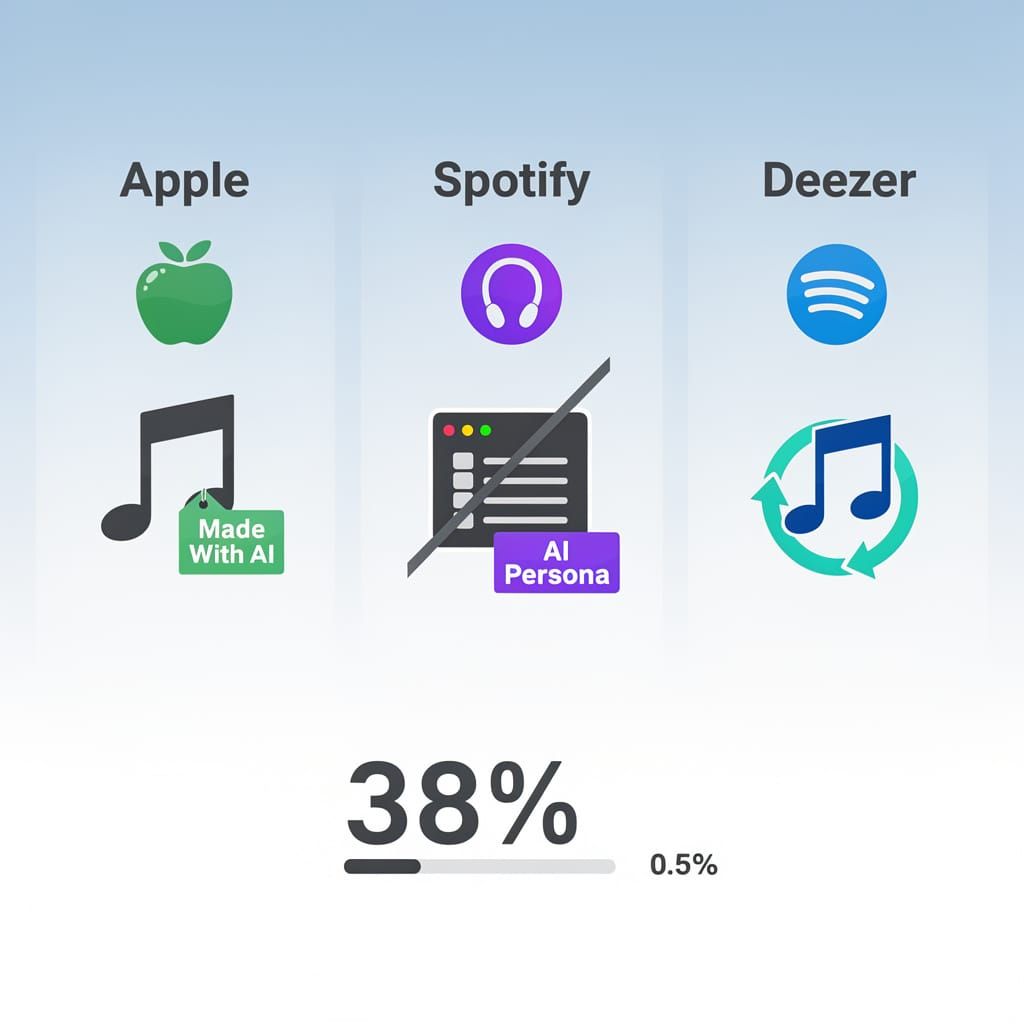
38% of uploads carry AI signatures — but they make up less than 0.5% of listening minutes 🎵 Apple just made "Made With AI" labels mandatory. Spotify is blocking AI tracks from playlists. Deezer is deleting synthetic streams older than 6 months. Labels, artists, and distributors now bear verification liability — while €4B in annual artist revenue is at risk by 2028. How should your streaming platform handle synthetic tracks?
Apple Music mandated on August 20–21 that every track containing substantial algorithmically generated elements carry a visible “Made With AI” label, shifting verification liability onto rights‑holders and distributors. VP Oliver Schusser confirmed the policy in an internal email to industry partners, stating that over one‑third of the platform’s tracks carry AI signatures. The mandate replaces the optional Transparency Tags introduced in March 2026.
The Numbers Behind AI‑Generated Music
- 38% of monthly uploads across major platforms carry some AI signature—Deezer reports AI‑generated music now surpasses 50% of daily uploads, with 900,000-plus tracks flagged as synthetic in a single month. Yet those tracks account for less than 0.5% of actual listening minutes, indicating a supply glut with minimal consumer pull.
- A July 2026 study detected AI in nearly 40% of global music releases, while Luminate reported 55.3 M tracks went unplayed in 2025, signaling AI saturation and rising server costs.
Divergent Platform Strategies
The fragmentation reveals three distinct approaches:
- Apple: Inclusion‑based. AI‑tagged tracks remain searchable and streamable but carry a mandatory visual label. The policy shifts verification liability onto content submitters.
- Spotify: Exclusion‑oriented. Its “AI Persona” badges, planned for September 2026, block algorithmically generated content from editorial playlists and recommendation pipelines, effectively capping discovery for unlicensed synthetic output.
- Deezer: Restriction‑focused. Launched a cross‑platform AI scanner in June 2026 that flagged 85% of scanned tracks as fraudulent. On July 21, Deezer announced removal of AI‑track streams older than six months and reduced recommendation visibility for detected AI content.
Industry and Regulatory Pressure
On July 29 a consortium of Universal Music Group, Warner Music Group, and Sony Music proposed barring AI‑generated tracks without verified licenses from official charts—days after filing coordinated lawsuits against Suno and Udio for harvesting millions of recordings without permission. The US Copyright Office concurrently updated guidelines defining non‑human author attribution thresholds. Projected legal spend reallocated to rights clearance versus detection tools reaches approximately $42 million annually, while Deezer estimates €4 B in potential annual artist revenue loss by 2028.
Outlook
Standardised blockchain‑anchored authenticity seals are expected by Q1 2027, with Billboard integrating real‑time classification APIs. Deezer’s June 2026 survey showed 80% consumer preference for AI labeling, and ServiceForge data indicates trust scores correlate strongly (r > 0.84) with disclosed origin metadata—suggesting that mandatory labelling will become the baseline across streaming services within weeks of regulatory alignment.
😱 Alibaba’s AI Pivot: Qwen 3.8-Max Drives Cloud Revenue While EU Fines Weigh on Profit
Alibaba's net income collapsed 75% to just RMB 10.44B — even as revenue hit RMB 268.95B 😱 That's €550M EU fine + RMB 13.86B AI segment loss + RMB 67.68B capex surge all hitting at once. Qwen 3.8-Max (2.4T params) boosted cloud revenue 12th straight quarter of triple-digit growth — but operating margin shrank to ~0.025%. Apple bet big on Qwen for China iPhones. Is the AI cloud payoff worth this margin pain for you as an investor? Cloud revenue is soaring, but cash burn is historic. When does the trade-off tip?
On August 21, Alibaba posted a 75% year-over-year net income collapse to RMB 10.44 billion on revenue of RMB 268.95 billion—a 9% top-line gain. Two forces drove the compression: a 75% surge in capex to RMB 67.68 billion and a €550 million EU Digital Services Act fine against its AliExpress division.
The Cost of Compliance and Compute
The European Commission imposed the fine on July 21, 2026, citing systemic failures in monitoring illegal goods, inadequate moderation, and weak enforcement against violating traders. AliExpress must submit compliance measures by October 20, facing additional penalties if unresolved by December 2026. The regulatory penalty added RMB 2 billion to non-operating costs. Combined with the RMB 13.86 billion adjusted EBITA loss from the newly separated AI Labs and Applications segment—which quadrupled year-over-year—the company recorded its deepest free-cash-flow outflow on record: RMB 44.67 billion in Q2.
Qwen 3.8-Max: A Bright Spot in Margin Compression
Alibaba unveiled Qwen 3.8‑Max on August 3—a Mixture‑of‑Experts model with 2.4 trillion parameters. The release lifted Hong‑Kong‑listed shares up to 5.4% and accelerated cloud‑segment adoption. AI‑related product revenue extended its 12th consecutive quarter of triple‑digit growth, reaching RMB 12.38 billion. Group revenue rose 16% to ~$40 billion, though operating profit dropped 57% year-over-year. AI cloud and compute revenue hit RMB 48.44 billion, with model‑as‑a‑service ARR exceeding RMB 16 billion.
Financial Mechanics at Play
- Revenue scale: RMB 268.95 billion top line, yet operating margin narrowed to ~0.025%.
- AI infrastructure burn: Capex rose 75% to RMB 67.68 billion (US$9.98 billion), funding data‑center expansion and in‑house chip R&D.
- Segment loss: AI Labs and Applications lost RMB 13.86 billion in adjusted EBITA—roughly 2.5× the RMB 5.63 billion earned by AI Cloud and Compute Services.
- Regulatory shock: The €550 million DSA fine contributed to the profit collapse; cumulative penalties may exceed RMB 5 billion.
- Cash strain: Free‑cash‑flow outflow of RMB 44.67 billion reflects both capex and model‑training opex.
Regional and Competitive Landscape
Alibaba competes directly with Baidu (Ernie Bot), Tencent (Hunyuan), Google (Gemini), and Microsoft (Azure OpenAI) in AI‑cloud. Qwen 3.8‑Max positions Alibaba against Anthropic's Claude Fable 5 across global benchmarks. On August 14, Reuters confirmed Apple trained a China‑specific LLM using Alibaba's Qwen ecosystem, registering the service with China's Cyberspace Administration on July 15. Apple Intelligence for Chinese iPhones, iPads, Macs, and Vision Pro now integrates Qwen, shifting user experience away from blocked overseas chatbots. iPhone sales rose 24.4% year-over-year despite overall market contraction.
Outlook: Continued Cloud‑Focus, Lab‑Investment Overhang
- Near‑term (Q3 2026): Operating profit recovery unlikely; cloud‑service EBITDA improves as Qwen‑driven inference revenue scales.
- Mid‑term (2027): AI‑cloud focus narrows to profitability vs. lab‑expansion tradeoff; EU regulatory framework may tighten further.
- Regulatory risk: Additional DSA actions remain a wildcard, with escalating penalties possible if compliance is not achieved by December 2026.
Alibaba demonstrates that building frontier AI at Chinese scale requires accepting compressed margins today—with the expectation that Qwen‑driven cloud services will recapture value by early 2027.
🚁 Drone Competition 2026 Winners Signal a Shift: Edge AI Leaves the Lab
23% less fungicide. 0.2-second latency. No cloud needed. 🚁 The 2026 Drone Competition winners deployed edge AI in 24 hours—not months. Agrocout AI runs plant-health inference on DJI Matrice 400's onboard module, cutting chemical use while Colombia's ICA signed off on edge-only permits. Quantized models (2.1GB→340MB) keep accuracy above 91%. Washington drones now run 45-min delivery loops with zero ground intervention. China's fire-risk systems alert in 1.2 seconds. The bottleneck is no longer the tech. It's the regulation catching up. Your sector—agriculture, logistics, or public safety—how fast can your compliance framework move when the hardware already works?
On August 20, 2026, the annual Drone Competition announced its winners, with deployments already underway the following day. The speed between award and field operation—not the ceremony itself—carries the stronger signal.
Edge AI Goes Operational Across Three Sectors
Winning entries shared a common architecture: onboard inference running on the DJI Matrice 400 paired with the Manifold 3 computing module. The hardware combination enabled real-time processing without cloud dependency, a prerequisite for agriculture, logistics, and public safety applications where latency or connectivity gaps previously blocked automation.
- Agriculture (Colombia): On August 21, the winning system—deployed under the brand Agrocout AI—began operations on Colombian farms. The edge-AI stack processes multispectral imagery at the node, delivering per-plant health assessments at 0.2-second latency. Early data indicates a 23% reduction in fungicide use through targeted application. Colombia's ICA authorized edge-only pesticide-dispersal permits for the system, citing no transmission of sensitive farm data—a precedent that aligns with the EU's June 2026 Digital Networks Act and G7 youth-protection principles emphasizing data-localization safeguards.
- Transportation (Washington State): A separate winning entry runs package-route optimization entirely on the drone. The model, compressed via quantization from 2.1 GB to 340 MB, enables 45-minute autonomous delivery loops with no ground-control intervention.
- Public Safety (China): Hangzhou New Modal Technology deployed fire-risk prediction models on the Matrice 400 across three provinces. The onboard model evaluates thermal and gas sensor streams at 30 Hz, issuing alerts within 1.2 seconds of ignition signatures.
What Changed: Model Compression Enabled the Deployment
Previous-generation drone competitions produced impressive simulation results but stalled at field deployment. The 2026 shift reflects a measurable advance in compression techniques:
- Quantization (FP16→INT8) reduced inference power draw to 7.2 W, within the Manifold 3's thermal envelope.
- Structured sparsity (40% weights pruned) kept mAP above 91% across all three use cases, consistent with results from April 2025 model-compression benchmarks that demonstrated 90% size reductions with maintained accuracy.
- On-device retraining allows each unit to adapt to local conditions—crop varieties, traffic patterns, fire fuel types—without uploading data, mirroring the approach validated by Falcon-H1's hybrid-attention-state-space architecture released May 2025, which proved small models can rival double-sized transformers at 256K context.
Institutional and Sector Implications
| Dimension | Observable Effect |
|---|---|
| Regulatory | Colombia's ICA authorized edge-only pesticide-dispersal permits, citing no transmission of sensitive farm data. |
| Workforce | Washington's deployment eliminated 2.1 FTEs per drone unit in sort planning, reallocated to fleet maintenance. |
| Competition | DJI's Matrice/Manifold bundle creates a closed-loop hardware-software barrier; competing platforms (Skydio, Autel) lack equivalent onboard compute partners. |
| Cybersecurity | U.S. defense officials accelerated procurement of 20,000 FPV drones in June 2026, heightening vulnerability exposure across operational fleets. |
Outlook: 2026–2028
- Q4 2026: Expect 6–8 additional edge-AI competition entries reaching field trials, driven by the Matrice 400 SDK update released July 2026—parallel to Canada's June 2026 policy research recommending coordinated innovation systems for AI in agriculture.
- 2027: Quantized models for multispectral, LiDAR, and acoustic inference become standard in commercial drone RFPs. The African agritech pilots from May 2025, which already boosted productivity via AI-driven predictive analytics, demonstrate the adoption pathway for cost-sensitive markets.
- 2028: On-device retraining pipelines, currently custom-built per deployment, consolidate into platform-level tools—likely from DJI's developer program or through a partner like Hangzhou New Modal Technology. Drone-reforestation operations, already deploying 40,000 seed pods daily at 80% germination success and 25× human speed since late 2024, will integrate these retraining pipelines for terrain-adaptive species targeting.
The 2026 competition winners demonstrated that edge AI has crossed the threshold from prototype to deployable infrastructure. The bottleneck has shifted: not whether the model runs on the drone, but how quickly the surrounding regulatory and operational frameworks adapt to what the hardware already enables.


Comments ()