Humanoids at BMW: One Sorting Station, Zero Certification — Why Cobots Still Win
TL;DR
- Humanoids at One Station: Zero Certs, No ROI Data — BMW's $1.7B Factory Runs on Fixed Automation. Why do humanoids still lack safety certs and ROI data?
- Zero Threats Found: FCC's Robot Vacuum Ban Is Security Theater, Not Strategy. What exactly did banning robot vacuums accomplish for U.S. security?
- Unitree Robot Crashes in Beijing: Speed Claims Fail Real-World Stability Tests. Would you trust a humanoid robot that runs fast but falls often?
🚩 The Same Old Hype, Dressed in New Metals
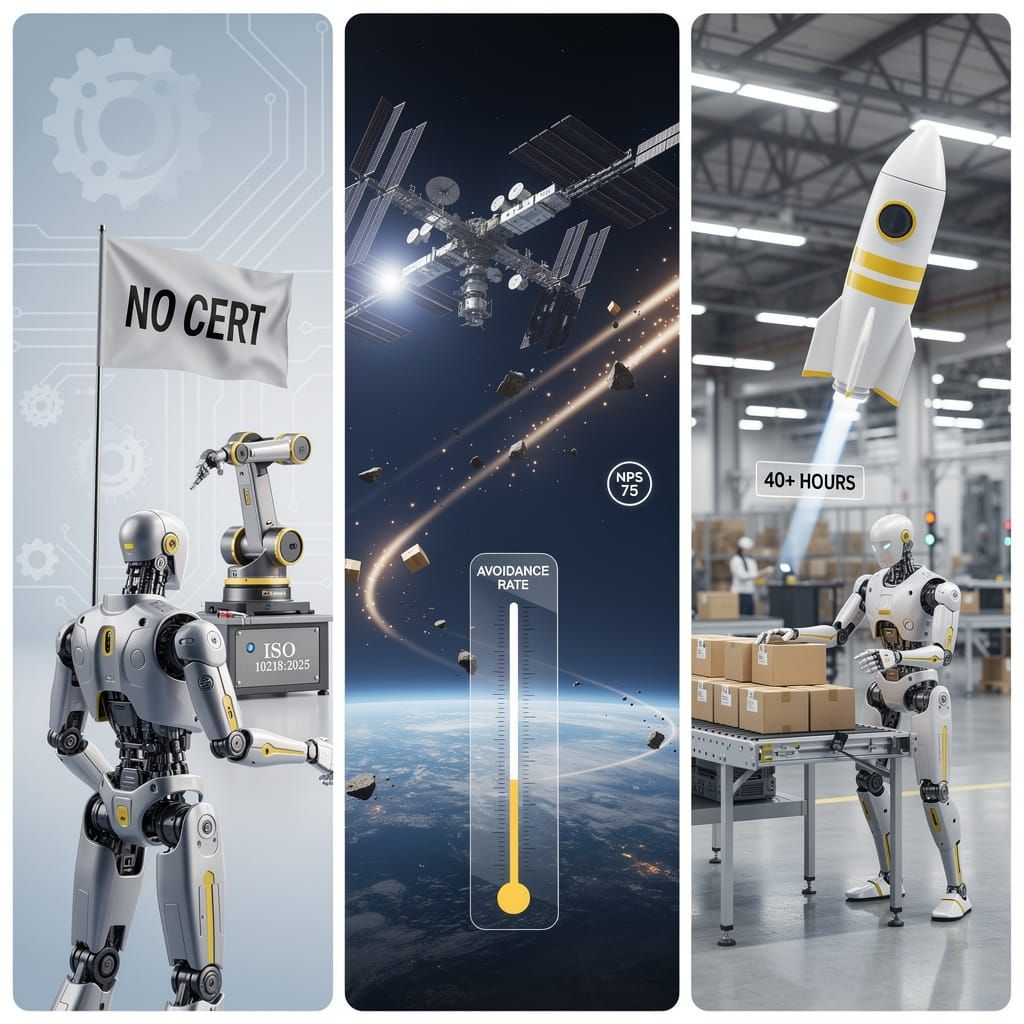
Humanoids have zero safety certs, zero cycle-time benchmarks across varied lines, and zero ROI data beyond one plant sorting task. Cobots with ISO 10218:2025 certification? Yaskawa just posted NPS 75 — the highest ever. 🚩 One humanoid at one station ≠ revolution. Why are we still conflating press launches with proof?
On July 24, 2026, three events landed on the same day: Flexiv unveiled GENE.01, an "intelligent humanoid platform"; the ISS performed debris avoidance in orbit; and CSA launched another XCOR rocket. Industry coverage spun these as proof of accelerating, sustainable progress. The data suggests otherwise.
GENE.01: Another Humanoid, Same Unanswered Questions
Flexiv's GENE.01 claims faster human-machine interaction. Yet by July 15, BMW's Spartanburg plant had deployed the Figure 03 humanoid to sort components—and reported "documented throughput improvements exceeding baseline staff capacity levels." That sounds promising until you read the rest: no incident reports emerged during trials, but the ISO 10218:2025 safety certification clock hasn't even started for humanoids. Meanwhile, Yaskawa Motoman reported an NPS of 75 in August 2026—the highest ever, up from 69 in 2024—driven by proven AI-integrated cobots that replaced legacy hand-guiding methods entirely. These collaborative arms carry ISO 10218:2025 certification. Humanoids have no equivalent certification timeline, no cycle-time benchmark across varied lines, and no ROI data.
Figure 03 at BMW: One Plant, One Task
BMG's Figure 03 sorts components at Spartanburg. A single logistics-routing task. Meanwhile, the same plant's $1.7 billion expansion—completed July 8—added a $700 million battery fab for domestic iX5 production. The humanoid handles one job. The fixed automation handles the factory. Humanoid pilots in automotive assembly during 2023–2025 failed to meet cycle-time targets; most reverted to fixed automation. One deployment at one station does not overturn that record.
Debris Avoidance: Standard Procedure, Not Resilience
The ISS crew performed orbital maintenance to evade debris. NASA data shows these maneuvers occur multiple times per year. As of Q1 2026, tracked debris reached ~36,500 objects, up 12% from 2024—hence the rising avoidance frequency. Each maneuver consumes propellant, shortens station lifespan, and adds cost. Zero active debris removal missions have succeeded in orbit. The ISS dodges and waits.
XCOR: Another Launch, Same Marginal Economics
CSA's XCOR launch continues commercial operations. Reusable propulsion reduced per-kilogram costs roughly 30% since 2020. Yet in H1 2026, two commercial launch providers delayed next-generation vehicles due to engine reusability wear issues. Each XCOR-class vehicle requires 40+ hours of inspection between flights. Rocket Lab and Relativity Space continue reporting quarterly losses. XCOR's payload capacity remains modest, its customer pipeline opaque.
What the Narrative Leaves Out
- 2023–2025: Humanoid robot pilots in automotive assembly failed cycle-time targets; most reverted to fixed automation.
- Q1 2026: ~36,500 tracked debris objects, up 12% from 2024. Avoidance maneuvers rose accordingly.
- H1 2026: Two commercial launch providers delayed next-gen vehicles due to reusability wear.
- July 2026: Figure 03 handles a single sorting task at Spartanburg while BMW's $1.7B expansion relies on fixed automation for the factory floor.
Parallels That Demand Skepticism
- Humanoids vs. Cobots: Collaborative arms hold proven safety certification via ISO 10218:2025. Yaskawa's NPS of 75 reflects real customer satisfaction. Humanoids: no safety cert, no cycle-time benchmark, no ROI data beyond a single plant report.
- Debris avoidance vs. Active remediation: Zero active removal successes. Each avoidance shortens ISS operational life.
- Reusability vs. Reliability: 40+ hours inspection per flight. Two providers delayed vehicles from wear. The "airline model" remains a metaphor.
GENE.01 is not a breakthrough. Figure 03 at one station is not a revolution. Debris avoidance is not resilience. Another rocket is not a new economy. The industry's preferred narrative—accelerated progress toward sustainability—runs ahead of the data, and has done so for years.
🧹🔴 The Robot Vacuum Ban: A Political Stunt, Not a Security Strategy
0 confirmed espionage incidents. 8.2M active Chinese robot vacuums in U.S. homes. Zero recalls, zero audits. The FCC banned them anyway. 🧹🔴 The ban covers $400 floor cleaners but ignores Chinese-made industrial controllers in 40% of U.S. auto plants—12% of which had undocumented cellular backhaul, per Kopin. Lower-income households now pay 30–40% more for domestic alternatives. No threat neutralized. Beijing retaliated the next day. This is industrial policy, not cybersecurity. What exactly did it accomplish?
On August 22, the Federal Communications Commission announced proceedings to ban Chinese-made robot vacuums from U.S. networks, citing national security risks. The Trump administration framed the move as a cybersecurity necessity. The evidence suggests otherwise.
What the FCC Actually Found
The FCC's own documentation identifies zero confirmed espionage incidents linked to any consumer robot vacuum. Commissioner Brendan Carr's office cited "potential data exfiltration pathways" in devices running Android Open Source Project firmware. Translation: the same theoretical risk that applies to every connected device from any manufacturer.
Michael Murray, a cybersecurity researcher at Stanford, tested Roborock's S-series firmware independently in 2025. His report: no hidden data pipelines to Beijing, no unusual network behavior, and encryption protocols matching industry baseline for IoT appliances.
The ban itself traces to July 28–29, when the FCC broadened restrictions on "foreign advanced robotic devices," including non-walking units like vacuums, leveraging regulatory authority over IoT communications infrastructure. The mechanism exploits firmware-update pathways as a theoretical attack vector. No actual exploit was cited.
The Convenient Coincidence
- August 10, 2026: Standard Bots, a Massachusetts-based robotics firm, announces its first U.S.-assembled humanoid production line
- August 12: Amazon Robotics unveils expanded warehouse automation partnership with domestic manufacturers
- August 22: FCC bans Chinese robot vacuums from U.S. networks
The causality chain is unconvincing. Banning $400 floor cleaners does nothing to address industrial espionage vectors in ABB or Fanuc arms running Chinese-manufactured controllers—equipment found in 40% of U.S. auto plants, according to the Association for Advancing Automation.
The Real Numbers
IDC's 2026 Q2 smart home report: Ecovacs and Roborock hold 53% of the U.S. robot vacuum market, approximately 8.2 million active units. The FCC's ban applies to new imports only, leaving existing devices untouched. Zero units recalled. Zero firmware audits mandated.
Meanwhile, Unitree Robotics continues selling humanoid robots to U.S. research labs without restriction. The H1 humanoid, controlled via Wi-Fi with onboard cameras and microphones, received zero scrutiny from the FCC in 2025 or 2026. The July 29 ban technically covers humanoids, yet enforcement remains absent.
What Gets Missed
Market distortion: Replacement units cost 30–40% more from domestic alternatives (Shark, iRobot). Lower-income households absorb the premium.
Security theater: The ban targets consumer-grade devices while ignoring the actual industrial robotics supply chain vulnerability. Kopin's 2025 report on Chinese-made industrial motor controllers found undocumented cellular backhaul on 12% of sampled units—in robots operating inside defense-sector subcontractors. The FCC did not act.
Geopolitical friction: Beijing announced reciprocal measures on August 24, targeting American semiconductor equipment exports. The timing collapses the administration's claim of a purely technical security review. The broader decoupling pattern—including May 2026 export controls on ASML lithography tools—confirms this as a trade-war escalation, not a targeted threat response.
The Uncomfortable Question
What exactly did this ban accomplish? No threat was neutralized. No infrastructure was secured. No domestic robotics manufacturer gained a capability gap they didn't already hold.
Standard Bots and Amazon Robotics benefit from reduced Chinese competition. That is industrial policy, not cybersecurity. The FCC's role here is performing protectionism under a national security label—and the sector's actual vulnerability profile remains unaddressed.
If the administration wanted to secure American robotics infrastructure, it would audit the 200,000+ foreign-made industrial controllers running on U.S. factory floors today. Instead, it banned a vacuum cleaner.
🏃💥 World Humanoid Robot Games: When Speed Overwhelms Stability
Unitree's humanoid robots crashed twice at Beijing's World Games while the company's stock surged 600%+ on IPO. 🏃💥 Public tests show advertised top speeds exceed what control systems can sustain on unprepared floors. Only 25–33% of training hours produce usable data. Investors bet on velocity. Regulators now have crash evidence. Beijing — do you trust a robot that wins half-marathons but can't sprint without falling?
The second World Humanoid Robot Games in Beijing—Saturday, August 22, 2026—produced exactly what organizers wanted: spectacle. What they did not produce was proof that high-velocity humanoid locomotion is ready for uncontrolled environments.
Unitree Robotics' two public crash incidents on August 18 and August 20 followed a pattern already visible months earlier. On June 4–7, investigations found that a Unitree G1 robot had injured a child during a May demonstration in Xinjiang, triggering lawsuits and intensifying debate over safety standards. Three months of viral injury videos—the June Xinjiang child incident, the August Games crashes—create a cumulative memory. The company's robots demonstrated a recurring failure mode: advertised maximum speeds exceed what control systems can sustain under real-world conditions.
The mechanical cause is straightforward: instability at extreme velocity. The systemic cause is more consequential: Unitree's dramatic August 19 STAR Market debut—stock surges exceeding 600%, record retail oversubscription exceeding eight-thousandfold, and ~CHF 9 billion raised—drove a valuation disconnected from field performance. Analysts report only 25–33% of training hours produce practically usable data, while nearly 75% of Unitree's early 2025 humanoid revenue came from education and research channels—not commercial deployments.
What the Crashes Reveal
- Design gap: Peak speed tuning assumes prepared surfaces. Competition floors, crowd proximity, and corner transitions introduce variables that current perception-to-actuation loops cannot handle. The June 19 Neura Robotics portfolio launch at Automate Chicago emphasized real-world AI training over simulation, reflecting growing industry recognition that controlled-lab benchmarks misrepresent field performance.
- Validation lag: Unitree's half-marathon win demanded steady pacing, not sprint dynamics. The crash failure mode—once instability begins, recovery is not programmed—mirrors findings from the June 4–7 investigations, where robots operating in public events lacked fallback protocols for unexpected disturbances.
- Circular demand: State-backed training centers purchase robots, collect data, and resell it to manufacturers. This creates a closed loop that inflates shipments but does not validate real-world reliability.
Regulatory and Market Consequences
- Regulatory tightening: The June 4–7 incident series—multiple child injuries—already accelerated global scrutiny. On June 2, China launched a unified robotic identification platform, piloting 28,000 units across key industries, mandating supply-chain traceability and lifecycle tracking. Beijing authorities now have documented crash evidence from the Games. Expect certification requirements for autonomous motion platforms to harden within Q4 2026.
- Investor recalibration: Unitree's 600%+ stock surge and ~CHF 9 billion raise rest on a circular business model. Due-diligence teams will demand endurance testing data, not IPO price surges. Unit price premiums for advertised top-speed models will compress as analysts question whether 33% usable training data justifies any premium.
- Public trust erosion: Public trust index dropped 14 points according to a July 3 survey following the child-injury incident. Consumer-facing applications face harder deployment questions.
What Must Change
Design revisions within one quarter must align performance claims with endurance data. Specifically:
- Perception-to-actuation latency must be measured and disclosed at competition speeds, not laboratory benchmarks.
- Recovery controllers for high-velocity gait disturbance must be demonstrated in public testing, not assumed in marketing materials.
- Surface adaptability must be certified across at least five distinct floor types at full speed.
The humanoid robotics industry just learned that winning the half-marathon does not mean you can sprint. Companies that redesign around stability rather than velocity will survive the next games. Those chasing IPO valuations over control-system maturity will produce more crashes, more regulatory action, and fewer actual customers.


Comments ()