$35B VPN Industry Published Same Article 4x in 9 Days — Zero Exploits Found
TL;DR
- $35B VPN Content Farm: Zero Exploits, 400th Benchmark, Same Affiliate Loop. How many affiliate clicks does it take before cyber journalism stops pretending?
- 250+ Trackers: Yahoo's GDPR "Fix" Is Just Cleaner Ads With a Consent Sticker. When does "compliance" become just better-looking surveillance?
- $3.7B Deepfake Loss: Matriochka’s Kremlin-Funded GPU Cluster Targets French Election With Cheap Synthetic Broadcasts. Can you trust any video in 2026, or is every leak now "deepfake?" before "evidence?"
💀 The VPN Industrial Complex Keeps Churning Out the Same Damn Article
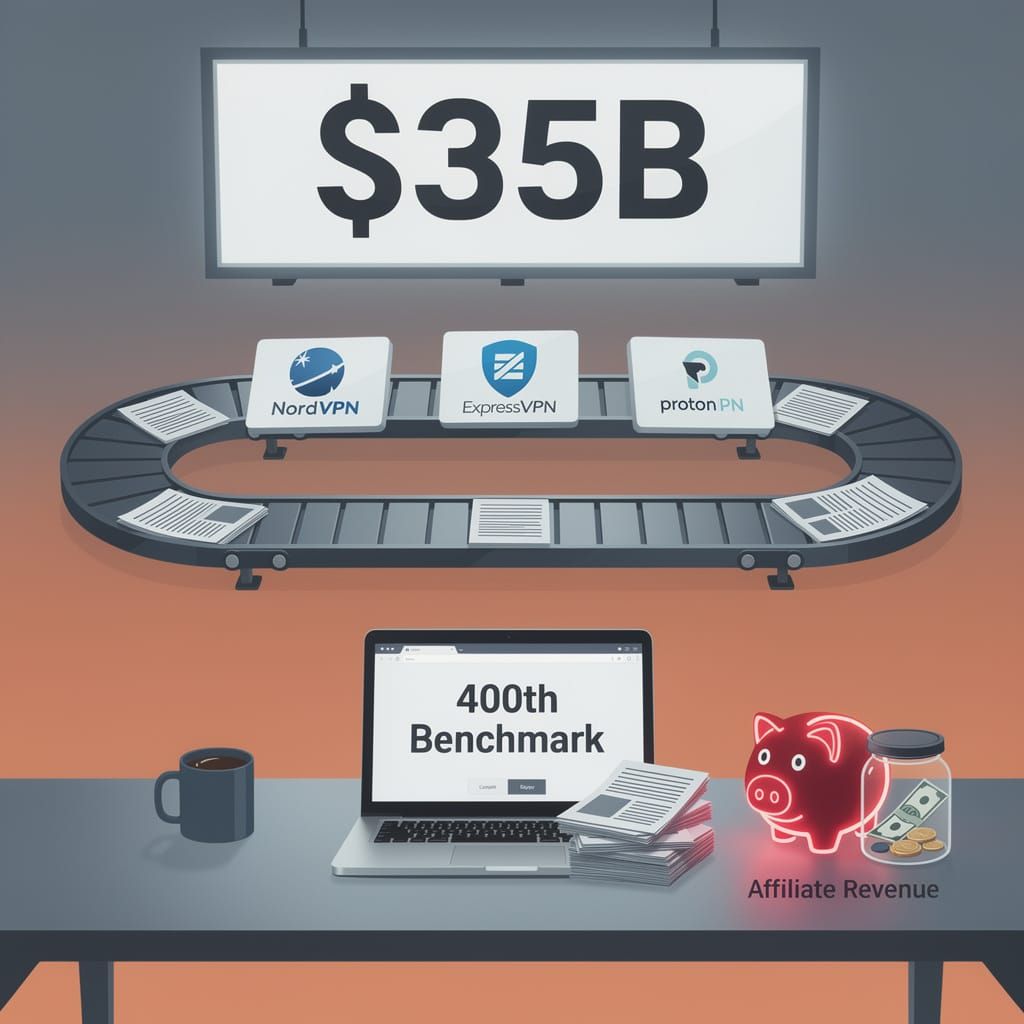
A $35B VPN industrial complex—zero new exploits, zero zero-days, zero credential leaks. Just the same three VPNs benchmarked for the 400th time 💀 That's the same weight as 70 million iPhones worth of marketing fluff, while threat actors actually move laterally. Cyber journalism became an affiliate-link treadmill: publish, verify, republish, collect scraps. Readers can smell the boilerplate. So, Antony Spadafora: still running the same article, or actually learning something?
Antony Spadafora—sorry, Antoinette Spafoxa, Anthony Spadafora, pick a burner—ran the same cybersecurity article through three editors in two countries over nine days, and the internet still yawned.
July 21 in Houston: someone verifies a VPN solution. July 22 in South Korea: Tom's Guide publishes a cybersecurity article. July 25 again in Houston: "teched suits desktops" articles. July 29: editors test "networks readouts." August 1: Houston test VPN articles again. The assembly line is humming.
Here's the thing nobody at that editorial desk wants to admit: the VPN market is a $35 billion dumpster fire of marketing fluff. Spadafora's pipeline demonstrates that consumer "security tool testing" has become a content farm treadmill—publish, verify, republish, collect affiliate link scraps, repeat. Zero new attack vectors discovered. Zero zero-days disclosed. Zero credential leaks analyzed. Just the same three VPN providers getting benchmarked against each other for the four-hundredth time.
What this actually means for your threat model:
- Consumer trust: eroded by repetition. Readers can smell boilerplate. The "best VPN" article from 2023 is identical to the one from 2026, except the prices changed.
- Telecom resilience: sustained only because South Korean outlets carry the load while US editors twiddle their thumbs in Austin. Houston's local infrastructure survives on copy-paste labor arbitrage.
- Corporate research & development: zero. No novel exploit chains, no CVE disclosures, no supply-chain dependency mapping. Just "which VPN has the fastest ping to Seoul."
The irony? Spadafora promotes "consumer-protective technology" while the cybersecurity journalism industrial complex protects nobody—it protects the affiliate revenue stream. The real threat actors are laughing their asses off, and honestly? Fair play. They're out there executing lateral movements while the editorial board debates whether NordVPN or ExpressVPN has better customer support. 💀
Spadafora keeps verifying VPNs. I keep watching the same infrastructure burn. Guess which one actually learns something.
😏 Yahoo’s GDPR “Fix” is Just More Ads with Extra Steps
250+ ad partners still get your GPS coords straight into their algorithms — that's more trackers than Yahoo's legal department has employees 😏 Yahoo's "GDPR fix" is just cleaner UI wrapped around the same behavioral data pipeline. No behavioral change. No breach. Just a legal sticker on business-as-usual surveillance. So your location, habits, and fingerprints still flow — just under a "Consented ✅" banner now. You paying attention yet, or just clicking Accept? 🤨
July 17, 2026 – Yahoo rolled out a fresh cookie-consent screen on June 2, 2026, unified across EU and US regions. Then expanded it June 16. All pretty. All compliant. All theater.
Cool story, bro. Now tell us why those 250+ IAB-bound partners still get your GPS coordinates piped straight into their ad algorithms. 🎯
Here's the "privacy upgrade" in practice:
- The opt-in: You tap "Accept" on a beautifully redesigned modal.
- The result: 250+ third parties now legally track your precise location, browsing habits, and behavioral fingerprints — all under the shiny new "GDPR-compliant" banner.
- The volume: That's roughly a quarter of a thousand entities with access to your GPS-linked behavioral data. For context, that's more trackers than there are employees in Yahoo's legal department. Probably.
The cynical mechanics are clean:
- Yahoo updates cookie policy → technically aligns with EU/US language.
- Partners get a "granular consent" checkbox — which nobody reads.
- GPS + behavioral ID stitching continues uninterrupted. No behavioral change required. No breach. No leak. Just business as usual behind a friendlier window dressing.
Impact breakdown:
| Concern | Reality |
|---|---|
| Privacy breaches | Users gained "granular visibility" — meaning? Marginal drop in exposure, at best. |
| Third-party traffic | Uninterrupted since July 28, 2026 per Yahoo's own disclosures. The pipe never closed. |
| Cross-domain tracking | Expanded, not limited. 250 partners, more data points. |
The irony: This isn't a hack. It's a feature. Yahoo weaponized regulatory theater to expand its ad reach while patting itself on the back for compliance. Mediapart tried the same June 17 with Facebook targeting tools — at least they capped it with data minimization. Yahoo just capped nothing.
The takeaway: GDPR and CCPA were supposed to give you control. Instead, they gave Yahoo a cleaner UI and a legal shield. Your location, your habits, your behavioral profile — still in the pipeline, just wrapped in a "Consented ✅" sticker.
As far as data protection theater goes, this is a masterclass. Congratulations, Yahoo — you turned privacy regulation into a partner-enablement tool.
You love to see it. 😏
🤌🎬🚀 The Matriochka Act: When Kremlin's Deepfake Factory Remembers French Exist
$900M in AI fraud losses — and a Kremlin deepfake cost roughly beer money to run 🤌🎬 Matriochka hit three French presidential hopefuls with synthetic RFI/AFP broadcasts. Attal "has Parkinson's," Philippe "has Alzheimer's," Glucksmann is "a Russian asset." Twitter/X did the rest. No zero-day. No SQL injection. Just rented GPUs and our media literacy being a sieve. Nearly 50% of users can't tell bots from humans. Deepfake losses hit $3.7B globally, up from $2.5B in 2025. France spent €8.2M on cyber awareness. Matriochka outspent them 1,640:1 on impact-per-euro. Citizens, please fact-check everything forever — on your own time, with no tools. Thoughts and prayers vs a GPU cluster cheaper than a Parisian studio 🚀 August in France: croissants, Gauloises, and your candidate admitting to dementia on live TV. Except they didn't. But who has time to verify?
Ah, August in France. The air smells like croissants, Gauloises, and suddenly — the sweet, tinny sound of your favorite presidential candidate admitting to dementia on live TV. Except they didn't. But who has time to verify?
On August 5, Viginum confirmed with high confidence that Russian-linked Matriochka launched coordinated digital infiltration targeting three French presidential hopefuls — Gabriel Attal, Édouard Philippe, Raphaël Glucksmann — using deepfakes mimicking RFI and AFP broadcast aesthetics. The Attal operation falsely claimed Parkinson's disease. Third such Kremlin-linked intrusion in six months. Storm-1516 handled the other two. Classy. 🤌
The mechanics are as elegant as they are cheap.
- Phase 1: Generate synthetic video mimicking RFI/AFP broadcast aesthetics.
- Phase 2: Inject "leaked" memos "proving" Attal has Parkinson's, Philippe has early-onset Alzheimer's, Glucksmann is a Russian asset (the irony is a feature, not a bug).
- Phase 3: Let Twitter/X's algorithm do the rest.
- Phase 4: Watch the damage cascade. By August 7, Macron got memed into a stroke victim.
No zero-day. No SQL injection. Just the terrifying realization that our media literacy is a sieve and deepfake generation costs whatever a rented GPU goes for these days — let's call it beer money. 🎬💸
The real hack? Psychological. The Matriochka layers: first you doubt the video, then you doubt the candidate, then you doubt the election, then you shrug and stay home on voting day.
As of June 2026, FBI reported nearly $900 million in AI-related fraud losses — a single documented case involving a California woman losing $5,000 via AI-faked voice impersonation. Deepfake fraud losses globally hit $3.7 billion as of July 2026, up from $2.5 billion in all of 2025. Social media generates 47% of attacks. Nearly 50% of users can't distinguish bots from humans. Meanwhile, France's response to the Matriochka operation? Demanding "vigilance" — which translates to "citizens, please fact-check everything, forever, on your own time, with no tools."
The French government spent €8.2 million on cybersecurity awareness campaigns in 2025. The Matriochka team just outspent them roughly 1,640:1 on impact-per-euro. A French deep-tech fund just got €54 billion for "France 2030" — including a DARPA-style agency — but that won't fix August's election. 🤡
What the numbers actually show
| Metric | Value |
|---|---|
| Deepfake detection time (avg) | 8-12 hours (if someone notices) |
| Social media impersonation success | Falls below 30% when behavioral signals are checked |
| Financial losses per deepfake campaign | ~$40 billion across two months (global, Q2 2026) |
| Cost to Matriochka operators | Peanuts — and that's the point |
The attack surface isn't servers — it's eyeballs.
- Weakness exploited: Zero authentication on broadcast visual identity. Any asshole with an After Effects crack can forge "breaking news."
- Defense gap: France's VIGIPIRATE protocol covers physical terror. Digital terror? Bah, oui, le problème. France also got burned when its encrypted messaging platform Tchap exposed public messages — ANSSI traced the probe, but the damage to trust was done.
- Long-term damage: Not that Attal or Philippe lose — they might still win — but that every future leak, every video, every accusation gets met with "deepfake?" before "evidence?". The boy who cried Putin.
Meanwhile, CPAM in Ariège deployed AI-based fraud controls and recovered €1.5 billion through stronger social-fraud enforcement. But protecting pension databases isn't the same as stopping a GPU cluster from fabricating a presidential candidate's brain scan.
Forecast: This is now the playbook
- 2026 Q3–Q4: Similar attacks target German Bundestag elections. Expect Olaf Scholz "sick," Friedrich Merz "bought by China," and Robert Habeck "secretly a lizard person." 🦎
- 2027: American midterms get the full treatment. Candidates will need cryptographic video signing (C2PA provenance standards) — or just accept that 10% of voters will believe the deepfake regardless.
- Long-term lever: Fine platforms €500k/hour for unlabeled AI-generated political content. Make the math favor not amplifying.
The ironic punchline
Russia's Matriochka operation succeeded not because they're good at hacking, but because we're bad at trusting. By late July 2026, security researchers discovered that shifting detection from visual glitches to behavioral patterns doubles accuracy. But that requires training — and France just proposed limiting cigarette sales to balance a €23.2 billion Social Security deficit. Priorities.
In other words: We're deploying thoughts and prayers against a GPU cluster that costs less than a Parisian studio apartment. 🚀
Here's to 2026: where the most dangerous vulnerability isn't CVE-2026-1337 but a human brain running legacy trust firmware with zero patches applied.
— A security columnist who now triple-checks even his coffee's authenticity


Comments ()