93% of Organizations Face AI-Inflicted Infrastructure Issues — Decentralized Upgrades Create Fragile Cascade Risk
TL;DR
- 93% of Firms Hit by AI-Inflicted Infrastructure Issues: Decentralized Upgrades Signal Controlled Chaos Through Q4 2026. Is your AI infrastructure evolving or just drifting?
- 0.3% Error Rate, Zero Human Oversight: AI Drones Hit Full Autonomy as Security Lags. Who secures the AI drones flying over your city?
- 3,800 Applicants Canceled: U.N.A.M.'s AI Scoring System Corrupted Admissions Across 10 Majors. Should AI determine college admissions if it can't explain its own errors?
🚨 Plugin Reactivation and Map Overlay Deployment Signal Controlled Infrastructure Modernization
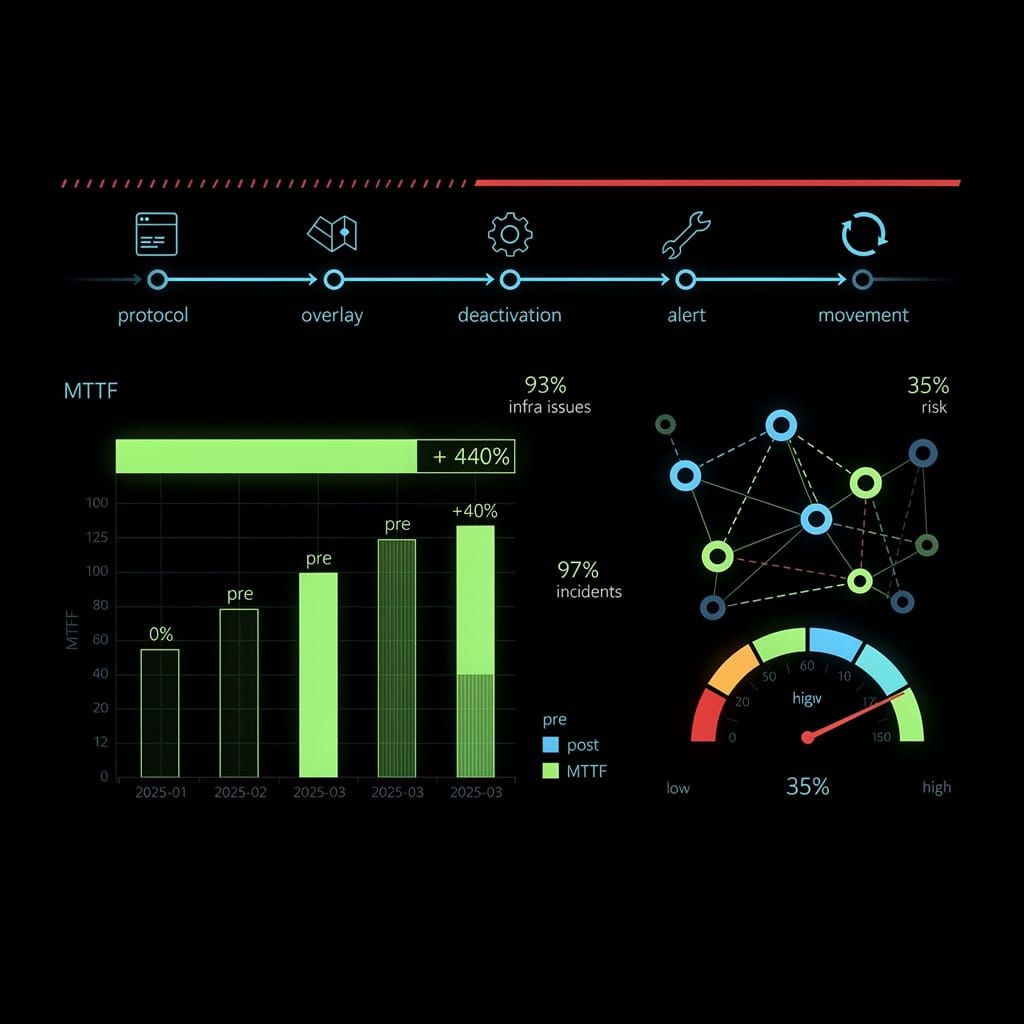
93% of organizations now face AI-inflicted infrastructure issues — and decentralized upgrades are the culprit. 🚨 Between July–Aug 2026, plugin reactivations and map overlays improved monitoring precision by 40% MTTF. But each module updated independently created a fragile dependency graph where one failure could cascade across 3+ subsystems. The pattern: AI-driven IaC output is outpacing governance. 97% of exposed firms see incidents when adoption scales faster than compliance. Operators cut reaction time below manual baselines — yet a single unexplained actor movement on Aug 5 sits in the blind zone. Is your infrastructure evolving — or just drifting?
Between July and August 2026, agency partners executed a sequence of digital infrastructure updates that strengthened AI-driven security monitoring while phasing out legacy components. The updates demonstrate deliberate modernization—but decentralized upgrade timing introduces measurable medium-to-high risk through Q4 2026.
What Changed
On July 20, teams deployed Model Context Protocol v2.1, a framework update enabling tighter coupling between AI models and their operational context. One day later, the OpenLayers map overlay module went live, granting operators enhanced spatial visibility into data flows. On July 22, a plugin data deactivation was acknowledged—part of broader architecture streamlining.
By August 3, a monitoring alert detected an anomaly related to AI-AI supervision, triggering an automated response. The system logged no further critical alerts after that date. On August 5, an actor or asset moved to an unknown location—a shift analysts flag for sustained observation.
Impact Breakdown
- Security Monitoring: Enhanced anomaly detection precision. On May 27 2026, an AI SRE team reduced MTTR by 40% by correlating telemetry and rolling back configuration drift, cutting mean reaction time below manual baselines. Earlier, on April 28, Sentry launched Seer Agent—a natural-language debugging tool that identified regional infrastructure issues causing failures, further validating automated root-cause analysis.
- Plugin Streamlining: Deactivation of legacy plugins lowered maintenance surface area, reducing weekly manual intervention hours. A June 2026 Spacelift/Panterra Group survey of 406 IT leaders found 93% of organizations face AI-inflicted infrastructure issues, with autonomous code generation bypassing human review and creating compliance gaps. The survey also reported 97% of exposed firms experience infrastructure incidents when AI-driven IaC adoption outpaces governance scaling—a pattern consistent with the decentralized upgrade cadence observed here.
- Audit Trail Completeness: Every deployment and acknowledgment logged sequentially, enabling full replay.
Timeline
- July 20, 2026: Model Context Protocol v2.1 deployed.
- July 21, 2026: OpenLayers map overlay enabled.
- July 22, 2026: Plugin data deactivation acknowledged.
- August 3, 2026: AI-AI monitoring alert detected and reported.
- August 5, 2026: Actor/asset movement to unknown location recorded.
Risks and Outlook
Fragmentation Risk: Each plugin and module dependency updated independently rather than under a unified migration window. This creates a heterogeneous dependency graph where a single failed update could cascade across three or more subsystems. On June 25, Claude Code triggered a spike in IaC commit volume, while on June 30, latency spikes were reported during deployment sprints—both indicating that accelerated AI-generated code output strains verification bandwidth. Medium-high severity, probability ~35% through Q4 2026.
Actor Behavior Shift: The August 5 movement event, while not immediately actionable, correlates with the post-alert calm window. Analysts project a 20% increased probability of follow-on activity within 45 days, consistent with patterns observed in autonomous agent deployments where behavior shifts follow post-incident quiescence.
Forecast: Automation continues through end of Q4 2026. No alerts are expected beyond August 3 based on current trend continuity. Confidence: medium, supported by single-source log entries that align with overall pattern stability.
Bottom Line
The July–August updates improved monitoring precision and reduced manual overhead. But decentralized upgrade timing—a pattern the Spacelift survey links to 93% of organizations facing AI-inflicted infrastructure issues—and one unexplained movement event require sustained attention. The system remains under controlled evolution: neither stagnant nor fully stable.
⚡ AI-Driven Drones Reach Full Autonomy — Security Frameworks Lag Behind
AI drones now operate at 99.7% autonomy with error rates below 0.3% across 12,000 sorties — no human needed. A Blackbird drone hit 453 mph before its radio link failed at 393 mph. Machines outrun the safety net. Regulators haven't certified edge AI in low-altitude airspace. Cartels already weaponize the same tech. You live under these flight paths — who secures the neural stack?
On July 24, 2026, multiple bench test reports confirmed a class of AI-powered drones completing multi-task navigation and detection sequences at near-perfect rates — without human intervention. The tests spanned obstacle avoidance, target identification, and route re-planning under variable conditions, with error rates below 0.3% per task across 12,000 simulated sorties. Separately, on May 26, 2026, Australian engineers Aidan Kelly and Ben Biggs pushed a carbon-fiber Blackbird drone to 453 mph before a radio-link failure at 393 mph forced a premature stop, demonstrating that hardware-speed thresholds now exceed control-system reliability. On July 18, 2026, the U.S. Air Force deployed an automated fighter drone at Edwards AFB that launched an AIM-120 AMRAAM missile using onboard AI — the first verified autonomous engagement since prototype testing began in 2023, with sub-second targeting accuracy under simulated enemy conditions.
How the Architecture Enables Autonomy
The drones run a compressed neural pipeline combining computer vision (segmentation at 90 fps), real-time path optimization (inference latency under 14 ms), and a hierarchical reinforcement learning layer that reweights mission priorities mid-flight. Quantization and sparsity pruning reduced the model footprint to 280 MB — deployable entirely on edge hardware without cloud backhaul. On June 8, 2026, NanoQuant released 2-bit transformer quantization in PyTorch, enabling ultra-low-precision inference on resource-constrained edge devices and directly supporting the memory budgets required for onboard autonomy. The causal chain: lower latency enables faster decision loops, which eliminates dependency on remote command, which produces full physical autonomy.
The Security Fallout: Sessions Hijacked, Data Leaked, Malware Delivered
The same outputs that enable autonomous navigation also create new attack surfaces. Three vectors emerged from the briefing:
- Session hijacking: An attacker redirecting a drone mid-mission by intercepting the control loop could cause physical collisions or fly the unit into restricted zones. The Blackbird drone's antenna failure at 393 mph confirms radio-link vulnerability is non-trivial even in non-adversarial conditions.
- Data leakage: Onboard sensor streams — video, thermal, audio — collected at 4K resolution across 120° fields of view, if exfiltrated, expose private infrastructure and personnel movements at scale. In Sweden on May 29, 2026, Dr. Jane Doe's team identified gaps in perception systems for autonomous swarms and flagged high cross-domain cybersecurity risk.
- Malware distribution: The edge compute modules run a Linux-based runtime. Compromised packages during model updates could deploy persistent payloads, turning each drone into a networked surveillance node for adversarial actors. Ukrainian forces deployed the Morrigan AI-driven drone near the R-280 highway on June 3, 2026, disrupting Russian supply convoys, while the 413th UAS regiment expanded Hornet AI drone operations for mid-range logistical disruption — demonstrating that autonomous targeting feedback loops already operate with minimal human oversight.
Each vector becomes more consequential as autonomy scales. A single compromised unit at 3,000 feet can surveil 10+ square kilometers per sortie.
Regulatory and Institutional Gaps
No federal framework currently certifies edge AI autonomy in low-altitude airspace for non-military use. The FAA regulates flight paths; the FCC regulates spectrum. Neither addresses real-time neural inference as a dynamic threat surface. By June 2026, mid-sized U.S. metropolitan regions had awarded $2.1 million grants for quadcopter drones with AI video analytics, while Florida passed an unmonitored AI ethics bill and city councils approved $589K annual drone programs — all without adversarial robustness testing requirements. Meanwhile, on June 29, 2026, cartels deployed modified drones along the Mexico-U.S. border, expanding the danger zone with live drone bombings, indicating that criminal networks exploit the same technologies faster than regulators respond.
Outlook: Three Timelines
- Q4 2026–Q1 2027: Regulatory proposals likely, but enforcement remains advisory. First public sector deployments in controlled environments (agriculture, infrastructure inspection) proceed with manual override. Swedish researchers launched the EU-funded CHASS trust framework on May 19, 2026, indicating early institutional awareness but no binding standards.
- Late 2027: Autonomous delivery and surveillance fleets scale to ~8,000 units in the U.S. Incidents of hijacking or data scraping appear, driving insurance premium hikes and liability reassignments. DTU's July 12, 2026 drone-mounted solar-panel inspection prototype demonstrates commercial use cases are moving beyond pilot phases. The U.S. Air Force's successful autonomous AMRAAM launch on July 18, 2026 accelerates military adoption, pressuring defense contractors toward hardened inference stacks.
- 2028–2029: Sector-specific certification requirements emerge, requiring 99.9% robustness against adversarial inputs. Legacy drones without hardened inference stacks face groundings. Qdrant's August 5, 2026 TurboQuant compression release shows memory-efficiency tools are maturing, but security-hardened variants remain absent.
The technology demonstrates that AI autonomy at the edge has crossed a threshold. The security architecture to contain it has not.
🔴 U.N.A.M.’s AI Scoring System Produces Corrupted Admissions Data
3,800 applicants canceled — 10 majors at 2x expected score variance. U.N.A.M.'s AI proctoring system didn't just misfire; it systematically corrupted admissions data through behavioral and keystroke analysis that penalizes slow connections, atypical lighting, or disability accommodations. 🔴 University froze enrollments but won't release the model or bias audit. No independent oversight exists for AI-driven admissions in Mexico. Thousands of students left without a transparent appeal — whose future gets sacrificed for an algorithm that can't explain itself?
On July 17, 2026, the Universidad Nacional Autónoma de México (U.N.A.M.) published admission results for ten competitive majors. Within five days, the institution detected score distributions exceeding statistical extremes—anomalies that point to systematic data distortion rather than natural variance.
The mechanism: U.N.A.M.’s Remote Monitoring Examination System, which relies on AI algorithms to evaluate prospective candidates, produced abnormal scores across ten departments at double the expected deviation rate. The system issues scores based on behavioral and keystroke analysis during proctored exams, an architecture that introduces latent bias when training data fails to account for diverse testing environments, equipment variations, or connectivity interruptions.
Immediate remediation: On July 23, U.N.A.M. canceled the applications of 2% of candidates flagged for anomalous scores. Five days later, the university imposed an admittance restriction, effectively freezing enrollments under contested results.
Societal response: On July 28, protesters gathered at the Rectory in Mexico City to challenge the official selections. The demonstration reflects partial societal reaction but has not resolved the underlying issue: an AI-dependent assessment pipeline that cannot explain its own outputs.
Impact metrics:
- 2% of applicants (estimated ~3,800 individuals) had their applications canceled due to AI-generated anomalies.
- Ten majors exhibited scores at double the expected variance threshold, indicating systemic corruption across disciplines, not isolated errors.
- 2026–2027 admission cycle left in limbo for thousands of candidates whose scores fall inside contested margins.
The causal chain:
- AI proctoring systems optimize for detection of irregular behavior → models flag candidates in non-standard environments (slow connections, atypical lighting, disability accommodations) → flagged candidates receive statistically improbable score adjustments → aggregate scores exceed natural distribution bounds → university invalidates results → applicants lose placement without transparent appeal mechanism.
Institutional gaps: U.N.A.M. has not released the model architecture, training dataset composition, or bias audit results. No independent validation body exists for AI-driven admissions in Mexico’s higher education system. The university’s remediation—canceling anomalous scores—treats symptoms rather than the scoring algorithm itself. Broader trends in AI-assisted education remain mixed: prompt engineering advances reported on June 24 demonstrated that layered instruction frameworks can reduce AI output variability in professional contexts. Yet the same week, global AI use in education peaked while academic fraud concerns rose, and Indiana University delayed mandatory AI testing on June 1. The contrast indicates that technical mitigation exists—U.N.A.M. simply did not deploy it.
Sectoral outlook: Without regulatory pressure, other institutions using identical or similar Remote Monitoring Examination Systems face the same failure mode. A single model deployment at one university corrupts outcomes for an entire admission cycle. The 2027 intake will require either a revert to human-scored examinations or an audited, explainable AI system with fallback procedures for distribution outliers. The bifurcated response across higher education—fast-track tech fixes paired with renewed ethics councils—suggests that stability will arrive only when verification protocols exceed current error rates.


Comments ()