30 nm Quantum Shift in Australia: Twistronics Risk vs Reward
TL;DR
- 30 nm Quantum Shift: UTS 'Twistronics' Faces Scalability Hurdles in Australia. Can mechanical twisting of 2D materials realistically scale for industrial quantum optoelectronic production?
- 288 GB/s Bandwidth Cap: AMD Versal Gen 2 Prioritizes Footprint Over HPC Performance. Is AMD's shift to Memory-on-Package a genuine innovation or a retreat from high-bandwidth memory bottlenecks?
- 15% Error Margin: Augsburg's 48-Electron Quantum Protocol Fails Chemical Accuracy Test. Can hybrid quantum encoding realistically achieve chemical accuracy if error rates remain at 15%?
🌀 The Twist in Quantum Emission
30 nm spectral shifts are staggering—roughly 3x the precision of static methods 🌀. But 'twistronics' relies on fragile lattice distortions. Is mechanical twisting really a viable path to mass production? Quantum engineers—can this actually scale beyond a lab bench?
Researchers at the University of Technology Sydney, led by Dr. Angus Gale, report a breakthrough in tuning quantum light emitters by stacking and twisting hexagonal boron nitride (hBN). By rotating nitrogen layers, the team claims to have bypassed the rigidity of static substrates, enabling the dynamic shifting of emitted light colors.
Does Geometry Solve the Tuning Problem?
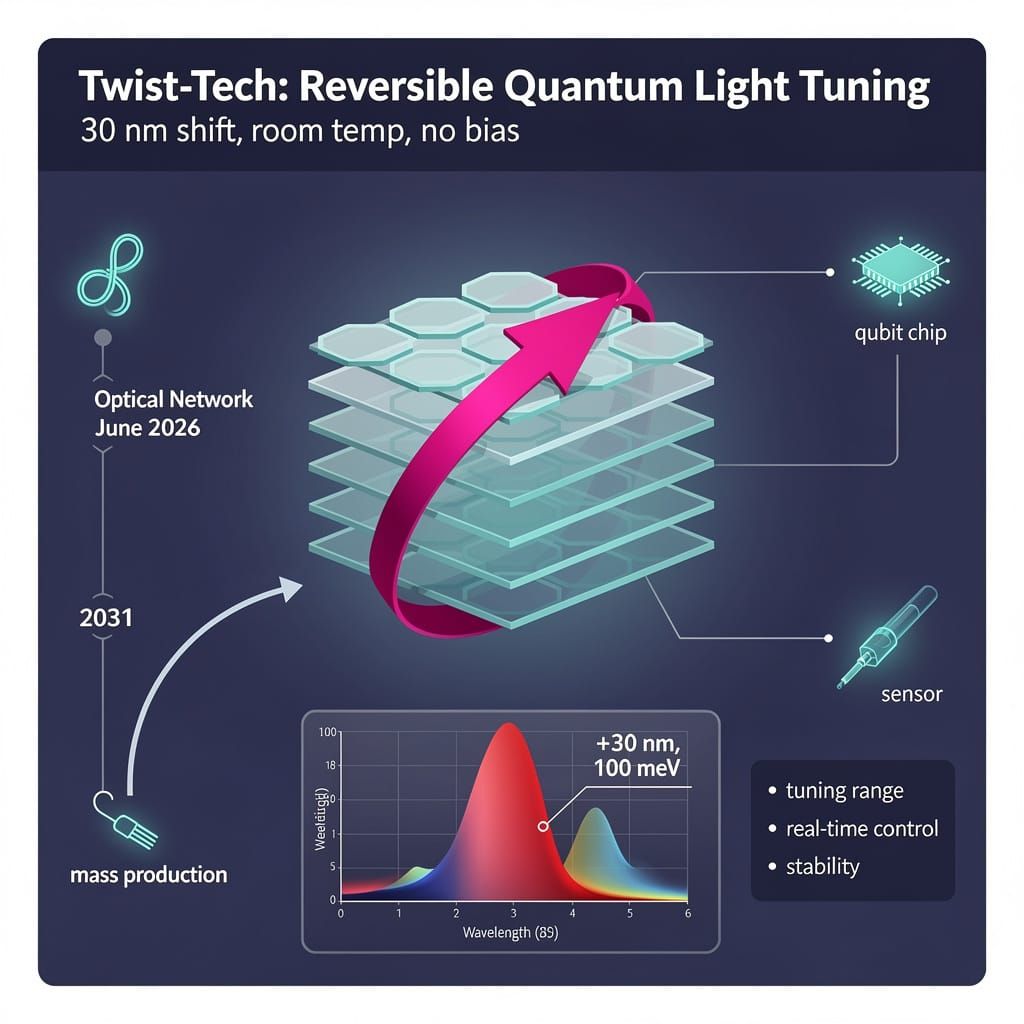
Traditional quantum emitters require exhaustive material fabrication to hit specific wavelengths. The UTS team attempts to resolve this through "twistronics." Reports from June 19 and June 25, 2026, indicate that rotating 2D material sheets enables spectral shifts of up to 30 nm (~100 meV), which exceeds previous static substrate methods. While the technical ability to achieve reversible control over individual emitters is evident, the claim that this overcomes scalability challenges remains debatable, as the mechanism relies on precise lattice distortion and atomic reconstruction.
Performance Metrics
- Tuning Range: Spectral shifts up to 30 nm, exceeding static methods.
- Control: Real-time, reversible modulation of quantum dot emission wavelengths.
- Stability: Room-temperature tunability achieved without external electrical bias.
Path to Integration
The research indicates a push toward functional, manufacturable quantum optoelectronic systems. However, the transition from a laboratory "twist" to a stabilized, mass-produced module is steep. The reported ability to perform post-fabrication correction of mismatches suggests a pathway to reduce error rates, but industrial integration with CMOS processes remains a projection. This aligns with a broader trend in quantum materials—such as the "magic-angle" effect validated at MIT—where precise angular alignment enables extreme physical properties.
- June 2026: Demonstration of 30 nm shifts and DFT model confirmation of atomic reconstruction.
- 2031 Projection: Integration of twisted-interface technology into scalable tunable quantum devices (estimated 5-year window).
Systemic Implications
If these results translate to industrial conditions, the impact spans three primary sectors, though significant technical hurdles persist:
Optical Networks: Large-scale wavelength shifts enable better wavelength-matching in circuits → results in denser multiplexing but requires extreme stability to prevent drift. Quantum Computing: Precise emitter tuning enables scalable qubit generation → reduces failure rates in device integration but demands repeatable angular precision. Quantum Sensing: Wavelength-tuned photon interactions can improve signal-to-noise ratios → enables higher-resolution sensing, demonstrated by related hBN research achieving a three-fold enhancement of ODMR contrast.
Despite the 30 nm shift, the reliance on mechanical twisting suggests a fragile architecture. Until the team demonstrates a method to lock these twisted layers into a rigid, chip-scale format without degrading the quantum state, this remains a laboratory success rather than a systemic hardware shift.
📉 Memory-on-Package: Solving a Footprint Problem, Not a Bottleneck
288 GB/s throughput is an underwhelming compromise—roughly 14x slower than HBM4E 📉. AMD’s Versal Gen 2 trades raw power for a 60% smaller footprint. Is this a breakthrough or just a supply chain retreat? Edge-AI users — is miniaturization worth the performance ceiling?
AMD's June 30, 2026, announcement of the Versal Premium Gen 2 Adaptive SoC integrates 32GB of LPDDR5X directly onto the silicon substrate. While marketed as a transition toward "chip-wide memory," the architecture primarily addresses physical dimensionality and supply chain volatility rather than dismantling the fundamental memory wall of high-performance computing.
Does Integration Equal Performance?
Moving to a Memory-on-Package (MoP) design results in a 60% reduction in PCB board area compared to discrete DRAM layouts, enabling system miniaturization for military payloads and compact AI data centers. However, the reliance on LPDDR5X—technology optimized for power efficiency—indicates a strategic compromise. The reported 288 GB/s throughput remains an order of magnitude below the 4 TB/s bandwidth achieved by HBM4E integrations from competitors like NVIDIA and SK Hynix.
Performance Metrics
- Throughput: 288 GB/s (Integrated LPDDR5X) → inadequate for exascale scientific workloads.
- Capacity: 32GB fixed on-substrate → creates a rigid hardware ceiling.
- Footprint: 60% reduction vs. discrete layouts → prioritizes mass budgets over raw compute.
The Integration Trade-off
Integrating memory onto the package binds the processor to a static capacity, removing the modular scalability found in traditional server racks. While AMD utilizes PCIe 6.0 and CXL 3.1 for expansion, the core compute remains tethered to the on-package limit. This shift is explicitly driven by supply chain failure; AMD is pivoting from HBM to LPDDR5X as HBM2e supplies dwindle and AI-driven demand shifts reduce FPGA relevance. This is a retreat to lower-cost DDR memory to bypass volatile HBM markets and high costs, not a leap in computational efficiency.
System Trade-offs
- Latency: Bypassing central controllers → lower latency for real-time edge analytics.
- Scalability: Fixed 32GB on-package → eliminates seamless in-field capacity upgrades.
- Durability: -40°C to 110°C operating range → targets ruggedized defense/industrial use.
Deployment Outlook
With sampling starting in late 2026 and volume production scheduled for mid-2027, the Versal Premium Gen 2 is a pivot toward the edge, not the core.
- Q4 2026–Q1 2027: Initial production rollout focusing on footprint reduction for edge-AI nodes.
- 2027 Q2–Q3: Mass shipment to aerospace, defense, and telecom sectors.
- 2028–2030: Market saturation in ruggedized hardware; potential shift toward 3D-stacked NAND/HBM hybrids to resolve the LPDDR5X bandwidth cap.
🧪 The 48-Electron Ceiling: The Mirage of Hybrid Encoding
15% error rate. This critical failure in 'chemical accuracy' is the reality of the new 48-electron hybrid encoding—roughly the gap between a successful drug and a toxic one 🧪. Theoretical gate reductions can't hide hardware instability. Quantum leaps or just academic mirages? University of Augsburg — is this actually scalable in real-world labs?
University of Augsburg researchers, led by Francisco Javier del Arco Santos and Jakob S. Kottmann, recently proposed a hybrid fermionic-bosonic encoding variant based on quantum valence bond theory. The protocol aims to bypass scalability bottlenecks in molecular simulation by mapping electron charge and vibrational motion onto compact qubit arrays. While the team claims this enables the simulation of structures with up to 48 electrons—a threshold supposedly unreachable due to impurity errors—the actual utility of this leap remains unproven.
Efficiency or Theoretical Exercise?
The protocol utilizes explicit bond topology to restrict information flow, reportedly requiring fewer than 21 logical gates. This attempts to counter the exponential gate growth seen in previous frameworks. However, the reported error rate remains under 15% compared to classical benchmarks. In high-precision quantitative chemistry, a 15% margin is not a breakthrough; it is a failure to achieve chemical accuracy.
Computational Metrics:
- Gate Logic: <21 gates → reduces overhead but ignores noise inherent in near-term hardware.
- Latency: Lower data movement → accelerates prototyping but relies on idealized circuit depth.
- Accuracy: <15% error → persists as a significant gap versus empirical ground truth.
Furthermore, the claim of "unreachable" thresholds is countered by broader industry trends. Recent simulations of T4-Lysozyme and Trypsin have already achieved a 40-fold increase in system size, suggesting that large-scale protein-ligand modeling is progressing via pathways independent of this specific hybrid encoding.
The Hardware Deadlock
Algorithmic efficiency cannot override physical instability. Current prototype chips struggle to sustain the coherence required for this protocol. While the Augsburg model targets 48 electrons, hardware reality remains fragmented and contradictory:
- Topological Limits: Microsoft and Atom Computing validated 24 logical qubits in November 2024, but Microsoft's Majorana qubit claims faced peer-review challenges in Nature in 2025, casting doubt on the stability of these milestones.
- Ion Trap Constraints: Quantinuum’s Helios chip processes up to 16 qubits with high reliability (99.92%), yet remains far below the scale needed for complex molecular systems.
- Industry Divergence: While IBM achieved an exact MIS solution on a 180-node graph using VQE in July 2026, analysts from IBM, Google, and Microsoft continue to warn that emerging quantum algorithms may offer limited utility in chemistry despite these hardware spikes.
Critical Gaps:
- Coherence: 24-logical-qubit benchmarks → restricts practical implementation of 48-electron models.
- Validation: Peer-review challenges to Majorana qubits → undermines confidence in topological scaling.
- Scalability: Dependency on error correction → results in a reliance on theoretical "fault-tolerance" not yet available at scale.
- 2026–2027: Slow integration into drug research labs as teams struggle with noise-mitigation.
- 2028: Potential for larger simulations only if qubit correlation stability improves by orders of magnitude.


Comments ()