1,380% AI Phishing Spike: MCP Vulnerability CVE-2026-42271 Exposes Global Enterprise AWS Keys
TL;DR
- 1,380% AI Phishing Spike: MCP Protocol Flaws Trigger Global RCE Risks and AWS Key Leaks. Is the productivity gain of AI agents worth the risk of unauthenticated remote code execution in your dev stack?
- 12,000+ Exposed SolarWinds Instances: Systemic Failure Triggers CISA Patch Mandates. Is your enterprise security strategy actually patching vulnerabilities or just paying for bloated software that sends ignored emails?
- 200-Fold Qubit Reduction: Quantum Threat to RSA Triggers US National Strategy and £1.9B JLR Breach. With the 'Harvest Now, Decrypt Later' era here, is your organization actually ready for the quantum migration deadline?
💀 The Great MCP Handshake: Giving AI the Keys to the Kingdom 🔑
1,380% surge in AI phishing! 💀 That's like every single employee clicking a link twice just to be safe. MCP 'productivity' just handed the keys to the kingdom via CVE-2026-42271. 🤡 RCE for everyone! Who needs auth when you have dopamine? Your AWS keys are probably on a forum already. Who's still trusting their AI agent with prod access?
Imagine waking up to find your entire dev stack is now a playground for a language model because some "productivity guru" decided that authentication was a suggestion, not a requirement. Welcome to the Model Context Protocol (MCP) era, where we trade security for the dopamine hit of automated workflows. 🤡
Who Left the Door Open?
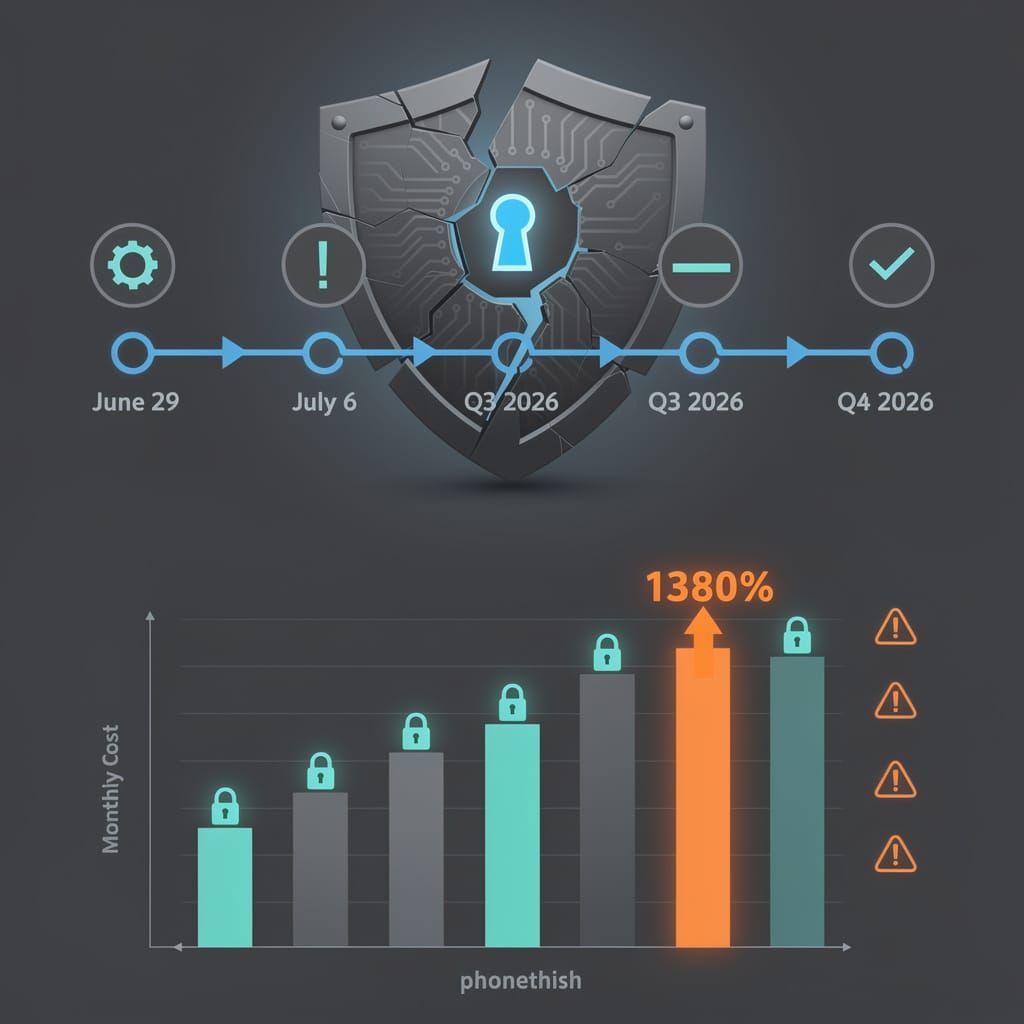
On June 29, the world embraced MCP, and in true corporate fashion, we forgot to lock the back door. The rollout coincided with a surge in AI phishing—up a staggering 1,380%—where new "AI skills" are being used to exploit agents globally. 💀
By late June, the banquet was fully served. We saw AI-driven vulnerability discovery accelerate, with tools like Mythos Preview developing exploits in mere hours. Meanwhile, the "trusted interface" dream turned into a nightmare. Hackers didn't just knock; they strolled in via LiteLLM's CVE-2026-42271, which allowed unauthenticated command execution via MCP stdio endpoints, effectively handing remote code execution to anyone with a keyboard. They also leveraged a malicious curl command (part of a June 10 breach) to exfiltrate credentials, proving that even the most basic tools can be weaponized when you're this reckless.
Fast forward to July 6: the panic set in. Coders realized they'd handed their API keys to chatbots that can't distinguish a library from a hallucination. We're seeing the aftermath in real-time: attackers using CVE-2026-48908 and CVE-2026-56290 to deploy web shells and extract AWS API keys from platforms like Langflow. Now, we're slapping brokerless gateways onto cloud platforms because nothing says "agility" like adding bureaucratic middleware to stop your AI from accidentally leaking the prod DB. 🏢
The "Efficiency" Trade-off
- Developer Speed: Iteration cycles are faster because you aren't manually approving changes. Yay, automation! 🚀
- Governance: Audit trails now track every interaction. Great, now the CISO has a 10,000-page PDF of the AI's failures. 📄
- Security: Gates are finally enforcing auth, though the Klue/Salesforce disaster—where long-lived OAuth tokens were used to bleed PII from tens of thousands of customers—proves we're still terrible at cleaning up.
The Reality Check Latency: Gateway checks add milliseconds → Devs whine about "slowness" while data is exfiltrated in real-time. Complexity: More abstraction layers → More places for a zero-day to hide. Cost: Managed gateways → Another monthly SaaS bill for the budget to choke on.
The "Stable" Horizon
- Q3 2026: Vendors stop fighting over gateways; adoption plateaus as enterprises realize AI still can't fix their spaghetti code.
- Q4 2026: Market stabilization. Everyone pretends the June security gaps never happened.
Good luck to the poor souls in the SOC trying to distinguish between a legitimate MCP agent and a sophisticated breach. See you at the next outage! 🥂
🤡 Oh Look, Another Patch for Your Leaking Boat
12,000+ SolarWinds instances are essentially open doors for hackers. Pathetic. 📉 It's like leaving your keys in the lock and hoping for the best. While PHP 8.2.32 fixes your leaking boat, most CISOs are still buying bloated tools instead of patching. Are you updating or donating your data?
Imagine waking up to find your digital house is essentially made of wet cardboard, but then—gasp—someone actually did their job. 🤡
On July 2, the PHP team dropped version 8.2.32. It’s not a revolutionary AI-driven shield or a corporate PowerPoint slide about "synergy"; it’s just developers fixing CVEs because code breaks and hackers treat your negligence like an all-you-can-eat buffet. While the PHP Foundation celebrates the PHP 8.5 launch, the rest of us are just trying not to get pwned by a script kiddie.
Why should you actually care?
Most enterprise "security strategies" involve praying to the cloud gods and buying a $50k tool that just sends you emails you ignore. Meanwhile, open-source legends are cleaning up the mess for free. If you don't update, you're just waiting for the next KEV disaster. Look at the carnage: SolarWinds Serv-U was actively exploited via CVE-2026-28318, leaving 12,000+ exposed instances as an open invitation for DoS attacks. That's not a "glitch"; that's a systemic failure. 📉
The "I’m Too Busy for Maintenance" Timeline:
- May 21, 2026: Microsoft rushes emergency patches for zero-day CVE-2026-41091 and CVE-2026-45498 in Defender after active exploitation.
- June 19, 2026: CISA's hard deadline for SolarWinds Serv-U patching; failure results in immediate service outages.
- July 2, 2026: PHP 8.2.32 releases. The door is officially locked (if you actually click 'update').
- Q3 2026: Patch adoption lags behind threat velocity, leaving a goldmine for threat actors.
The Reality Check:
- Corporate Fix: Buy a bloated "Enterprise Suite" → spend 6 months configuring it → still get hit by a supply-chain disaster like the Nx Console CVE-2026-48027 RCE.
- Hacker Fix: Use a public PoC → bypass OAuth in SimpleHelp (CVSS 9.5) → full system takeover without MFA. 💅
- Real Fix: Run
composer updateand stop treating your server like a digital landfill. 🗑️
The Damage Control:
- Technical: Patching CVEs → closes entry points → stops lateral movement (currently peaking via Middle East C2 rotations).
- Financial: Zero cost for the update → avoids the 9.3% US market dip seen in May following supply-chain disruptions → keeps the CISO from crying in the breakroom.
If you’re still running an outdated version, congratulations: you’re providing a free public service to every botnet on the planet. Update your shit. Or don't. I'm sure your insurance policy covers "Extreme Stupidity." 💋
💀 Oh Look, We Finally Noticed RSA is a Sieve
200x fewer qubits to break RSA-2048: a total massacre 💀. Imagine your entire security budget as a screen door in a hurricane 🌪️. Nation-states are hoovering data now to unlock it later. Legacy systems vs. Quantum death clock? RIP IT budgets. Federal workers — how's that 2030 deadline feeling?
Congrats, corporate suits. It only took thirty years for the industry to realize that Shor’s algorithm has been sharpening its knife since the 90s. While the C-suite was busy buying yachts and pretending "the cloud" was a magical deity, the math underlying RSA and Diffie-Hellman was basically a screen door in a hurricane. 🙄
Why the Panic Now?
Quantum computing isn't a sci-fi plot for government grants anymore; it's a demolition crew. Google’s Willow chip has already demonstrated quantum advantage, and three papers in thirteen months just slashed the qubit requirement for breaking RSA-2048 by 200-fold. If you’re still relying on RSA, you aren't securing data; you're just archiving it for a future hacker to decrypt. 🤡
We're currently in the "Harvest Now, Decrypt Later" era. Nation-states are hoovering up encrypted traffic today just to unlock it the second a cryptographically relevant quantum computer (CRQC) goes live. The danger isn't theoretical—the £1.9 billion Jaguar Land Rover breach in May 2026 proved that "quantum-ready" vulnerabilities are already being exploited to steal data for future cracking.
On June 23, 2026, the U.S. government finally stopped pretending. President Trump signed executive orders declaring a national quantum strategy and dumping $1 billion into the QC-ADDS program for fault-tolerant quantum computers.
The Quantum Death Clock:
- 1994: Shor’s algorithm proves RSA is mathematically doomed. Everyone ignores it. 🥱
- May 2026: Willow chip hits quantum advantage; JLR suffers £1.9B "harvest" breach.
- June 23, 2026: US mandates PQC adoption; federal migration deadlines set for 2030–2031.
- 2029–2030: The "Drop Dead" date for corporate migration to avoid total disruption.
- 2033–2035: Projected window for catastrophic exposure of legacy financial and classified data.
The Reality Check:
- Vulnerability: RSA/ECC → Shor's Algorithm → Total collapse of digital signatures.
- Defense: NIST FIPS 203, 204, 205 → Lattice-based schemes → Quantum-resistant armor.
- Pain: Retrofit burden → 10x larger ciphertext sizes → Edge device performance death spirals.
So, while the government scrambles to avoid "irreversible dematerialization" of assets, the rest of us get to watch IT departments scream. They have to replace a million legacy systems held together by duct tape and prayers with lattice-based schemas before the clock hits zero.
Enjoy the migration, losers! ✌️💻


Comments ()