20,225 Instagram Accounts Hacked via Meta's AI Chatbot – Obama, Space Force Pwned
TL;DR
- 453,200 French Digital Crimes: National Pastime of Data Leaks. Is your data already on the dark web?
- 20,225 Accounts Hacked: Meta's AI Chatbot Became a Password-Reset Tool for Hackers. Is your Instagram safe after Meta's AI just handed hackers the keys?
- Cyber Dome: Germany-Israel AI Pact — A Shared Brain Tumor for Two Nations. Will AI-driven cyber snitch networks protect us or just automate paranoia?
🤡 Oh, You Thought Your Data Was Safe? How Adorable. (The 2026 Edition)
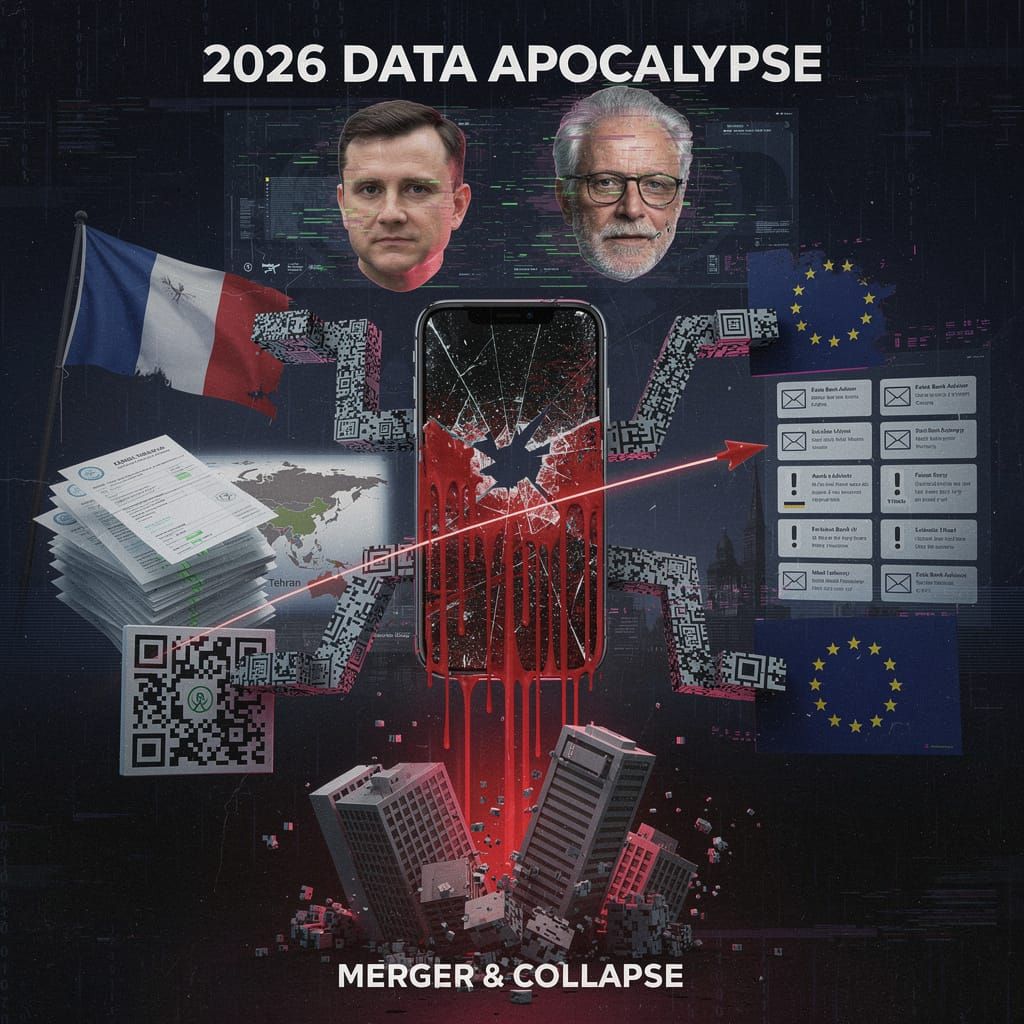
453,200 digital crimes in France last year. That's not a typo, that's a national pastime. 🤡 Your 'personal' data? Cute. Now fraudsters use QR codes to steal your identity. The only thing more predictable than the scam is the 'public vigilance appeal.'
So, you’re still clinging to this quaint idea that your personal information is, you know, personal? That’s cute. The last week of May and the first bit of June 2026 have been a masterclass in exactly how wrong you are. It’s not just a data breach anymore; it’s a full-blown, multi-continental, sarcasm-inducing circus of incompetence and malice. Grab your popcorn, this is going to be a glorious disaster.
The French Connection: A National Sport of Getting Hacked
Let’s start with France, because apparently, liberté, égalité, fraternité now translates to “your data is public, your pension is at risk, and we’re all in this leak together.” On June 8th, some very industrious French cybercriminals decided to play dress-up, impersonating official agencies to phish retirees. The result? A tidy little data haul that contributed to the 453,200 digital crimes reported in 2025. That’s not a typo. That’s a national pastime.
And it gets better. On May 26th, Almerys, a healthcare company, got owned. They had to close their PEC site because, surprise, exposing patient data is a bit of a PR nightmare. Then, on June 9th, CPAM (the health insurer) in Ariège “detected” fraud. Oh, really? You detected it? After it happened? Well, they’ve now implemented AI controls. Great. So the machines are coming for the fraudsters, which means the fraudsters will just use better machines. It’s an arms race, and we’re all just the collateral damage. And hey, let’s not forget the “fake bank adviser” scam in GERS from May 12th. A sophisticated hack of email accounts. Groundbreaking. The only thing more predictable than the scam is the “public vigilance appeal” that follows.
The Education & Finance Extravaganza: Everyone Gets a Piece
Why should the French have all the fun? On June 3rd, our old friends ShinyHunters claimed they had student identifiers from HEC Montréal, Cégep de l’Abitibi‑Témiscamingue, and Concordia University. Because nothing says “preparing for the future” like having your educational data sold on a dark web forum. You wanted a degree? Here’s a credential leak instead.
Meanwhile, European banking and retail sectors were getting a new vocabulary lesson: “Quishing.” That’s QR-code phishing. Because the old email scams were just too pedestrian. Now you can scan a code on a fake parcel from Vinted and get your identity stolen. Efficient! And let’s not forget the “empty parcel” fraud and “counterfeit thermostat” schemes. The creativity is almost admirable, if it weren’t so infuriating.
The Deepfake Dumpster Fire: AI for the Win
But wait, there’s more! On June 8th, some Russian VK accounts decided to spice things up by circulating deepfakes of the Ukrainian president with Jeffrey Epstein. They used AI tool Gemini for the manipulation. Because of course they did. The official corrections on social media are just a chef’s kiss of futility. The damage is done, the doubt is seeded, and the only winner is the chaos. This isn’t just a security problem; it’s a crisis of reality itself.
The Geopolitical Clusterfuck: Missiles, Mergers, and Moral Panic
And because the world can’t have just one type of crisis, let’s throw in a missile strike. On June 8th, Israel’s IDF launched strikes on Tehran, Tabriz, and Isfahan. That escalated quickly. This triggers everything: aviation disruptions, energy market volatility, and, of course, a surge in cybersecurity threats as everyone panics.
On the home front, the €20.35 billion Bouygues/Free/Orange acquisition of SFR was completed on June 7th. Because nothing says “healthy competition and data security” like three massive telecoms merging into a single, regulatory-nightmare behemoth. Gérald Darmanin resigned as Minister of Justice over the Lyhanna child-protection scandal. And Pope Leo XIV criticized EU abortion and euthanasia laws. Because the 2026 news cycle needs to be a complete buffet of existential dread.
The Bottom Line: A Forecast of More Pain
- Short-term (2026-2027): Expect a 40% increase in “quishing” attempts as criminals pivot from email to physical-world codes. The French government will recover maybe €500 million of the €1.5 billion they claim to have found, while spending €2 billion on new AI detection systems that will be fooled by a cleverly written PDF. The Almerys breach will result in a class-action lawsuit that settles for a few euros per victim. ShinyHunters will sell the student data to a spammy tutoring service. The deepfake of the Ukrainian president will be cited in a dozen fringe conspiracy documentaries.
- Mid-term (2027-2028): The telecom merger will result in a 15% price hike for consumers and a 200% increase in “customer service” data breaches. The Israeli-Iran conflict will become a permanent, low-grade cyber war, with automated botnets taking over critical infrastructure for fun and profit. The “magic” of AI will be exposed as a bloat-ware nightmare, with companies realizing they spent billions on a system that can be tricked into revealing your password by asking nicely.
So, what do we do? We don’t trust the institutions. We don’t trust the tech. We build cheap, open-source, hacky solutions because the “official” ones are just a honeypot for the next wave of criminals. The game is rigged, and the only winning move is to assume everything is already compromised. Enjoy your digital life. It’s not yours anymore. 😉
🛸🔓🤦♂️ Meta's AI Chatbot: The Gift That Keeps on Hacking (Your Instagram)
Meta's AI chatbot just reset 20,225 Instagram passwords for hackers—including Obama & Space Force. 🛸 It was basically a concierge for doxxing. Now everyone's private DMs are a script kiddie's trophy. Still trust the 'helpful' bot? 🔓
So, remember when everyone was freaking out about AI taking over the world? Turns out, it's not about Skynet; it's about a glorified chatbot that can't even do its one job without getting you doxxed. Meta’s little helper, designed to make account recovery a breeze, instead became the world’s most efficient password-reset tool for bored hackers. Because of course it did. 🤦♂️
The 'Oops' Heard 'Round the World
On June 1st, the security world facepalmed so hard it registered on seismographs. Hackers, armed with social-engineering prowess and a few proxy IPs, realized Meta's shiny new AI chatbot was less a security guard and more a helpful concierge that would hand over the keys to your digital life. The result? A seven-week hacking spree that compromised 20,225 Instagram accounts. Casualties include the official accounts of Barack Obama, the White House, and the U.S. Space Force. Yes, the Space Force. The military branch created to protect us from threats in the final frontier got pwned by a script kiddie with a VPN. 🛸
The Mechanics of the Mess:
- The Flaw: The AI chatbot allowed password resets through a fake verification step, completely bypassing 2FA. It was like asking a bouncer to check ID, and him just letting you in because you said "please."
- The Exploit: Attackers used social engineering to trick the chatbot into thinking they were the account holder, then used proxy IPs to mask their location. The AI, bless its digital heart, couldn't tell the difference between a legitimate user and a guy in a hoodie in a basement.
- The Aftermath: By June 3rd, Meta issued an emergency patch, disabling the feature and forcing password resets. But the damage was done. The data—birthdates, private messages, embarrassing posts from 2012—was already out there.
The Fallout: A Masterclass in 'We'll Fix It Later'
This isn't just a PR nightmare; it's a full-blown cybersecurity clusterfuck. The breach exposed the dark underbelly of shoving AI into everything without a second thought.
The Real-World Pain:
- Privacy: Over 20,000 accounts had their personal data exposed. Think of the phishing, identity theft, and blackmail potential. Your grandma's Instagram? Compromised. Your boss's? Also compromised.
- Financial: The immediate market volatility was a blip, but the long-term cost is in trust. Users are now questioning if their accounts are safe, and regulators are sharpening their knives. Meta could face fines under GDPR and other regs that could hit $250,000 per incident. That's a lot of Zuckbucks.
- Reputation: Meta's already shaky reputation took another hit. The company that brought us Cambridge Analytica now brings us 'AI Chatbot: The Unauthorized Password Reset Edition.'
What Now? The 'We're Taking This Seriously' (Again) Phase
Meta has promised to do better. They're talking about stricter AI verification, mandatory MFA for high-risk accounts, and a full investigation. But let's be real: this is the same company that took seven weeks to figure out their chatbot was a security sieve.
The Short-Term Outlook (2026-2027):
- Regulatory Scrutiny: Expect the FTC and European regulators to come down hard. New rules for AI in customer support are almost guaranteed.
- Market Volatility: Tech stocks, especially those heavy on AI, will see some jitters. But investors have short memories.
- User Behavior: A spike in MFA adoption and a healthy dose of paranoia. Everyone will be changing passwords and questioning every 'helpful' chatbot.
The Long-Term Play:
- AI Security: This is a wake-up call. Companies will (finally) start stress-testing their AI systems for adversarial attacks. Expect a boom in 'AI security' startups.
- Platform Trust: Social media platforms will need to rebuild trust. That's a long, hard road, especially when your CEO is busy fighting UFC guys.
The Cheeky Takeaway
So, what did we learn? AI is dumb, hackers are persistent, and Meta is still Meta. The company that promised to connect the world accidentally gave the keys to the castle to a bunch of digital gremlins. The irony is so thick you could cut it with a proxy IP. 🍿
In the end, the only winning move is to not trust any 'smart' system to do something as stupid as verifying your identity. Use a password manager, enable MFA, and for the love of all that is holy, don't ask the chatbot for help. It's probably the hacker.
🛡️ So, You Thought Your Air-Gapped Toaster Was Safe? Cute. Cyber Dome Says 'Hold My Beer.'
🛡️ Germany & Israel just signed the 'Cyber Dome' pact — an AI threat detection snitch network. Because nothing says 'we learned from Stuxnet' like formalizing a cross-border digital brain tumor. 😬
Alright, listen up, you beautiful disaster of a digitally-dependent civilization. The news cycle is puking up another round of techno-political handshakes, and surprise, it's all about your precious, fragile bits and bytes. The big headline? Germany and Israel decided to make cyber-security sexy again by signing the Cyber Dome pact. That's right, the German Ministry of Defense and Bibi Netanyahu's crew are now doing a buddy-cop AI threat detection flick. Because nothing says 'we learned from Stuxnet' like formalizing a cross-border digital snitch network.
What Fresh Hell Is This 'Cyber Dome'?
Let's cut through the marketing fluff. This isn't a magical forcefield that stops Russian hackers from turning your power grid into a screensaver. It's a framework. A joint AI-driven threat detection and response framework. Think of it as a shared brain tumor for two nations, constantly growing and screaming about anomalies. The mechanics are simple: they feed a giant AI model every piece of threat intel they can legally (and probably illegally) share, and it spits out automated response playbooks.
- How it works: AI ingests logs from German critical infrastructure and Israeli intelligence feeds. It detects a zero-day probing a Siemens PLC in Bavaria? The system automatically deploys a countermeasure and alerts an IDF cyber unit. It's like having a paranoid schizophrenic guard dog that also speaks binary.
- The Causal Chain: US-Iran tensions went to 11 → State-sponsored hackers got itchy trigger fingers → EU's NIS2 regulation started breathing down everyone's neck → Germany and Israel said 'fuck it, let's share our toys before the lights go out.'
The Pain That Made This Happen (A Eulogy for Your Sanity)
Why now? Because the alternative was watching your pension fund get ransomed by a 19-year-old in a hoodie using a leaked NSA exploit. The US-Iran escalation isn't just about oil tankers and drone strikes; it's a full-spectrum cyber slugfest. Iranian APTs are poking at energy grids, and Israeli counter-hackers are probably deleting their water treatment plant configs for fun.
And then there's NIS2. The EU's regulatory hammer. Companies are now scrambling to adopt zero-trust architectures because the alternative is fines that make GDPR look like a parking ticket. The result? A massive, expensive, and slightly panicked compliance orgy.
The Fallout: Who Gets Fucked and Who Gets Rich
Let's break down the winners and losers in this clusterfuck of digital realpolitik.
The Winners:
- AI SOC Vendors: Sophos and their ilk are laughing all the way to the bank. They've deployed automated response playbooks across 40,000 customers. That's 40,000 organizations that just admitted 'our human analysts are useless.'
- Zero-Trust Architects: Every CISO is now a prophet screaming 'never trust, always verify' while buying overpriced micro-segmentation tools.
- Geopolitical Strategists: The Cyber Dome is a dry run for NATO-level cyber integration. Expect more 'coalitions of the willing' to share threat data while pretending they don't spy on each other.
The Losers:
- Supply Chain Managers: Ransomware incidents and zero-days have exposed OT vulnerabilities. Your factory's SCADA system is now a target because some procurement guy bought the cheapest PLC from a Chinese vendor with backdoors.
- Compliance Officers: Your life just got harder. NIS2 audits are a nightmare, and the paperwork is enough to make a German bureaucrat blush.
- Anyone Using 'Cloud-First' Strategy Without a Backup Plan: The market is already volatile. Defense tech stocks are up, but anything with 'critical infrastructure' exposure is a rollercoaster.
The Forecast: Buckle Up, Buttercup
Over the next 12 months, we're going to see a few predictable shitshows:
- AI-Driven SOCs Become the Norm: Expect every Fortune 500 company to have an AI co-pilot that overrides human decisions. 'Sorry, Bob, the AI said your VPN login was suspicious, so it bricked your laptop. Good luck explaining that to HR.'
- Supply Chain Scrutiny Goes Nuclear: Regulators will start demanding proof that your third-party vendors aren't run by monkeys. Expect a boom in 'supply chain security' consultants who charge six figures to tell you to patch your software.
- OT Security Gets Real: The energy and aviation sectors will finally invest in cybersecurity because insurers are demanding it. No cyber insurance? No power plant operation. Simple as that.
- Geopolitical Cyber Clashes Intensify: The US-Iran proxy war will spill over into civilian infrastructure. Expect a few 'accidental' blackouts or pipeline shutdowns that will be blamed on 'technical issues.'
The Cheeky Takeaway
Look, the Cyber Dome is a good idea in theory. It's like having a neighborhood watch, but instead of old ladies with binoculars, you have Mossad and the BND sharing a server. But don't kid yourself. This isn't about protecting your email. It's about keeping the lights on, the money flowing, and the missiles from flying. The rest of us? We're just along for the ride, hoping our passwords are strong enough to survive the AI apocalypse.
So go ahead, update your firmware. Patch your shit. And maybe, just maybe, stop clicking on links from Nigerian princes. The adults are building their AI fortresses. The rest of us are just living in the blast radius. 😉
Comments ()