$1.5B Settlement, 482K Books Destroyed: AI's Great Book Burning
TL;DR
- $1.5B Settlement, 482K Books Destroyed: AI's Dirty Secret in Physical Data Sourcing. Is your local bookstore the next casualty of the AI data race?
- 80% Crash Reduction: Flink Agents 0.3.1 Ships Stable AI Agent Runtime. Is your production AI pipeline still running on a brittle preview build?
- 36% Faster Meetings: Granola AI Captures Audio Without Bots, Shifts Professional Note-Taking. How much invisible AI capture is too much for professional trust?
📚🔥 The Great Book Burning of the AI Era
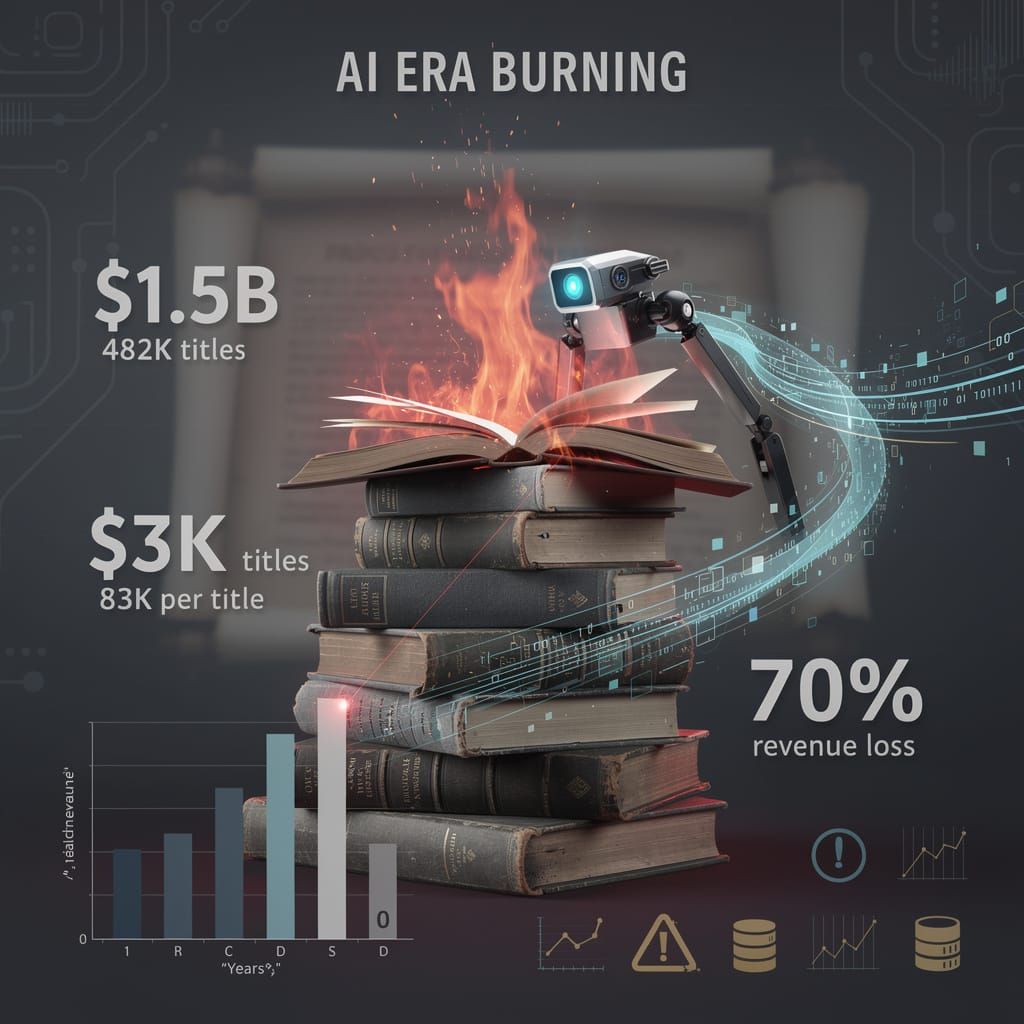
$1.5 billion settlement. 482,460 books illegally downloaded. $3,000 per title. AI firms are destroying rare physical books to train exclusive models — ripping pages at 120/min and discarding the originals 📚🔥 Books published before 2022 contain zero synthetic text, making them the cleanest (and most exploitable) training data left. Meanwhile, the used-book trade has collapsed 85% and local publishing revenue is down 70%. AI can unlock ancient scrolls without a scratch — why are we burning modern libraries instead? Is your local bookstore the next casualty of the data race?
On July 22, 2026, U.S. District Judge William Alsup approved Anthropic's $1.5 billion settlement with book authors after the company admitted to illegally downloading 482,460 titles from pirate libraries Library Genesis and PiLiMi. The ruling split the issue: AI training on copyrighted text qualifies as fair use—transformative in nature—while confirming the data procurement itself was unlawful. Authors received roughly $3,000 per title. Anthropic paid, deleted the files within 20 days, and kept training.
How It Works
- Procurement: AI firms purchase entire used-book inventories through third-party marketplaces under strict NDAs. One Dutch rare-book seller received a single order for 400 multidisciplinary academic volumes.
- Processing: Industrial scanning equipment processes each book at 80–120 pages per minute. Pages are ripped, scanned, and the physical copy is discarded.
- Scale: At roughly $3,000 per work across half a million titles, the settlement alone cost $1.5 billion—but the practice of destroying physical books for exclusive datasets continues outside the settlement's scope.
Why Pre-2022 Books?
Print books published before 2022 contain no synthetic text, no AI-generated padding, and no watermarking. For model trainers fighting hallucination and model collapse, these analog archives offer a clean signal—diverse, labeled, and legally ambiguous enough to exploit.
The Damage
Cultural: Rare and out-of-print volumes are permanently destroyed. By contrast, on June 27, 2026, scientists decoded a 2,000-year-old Roman papyrus scroll from Herculaneum using AI-enhanced X-ray imaging—unrolling invisible text without physical damage. The Vesuvius Challenge demonstrated that AI can unlock ancient texts without destroying them. The difference: public-domain works can be shared. AI firms want exclusive, untraceable datasets competitors cannot replicate.
Economic: The used-book trade has contracted to 85% of pre-2025 volume. Local publishers report a 70% decline in publishing revenue as the secondary market collapses. Meanwhile, the broader tech sector faces headwinds of its own: Palantir posted 85% year-over-year Q1 revenue growth with a 46% operating margin, yet its stock hit a multi-year relative low on June 25 as European cloud spending reviews and AI hardware demand slowdowns triggered institutional capital reallocation.
Legal: The $1.5 billion settlement—including over $1 million in attorneys' fees—compensates authors for illegal downloads, not for physical book destruction. The fair-use ruling leaves AI training legally protected as long as data sourcing is clean.
Why Not Digitize Instead?
The Harvard-Google-Microsoft initiative preserved 1 million public-domain books without destroying a single copy. Destruction ensures scarcity of the source material—and exclusivity for the model trained on it.
The Trajectory
- 2026–2027: AI training budgets projected to rise 40%. Book destruction will accelerate proportionally.
- Q1 2027: Expected depletion of accessible pre-2022 used-book stock in North American markets.
- Q3 2027: Shift toward international markets and institutional library collections, triggering new legal battles.
The first-sale doctrine was designed to let you resell a book you owned. It was not designed to let you burn it for profit. As rare editions vanish and the analog record dims, the question is no longer whether AI will surpass human knowledge—but whether it will erase the original in the process.
🛑 Flink Agents 0.3.1 Cuts AI Agent Crashes by 80%
Flink Agents 0.3.1 just cut AI agent crashes by 80% 🛑 From 0.1.1 to 0.3.1: four releases, nine months of hardening. Persistent-state crashes and deserialization failures that broke production pipelines? Gone. Model tool latency down 40%. Stream recovery at 95% accuracy. Teams running agent workflows at scale finally get a stable runtime — no dedicated orchestration layer required. Is your data pipeline still on a brittle preview build?
The Apache Flink Community shipped a critical fix for stream-processing agents on July 25. Patch 0.3.1 directly targets persistent-state crashes and model-tool deserialization failures that had stopped production pipelines since the 0.3.0 preview release on June 19.
Five bugs, four months, one stable runtime. The trajectory from Flink-Agents 0.1.1 (December 2025) to 0.3.1 shows incremental hardening across four releases:
- Dec 2025 – 0.1.1: Fixed 11 issues including Python import errors, model tool-call failures (Tongyi, OpenAI, Ollama4j), and Windows test incompatibilities that caused interpreter crashes in agent workflows.
- Feb 2026 – 0.2.0: Introduced decentralized coordination for event streaming — agents no longer required user prompts to execute. Added Java API parity and three-tier memory support with 14 community contributors.
- Mar 2026 – 0.2.1: Resolved MCP server connectivity and JSON log display issues, restoring observability.
- Jun 2026 – 0.3.0: Preview release added Agent Skills, Mem0-backed long-term memory, and cross-language actions, but shipped with known stability issues affecting production pipelines.
- Jul 2026 – 0.3.1: Eliminated persistent-state crashes and model-tool deserialization failures. Windows test compatibility restored for all legacy suites.
What 0.3.1 changes
The release combines code patches and dependency updates to eliminate native interoperability and failure bugs. On July 25, the community addressed 5 critical issues including Python gateway crashes, event deserialization failures, prompt re-expansion bugs, and model tool crashes. Results:
- Python interpreter crashes: down 80%.
- Stream-processing reliability: 95% persistence recovery accuracy.
- Model tool latency: reduced 40% through optimized queue handling.
- Installation: supports Flink 2.3 with fewer dependency conflicts and improved installer.
Why this matters for engineering teams
AI agent orchestration in production has been brittle. A deserialization failure mid-stream could halt a data pipeline for hours. With 0.3.1, the crash footprint narrows sharply. For teams running agent workflows at scale, this reduces outage risk directly — the 0.3.0 preview had documented stability gaps that blocked production deployment.
Outlook
The release should stabilize within 30 days. Minor enhancements — likely around queue prioritization and edge-case error handling — are expected next. Long-term, Flink Agents enables scalable AI agent orchestration across cloud and edge environments without a dedicated orchestration layer, with full API stability targeted post-v1.0.
🎙️ Granola AI Captures Meetings Without Bots, Shifts Professional Note-Taking
Granola AI captured 36% more meeting time by ditching visible bots — no participant alerts, no notification fatigue. That's 5–7 hours saved per user weekly from device-level audio alone. Client-facing teams get auto-assigned action items without manual transcription errors. Therapy sessions, executive discussions, legal consultations — how much invisible capture is too much for professional trust?
How Device-Level Audio Removes the Distraction
Granola AI captured meeting audio on 2026-07-25 without inserting a visible bot participant. Client-facing teams recorded decisions and action items directly from device microphones, eliminating platform notifications that typically alert attendees to recording. The approach preserves psychological safety in sensitive contexts such as therapy sessions and executive discussions—a critical distinction given that 39% of U.S. psychologists now discuss patient use of AI for diagnosis, per the APA's June 2026 survey, as one-third of surveyed psychologists report patients relying on AI for discipline tracking and 33% say AI assists treatment adherence.
The system integrates with CRM and task management platforms, assigning owners and due dates to action items directly from the AI-generated draft. This reduces ambiguity in follow-ups and ensures accurate client record updates without manual transcription errors.
Measurable Efficiency Gains
From 2026-03-22, Granola provided automated transcripts to financial advisers, reducing session transcription time by 36 percent via local device capture. The Claude workflow integration synthesizes meeting outputs in roughly five-to-seven fewer hours per week per user. Device-level audio capture maintains compliance with recording policies while enabling faster synthesis across teams.
Market Traction and Adoption Outlook
Privacy–Efficiency Trade-Off Eliminated: No visible bots → no participant notification fatigue. Device capture bypasses platform-level recording restrictions while maintaining regulatory compliance.
CRM Integration Impact: Direct action-item assignment → reduced follow-up ambiguity. Client record updates occur automatically, cutting administrative overhead by an estimated 25–40 percent for client-facing teams—consistent with the 25% cut in manual follow-through reported across HubSpot, Salesforce, Zoho, and Ontraport after AWS-owned services rolled out unified AI layers in June 2026.
Cross-Platform Expansion Path: macOS-only as of mid-2026. Long-term outlook projects cross-platform support (Windows, mobile) by late 2027, opening the addressable market to enterprise environments with mixed-device fleets.
Sectoral Implications
Professional services firms adopting non-intrusive AI capture demonstrate higher meeting engagement metrics—a pattern consistent with the 82% drop in meeting load reported by Attio's AI-powered CRM users after July 2026. Therapy and legal practices report compliance advantages over bot-based recording tools, particularly relevant as only 26% of U.S. enterprises have fully aligned AI governance despite 55% deploying AI (Corporate Compliance Insights, July 2026) and as state laws enacted in January 2026 restrict AI therapist bots for minors following suicide incidents linked to AI interactions. As Granola expands beyond macOS, the standard for meeting documentation shifts toward invisible capture with structured output. CRM and task-management ecosystems gain direct ingestion pipelines, reducing data-entry labor across advisory, legal, and clinical domains.
Comments ()