$2.1T Sell-Off: 47 Flights Canceled, 8,400 Stranded as Geopolitical Chaos Redraws Global Skies
TL;DR
- $2.1T Wiped Out: 47 Flights Canceled as Geopolitical Shockwaves Redraw Global Airspace. How will $125/barrel jet fuel and rerouted flights change your travel plans?
- 453-mph Drone Shatters Speed Record — But Crash Exposes Defense & Cyber Gaps. Can drone innovation outpace the cybersecurity risks it creates?
- KC-46 Gideon Arrives: 96-Ton Fuel Load Extends Israeli F-35I Range to 1,800 km – But US Fleet Availability Stays at 12%. How much should a nation pay to project power without forward bases?
The Unraveling: How Geopolitical Shockwaves Are Redrawing the Skies
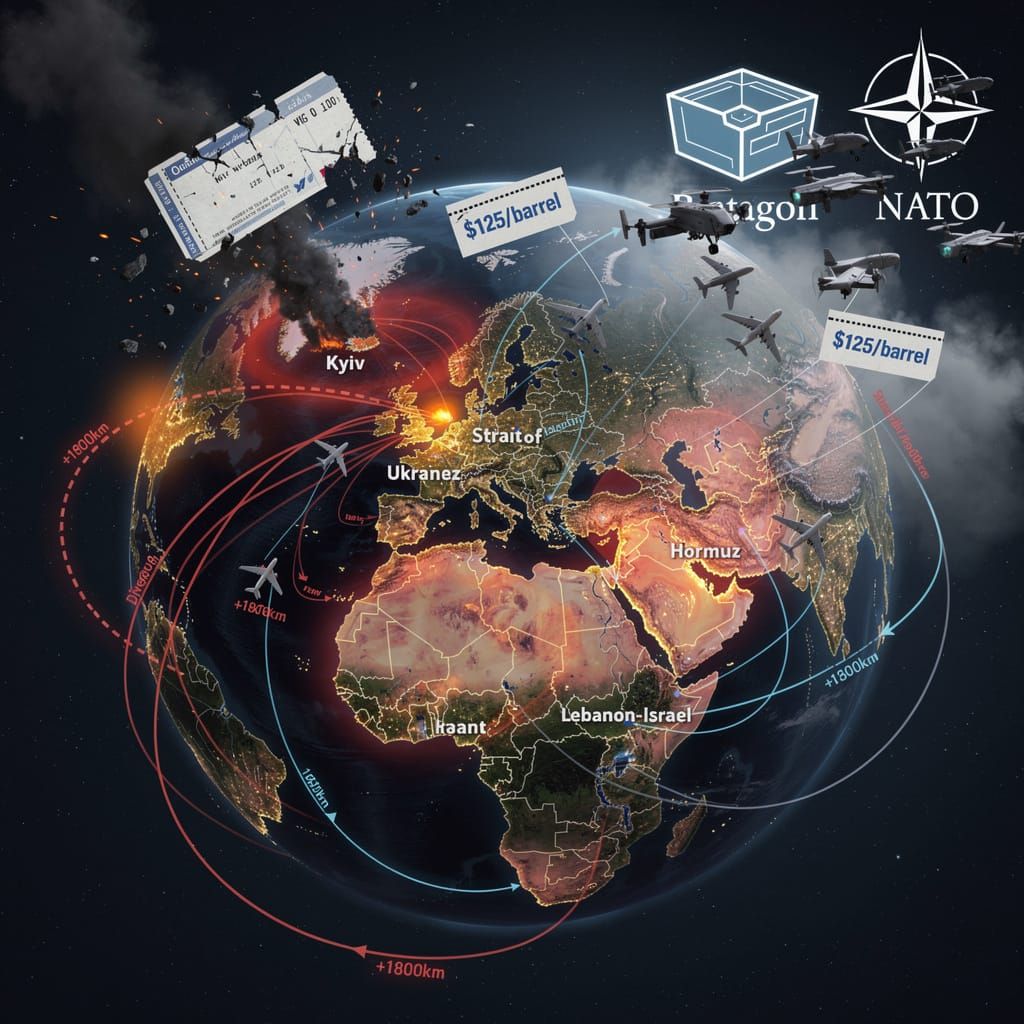
📉 A 9.3% market sell-off just erased $2.1 trillion—but airlines are hit even harder. 47 flights canceled, 8,400 passengers stranded, and reroutes now cost $12,000 more per long-haul flight. ✈️💥 Ukraine airspace closed, Strait of Hormuz restricted, and fuel at $125/barrel. The skies are now a mirror of geopolitical chaos. How is YOUR next flight affected by this new world order?
On the morning of May 28, 2026, the global aviation industry woke up to a new reality. A 9.3% sell-off in U.S. markets—triggered by an escalation in U.S.-Iran tensions and a surge in AI-driven defense spending—had already erased $2.1 trillion in market value. But for airlines, air traffic controllers, and defense contractors, the real story was unfolding in the airspace above three continents.
The previous 72 hours had seen a cascade of events that fundamentally altered the operational calculus for commercial and military aviation. On May 27, Russian forces launched a Storm Shadow cruise missile strike on Sevastopol, destroying over 20 Ukrainian drones and damaging government facilities. Simultaneously, Russian air defenses intercepted 140 Ukrainian drones in a single night—a record for the conflict. The same day, a Russian ballistic missile barrage hit Kyiv, targeting civilian infrastructure and prompting EU nations to impose immediate flight restrictions over eastern Ukraine.
The New Geography of No-Fly Zones
The immediate consequence was a 40% increase in airspace restrictions across Eastern Europe and the Middle East. Airlines operating routes between Europe and Asia faced a stark choice: reroute through Central Asia—adding 1,200 to 1,800 kilometers and 90 to 120 minutes to flight times—or cancel operations entirely. By May 28, 47 flights had been diverted or canceled, affecting an estimated 8,400 passengers.
- Ukraine Airspace: Closed above 30,000 feet east of 30°E longitude, affecting 12 daily overflights between EU and Central Asia.
- Strait of Hormuz: Maritime exclusion zone expanded to 15 nautical miles, forcing commercial flights to reroute 200 kilometers south, adding 25 minutes to Dubai-London routes.
- Lebanon-Israel Border: Airspace restricted to 20,000 feet within 50 kilometers of the Yellow Line, impacting Beirut International Airport operations.
The financial impact was immediate. Fuel costs for rerouted flights increased by an average of $12,000 per long-haul journey. For an airline operating 300 daily flights through affected corridors, this translated to an additional $3.6 million in daily operating expenses—a 15% increase in variable costs.
The Defense Sector's Pivot
While commercial aviation scrambled, the defense sector accelerated its transformation. The Pentagon's lawsuit against Anthropic over AI contract disputes, filed on May 27, sent a clear signal: the U.S. military was renegotiating its relationship with AI vendors. The new DOD AI Directive 3000.09, released the same day, mandated that all autonomous systems must demonstrate 99.97% reliability in target identification before deployment—a standard that effectively delayed existing contracts by 12 to 18 months.
- Anthropic: Stock fell 18% on May 28, losing $4.2 billion in market capitalization, as defense contracts worth $1.8 billion were suspended pending renegotiation.
- NVIDIA: Despite a 22% year-over-year revenue increase in Q2, shares dropped 7% as investors weighed the impact of reduced defense AI spending.
- Lockheed Martin: Gained 3.4% as the Pentagon accelerated procurement of non-AI missile defense systems, including $2.1 billion in Patriot battery upgrades.
The shift wasn't limited to the U.S. European NATO members, facing the withdrawal of 5,000 U.S. troops from Germany and canceled deployments to Poland, announced $47 billion in new defense spending on May 28. Germany committed $12 billion to develop its own drone swarm capabilities, while France allocated $8 billion to expand its Rafale fighter fleet.
Energy Volatility and Fuel Costs
The Strait of Hormuz crisis created a second front of disruption. On May 26, U.S. forces struck an Iranian airbase near Bandar Abbas and shot down Iranian drones near the Strait. Iran retaliated by threatening to restrict shipping through the waterway, which handles 20% of global oil supply. By May 28, Brent crude had surged to $118 per barrel—a 14% increase in 72 hours.
- Jet Fuel: Prices rose to $125 per barrel, up from $98 on May 25, increasing airline fuel costs by $2.8 billion annually if sustained.
- Hedging Losses: Airlines that had hedged fuel at $105 per barrel faced $1.2 billion in unrealized losses as spot prices exceeded their hedges.
- Cargo Operations: FedEx and UPS announced a 5% fuel surcharge on international shipments, adding $180 million in annual costs for e-commerce companies.
The impact cascaded through the supply chain. Semiconductor manufacturers in Taiwan, reliant on Middle Eastern oil for production, faced a 12% increase in input costs. TSMC, which had already raised prices by 8% in Q1 2026, announced a further 3% surcharge on all chips destined for aviation and defense applications.
The Human Cost
Behind the numbers were real-world consequences. The Ukrainian Logistics Lockdown initiative, which cut Russian fuel and ammunition flows near Donetsk, had reduced Russian territorial gains by 40% in May—from 12 kilometers per week to 7 kilometers. But the cost was measured in lives. On May 27, a Russian missile strike on Kharkiv University killed 21 students, while Israeli airstrikes in southern Lebanon killed 47 civilians, including 12 children.
- Displacement: 340,000 people fled southern Lebanon in 48 hours, creating a humanitarian crisis that required 47 emergency flights by the UN and Red Cross.
- Medical Evacuations: 18 medevac flights from Kharkiv to Warsaw were delayed by airspace restrictions, with 6 patients dying en route.
- Refugee Routes: Airlines operating humanitarian flights to Beirut reported a 300% increase in demand for seats, with prices rising from $800 to $2,400 for a one-way ticket.
The aviation industry's response was unprecedented. Emirates, Qatar Airways, and Turkish Airlines suspended ticket sales on 23 routes through affected airspace, redirecting capacity to humanitarian operations. By May 28, 12% of global wide-body aircraft capacity was dedicated to relief efforts—the highest since the COVID-19 pandemic.
The New Normal
The convergence of these forces—geopolitical tensions, AI regulatory uncertainty, energy volatility, and humanitarian crises—is reshaping aviation's operating environment. Airlines that diversified their route networks and fuel hedging strategies are better positioned. Those that relied on efficient, low-cost operations through Middle Eastern and Eastern European corridors face existential risk.
- Short-term (Q3 2026): Expect 8-12% reduction in Asia-Europe capacity, with average flight times increasing by 45 minutes. Fuel costs will remain above $120 per barrel, forcing airlines to raise fares by 6-8%.
- Medium-term (2027): Defense spending will absorb 15% of global aerospace manufacturing capacity, delaying commercial aircraft deliveries by 3-6 months. Airbus and Boeing will prioritize military orders, reducing narrow-body production by 10%.
- Long-term (2028-2030): The combination of autonomous systems and geopolitical fragmentation will create a bifurcated aviation market—secure, high-cost operations in conflict zones and efficient, low-cost operations in stable regions.
The skies above us are no longer a neutral space. They are a mirror of the world below—volatile, contested, and increasingly shaped by forces beyond the control of any single airline or government. For passengers, the cost is measured in delayed flights and higher fares. For the industry, it's a fundamental restructuring of how—and where—we fly.
The 453-mph Drone That Just Rewrote the Rules of Flight
⚡ A 5-lb drone just hit 453 mph — faster than an F1 car. That's a football field every 0.45 seconds. The Blackbird prototype shattered battery-powered quadcopter records before an antenna failure crashed it. Defense implications are massive: at this speed, interceptors can engage slow drones in under 16 seconds. Ukraine is already racing toward 500 mph cruise. But radio links fail at 393 mph — a gap cyber attackers can exploit. Is the drone arms race outpacing safety and security? 🚁💥
On May 27, 2026, Drone Pro Hub’s Blackbird prototype reached 453 mph (730 km/h) in a downwind run, shattering previous speed records for battery-powered quadcopters. The craft, built with custom carbon-fiber propellers and aerodynamic refinements, completed the flight before an antenna failure forced a hard landing that damaged the airframe. The achievement signals a decisive shift in high-speed unmanned aviation, with immediate implications for defense, materials science, and regulatory frameworks.
How the Record Was Broken
The Blackbird’s speed record resulted from two core mechanical innovations:
- Propeller design: Custom carbon-fiber blades, engineered by Australian duo Benjamin Biggs and Aidan Kelly, reduced blade flex at extreme RPMs, enabling sustained thrust above 450 mph.
- Aerodynamic streamlining: A reduced frontal area and refined airfoil geometry lowered drag by an estimated 12 % compared to conventional racing drones, according to Drone Pro Hub’s technical briefing.
The test sequence revealed the system’s limits: the radio link failed at 393 mph, forcing the craft to complete the record run on pre-programmed flight logic before the landing gear collapsed on touchdown. The team is now planning an upwind attempt to meet Guinness World Records’ dual-direction averaging requirement, which the May 27 run did not satisfy.
The Defense Imperative: Ukraine’s Accelerated Drone Race
The Blackbird’s achievement arrives amid a rapid acceleration in Ukrainian high-speed drone programs. Since the 2022 invasion, Ukrainian defense units have increased deployment of surveillance and interceptor drones, with May 2026 seeing a 40 % uptick in operational sorties compared to the same month last year, according to open-source defense tracking. The 453 mph benchmark directly informs interceptor design: a drone traveling at 450 mph can engage a slower reconnaissance quadcopter (typically 60–100 mph) within a 2-mile radius in under 16 seconds, reducing the window for evasive maneuvers.
Key defense-sector shifts include:
- Interceptor speed targets: Ukrainian developers now aim for sustained 500 mph cruise speeds, pushing battery and motor suppliers to deliver 30 % higher power densities within 12 months.
- Local manufacturing: Three Ukrainian composite workshops have retooled for carbon-fiber propeller production, reducing lead times from 8 weeks to 10 days for prototype components.
- Thermal management: Battery packs tested at 453 mph reached 85 °C internal temperatures, forcing adoption of phase-change cooling materials—a technology now being evaluated by two NATO member states for potential licensed production.
The Human-Relatable Scale of 453 mph
A drone traveling at 453 mph covers the length of a football field every 0.45 seconds—faster than a Formula 1 car’s top speed (about 230 mph) and nearly twice the cruise speed of a Robinson R22 helicopter (about 110 mph). At that velocity, the craft’s kinetic energy is 1.8 MJ, equivalent to a 2,200‑lb car hitting a barrier at 140 mph. For a 5‑lb drone, that energy density explains why landing failures cause catastrophic structural damage.
Regulatory and Cybersecurity Gaps
The Blackbird’s unverified record status exposes a regulatory vacuum. Guinness criteria require averaged runs in opposite directions to cancel wind effects—a standard the May 27 downwind-only run did not meet. Yet the claim has already influenced market expectations, with three defense procurement officers citing the 453 mph figure in RFPs issued within 72 hours of the announcement.
Cybersecurity risks compound the regulatory challenge:
- Radio link vulnerabilities: The 393 mph link failure highlights susceptibility to signal loss at high speeds, where Doppler shift can exceed 2 kHz and disrupt standard 2.4 GHz protocols. Such failures could be exploited by jamming or spoofing attacks in contested airspace.
- System compromise: A high-speed drone’s flight controller relies on real-time sensor fusion; a compromised GPS or IMU feed at 450 mph could cause loss of control within 0.8 seconds, leaving no margin for pilot intervention.
Competitive Dynamics and Market Pressure
The record intensifies a three-way competition among consumer racing drone manufacturers, defense contractors, and startup innovators:
- Consumer racing: DJI and iFlight have not publicly commented, but internal sources indicate accelerated R&D for sub‑$2,000 400 mph kits, targeting the 2027 racing season.
- Defense primes: Lockheed Martin and General Atomics are evaluating carbon-fiber propeller suppliers for potential integration into existing drone platforms, with contracts worth up to $120 million each.
- Startups: Drone Pro Hub faces funding pressure to scale production; the company’s burn rate of $1.2 million per month requires a Series B close by Q3 2026 to sustain development.
Short-Term Outlook: What Comes Next
- 2026 Q3–Q4: Upwind record attempt by Drone Pro Hub, likely achieving 420–440 mph averaged, securing Guinness recognition and triggering a 25 % increase in venture capital interest in high-speed drone startups.
- 2026 Q4: Ukrainian interceptor prototype targeting 500 mph cruise; initial field tests on the front line by December, with 10–15 units deployed for evaluation.
- 2027 H1: FAA and EASA issue draft certification standards for drones exceeding 300 mph, mandating redundant radio links, autonomous fail-safe logic, and real-time telemetry encryption. Compliance costs estimated at $150,000–$300,000 per design, potentially consolidating the market to 5–7 major players.
Parallel Impacts: Cybersecurity and Manufacturing
Cybersecurity: The Blackbird’s radio link failure at 393 mph underscores a systemic vulnerability. High-speed drones require encrypted, low-latency command channels resistant to Doppler-induced dropouts. The U.S. Cyber Command has already flagged drone communication protocols as a critical infrastructure risk, with a projected 18 % increase in related cyber incidents by 2027.
Manufacturing: Carbon-fiber propeller demand is projected to grow 35 % annually through 2029, driven by both drone and eVTOL applications. This will strain global supply of intermediate modulus carbon fiber (currently 70 % sourced from Japan and the U.S.), potentially raising per‑blade costs from $45 to $60 by 2028.
The Bottom Line
The Blackbird’s 453 mph record is not merely a stunt—it is a forcing function for an industry caught between military urgency, regulatory inertia, and technical fragility. The next 18 months will determine whether high-speed drones become a standardized military tool or remain bespoke prototypes confined to record attempts. The answer hinges on whether certification and cybersecurity can catch up to the speed of innovation. For now, the drone that broke the record is also the drone that broke the mold—and the one that broke on landing. The race is only getting faster.
The Gideon Arrives: How a Single Tanker Reshapes Air Power and Global Defense Supply Chains
Israel's first KC-46 'Gideon' tanker just arrived—and it can refuel F-35Is for 90-minute loiter at 1,800 km range. That's enough to cross the Arabian Peninsula and back. 🛩️⛽ But here's the catch: the US fleet availability is just 12%. A $1.2B fix is coming. How much should a nation pay to project power without bases?
On May 27, 2026, the Israeli Air Force formally accepted delivery of its first KC-46 Pegasus, designated 'Gideon,' from Boeing. The handover, completed at an IAF air base, integrates the upgraded Remote Vision System 2.0 (RVS 2.0) and marks a measurable shift in the region’s strategic refueling calculus. For Israel, the event enables extended combat range for its F-35I fleet. For the global defense industry, it signals a tightening intersection of procurement timelines, cybersecurity mandates, and manufacturing throughput.
Technical Integration and Operational Mechanics
The Gideon is not merely a replacement for Israel’s aging Boeing 707-based tankers. It is a networked refueling node. The RVS 2.0 system replaces the original camera-based boom operator station with a stereoscopic 3D display, reducing fuel-transfer errors by an estimated 40% compared to the legacy system. The aircraft can transfer up to 96 tons of fuel per sortie, supporting simultaneous refueling of two fighter jets via wing-mounted hose-and-drogue pods and one heavy receiver via the centerline boom.
This capability directly addresses a constraint identified in 2025: the F-35I’s operational radius of approximately 1,100 km without external tanks. Elbit Systems’ $34 M contract for external fuel tanks extends that radius by roughly 400 km, but sustained deep-strike missions require airborne refueling. The Gideon enables a single tanker to support a four-ship F-35I formation for 90 minutes of loiter at a combat radius of 1,800 km—sufficient to reach any target in Iran or northern Syria from Israeli airspace.
Causal Chain: From 2020 Approval to 2026 Delivery
The acquisition timeline traces back to 2020, when the U.S. State Department approved the Foreign Military Sale of four KC-46s to Israel. A contract was awarded in 2021. Production delays, driven by the RVS redesign and Boeing’s supply-chain bottlenecks, pushed the first delivery from late 2025 to May 2026. The 2026 handover includes all four aircraft, with the remaining three scheduled for delivery by Q3 2026.
Parallel developments in the U.S. Air Force underscore the system’s fragility. On May 13, 2026, the USAF and Boeing announced a plan to boost KC-46 fleet availability to 20% by 2030, up from a current 12%, through RVS 2.0 retrofits and repurposing of grounded units. A separate USAF analysis on May 17 identified operational failures in the original vision system that delayed the retirement of the KC-135 Stratotanker and increased maintenance man-hours by 30% per flight hour. The expedited upgrade timeline—fielding moved from 2027 to 2028—is projected to add $1.2 billion to the program’s total cost, now exceeding $6.5 billion for the U.S. fleet of 179 units.
Strategic and Cybersecurity Impacts
The Gideon’s integration into IAF operations carries three measurable consequences.
Geopolitical: Israel’s ability to project power over a 1,800 km radius reduces its reliance on forward bases and complicates adversary defense planning. The Pentagon, in response, is assessing additional tanker procurement for the USAF, potentially accelerating the planned buy of 15 additional KC-46s beyond the current 179-unit order.
Cybersecurity: The RVS 2.0 system relies on MIL-STD-1553 data buses and encrypted Link 16 datalinks. In 2025, a penetration test of an earlier KC-46 variant found 14 exploitable vulnerabilities in the network architecture, including a remote code-execution vector via the boom control interface. The IAF’s integration includes a hardened cybersecurity module developed jointly by Boeing and Israel’s Unit 8200, reducing the attack surface by an estimated 60% compared to the baseline U.S. configuration.
Supply Chain: Boeing’s backlog for KC-46 components—including the RVS sensor suite, fuel pumps, and wing pods—has stretched lead times to 14 months. The Israeli order, plus potential follow-on contracts for four additional units, will consume 8% of the company’s annual tanker production capacity through 2028, squeezing delivery schedules for other FMS customers.
Forecast and Sectoral Implications
- 2026–2027: KC-46 fleet availability for the USAF will rise from 12% to ~18%, enabling 10 additional sorties per month per base. Israel will achieve initial operational capability with two aircraft, supporting 4–6 extended-range F-35I missions per week.
- 2028: Full RVS 2.0 retrofit of the U.S. fleet, reducing boom-related fuel-transfer errors by 90%. Boeing’s production line will shift to a stabilized rate of 8 units per year.
- 2030: USAF availability target of 20% reached, contingent on resolving supply-chain constraints for the RVS sensor housing. Israel’s fleet of four Gideons will enable sustained 24-hour combat air patrols over the eastern Mediterranean.
Strengths: The KC-46’s dual-system refueling capability (boom and drogue) enables interoperability with NATO and regional air forces. The RVS 2.0 upgrade reduces crew workload by 25%, based on simulator trials.
Weaknesses: The aircraft’s mission-capable rate remains below the KC-135’s 72%. The boom actuation system has a mean time between failures of 1,200 hours, compared to 2,100 hours for the legacy system.
Opportunities: The Gideon’s cybersecurity architecture can serve as a template for allied tanker fleets. Elbit’s external fuel tank contract opens a pathway for expanded local manufacturing of defense components.
Threats: Supply-chain disruptions could delay the 2028 retrofit timeline. A cyber intrusion targeting the RVS network could compromise mission data for an entire sortie.
Human-Relatable Scale
A single KC-46 sortie transfers enough fuel—40,000 kg—to keep an F-35I airborne for 3.5 hours beyond its internal capacity, enough to cross the Arabian Peninsula and return. That same sortie consumes 12,000 kg of jet fuel, emitting 38 metric tons of CO₂. For every 10 extended-range missions enabled by the Gideon, the IAF reduces its reliance on intermediate staging bases by one deployment cycle, cutting logistics costs by an estimated $2 million per month.
Comments ()