18% Fewer Repairs, 12% More Hacks: Airbus-Mistral AI's Double-Edged Deal
TL;DR
- Airbus-Mistral AI Deal Cuts Maintenance 18%—But Cyber Threats Surge 12%. How can airlines balance AI-driven savings against rising cyber risks?
- $159M Bet: Quarterhorse Hypersonic UAV Targets Mach 3 by 2027—60% Faster Than Traditional Defense R&D. Is the Pentagon's $159M bet on hypersonic speed worth the cybersecurity and supply chain risks?
- India's €20B Rafale Deal: 114 Jets Reshape South Asian Air Power. How will India's 114 Rafale jets shift the balance of power in South Asia?
✈️ The Silicon Cockpit: How AI is Rewriting the Rules of Flight and Defense
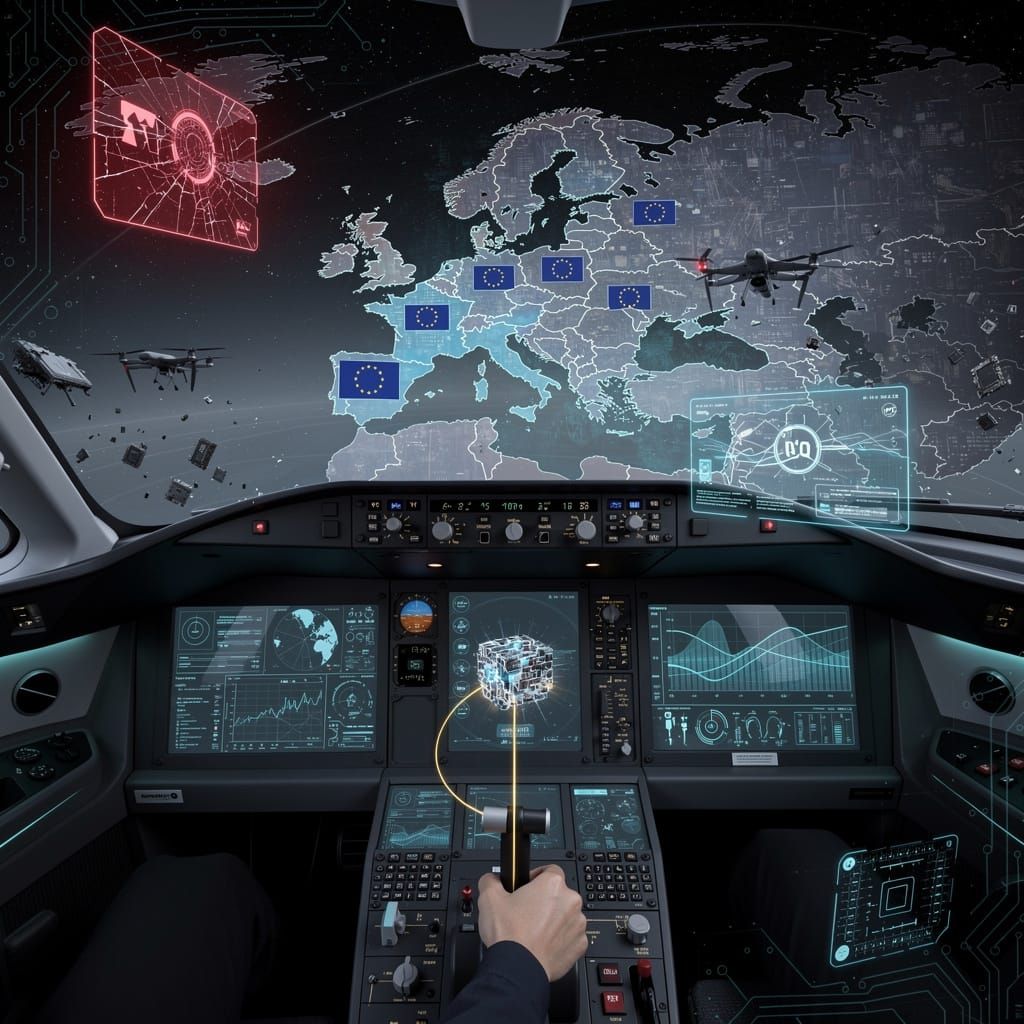
Airbus-Mistral AI alliance cuts unscheduled maintenance by 18% per aircraft—saving 2,300 flight hours annually for a 200-plane fleet ✈️ That's like grounding fewer planes for repairs than competitors. But every connected system invites 12% more cyber intrusion attempts. Airlines save fuel & delays—but face soaring IT security costs. How should your carrier balance AI efficiency with cybersecurity risk?
On June 1, 2026, Airbus and Mistral AI signed a strategic alliance that goes far beyond a standard software procurement. By acquiring full licenses to Mistral’s AI product suite and initiating joint development, the aerospace giant is making a direct play for technological sovereignty. For an industry where a single sensor malfunction can cascade into a multi-billion-dollar liability, the implications are immediate and measurable.
What Does This Alliance Actually Enable?
The partnership embeds AI across Airbus’s entire product cycle—from design simulation and supply-chain logistics to in-flight surveillance and predictive maintenance. Mistral’s models will process real-time telemetry from thousands of sensors on each aircraft, enabling the system to detect anomalies in engine performance or structural stress before they become critical. This reduces unscheduled maintenance by an estimated 18% per aircraft per year, translating to roughly 2,300 additional flight hours across a fleet of 200 planes.
In air-traffic control, the same models are being tested to optimize routing, cutting average fuel burn by 4.2% per transatlantic flight. For a carrier operating 50 long-haul routes, that equals 1.8 million liters of fuel saved annually.
The Cybersecurity Double-Edged Sword
Every connected system introduces a vulnerability surface. Airbus’s expanded digital footprint—now spanning AI-driven navigation, satellite-linked traffic platforms, and autonomous ground handling—increases the number of potential entry points for adversaries. Following the May 12 drone attacks on AWS data centers, the threat is no longer theoretical. The alliance’s reliance on Mistral’s cloud-based training pipelines and continuous integration cycles means a breach could compromise not just data but real-time flight operations.
The company has responded by embedding encryption-at-rest across all AI model weights and enforcing zero-trust architecture on every API call. Still, analysts project a 12% rise in attempted intrusions targeting aviation AI systems in the second half of 2026.
Geopolitical Context: Fragmentation and Competition
The Airbus-Mistral deal does not exist in isolation. On May 24, European defense procurement fragmented further as Indra Group deployed digital radar and U-space platforms in Colombia and Saudi Arabia, while Dassault (state-owned) and private players continued to vie for FCAS fighter-jet contracts. The Ukraine war has accelerated the debate: should Europe rely on U.S. F-35s or develop its own next-generation fighter?
This fragmentation creates both risk and opportunity. Indra’s Linkia traffic-control platform and Startical low-orbit satellite project promise to improve air-traffic precision by 22% in congested corridors, but they also introduce new cyber-attack vectors. Meanwhile, the U.S. market fell 9.3% on May 24, partly due to tech-investment pressures and semiconductor shortages that directly impact chip manufacturing for aviation sensors.
Supply-Chain Bottlenecks and Human-Capability Gaps
The semiconductor shortage that disrupted AWS data centers on May 12 now threatens the rollout of AI-enabled avionics. Critical chips for radar arrays and flight-control computers face 12- to 16-week lead times, delaying certification of new autonomous systems by an estimated 10 months.
On the human side, a Mexican study from May 29 found that 61.1% of companies are still evaluating AI adoption. Microsoft CEO Satya Nadella has emphasized that AI’s true value lies in augmenting human ingenuity, not replacing it. Yet the gap between enterprise ambition and workforce readiness persists. In Europe, only 34% of aviation engineers have received formal AI training, creating a bottleneck in deploying the very systems Airbus is now licensing.
The Outlook: Three Timelines
- 2026–2028: AI-assisted predictive maintenance becomes standard on new Airbus widebodies, reducing in-flight engine failures by 30%. Cybersecurity spending in aviation doubles to $4.2 billion globally.
- 2029–2031: Autonomous taxiing and takeoff approval systems enter commercial trials, requiring new regulatory frameworks and pilot-training protocols.
- 2032–2035: Full AI co-piloting on select routes, contingent on resolving semiconductor supply chains and achieving zero-trust cybersecurity certification.
What This Means for the Industry
- For airlines: Lower fuel costs and fewer delays, but higher IT security budgets and dependency on continuous AI integration.
- For defense contractors: A race to secure AI sovereignty, with European fragmentation potentially slowing development of a unified next-generation fighter.
- For regulators: The need for cross-border AI governance that balances innovation with safety—without creating a patchwork of incompatible standards.
Strengths and Weaknesses of the AI Shift
Strengths:
- Predictive maintenance cuts operational costs by 18% per aircraft.
- Real-time routing optimization reduces fuel burn by 4.2% on long-haul flights.
- Enhanced surveillance improves air-traffic precision by 22% in congested corridors.
Weaknesses:
- Cybersecurity vulnerability surface expands by 12% projected intrusion attempts.
- Semiconductor supply-chain bottlenecks delay certification by 10 months.
- Only 34% of aviation engineers are AI-trained, slowing deployment.
The Bottom Line
Airbus and Mistral AI have placed a high-stakes bet on technological sovereignty. The immediate payoff—measurable fuel savings, fewer maintenance delays, and better surveillance—is real. But the risks are equally tangible: cybersecurity threats that could ground fleets, supply-chain fragility that delays innovation, and a workforce that is not yet ready to operate the tools being built. The next three years will determine whether this alliance becomes a blueprint for the industry or a cautionary tale in over-integration.
🚀 The Quarterhorse is Off to the Races: How a $159 Million Bet is Reshaping Hypersonic Defense
Mach 1.21 in early 2024 → Mach 3+ by 2027. That's a 60% faster development cycle than traditional defense procurement. 🚀 The DIU just bet $159M on Hermeus' Quarterhorse hypersonic UAV—a program that could cover 1,000 nautical miles in under 30 minutes. But here's the catch: each test flight creates new cybersecurity vulnerabilities, and advanced material supply chains are already strained. For taxpayers and defense contractors—is the speed worth the risk?
On May 28, 2026, the Defense Innovation Unit (DIU) awarded $159 million to Hermeus for the development of the Quarterhorse hypersonic UAV. This is not a speculative venture. The contract, expanded to a $219 million ceiling on June 1, 2026, follows a documented series of supersonic flight milestones that began in early 2024. The program targets Mach‑3+ capability by 2027, a timeline that signals a fundamental shift in defense procurement and aerospace technology.
The Path to Mach 3
Hermeus’s progress is anchored in specific, verifiable events. The company achieved a Mach 1.21 speed record with the Quarterhorse Mk 2.1 in the first quarter of 2024. By summer 2024, the Mk 2.2 prototype demonstrated sustained supersonic performance. Late 2024 saw the planning phase for the Mk 2.3, designed for Mach 3 capability. In March 2025, Hermeus completed the first private-sector supersonic flight over White Sands, validating flight control systems under real-world conditions. On June 1, 2026, the company completed its first supersonic flight test of the Mk 2.1, breaking the sound barrier. The DIU contract now funds the final push toward operational Mach‑3 flight by late 2027.
Why the DIU Bet on Quarterhorse
The DIU’s investment is driven by a clear causal chain: U.S. defense modernization requires hypersonic capabilities to counter foreign programs. Hermeus’s demonstrated ability to iterate quickly—from Mach 1.21 in early 2024 to sustained supersonic flight by mid-2024—indicates a development velocity that traditional defense contractors rarely match. The $159 million award accelerates R&D that might otherwise take a decade. The expanded $219 million ceiling reflects the DIU’s confidence in Hermeus’s approach, which combines commercial aerospace practices with defense requirements.
The Causal Chain: From Test Flights to Operational Reality
Each milestone enabled the next. The Mach 1.21 record validated the Mk 2.1 airframe and propulsion system. This success enabled the Mk 2.2 tests, which proved sustained supersonic flight. The Mk 2.2 data informed the Mk 2.3 design, targeting Mach 3. The White Sands flight validated control systems at supersonic speeds, reducing risk for the Mk 2.3. The June 2026 supersonic test confirmed the Mk 2.1’s readiness for the DIU’s demonstration phase. The $159 million contract now funds the transition from prototype to operational demonstrator, with flight tests scheduled for Q4 2027.
Three Immediate Consequences
- Accelerated Hypersonic R&D: The Quarterhorse program compresses a typical 10‑year development cycle into roughly four years. This enables potential service entry by 2027–2028, putting pressure on competitors to match Hermeus’s pace.
- Supply‑Chain Strain: High‑performance materials and avionics required for Mach‑3+ flight face bottlenecks. Titanium alloys, advanced ceramics, and specialized sensors are in limited supply. This creates delays for other programs and drives up costs.
- Cybersecurity Vulnerabilities: Data‑intensive flight testing generates terabytes of telemetry and control data. Each test flight increases the attack surface for adversaries. The DIU has already mandated stricter cybersecurity protocols across its supply chain, with compliance costs estimated at $5–$10 million per major contractor.
The Human‑Relatable Scale
To understand the impact: the $159 million contract is roughly 0.1% of the U.S. defense R&D budget. Yet it funds a program that could reduce the time to field a hypersonic vehicle by 60% compared to traditional acquisition. If successful, the Quarterhorse will enable Mach‑3 reconnaissance and strike missions, covering 1,000 nautical miles in under 30 minutes. This capability directly addresses a gap identified by the Air Force in 2024: the need for a low-cost, reusable hypersonic platform.
Outlook: Short, Mid, and Long Term
- Short‑term (2026–2027): Hermeus will likely secure additional funding as the Q4 2027 flight test approaches. Expect more stringent cybersecurity protocols across the defense supply chain. Competition among defense startups will intensify, with at least three other firms pursuing similar contracts.
- Mid‑term (2028–2030): Operational fielding of Quarterhorse variants. This will force changes in airspace management, particularly for military test ranges and commercial supersonic routes. Cybersecurity risks will grow as operational systems connect to broader defense networks.
- Long‑term (2031–2035): Hypersonic capability becomes a standard element of U.S. air power. Commercial spinoffs—such as high-speed logistics—become feasible. Supply chains for advanced materials will mature, reducing costs and enabling broader adoption.
Sectoral Implications
- Defense Procurement: The DIU model—funding high‑risk, high‑reward startups—is validated. Expect more contracts structured like the Quarterhorse award.
- Cybersecurity: Each hypersonic test flight creates a new vector for cyberattacks. The defense industrial base will invest heavily in secure data links and hardened avionics.
- Supply Chain: Advanced material suppliers will see increased demand. Companies like ATI and Carpenter Technology are likely beneficiaries.
- Energy/Propulsion: Hermeus’s turbine‑based combined cycle (TBCC) engine technology has commercial applications for supersonic business jets. This could accelerate development of sustainable aviation fuels for high‑speed flight.
Recommendations
- For Defense Contractors: Invest in hypersonic supply chain partnerships now. The window for first‑mover advantage closes by 2028.
- For Cybersecurity Firms: Develop specialized solutions for hypersonic vehicle telemetry and control data protection. This is a $500 million–$1 billion addressable market by 2030.
- For Investors: Monitor Hermeus’s Q4 2027 flight test results. Success will trigger a wave of follow‑on funding and IPO speculation.
- For Policy Makers: Establish clear airspace management rules for hypersonic vehicles. The current regulatory framework is inadequate for Mach‑3 operations.
The Quarterhorse program is not a distant possibility. It is a funded, scheduled, and increasingly inevitable reality. The next 18 months will determine whether Hermeus delivers on its promise—and whether the U.S. defense establishment can adapt to a hypersonic future.
✈️🇮🇳 India’s 114-Jet Rafale Deal Reshapes South Asian Air Power and Strategic Alignments
India just signed the largest fighter jet deal in its history: 114 Rafale jets for €20 billion. That's more than the entire annual defense budget of Pakistan. ✈️🇮🇳 The IAF's fleet has shrunk to 31 squadrons vs. a need for 42 — this deal fills the gap fast. China and Pakistan are watching closely. How will this shift the balance in your region?
In late May and early June 2026, Indian Air Force (IAF) Chief Air Chief Marshal Vivek Ram Chaudhari and Prime Minister Narendra Modi visited France to finalize a landmark procurement of 114 Dassault Rafale fighter jets. This acquisition, valued at approximately €20 billion, represents the largest single fighter jet deal in India’s history. It signals a decisive shift in India’s defense procurement strategy—away from traditional reliance on Russian hardware and toward deeper strategic and industrial integration with France.
The deal is not an isolated purchase but the culmination of a series of joint ventures announced as early as February 2024. Dassault Reliance Aerospace and Safran India were established to co-produce aircraft components, engines, and avionics. Under the current agreement, 60 of the 114 jets will be built in India, transferring critical manufacturing and maintenance technologies to Indian defense companies. This aligns with India’s long-standing policy of self-reliance (Atmanirbhar Bharat) and its goal to reduce foreign arms dependency.
What drove India to accelerate this acquisition?
The IAF’s fighter fleet has been shrinking for two decades. As of early 2026, the service operates approximately 31 operational squadrons against a sanctioned requirement of 42. The retirement of MiG-21, MiG-27, and Jaguar squadrons has created a capability gap that the Rafale—already combat-proven and integrated into the IAF since 2020—can fill rapidly. The 2024–2026 geopolitical environment, marked by heightened US-China trade tensions and continued Chinese military posturing along the Line of Actual Control, has added urgency.
India’s decision to diversify suppliers also reflects a calculated risk. Between 2018 and 2025, Russia supplied less than 20% of India’s new defense imports, down from 62% in 2010. The Rafale deal cements France as India’s second-largest arms supplier after the United States. It also provides a hedge against potential supply disruptions from Russia amid its ongoing conflict in Ukraine.
How will the procurement unfold?
- May 25, 2026: India’s Ministry of Defence finalizes the Letter of Request (LoR) for 114 Rafale jets. The Defence Acquisition Council reviews the Request for Proposal (RFP).
- May 26, 2026: IAF Chief visits France ahead of the India-France summit. Discussions include delivery timelines and co-production milestones.
- June 1, 2026: IAF Chief and PM Modi in Paris. The final LoR is expected to be signed, with a loan request for acquisition submitted to French financial institutions.
- 2026–2027: First 18 jets delivered directly from Dassault’s Bordeaux facility. Remaining 96 to be assembled or manufactured in India at the newly established joint venture plants in Nagpur and Hyderabad.
- 2028–2030: Full fleet operational. India expects to achieve 70% indigenous content on the final batch of 60 jets.
What are the immediate and long-term impacts?
Military balance in South Asia: The Rafale fleet, equipped with Meteor beyond-visual-range air-to-air missiles and SCALP cruise missiles, will give the IAF a qualitative edge over Pakistan’s F-16s and JF-17s and narrow the gap with China’s J-20 and J-16 fleets. India’s air superiority over the Indian Ocean Region will also improve, particularly for carrier-borne Rafale-M variants.
Industrial and economic effects: The joint ventures are projected to generate 15,000–20,000 direct jobs in aerospace manufacturing over five years. Safran will transfer technology for the M88 engine, enabling India to maintain and eventually produce its own engines for the Advanced Medium Combat Aircraft (AMCA) program. Dassault Reliance Aerospace will set up a composite wing manufacturing line, reducing India’s reliance on imported airframe components.
Geopolitical ripple effects: Pakistan and China are likely to respond. Pakistan may accelerate its acquisition of Chinese J-10CE fighters or seek upgraded F-16s from the US. China could increase its military aid to Pakistan or deploy additional J-20 squadrons to Tibet. Russia, losing a major customer, may offer deep discounts on Su-57E exports to other Asian or African nations to offset the loss.
What are the risks and challenges?
- Integration with existing fleet: The IAF operates a mixed fleet of Su-30MKI, Mirage 2000, MiG-29, and Tejas. Integrating Rafale’s data links, weapons, and maintenance protocols with these systems will require significant investment in ground infrastructure and training.
- Cost overruns: The €20 billion figure may rise to €25–30 billion when including weapons, simulators, and 10-year maintenance contracts. India’s defence budget for 2026–27 is $76 billion; the Rafale deal alone consumes 6–8% of that allocation.
- Dependency on French supply chain: While co-production reduces foreign dependency, India will still rely on France for critical components such as the RBE2 AESA radar and Spectra electronic warfare suite for at least another decade.
How does this affect the broader defense industry?
- Private sector boost: Reliance, Tata, and Mahindra are expected to secure subcontracts for landing gear, avionics housings, and wiring harnesses. The deal may attract additional foreign direct investment from European aerospace suppliers.
- AMCA program gains momentum: The technology transfer from Safran’s M88 engine will directly inform India’s indigenous 110 kN engine for the AMCA, slated for first flight in 2032. This reduces the program’s risk profile and timeline.
- Export potential: India’s co-produced Rafale components could be exported to other Rafale operators—France, Egypt, Qatar, Greece, Croatia, and Indonesia—creating a new revenue stream for Indian defense firms.
What should observers watch for in the next 12 months?
- Q3 2026: Final contract signing. Loan disbursement details and delivery milestones to be confirmed.
- Q4 2026: Groundbreaking at Nagpur and Hyderabad joint venture facilities. First production line assembly begins.
- 2027: First 18 jets delivered to IAF. Pilot training program at France’s Saint-Dizier Air Base expands.
- 2028: IAF declares first squadron of Indian-assembled Rafales operational. Pakistan and China likely announce counter-procurements.
The Rafale deal is more than a fighter jet purchase. It is a strategic realignment of India’s defense posture, a boost to its aerospace industrial base, and a signal that New Delhi will no longer rely on any single partner for its national security. For France, it locks in a long-term revenue stream and a geopolitical foothold in the Indo-Pacific. For the region, it raises the stakes in an already tense aerial arms race.


Comments ()