100% DNSSEC Failure: Albania .AL Domains Crippled by AKEP Misconfiguration
TL;DR
- 100% TLD Outage: Albania .AL DNSSEC Failure Forced Global Security Bypass. Would you prefer a secure internet that doesn't work, or a broken security system that lets you browse?
- 64-bit GDID Hardware IDs: Microsoft Telemetry Enables Global FBI Tracking. Does Microsoft's GDID make VPNs completely obsolete for identity masking?
- 300% Breach Spike: AI-Driven Attacks Hit Password Managers and LastPass Salesforce Data. Are you still trusting a corporate paywall to guard your identity, or is it time for open-source?
🤡 The Great .AL DNSSEC Faceplant
100% DNSSEC failure rate in .AL domains! 🤡 Pure corporate-grade incompetence where 'perfect' keys bricked a whole TLD. Cloudflare had to literally tell the internet to ignore security just to get sites back online. Security vs. Connectivity: who wins? .AL users — is your ISP lying to you about 'stability'?
Imagine spending months polishing your DNSSEC key rollover, only to have the world's resolvers decide your new keys look like garbage and simply stop talking to you. Welcome to July 2026, where Albania's national web registry (AKEP) proved that "perfect technical implementation" is just corporate-speak for "it worked in the lab, but the real world hates us." 🤡."
Who Broke the Internet (Briefly)?
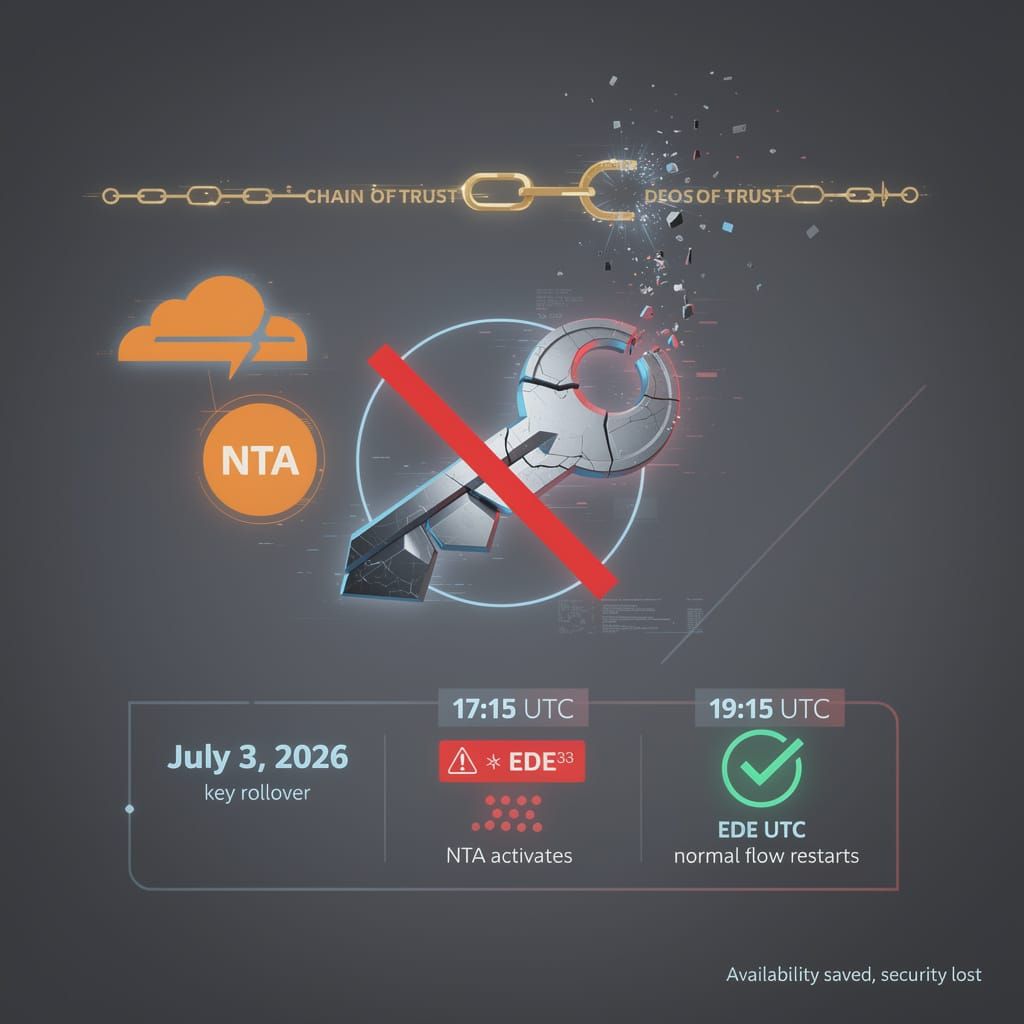
On July 3, 2026, AKEP initiated a DNSSEC key rollover that managed to break the chain of trust between the root zone and subdomains. The result? Resolvers—including Cloudflare’s 1.1.1.1—rejected the invalid keys, triggering a wave of SERVFAIL responses. For a few hours, .AL domains were ghost towns because the system chose strict validation—the digital equivalent of refusing entry to a building because the ID card is the wrong shade of beige—over actually functioning.
While AKEP stared at the wreckage, Cloudflare stepped in with a "Negative Trust Anchor" (NTA) per RFC 7646. Essentially, Cloudflare told the system: "Look, the .AL keys are a mess, so just ignore the security check and let the traffic through." High-security? No. Did it stop the bleeding? Yes.
- 17:15 UTC: NTA activated; system starts issuing Extended DNS Errors (EDE 33) alongside EDE 9 to let clients know validation is dead.
- 19:15 UTC: Things normalized after someone finally deleted the erroneous DS record.
- Post-Incident: Recovery expected within days as NS records are corrected and DS is restored.
The Damage Report
Availability: Cloudflare’s NTA kept .AL users online, but at the cost of the very encryption verification DNSSEC is supposed to provide. Transparency: The industry realized that NTA deployment lacks direct notification, prompting the standardization of "Expanded DNS Error type 33" (EDE 33) on the fly so logs aren't as vague as an HR memo. Stability: Global connectivity stayed afloat via non-DNSSEC paths, proving strict security is great until it bricks an entire TLD. 📉
Security: Strict validation → total outage. Recovery: NTA fallback → restored access, zero validation. Coordination: Regional authorities → total systemic fragility.
Congrats to the engineers who realized that decentralized fallbacks beat blind outages. Now, maybe we can stop pretending that automated rollovers are "set it and forget it." ✌️
🤡 The Eternal Digital Leash: Microsoft’s GDID
64-bit GDID is a permanent digital ankle monitor 🤡. Like a tattoo on your motherboard that survives OS reinstalls. Microsoft’s telemetry just makes VPNs a joke for 1.6B users. Hard-coded kernel tracking is the new 'unified auth'? Your laptop is a snitching. Is your hardware already talking to the FBI?
Congratulations to everyone who spent thousands on high-end VPNs, obfuscated relays, and the delusion of digital invisibility. It turns out your OS was just snitching on you the whole time. 🤡
What is the GDID?
Microsoft confirmed the Global Device Identifier (GDID), a persistent, 64-bit driver-linked ID that maps your hardware directly to your MS Account. Unlike your flimsy IP address or a browser cookie you can clear with a click, the GDID is an immutable fingerprint stored in Azure Monitor telemetry. It survives OS reinstalls and device restarts; it doesn’t give a damn about your proxy rotation because it’s baked into the activation services.
The 'Stokes' Case Study
The FBI recently turned this feature into a global GPS for the targeted. Peter Stokes, a 19-year-old suspect linked to the "Scattered Spider" collective, thought he was slick using ngrok tunnels and VPNs to hide. He wasn't. He allegedly used social engineering to bypass 2FA and breach a luxury jewelry firm in May 2025, resulting in a $8 million Bitcoin ransom demand.
- May 12, 2025: GDID records link Stokes to a dashboard.ngrok.com signup, creating a permanent forensic trail.
- July 2, 2026: Stokes is extradited from Finland to the US after being detained under an INTERPOL red notice.
- July 7, 2026: MS telemetry provides the final nail, linking his identity through GDID across IP logs and service interactions, enabling precise investigative action.
The Reality Check
VPNs: Rendered functionally useless for identity masking → purely for encrypting traffic, not hiding personhood. Anonymity: Shifts from 'possible' to 'theoretical' → hardware-level attribution is now the default for 1.6 billion Windows users. Corporate Liability: Higher risk for firms using MS ecosystems → telemetry binds personalized internal data flows, creating a goldmine for state-level surveillance.
The 'Corporate' Fix
Microsoft calls this 'unified authentication.' In real-world terms, it’s a permanent ankle monitor. Because why bother with the hard work of forensic investigation when you can just hard-code a tracking ID into the kernel? 🙄
- Short-term: Law enforcement accelerates the use of GDID for cross-border attribution and behavioral profiling.
- Mid-term: Regulators may force transparency measures as the public realizes they're being tagged like migratory geese.
- Long-term: Total normalization of non-optatory OS surveillance.
Better start practicing your 'I was just testing the security' face for when the FBI knocks, because your laptop already told them exactly which hotel room you're in. ✌️
💀 The Great Password Manager Funeral 💀
3x surge in AI-driven breaches is a total nightmare—like inviting a terminator to manage your keys 🤖. Your 'free' vault is now a toll booth. Pay up or get leaked! 💸 One OAuth token ruin your Tuesday? LastPass users — how's that 'secure' rental feeling today?
Congratulations! You’ve spent years stuffing every digital key to your existence into one shiny, convenient basket. Now, the industry's reality check is here: the "forever free" dream is dead. Welcome to the era of the "conditional incentive," which is corporate-speak for pay up or get out while we pretend it's for your own good. 🙄
Why is your vault suddenly a toll booth?
Legacy models are cratering because "free" is basically a welcome mat for disaster. The 2026 Verizon DBIR proves that while credential theft remains a staple, the game has evolved; attackers are now leveraging AI-driven vulnerability research to smash through network edge assets, with breaches surging threefold since 2025. Letting users coast on weak, free-tier habits isn't just a risk—it's a gift-wrapped invite for an AI-powered breach. 🎁
Meanwhile, enterprises are breathing down vendors' necks for "compliance." In the real world, this means EU regulators (ICO) are demanding strict GDPR alignment. For vendors, this is just a convenient excuse to squeeze you for cash before you notice the security surface is expanding like a balloon in a microwave. 🎈
When one vendor dominates the market, it creates a giant, juicy target. Just look at the June 23, 2026, disaster: attackers used stolen OAuth tokens from a Klue breach to slide right into LastPass's Salesforce system, exporting names, emails, and CRM records. Vaults might be "intact," but your personal identity is now just another line item in a hacker's spreadsheet. 🎯
The "Gratis" Decay
- Q3 2026: Free-tier adoption slides as "conditional incentives" replace permanent access.
- Q4 2026: Tiered subscriptions become the only way to access basic security hygiene.
- 2027: Massive migration spikes toward open-source alternatives as the "free" lures vanish.
The Reality Check Vendor Lock-in: High dependency → Zero leverage when pricing spikes. 💸 Attack Surface: Single-vendor dominance → One OAuth token leak ruins everyone's Tuesday. 📉 Corporate BS: "Enhanced Security" → A paywall for features that should have been default.
Stop trusting a polished UI to guard your PII. If you aren't running a local, open-source vault that you actually control, you're just renting a locker from a company that will eventually charge you for the key. 🔑
Enjoy the subscription fees, peasants! 🥂



Comments ()