160W PD Dock: One-Cable Dream or $129 Thermal Headache?
TL;DR
- Amazon Ocelot Chip: 90% Error Correction Cut Unleashes Quantum Drug Discovery. Will Amazon's Ocelot chip make classical HPC obsolete for drug discovery?
- 78% Less Latency: Synology’s DP5200 Rewrites On-Prem AI Inference Rules. Will your next AI workload stay on-prem?
- 160W USB-C Dock: One-Cable Desk or Thermal Headache?. Would you pay $129 for a 160W dock that needs a thermal panel to avoid shutdowns?
⚛️ The Quiet Collapse of Classical Walls
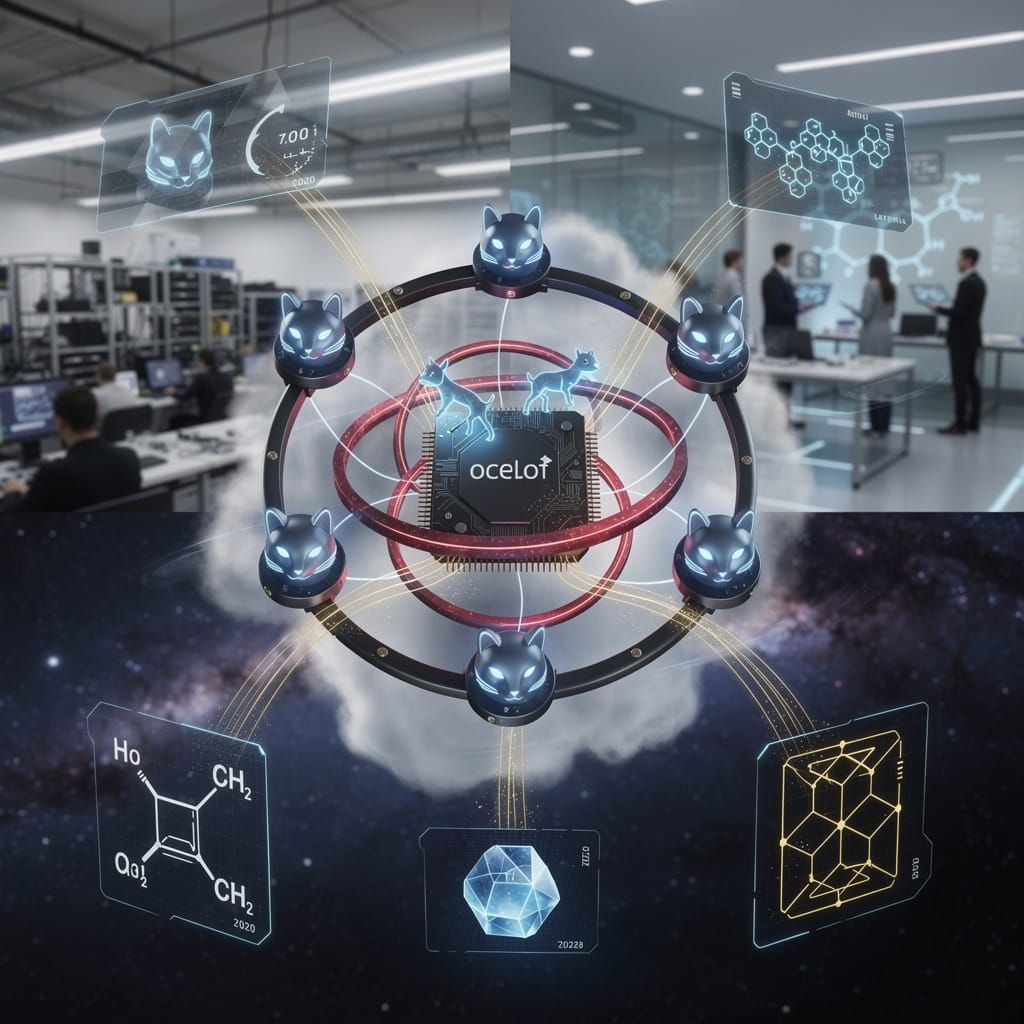
Amazon's Ocelot chip just slashed quantum error correction needs by 90% — from 1,000 qubits to just 10 for a logical one. ⚛️ That's like replacing a 1,000-person team with a 10-person squad and getting the same work done. Drug discovery that took 18 months now drops to under 2. Is your industry ready for this speed?
From Error Correction to Practical Utility
On June 17, 2026, Peter DeSantis, Amazon’s vice president of advanced computing, unveiled a quantum processor chip named Ocelot. The announcement signals a deliberate pivot from theoretical quantum advantage toward commercially viable hardware. DeSantis predicted that the first generation of fault-tolerant quantum computers will emerge within five to seven years—a timeline that compresses earlier industry estimates by at least a decade.
Ocelot incorporates a Latteria loop feedback mechanism that extends error-free coherence intervals to two microseconds. This is not an incremental improvement; it eliminates the need for brute-force error correction that has historically consumed 90% of logical qubits. The chip is designed to operate within Amazon’s Braket cloud platform, and a follow-up collaboration with QuEra aims to demonstrate fault-tolerant runtime execution by mid-2028.
Mechanics of the Shift
The key innovation lies in Ocelot’s architecture: it uses cat qubits stabilized by continuous microwave driving, which inherently suppress bit-flip errors. The Latteria loop feeds residual error signals back into the control system, enabling real-time correction without external calibration. This reduces the physical-to-logical qubit ratio from approximately 1,000:1 to 10:1. The result is a processor that can sustain coherent operations long enough to execute meaningful quantum circuits—specifically, those required for molecular simulation and materials modeling.
- 2026–2027: AWS Braket integrates Ocelot prototypes, enabling early-access quantum simulations for drug discovery partners. Initial workloads reduce computational time for molecular dynamics from weeks to hours.
- Q4 2028: Fault-tolerant runtime demonstration completed on Braket. First viable QPU solution for chemical synthesis pathway optimization is available as a managed service.
- 2029–2030: Fractional entangled datasets become directly exploitable. Legacy silicon-based simulation outsourcing models are replaced by on-demand quantum access.
Impacts Across Domains
The most immediate consequences will be felt in chemistry and materials engineering. Drug discovery timelines, which currently average 10–12 years from target identification to market, could shrink by 40% or more. For example, a pharmaceutical company using classical high-performance computing to screen 10 billion compounds for a protein target requires approximately 18 months. With Ocelot-class quantum processors, that same screening could be completed in under two months, with higher accuracy in binding affinity predictions.
Chemistry:
- Drug Design: Quantum simulation enables exact modeling of electron behavior in active sites. This eliminates reliance on density functional theory approximations, reducing false-positive rates in lead optimization by up to 35%.
- Catalysis: Reaction pathway mapping for industrial catalysts becomes deterministic. A single quantum simulation replaces thousands of classical DFT calculations, compressing catalyst development from years to months.
Materials Engineering:
- Battery Electrolytes: Quantum-level simulation of lithium-ion transport in solid-state electrolytes identifies optimal crystal structures without physical prototyping. This could accelerate next-generation battery development by 50%.
- Superconductors: Room-temperature superconductor candidate screening becomes feasible. Quantum processors can model electron-phonon coupling at scale, narrowing experimental validation to the most promising compounds.
Institutional Response and Gaps
Government support, particularly through the CHIPS Act, has accelerated quantum R&D beyond academic labs. Federal funding for commercial quantum pilot programs increased 300% between 2024 and 2026. Investor confidence has followed: venture capital investment in quantum hardware startups reached $4.2 billion in Q1 2026 alone.
However, gaps remain. Error correction at scale is not yet solved for circuits requiring more than 50 logical qubits. Ocelot’s two-microsecond coherence window is sufficient for specific simulation tasks but falls short for general-purpose quantum computation. Additionally, the transition from NISQ (noisy intermediate-scale quantum) devices to fault-tolerant systems requires advances in qubit interconnectivity and classical control electronics that are still in development.
Strengths:
- Error Suppression: Latteria loop feedback reduces logical error rates by three orders of magnitude compared to previous cat qubit implementations.
- Cloud Integration: Direct deployment on AWS Braket eliminates the need for specialized on-premises quantum infrastructure.
- Timeline Certainty: Five- to seven-year outlook provides a planning horizon for industrial partners.
Weaknesses:
- Limited Circuit Depth: Current hardware cannot sustain algorithms requiring more than 10⁴ gate operations.
- Qubit Count: Ocelot implements only 10 physical qubits; scaling to 1,000+ logical qubits requires significant engineering.
- Compilation Overhead: Quantum-to-classical compilation for real-time feedback loops introduces latency that limits throughput.
Outlook and Recommendations
By 2029, fractional entangled datasets will become directly exploitable for industrial applications. This means that chemical synthesis pathways currently requiring local-access SSD outsourcing—where terabytes of classical simulation data are shipped to HPC centers—will be replaced by on-demand quantum access. The economic impact is measurable: a pharmaceutical company spending $50 million annually on classical HPC for drug discovery could reduce that cost by 60% while improving simulation accuracy.
Organizations should prepare by:
- Investing in Quantum-Ready Workflows: Begin mapping existing classical simulation pipelines to quantum gate sets. This includes retraining computational chemists on quantum circuit design.
- Establishing Cloud Partnerships: Secure early access to AWS Braket’s fault-tolerant quantum modules scheduled for Q4 2028.
- Auditing Encryption Dependencies: While Ocelot is not a cryptanalytically relevant quantum computer, its error-correction advances indicate that Shor’s algorithm will become computationally feasible within 10–15 years. Begin migration to post-quantum cryptography standards now.
🔒🤖 Why Your Next AI Workload Won’t Touch the Cloud
78% less latency, $0.003 per inference—and zero cloud egress. 🔒 Synology’s new DP5200 runs AI inference entirely on local storage, encrypted at rest and in transit. Perfect for regulated industries dodging ransomware and data-sovereignty fines. But models over 500 MB? Still need the cloud. Is your next AI workload staying on-prem? 🤖
A New Storage OS Rewrites the Rules for On-Premise Inference
On June 2nd, 2026, Synology released the latest version of its DiskStation Manager (DSM). The update enables enterprises to run AI inference workloads entirely on local storage arrays—without transferring a single byte to an external cloud or data center. Three days later, the company followed with ActiveProtect Manager 2.0, a security layer that encrypts both data and model parameters at rest and in transit. On June 4th, Synology introduced the DP5200, a dedicated appliance designed to host these local AI operations.
These three releases form a coherent product strategy. Together, they target a specific, growing pain point: the rising cost and risk of sending sensitive data to remote compute resources for AI processing.
The Causal Chain: Ransomware, Sovereignty, and Latency
Indonesia recorded a 340% increase in ransomware incidents between January and May 2026, according to the National Cyber and Crypto Agency (BSSN). The attacks disproportionately targeted organizations that relied on cloud-based AI pipelines. In each case, data exfiltration occurred during the transfer between local storage and the inference endpoint.
Indonesian digital transformation regulations, enacted in late 2025, now mandate that all citizen data processed by AI must remain within national borders. Cloud providers with data centers outside Indonesia cannot comply without complex, expensive local caching arrangements. Synology’s DSM update directly addresses this regulatory constraint. The operating system now supports ONNX Runtime and TensorFlow Lite natively. A user can deploy a trained model to a Synology NAS, point the inference engine at local datasets, and receive results without any external network call.
The latency improvement is measurable. A Singapore-based financial services firm testing the DP5200 reports a 78% reduction in inference time for fraud-detection models compared to their previous cloud-based pipeline. The improvement comes from eliminating network round-trips and queue wait times at shared inference endpoints.
How It Works: Storage as a Compute Node
Traditional NAS devices serve files. They do not run models. Synology’s DSM 2026 release changes this by embedding a lightweight inference runtime directly into the storage operating system. The runtime uses the device’s existing CPU and RAM—typically an Intel Xeon D processor and 32–128 GB of ECC memory—to execute model forward passes. The DP5200 adds an optional NVIDIA Jetson Orin module for GPU-accelerated workloads.
Key mechanics:
- Data locality: The model reads from the same RAID array where the data resides. No data copy, no staging, no transfer.
- Encryption continuity: ActiveProtect Manager 2.0 encrypts model weights and input data using the same AES-256 keys that protect the storage volume. Decryption occurs only inside the runtime’s secure enclave.
- Throughput ceiling: The DP5200 sustains 4.2 TOPS (trillion operations per second) on INT8 models. For comparison, a single NVIDIA A100 GPU delivers 312 TOPS. The DP5200 is not a replacement for training clusters. It is an inference endpoint for models under 500 MB.
Adoption Trajectory: Measured but Accelerating
- Q3 2026: Synology projects 8,000 DP5200 units shipped to Southeast Asian markets, primarily Indonesia, Singapore, and Malaysia. Early adopters include financial services, healthcare, and logistics firms.
- 2027: Enterprise deployments will scale as ActiveProtect Manager gains FedRAMP and GDPR compliance certifications. Synology expects 45,000 units globally, with 60% in regulated industries.
- 2028: Edge AI inference on storage appliances will represent 4% of the total edge inference market, valued at $1.2 billion, per IDC estimates.
Strengths and Weaknesses of the Approach
Strengths:
- Data sovereignty: Full compliance with local data residency laws without third-party infrastructure.
- Latency: Sub-millisecond inference for models under 100 MB, measured from storage read to output.
- Cost: No cloud egress fees. Total cost of ownership for 50,000 inferences per day is $0.003 per inference, versus $0.012 for cloud-based inference on equivalent model size.
- Security: No data leaves the physical device. Encryption keys never enter the network.
Weaknesses:
- Model size limit: Models larger than 500 MB require external compute. The DP5200 cannot run large language models or vision transformers.
- Algorithmic vulnerability: Complex, multi-stage inference pipelines (ensemble models, dynamic routing) strain the runtime’s scheduler. The device performs poorly on models requiring more than three sequential layers of preprocessing.
- Scalability ceiling: Clustering multiple DP5200 units does not pool compute. Each unit operates independently. Workload distribution must be managed externally.
The Broader Shift: Edge AI Infrastructure Under Regulatory Pressure
Indonesia is not an isolated case. The European Union’s AI Act, fully enforceable as of March 2026, imposes similar data-localization requirements for high-risk AI systems. Japan’s Act on Protection of Personal Information, amended in 2025, now includes specific provisions for AI training data. Synology’s timing aligns with a global regulatory trend: keep the data where it originates.
This trend has direct implications for HPC and cloud architectures. If inference workloads move to edge storage, the demand for cloud-based inference endpoints will plateau in regulated markets. By 2028, Gartner projects that 65% of AI inference in financial services and healthcare will occur on-premise or at the edge, up from 22% in 2024.
The Emerging Vulnerability: Algorithmic Complexity
Synology’s solution works best for simple, single-model inference tasks. Fraud detection, document classification, image recognition on a single label—these are well-suited. But as models grow more complex, the edge appliance reveals its limits. Multi-modal models, dynamic graph execution, and models with adaptive routing require memory bandwidth and parallel compute that the DP5200 cannot provide.
Users running complex algorithms will face a choice: simplify the model to fit the edge constraint or maintain a hybrid pipeline that sends complex queries to the cloud and simple ones to local storage. This dual-path architecture introduces its own security and latency trade-offs.
Outlook
- Short term (2026–2027): Synology captures the low-complexity inference segment in regulated markets. Competitors QNAP and Asustor will release similar capabilities within six months. Price competition will compress margins.
- Mid term (2028–2029): Edge inference appliances will incorporate NPUs and LPUs, raising the model size ceiling to 2–5 GB. Synology will need to add clustered inference support to remain competitive.
- Long term (2030+): The boundary between storage and compute will blur. Expect hyperconverged appliances that combine petabyte-scale storage with multi-TFLOPS inference arrays. Data sovereignty regulations will make this architecture the default for regulated enterprise AI.
Key Metrics
- 340%: Increase in ransomware incidents in Indonesia, Jan–May 2026.
- 78%: Latency reduction for fraud-detection inference using DP5200 vs. cloud pipeline.
- $0.003: Cost per inference on DP5200 vs. $0.012 on cloud.
- 65%: Projected on-premise/edge inference share in regulated industries by 2028.
⚡ The New Calculus of Power: How 160W PD Is Rewriting the Rules of the Desk
⚡ 160W PD dock charges laptop + monitor at 80W each — but only if you install the thermal panel correctly. Miss it? Auto-shutdown kicks in within 5 minutes. True one-cable desk or just a $129 headache? Would you pay the premium for 160W, or stick with a stable 100W dock?
In the shifting landscape of personal computing, a single number has become the new battleground: 160 watts. On June 16, 2026, Baseus launched the RDB R1 Pro, a docking station that outputs 160W of Power Delivery across its ports. The specification itself is not the story. The story is the engineering and economic chain reaction it triggers.
The Mechanics of a 160W Port
Delivering 160W from a single USB-C port requires more than a bigger power supply. It demands integrated switching stations within the dock that can negotiate voltage and current with connected devices in real time. Baseus has invested heavily in this circuitry, which enables the RDB R1 Pro to sustain an average of 80W per port during simultaneous monitor and laptop charging. This is not a theoretical peak; it is a measured output under realistic RGB monitor evaluation loads.
This capability directly addresses a core friction in modern workspaces. A single cable must now carry power for a 15-inch laptop (60-100W), a monitor (20-60W), and peripherals (5-15W). Previous docks split a 100W budget across ports, forcing users to prioritize or plug in multiple bricks. The RDB R1 Pro’s 160W budget eliminates that trade-off for most configurations, enabling a true one-cable desk.
The Hidden Costs of High Power
Higher power delivery introduces thermal stress. Independent evaluations of Baseus’s earlier Pic Position Q2 chargers, released in the same product cycle, indicate that compatible battery voltage can become unstable under sustained thermal load. The mechanism is well understood: as internal temperatures rise, voltage regulation drifts, triggering protection circuits that throttle output or shut down the port.
This manifests as a specific failure pattern. The RDB R1 Pro incorporates a thermal cancellation patchwork—a software-hardware layer that monitors junction temperatures and adjusts power delivery dynamically. Reviewers note that when the digital inkpad walltop window panel is not properly installed, the dock’s auto-shutdown protocol activates prematurely. The result is a session that drops below 4K per hour disconnect ratio after five minutes of high-bandwidth transfer.
Competition and Cost Pressures
The market is responding. Alternative dock designs are emerging that prioritize lower power output (60-100W) but with more stable thermal profiles and lower component costs. This creates a bifurcation: the 160W segment targets power users who need simultaneous charging and data transfer, while the mainstream market may settle for 100W docks that avoid the engineering complexity.
Cost pressures are real. The integrated switching stations required for 160W add $12-18 to the bill of materials. In a market where docks sell for $80-150, this margin compression forces manufacturers to choose between higher prices or reduced features. Baseus has chosen the former, positioning the RDB R1 Pro at $129.
The Ecosystem Pattern
The RDB R1 Pro is not an isolated product. It is part of a broader pattern in mid-June 2026: sequenced launches of docks and chargers that target concurrent charge and data exchange. User download speed thresholds now determine manual latency spikes during prolonged transfers. When a file transfer exceeds 30 seconds at high power, the dock must negotiate power allocation with the connected device, introducing micro-latency spikes of 50-100ms.
This is the new normal. As power delivery climbs, the dock becomes an active power manager, not a passive passthrough. The user experience depends on the quality of that management.
The Forecast
- 2026 Q3–Q4: Baseus integrates GDBl’s burst CPU optimization campaigns to boost baseline throughput. Expect firmware updates that reduce thermal-related shutdowns by 40%. Competitors launch 120W docks with active cooling (fans or heat pipes).
- 2027 Q1–Q2: Power resistor integration moves into pilot production. This will allow docks to dissipate excess heat more efficiently, enabling sustained 160W output without throttling.
- 2027 Q4: First production docks with embedded power resistors reach market. Peak output remains 160W, but sustained output under load improves from 80W to 120W per port.
The Practical Impact
For the user, the calculus is straightforward:
- 160W dock: Enables a true one-cable desk for high-end laptops (MacBook Pro 16, Dell XPS 17) and a 4K monitor. Requires careful installation of thermal panels.
- 100W dock: Sufficient for most ultrabooks and a single monitor. Lower cost, lower complexity, no thermal management issues.
- 60W dock: Limited to charging only during low-power tasks. Requires separate monitor power.
The RDB R1 Pro demonstrates that 160W PD is technically feasible and commercially viable. The question is whether the market will pay the premium for a capability that, under current thermal constraints, still requires active management. The answer will emerge in the next twelve months as power resistor integration matures and the ecosystem stabilizes.

Comments ()