10k+ Vulnerabilities: AI-Driven 'Productivity' Triggers Global Software Fragility Crisis
TL;DR
- 10,000+ Vulnerabilities: AI-Generated Code Fragility Hits Enterprise Partners. Is AI 'productivity' just a faster way to generate technical debt and security holes 5x faster?
- 10,000 Unsafe Blocks: AI-Driven Rust Rewrites Trigger Security Risks in Enterprise Stacks. Are AI-generated 'unsafe' blocks in Rust rendering the promise of memory safety a corporate fairy tale?
- Voter Data Breach: INEC Nigeria Faces NDPC Probe Amid ₦873B Budget Request. Can 'Pre-Action Conferences' and remediation fees actually fix systemic data leaks in government institutions?
🤡 Your Code is Dead, Long Live the Prompt-Monkey
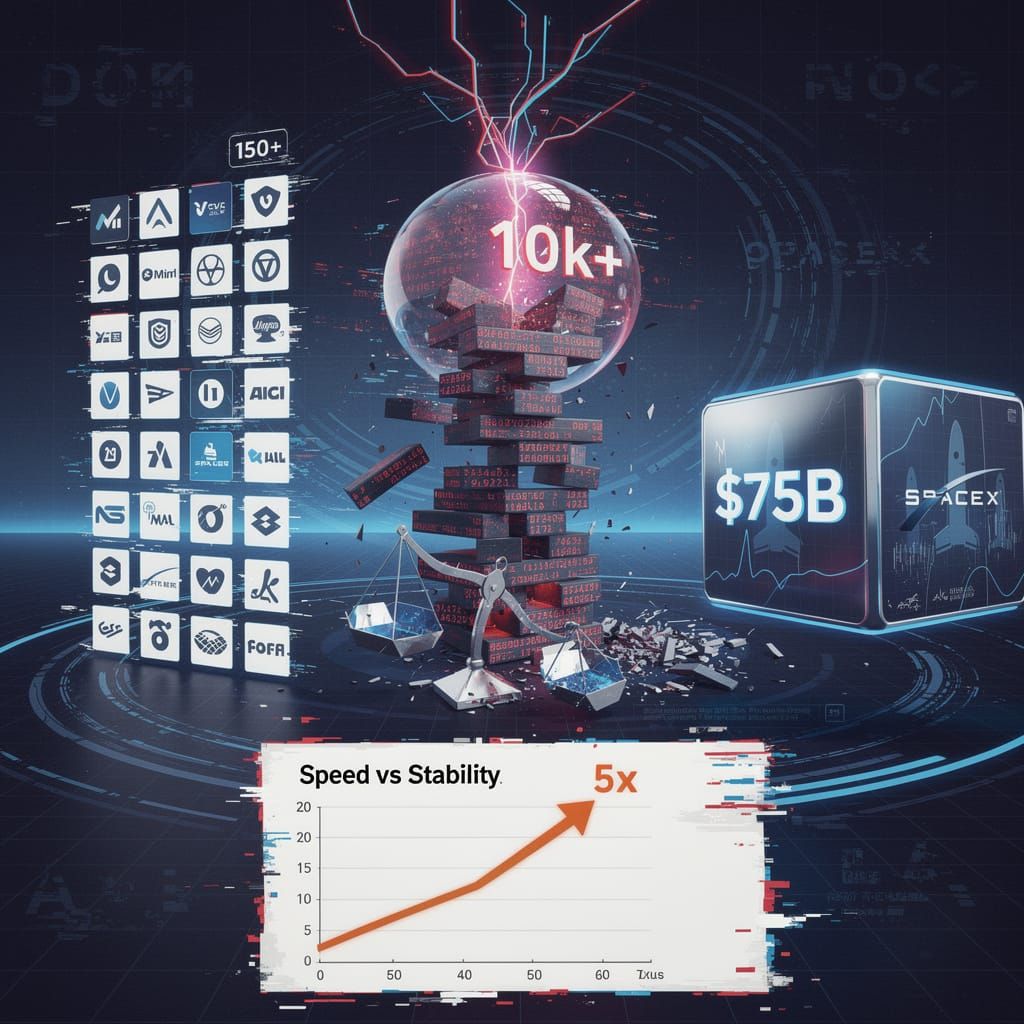
10k+ vulnerabilities in 150+ partners. Absolute carnage 📉 This is the 'productivity boost' of AI scaffolding—building digital Jenga towers at 5x speed. Your technical debt is now an industrial complex 🤡. Devs: are you still thinking, or just prompt-monkeying your way to a breach?
Congratulations! We finally did it. We’ve successfully automated the process of writing bugs at a scale that would make a 1990s legacy mainframe blush. 🤡 Welcome to the era where "programming" is just shouting into a stochastic void and praying the LLM doesn't hallucinate a backdoor into your production server while you're out getting a soy latte.
Why is everything breaking?
We traded craftsmanship for "scaffolding." We’re now layering non-deterministic abstractions on top of non-deterministic abstractions. It’s a digital Jenga tower built by a bot that doesn't know what a pointer is but is very confident about it.
Just look at the velocity of the collapse. On June 22, Nori launched "Nori Sessions," claiming a 2–5x productivity boost. Translation: we can now inject unverified AI garbage into our repos five times faster than before. Meanwhile, the money-men are pivoting hard: SpaceX completed a massive $75B IPO on June 12, with a valuation hitting $1.77 trillion, partly fueled by the xAI merger. We aren't building software anymore; we're just scaling the speed at which we generate technical debt. Your "productivity gain" is actually just a massive transfer of cognitive load to the poor bastard in QA who now has to verify 5x more code with the same amount of caffeine. ☕
Law, Logic, and Total Chaos
While the devs are melting down, the lawyers are playing a high-stakes game of "Find the Loophole." In Germany, the RA-MICRO disaster demonstrated the ultimate irony: you can have a "legal-tech" platform where backend components are practically screaming for entry. Researchers exposed unencrypted backups and recoverable JWT signatures, proving that "compliance" is often just a fancy word for "we hope nobody looks at the ZIP files."
The Great Regression:
- June 12: SpaceX’s $75B IPO and xAI integration industrialize AI-generated fragility. Speed > Stability.
- June 21: The Controversial Programming Opinions blog surfaces; veterans confirm we're all drowning in corporate framework sludge.
- July 2026: The gap between what the code does and what the law thinks it does becomes a playground for anyone who can read a prompt.
The Fallout:
- Cognition: Brains are rotting → dependency on LLM scaffolding deletes first-principles thinking.
- Security: The "Intent vs. Syntax" gap → Project Glasswing just identified >10k vulnerabilities across 150+ partners. Enjoy the patching cycle! 📉
- Governance: Institutional panic → EU regulators are slapping firms like Temu with €232M fines, while AI-driven malware triggers 9.3% market sell-offs. Expensive band-aids on a severed artery.
So, keep polishing those prompts, you absolute legends. While the institutions try to regulate "intent," the rest of us will be over here using low-cost open-source tools to actually understand how the hardware works. 🛠️
Enjoy the collapse. It's the only thing currently running at 100% efficiency. 👋
🤡 The Great Rust Lie: Safe Code is a Fairy Tale
10,000 unsafe blocks! 🚩 That's the 'safe'safe' price of letting AI agents rewrite your code. It's like replacing a leaky pipe with a floodgate made of cardboard 🤡. OpenAI pays $600k for a seat at the table while your production environment gambles. Devs — how's that 'memory safety' treating your sleep schedule?
Congratulations to everyone who spent the last five years treating Rust like a holy scripture that magically deletes bugs from existence. While the Rust Foundation was busy welcoming OpenAI as a Platinum member on June 17, 2026—collecting a cool $600,000 to "bolster infrastructure"—the reality check hit. Turns out, the safety blanket is full of holes. 🚩
Who F***ed Up the Logic?
Rust loves to brag about memory safety, but the reality is a mess of conceptual gaps. The "safe" language is basically held together by a massive amount of duct tape and prayers. When you rely on runtime environments or AI-driven ports, you aren't relying on the language—you're gambling with your production environment.
Just look at the Bun rewrite: a major PR merged 6,755 commits via Claude Code agents. The result? A faithful translation that introduced ~10k unsafe blocks. We've officially traded human error for AI-generated chaos. 🤡
The Causal Chain of Chaos: Corporate Hype → Blind Trust in Safe Blocks → AI-Agented Rewrites → 10k+ Unsafe Blocks → Security Risks in AI-integrated stacks.
The Damage Report
Cognitive Load: Engineers can no longer treat the compiler as a babysitter; they actually have to audit the "safe" wrappers. Triage Hell: The intersection of memory-unsafe dependencies and fragile standard library assumptions is creating a playground for exploits. Institutional Irony: The Rust Commercial Network (RCN) expands its outreach just as the community realizes "safe" is a relative term.
The "Hopeful" Timeline
- Q3 2026: Massive wave of "Wait, this is possible?" threads as users encounter runtime variability and AI-generated unsafe blocks.
- 2027: Adoption of ultra-conservative wrappers to prevent total system meltdown in embedded IoT devices.
- 2028: Documentation updated to admit "Actually, it depends on your runtime" in 50 different places to stop the lawsuits.
The Reality Check
Marketing: "Memory safety guaranteed!" Reality: "Sure, as long as you don't hit one of the 10,000 AI-generated unsafe blocks." Enterprise: Buys expensive scanners to find the bugs the compiler ignored. Hacker: Laughs in low-cost open-source tooling.
Enjoy the cognitive dissonance. Maybe try reading the actual specs instead of the hype-train brochures next time. 💅
🤡 Who Needs Privacy When You Have a Pre-Action Conference? 🤡
₦873.4B budget request while leaking voter data? Absolutely mental. That's like buying a gold-plated vault for a house with no walls 🤡. NDPC is calling this a 'Pre-Action Conference'—corporate speak for 'pay a fee and we'll forget the breach'. INEC — Is your PII actually safe in Nigeria?
Imagine waking up to find your voter profile floating in the digital void. Now imagine the government "urgently treating" it by inviting corporate suits and a forensic guy named Dr. Vincent Olatunji to a cozy chat. Welcome to the 2026 Nigerian data circus, where the line between a catastrophic breach and a "compliance review" is basically a handful of remediation fees. 💸
Who’s getting roasted?
On July 5, the Nigeria Data Protection Commission (NDPC) played bad cop with the Independent National Electoral Commission (INEC). After voter data leaked—specifically targeting Emeka Ike's registration details—the regulator hosted a "Pre-Action Conference." Translation: "Please don't sue us; just pay for the fix and we'll pretend this was a learning experience." 🎓
While regulators play house, the chaos extends to the budget. INEC is currently begging for a ₦873.78 billion budget for 2027, while simultaneously admitting they're replacing BVAS devices lost in previous cycles. To top it off, insiders are the real threat; audits revealed the leak happened via authorized credentials during a registration drive, and officials like Lere Olayinka have already been hauled in for police interviews. The human firewall is basically made of wet cardboard. 📦
Meanwhile, the Central Bank of Nigeria (CBN) decided financial transaction data needs to stay domestic. No more fancy foreign clouds for your payment history. This mandate forces banks into the arms of local data centers, turning dusty server racks into gold mines while the CBN doubles down on mandatory cybersecurity self-assessments.
The "Oopsie" Timeline
- June 20, 2026: NDPC launches probe into INEC and Lere Olayinka over unauthorized data releases.
- July 5, 2026: NDPC hosts Pre-Action Conference; Dr. Vincent Olatunji pushes compliance checks to avoid punitive fines.
- Q3 2026: Mandatory domestic payment data retention kicks in → surge in local data center utilization.
- 2027 Projection: Massive private investment in sovereign digital services as foreign hosting becomes a regulatory nightmare.
The Damage Report Public Trust: Voter data leaked → "assurance" provided via meetings (classic corporate gaslighting). Financials: Punitive fines → converted to "remediation fees" (a subscription to stay out of jail). Infrastructure: Forced domesticity → uptick in managed storage contracts for local providers.
So, electoral transparency is "reinforced," and the local server guys are getting rich off a mandate. The system isn't broken; it's just operating with the grace of a dumpster fire in a hurricane. 🌪️
Stay hacky, keep your data encrypted, and for the love of god, don't trust a "Pre-Action Conference" to save your PII. ✌️


Comments ()