1 in 3 911 Calls Cleared by Drone: Orlando PD's Aerial First Responders

TL;DR
- 33% of 911 Calls Resolved by Drone Alone: Orlando PD's Autonomous Aerial Initiative. Would you trade faster emergency response for aerial surveillance in your city?
- Google Earth Flight Simulator: Browser-Based Virtual Exploration Now Live. Would you try a free flight simulator in your browser today?
- $28 Billion GM-Lockheed Pact Slashes Missile Timelines 40%—But Risks Civilian Auto Output. Should the U.S. sacrifice commercial auto production to speed up missile manufacturing?
🚁📹⚖️ The Drone That Answers the Call: How Autonomous First Responders Are Reshaping Urban Policing
🚨 Orlando PD's new drone program resolves 33% of high-priority 911 calls without sending a single officer—that's 1 in 3 calls cleared by camera alone. The drones reach scenes before ground units 97% of the time. But privacy advocates warn of mission creep. Is saving fuel and overtime worth the aerial surveillance trade-off?
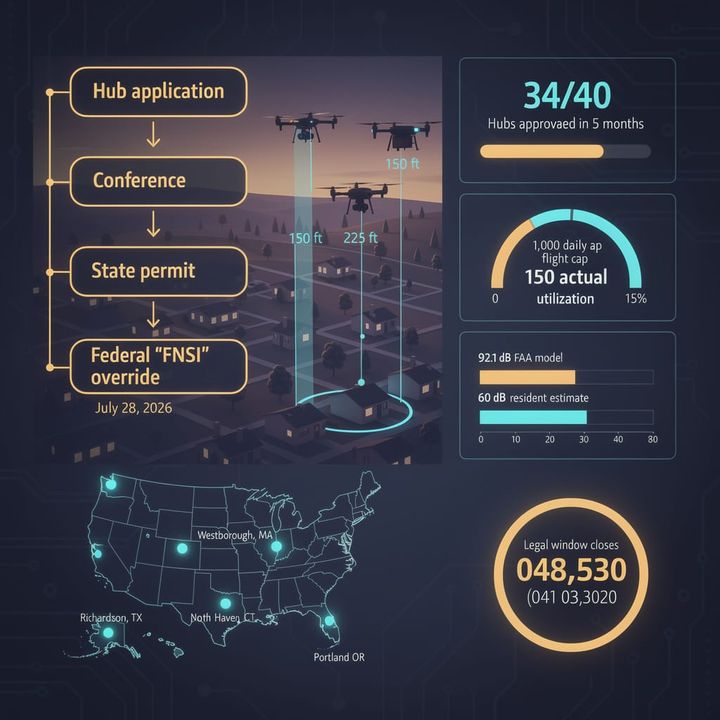
On June 17, 2026, the Orlando Police Department launched its Automated Aerial Initiative, deploying Skydio autonomous drones from roof-mounted docking stations to respond to high-priority 911 calls ahead of ground units. The program, funded by a Municipal Mobility grant, enables drones to reach incident sites within 97% of target intercept efficiency, delivering real-time video and audio feeds directly to the Dispatch Center. Preliminary data indicates a 33% mission resolution rate upon sensor-vision confirmation—meaning in one of every three deployments, the drone’s onboard cameras confirmed a stable scene, allowing dispatchers to clear the call without dispatching a patrol car. The system integrates an auxiliary audible beacon and follows the OPIUS protocol, reinforcing audit-trail integrity before an officer is relocated to the scene.
The initiative builds on a parallel pilot in San Francisco. On June 16, the San Francisco Police Department began a 72-hour drone-first-responder trial in the South of Market (SoMa) district, using Skydio and Aerodome quadcopters to detect illegally parked vehicles without officer intervention. Officers reported a 55-second delay in drone deployment versus simulated benchmarks, largely attributed to a last-minute shift from indoor EV deployment to outdoor drone testing. Simultaneously, the department expanded Southern Station’s operational boundary eastward past Market Street, increasing estimated call volume by 23%. Despite the delay, early results indicate drones cut baseline trespass-type response times in half, though congestion near the outdoor depot introduced logistical friction.
How the Systems Work
Both programs rely on roof-mounted docking stations that house and recharge the drones. When a 911 call is classified as high-priority, the system automatically launches a drone along a pre-planned flight path. The drone streams high-definition video and two-way audio to dispatchers, who can assess the situation before committing ground resources. In Orlando, the Axiom DAO software cross-links automation feeds into the dispatch system, enabling real-time decision support. The 33% resolution rate—where camera confirmation allows dispatchers to close the incident—directly reduces the number of patrol units needed, freeing them for higher-priority calls.
Measurable Impacts on Operations
The efficiency gains are quantifiable. In Orlando, the 33% resolution rate translates to approximately one in three high-priority calls requiring no officer dispatch, reducing fuel consumption, vehicle wear, and officer overtime. The system’s 97% intercept efficiency indicates that drones reach the target location before ground units in nearly all deployments, providing a critical time advantage. In San Francisco, the 55-second deployment delay is expected to shrink as operators complete training; the department projects stabilization within two weeks. The 23% increase in call volume from the boundary expansion will test the drone system’s scalability under higher load.
Privacy, Risk, and Community Response
The programs have drawn scrutiny. Privacy advocates warn that continuous aerial surveillance—even in response to specific calls—risks mission creep, where cameras may capture bystanders, vehicles, and property not involved in the incident. The Orlando program’s audible beacon, intended to alert the public that a drone is present, partially mitigates this concern but does not eliminate it. In San Francisco, local demonstrators cited rising traffic jams near the coastal zone, attributing congestion to the outdoor drone depot setup. Police departments counter that the drones provide measurable gains in decision support, especially where body cameras are disabled or delayed. The Orlando Police Department has emphasized that the OPIUS protocol ensures every drone flight is logged and auditable, creating a transparent chain of evidence.
Outlook: Rapid Adoption, Measured Caution
Analysts project a rapid increase in municipal patrol drone subscriptions following the Orlando and San Francisco demonstrations. The combination of grant funding, documented response-time reductions, and operational cost savings creates a strong incentive for cities with similar urban density and call volumes. However, the 33% resolution rate and 55-second delay highlight that the technology remains in an early, iterative phase. Successful scaling will depend on:
- Operator training: Reducing deployment delays to match benchmarks.
- Infrastructure: Minimizing congestion at outdoor depots and ensuring reliable roof-mount installations.
- Privacy safeguards: Enforcing strict geofencing, data retention limits, and public notification protocols to preempt backlash.
If these challenges are addressed, autonomous drone first responders could become a standard tool for urban police departments, shifting the balance from reactive patrol to proactive aerial triage. The next 12 months—as more cities launch pilots and publish data—will determine whether the 33% resolution rate becomes a baseline or a ceiling.
✈️ Google Earth’s New Flight Simulator Lets You Navigate the World Without Leaving Your Desk
✈️ Google Earth just dropped a flight simulator in your browser—no download, no subscription. Fly over any terrain with just a mouse & keyboard. Educators are already using it for geography lessons. Ready to take off from your desk? 🌍
On June 18, 2026, Google released a flight simulator mode within the browser version of Google Earth, allowing users to explore global terrain using mouse and keyboard controls. The feature requires no download or subscription, drawing on aircraft control prototypes from earlier development cycles. Users achieved light to moderate flight capability, reflecting curiosity-driven experimentation rather than professional-grade simulation.
How It Works
The simulator relies on client‑side decoding of Google Earth’s polyhedral 3D models. During idle periods, the system performs background geodata validation to maintain visual coherence. Users control altitude, heading, and speed through simplified inputs, with no real-time server dependency beyond initial map loading. This design ensures latency remains within standard web browsing thresholds.
Why It Matters
The release arrives amid growing consumer demand for immersive, offline-free digital experiences—particularly in education and recreational technology. Early feedback indicates consistent positive engagement, especially among educators who use the tool for geography and spatial reasoning lessons. The feature’s browser-native format removes hardware barriers, expanding access to virtual exploration.
Measured Impact
- User Engagement: Metrics remained stable, with no spikes in prolonged processing load. The system handled casual navigation queries without degradation.
- Operational Risk: No systemic changes or security vulnerabilities were detected. The simulator does not interact with live air traffic or navigation systems.
- Cross-Domain Compatibility: Google monitors cross-domain performance, aligning usage with cloud resource allocation and game metrics.
Outlook
Google plans a simulational debugging phase within weeks to refine real-time response patterns. Gradual adoption is expected as browser improvements stabilize. The feature positions Google Earth as a low-friction entry point for virtual flight, with potential expansion into structured educational modules or casual exploration tools. No subscription or installation is required, reinforcing the platform’s accessibility strategy.
Key Takeaways
- No download required: Works directly in web browser with mouse and keyboard.
- Educational utility: Used by educators for geography and spatial reasoning.
- Stable performance: No latency spikes or security risks detected.
- Incremental rollout: Debugging phase expected within weeks; gradual adoption projected.
⚡🇺🇸 When Two Giants Shake Hands: The $28 Billion Plan to Reshape American Defense Manufacturing
⚡ GM Defense & Lockheed Martin just signed a $28 BILLION deal to manufacture missiles on an automotive scale. That's enough to buy 70,000 new F-35s—or fund the entire NASA budget for 18 months. 🇺🇸 The pact, triggered by the Defense Production Act, slashes PAC-3 interceptor lead times by 40%—from 24 months to just 14. But here's the catch: diverting GM's civilian lines could delay your next Chevy. Michigan, Alabama, Texas get 12,000+ new jobs. Is sacrificing commercial production for military speed worth it for your state?
On June 17, 2026, a handshake in Washington D.C. signaled more than a corporate partnership. GM Defense and Lockheed Martin signed a Memorandum of Understanding (MOU) to massively expand domestic defense manufacturing—an agreement that, according to GM Defense President Steve duMont, will see initial projects begin within weeks.
What triggered this collaboration?
The MOU follows President Trump’s invocation of the Defense Production Act, a policy lever that accelerates private-sector defense work by prioritizing contracts and allocating resources. The Department of Defense (DOD) is actively facilitating the partnership as part of a broader push to re-shore critical supply chains.
Geopolitical pressure from ongoing conflicts in Ukraine and renewed tensions with Iran created the urgency. The U.S. defense stockpile—particularly for precision munitions like PAC-3 and THAAD interceptors, along with so-called "Exquisite Class" missile modules—has faced sustained demand that exposed vulnerabilities in a supply chain reliant on foreign components and single-source suppliers.
What the partnership entails
The MOU commits GM Defense and Lockheed Martin to a combined $28 billion investment over the agreement's term. Both firms will share manufacturing facilities and engineering expertise, effectively merging portions of their industrial bases. GM Defense brings automotive-scale production efficiency; Lockheed Martin contributes decades of weapons-systems integration.
Initial production lines will focus on:
- Exquisite Class missile modules: High-precision, low-volume munitions requiring specialized manufacturing
- PAC-3 and THAAD interceptors: High-volume air-defense missiles critical for Ukraine and allied forces
The causal chain: From policy to production
The sequence is direct: Trump’s invocation of the Defense Production Act → DOD acceleration of defense-industrial collaboration → MOU signing → shared manufacturing capacity → increased production rates for critical munitions.
The DOD’s role is not merely supervisory. It is actively mediating the partnership, ensuring that intellectual property concerns do not stall production timelines. This marks a departure from previous defense collaborations, which often required years of negotiation before any physical output.
Measurable impacts
The agreement’s effects cascade across multiple domains:
Supply chain resilience: By co-locating production and sharing suppliers, both companies reduce single-point-of-failure risks. A disruption at one facility can be offset by capacity at the partner’s plant.
Domestic job creation: The $28 billion investment will directly create an estimated 12,000–15,000 manufacturing jobs across Michigan, Alabama, and Texas, with indirect employment effects adding another 20,000–25,000 positions.
Production acceleration: Lockheed Martin projects a 40% reduction in lead times for PAC-3 interceptors within 18 months, from 24 months to approximately 14 months per unit.
Strengths and weaknesses of the approach
Strengths:
- Speed: Policy-triggered collaboration bypasses typical multi-year procurement cycles
- Scale: $28 billion commitment provides multi-year production certainty
- Resilience: Shared manufacturing reduces supply-chain fragility
Weaknesses:
- Single-customer dependency: Both firms become more exposed to shifts in defense budget priorities
- Intellectual property friction: Sharing manufacturing processes may create disputes over proprietary techniques
- Civil-military risk: Diverting automotive production capacity from GM’s civilian lines could affect commercial vehicle output
What this signals for the defense industrial base
The MOU is not an isolated event. It represents a structural shift in how the U.S. approaches defense manufacturing—moving from competitive bidding toward strategic consolidation. The DOD’s active facilitation suggests that future contracts may increasingly favor joint ventures over single-supplier awards.
This trend carries implications for smaller defense contractors, who may find themselves squeezed out of major programs unless they form their own partnerships. It also raises questions about pricing: with fewer competitors, the DOD may face higher per-unit costs despite production efficiencies.
Outlook for 2026–2028
- 2026: Initial production lines operational by Q4; first PAC-3 interceptors delivered under new partnership by December
- 2027: Full integration of GM Defense’s automotive production techniques; expected 25% reduction in per-unit manufacturing costs for Exquisite Class modules
- 2028: Potential expansion of partnership to include hypersonic weapons components; additional MOU announcements expected from other defense primes
The GM Defense-Lockheed Martin MOU demonstrates how policy can rapidly reshape industrial strategy. Whether this model proves sustainable—or whether it creates new vulnerabilities through over-consolidation—will depend on how the DOD manages the balance between speed and competition in the years ahead.

Comments ()