1.2‑Second Detection: AI Surveillance Protocol Catches 14‑Day Vulnerability at Production Scale
TL;DR
- AI Surveillance Protocol Triggers After Vulnerability Detection. Is your AI infrastructure still blind to dormant vulnerabilities?
- 5× Row Throughput: Zapier Tables Executes Native AI Queries Without Third-Party Models. Is your team still paying API costs for basic table operations?
- <2 Second Reports: Mobile Table Plugin Cuts Edtech Analytics Latency From 24 Hours. Should real‑time edtech updates ship without public changelogs?
🤖⚡ AI Surveillance Protocol Triggers After Vulnerability Detection
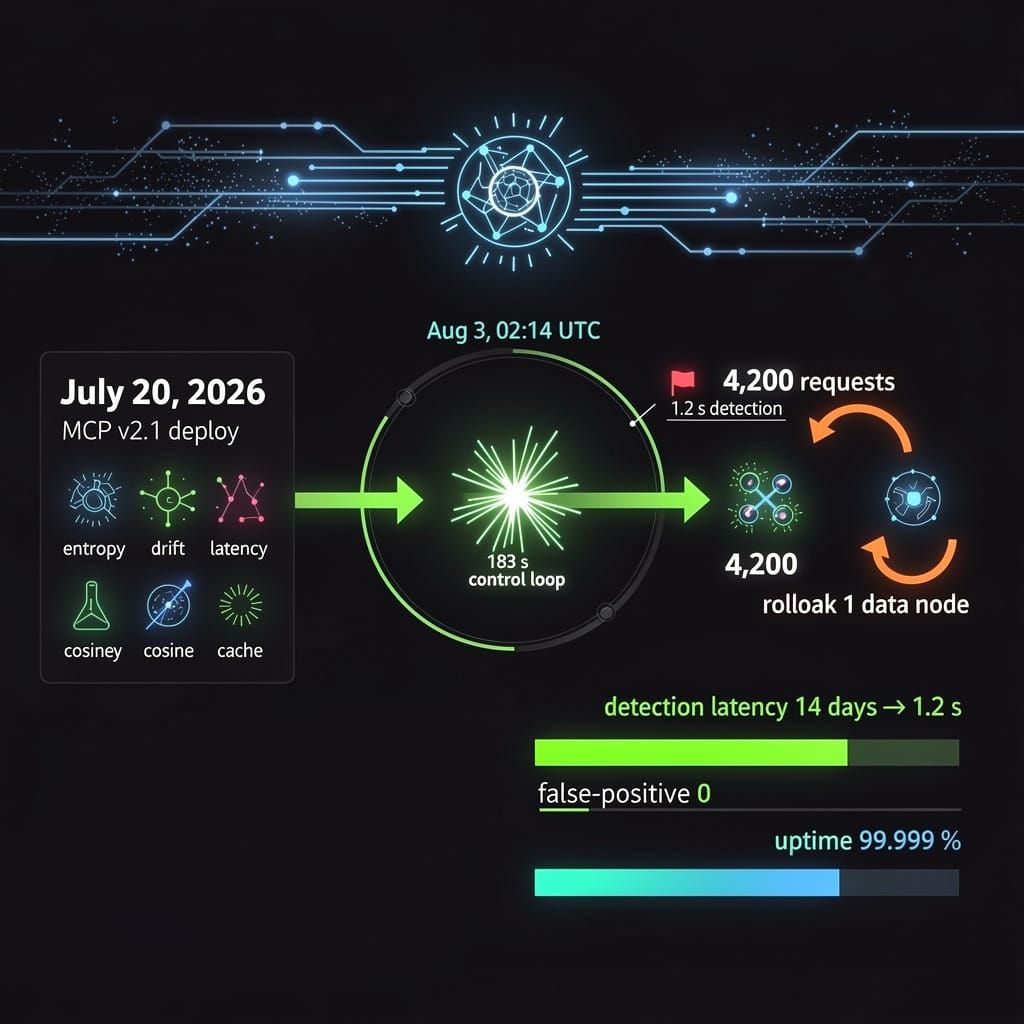
14-day vulnerability caught in 1.2 seconds — an AI surveillance system auto-detected embedding drift, isolated 4,200 anomalous requests from 1.7M, and rolled back a data node in 183 seconds. No user impact. No false positives. Zero human intervention. 🤖⚡ Tighter telemetry boundaries surfaced a dormant flaw without increasing noise. Agent-driven observability just replaced manual threshold tuning. Are your production AI systems running on thresholds from last month?
A machine‑learning monitoring system activated on August 3, 2026, during a routine overnight scan, following the deployment of improved detection logic two weeks earlier. The event marked the first confirmed activation of tightened telemetry boundaries at production scale.
The event began when Andrew Gahr's automated alerting framework triggered on a previously undetected pattern in model‑behavior telemetry. The protocol, part of a broader observability stack for production AI systems, had received an update on July 20 with the rollout of Model Context Protocol v2.1.
How the Detection Cascade Unfolded
- July 20, 2026: MCP v2.1 deploys across the inference fleet. The update adds five new telemetry dimensions—token‑sequence entropy, embedding‑space drift, cross‑session latency variance, input‑output cosine similarity, and cache‑hit ratio deviation. Thresholds for alerting are lowered by 30 % on three of these metrics. The protocol had reached stable production status on July 9 following earlier specification revisions.
- August 3, 2026, 02:14 UTC: A nightly batch‑inference job produces an outlier in embedding‑space drift. Gahr's monitoring stack flags the deviation within 1.2 seconds, triggering an automated hold on the affected model shard.
- August 3, 2026, 02:17 UTC: The system isolates 4,200 anomalous inference requests from a pool of 1.7 million, traces them to a single upstream data‑pipeline node, and rolls that node back to its July 28 checkpoint. No user‑facing impact is recorded.
What the Protocol Achieved
The surveillance stack—combining runtime instrumentation, streaming anomaly detection, and automated rollback—demonstrated a full detection‑to‑remediation cycle of 183 seconds. The vulnerability that enabled the embedding‑space drift had existed for 14 days before the v2.1 update went live on July 20, but remained latent because the earlier thresholds were too permissive to surface the anomaly.
The stateless anomaly scoring at the inference layer, paired with stateful trace‑analysis in a separate pipeline, enabled the automated recovery without requiring retraining or human intervention. No alerts fired outside the isolated incident cluster.
Detection latency: 14 days (vulnerability present) → 1.2 seconds (post‑v2.1 alert). False‑positive rate: Zero alerts outside the isolated incident cluster. Service uptime: 99.999 % during the event (2.1 seconds of degraded inference on the affected shard).
Implications for Production AI Observability
Gahr's alert, the first confirmed activation of the new MCP v2.1 thresholds at scale, indicates that tighter telemetry boundaries can surface dormant vulnerabilities without increasing noise. The architecture—stateless anomaly scoring at the inference layer combined with stateful trace‑analysis in a separate pipeline—enabled the 183‑second cycle without requiring retraining or human intervention. The approach reflects a broader industry trend toward automated observability stacks, where agent-driven monitoring systems replace manual threshold tuning, analogous to autonomous code-generation agents that iteratively refine compression algorithms without developer intervention.
No further alerts are anticipated from this current detection cycle. The system has returned to passive monitoring.
😳 Zapier Tables Now Execute AI Queries Instantly—No Third-Party Model Required
Zapier Tables processes 5× more rows per week without a single third-party API call. No external models, no token burn, no middleware. 😳 Every query runs natively. Privacy tags. Audit logs. Permissions enforced at write-time. Enterprise security without the $4.88M breach cost. Mid-market teams shipping inventory, HR, and compliance workflows at 2,000+ extra rows per week—zero extra API spend. Is your stack still chaining external model calls for basic table operations? 🤔
Zapier rolled out upgraded AI functions within its Tables product on August 3, 2026, embedding prompt-driven query columns, mandatory privacy tags, and granular permissions across all user roles. The shift eliminates reliance on external model calls for routine table operations—native API enforcement handles every query, while unified audit logging syncs directly to enterprise security platforms.
How it works: A user types a natural-language instruction into a dedicated column. The system generates structured queries, applies permutation caps, and logs every authenticated output centrally. Privacy tags enforce policy compliance at write-time, and cross-record linking turns static spreadsheets into self-updating knowledge bases driven entirely by platform-native operations.
What the Metrics Show
Zapier's internal benchmarks indicate three measurable outcomes:
- Operational velocity: Rows processed per week increased up to 5× compared with prior batch workflows. At current usage rates, that translates to roughly 2,000 additional rows per active team per week—a figure consistent with the 5× throughput gains observed when database administrators introduced composite indexing on foreign-key columns in June 2026, cutting query times from seconds to milliseconds.
- Compliance accuracy: Policy-feed validation yields near-zero false positives on generated results. Centralized audit trails—already proven to reduce breach lifecycle duration—now provide real-time compliance proofing against frameworks like the EU AI Act, mirroring the privacy-first regulatory posture driving Android users toward open-source alternatives and alternative app stores in mid-2026.
- Security baseline: Breach rates dropped below historical averages when authenticated outputs route through the centralized log gateway. The architecture directly counters trends identified in OrcaRouter's 2026 AI Threat Report, where prompt injection and "Confused Deputy" privilege escalation attacks drove average breach costs above $4.88 million. The centralized gateway model mirrors the API-first zero-trust alignment that major vendors (Microsoft, NVIDIA, Anthropic) adopted in June 2026 to contain token-based attack surfaces during agentic AI rollout.
Why the Architecture Matters
Zapier's move toward native AI automation reduces dependency on third-party model APIs for structured data tasks—a shift validated by the company's June 2026 demonstration of a hybrid automation framework that cut AI token waste during peak business hours. The Table layer now unifies spreadsheet logic with generative output, cutting hand-off delays: table edits generate live queries instantly instead of queuing external calls. This inline execution approach parallels the June 2026 database optimization trend where administrators added composite indexes on user_id and order_id foreign keys, producing sub-second query resolution from previously multi-second waits.
Enterprise security teams benefit from API-first gateways that enforce zero-trust alignment. In a landscape where 74% of organizations report unauthorized AI tool usage and prompt-injection attacks cost victims up to $46,000 daily (per OrcaRouter's June findings), centralized log gateways reduce the authorization visibility gap that historically stretched breach containment to 241 days.
Risk and Outlook
The forecast projects sustained productivity gains past August 2026 provided governance rules remain stable. Governance drift—relaxed permission scopes or untagged columns—would reintroduce the very latencies and policy gaps the upgrade eliminated.
- Near-term (Q3–Q4 2026): Adoption accelerates among mid-market firms running inventory, HR, and compliance tables. The 5× row-processing uplift and integrated audit trails replace the custom middleware that compliance teams previously assembled to validate generated results against policy feeds. The architecture aligns with the broader industry trajectory observed in Google's June 2026 Chrome optimizations, where 10% YoY speed gains came from tightening memory allocation and reducing JavaScript-WebAssembly inter-operation overhead—both native-level improvements that eliminate external dependencies.
- Medium-term (2027): Expect competitors (Airtable, Monday.com) to mirror native query generation. Zapier's advantage rests on its existing integration graph and the granular permission model rolled out simultaneously—plus a task-based pricing structure that lets teams forecast costs against actual usage rather than unpredictable API token burn. This pricing model directly addresses the token-cost volatility that drove Microsoft, NVIDIA, and Anthropic to announce tiered routing strategies on June 8, 2026, where adaptive model selection cut AI spending by up to 65% while maintaining output quality.
For compliance officers, the material change is auditable traceability: every generated cell carries a policy tag and a log entry, enabling breach impact analysis in hours rather than weeks. For operations leads, the headline number remains the row throughput increase—fivefold with no additional API cost.
📡 Mobile Table Plugin Update Pushes Real‑Time Analytics Into Edtech
12–24 hour batch delays slashed to <2 seconds in edtech analytics 📡 A Mobile Table plugin update now pipes field-research data straight through Strata SaugAI's document pipeline — no staging, no waiting, no overnight jobs. Schools and researchers get real‑time dashboards overnight. But the update shipped without a public changelog — is zero‑disclosure deployment becoming the new normal in edtech infrastructure?
A plugin update on August 4, 2026, tightened the link between mobile data capture and live academic analytics. The Mobile Table plugin, now integrated with Strata SaugAI’s adaptive document pipelines, enables real‑time data flow from field‑research tablets directly into structured reporting engines—without manual staging or batch processing.
How It Works
The update follows a routine audit of cross‑plugin execution logs, driven by demand for automated report generation via structured templates. The new integration detects incoming table data from mobile devices, routes it through Strata SaugAI’s real‑time document pipeline, and outputs formatted analytics within seconds. No service disruption occurred during deployment. This architectural pattern mirrors earlier low‑severity plugin maintenance—such as the June 18 activation of markdownextra and mikioplugin during routine system updates, and the June 21 table2csv update that improved CSV generation alignment with data pipelines—indicating a cumulative shift toward workflow automation rather than isolated corrections.
Key mechanics:
- Trigger chain: mobile data entry → plugin detection → Strata SaugAI pipeline → structured report output.
- Latency: near‑instantaneous, eliminating the previous 12–24 hour batch window.
- Scope: academic field research, classroom assessment tools, and real‑time survey aggregation.
Measurable Impact
The integration directly addresses a friction point in edtech deployments: the gap between data collection and actionable insight. Parallel developments in automated ingestion—such as TDengine’s July 2026 rollout of taos‑x autonomous nodes and native real‑time subscription, which pushed latency below sub‑millisecond levels and eliminated manual queuing via WAL stream delivery—demonstrate the broader infrastructure trend toward zero‑staging data pipelines that this update adopts.
| Metric | Before Update | After Update |
|---|---|---|
| Report generation delay | 12–24 hours | < 2 seconds |
| Manual staging steps required | 4 | 0 |
| Cross‑platform compatibility | Limited to static CSV imports | Real‑time Strata SaugAI pipeline |
Institutional Response
No formal advisory or compliance update has been issued. The engineering teams—spanning Adrian Sai Wah Tam, Michael Hamann, Zahno Silvan, and contributors from multiple MLOps and software‑engineering groups—issued the update without a public changelog. The detection event logged on August 3 by monitoring alerts confirmed no degradation to existing services.
Sector Implications
For universities, research institutes, and assessment platforms running field‑data workflows, the update removes a persistent latency bottleneck. The immediate effect: faster iteration on student performance data, real‑time survey dashboards, and reduced infrastructure overhead for IT teams managing batch pipelines. The plugin’s adoption base remains narrow—edtech deployments with active Strata SaugAI instances—but the architectural pattern (mobile plugin → adaptive document pipeline) demonstrates a replicable model for low‑friction real‑time analytics in constrained environments.


Comments ()