US Closes Brazil Embassy Days Before Closest Vote in a Generation
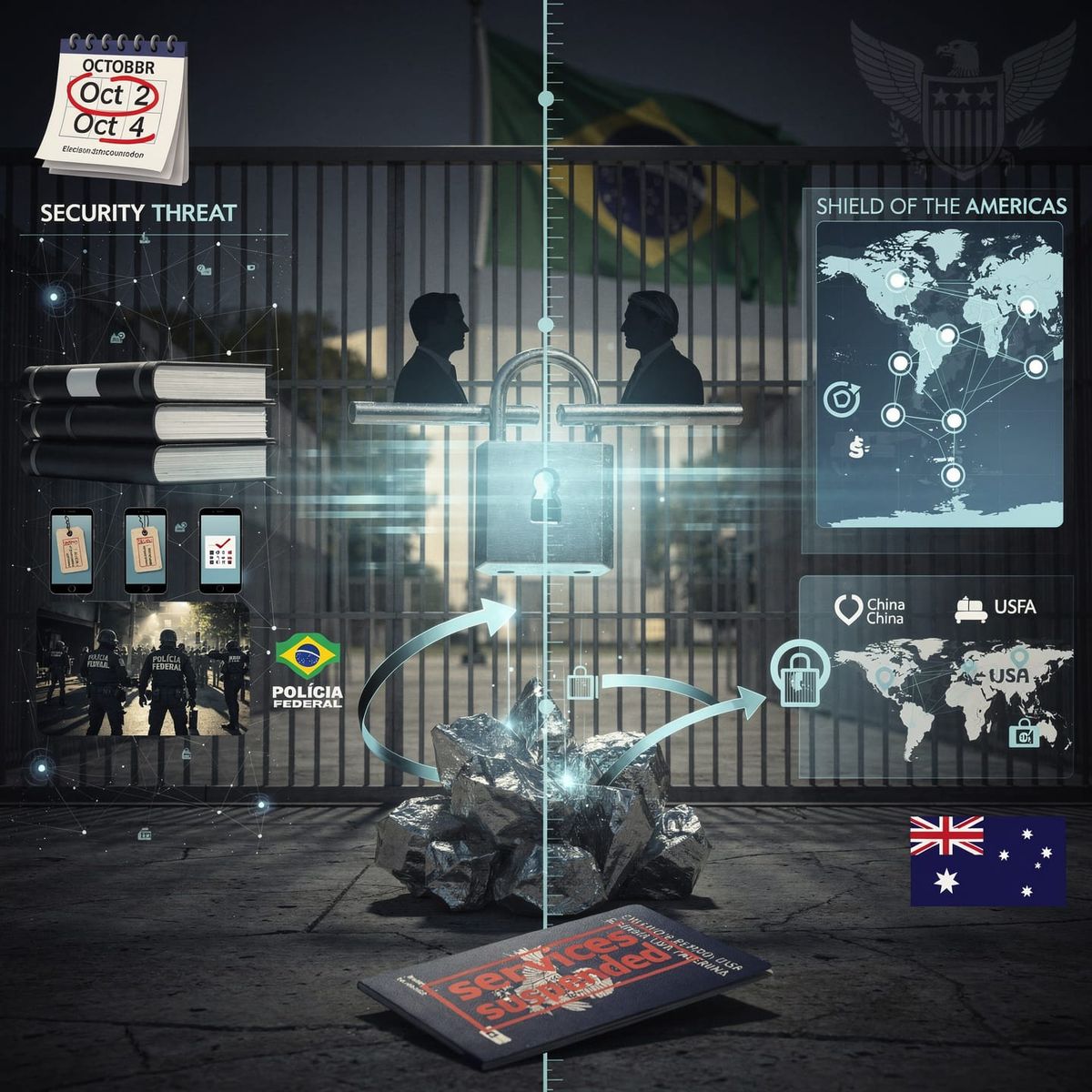
Days before Brazil's tightest presidential race in a generation—and three days after Trump launched the 17-nation "Shield of the Americas"—Washington abruptly closed its Brasília embassy and suspended consular services. The stated reason: a security threat. Brazil's Federal Police raided São Paulo and Brasília, seizing phones and computers to probe alleged plots against the mission. Australia followed in a rare show of solidarity. But the counter-narrative is moving fast. Attorney General Jorge Messias has asked the Supreme Federal Court to investigate claims that U.S. funds flowed to far-right movements—a charge Lula's Workers' Party says is groundwork to delegitimize a Lula win. The confirmed reality: services stay suspended indefinitely, and Americans in Brazil are left without passport renewals or emergency help. What's unconfirmed: whether the threat is real or theater aimed at October 4. Who bears the cost either way? U.S. citizens on the ground.
It's an odd thing when a superpower quietly locks its own doors. But that's exactly what happened on October 2, when the United States abruptly suspended consular services and shuttered its embassy in Brasília—with Australia, in a rare display of diplomatic solidarity, closing its own mission shortly after.
Officially, the reason is "security." The U.S. State Department cited a threat assessment. Brazil's Federal Police, meanwhile, launched a secret operation—raids in São Paulo and the Federal District, seizing phones and computers—to investigate alleged plots against the American embassy. The Brazilian Intelligence Agency (ABIN) is reportedly involved. So, yes, something is happening. By the next day, Attorney General Jorge Messias had formally asked the Supreme Federal Court to probe allegations that U.S. funds were flowing to far-right movements. The counter-narrative is already in motion.
But here's where things get interesting.
A Conveniently Timed Threat
The timing is hard to ignore. Brazil votes for president on October 4—a neck-and-neck race between incumbent Luiz Inácio Lula da Silva and Senator Flávio Bolsonaro. Flávio isn't just any challenger; he's the son of Jair, Toro enthusiast and patron saint of Brazil's hard right.
Cue the dog-whistles. During the campaign, Flávio has leaned hard into symbolic submission to Trump's orbit—inviting U.S. forces to "combat terrorist organizations" in Rio, pledging to "decree that Brazil belongs to the Lord Jesus Christ," and basking in footage of American ships destroying a vessel in the Caribbean. Brother Eduardo's been rooting from the sidelines, celebrating Trump's tariffs on Brazil. The Bolsonaro brand, in 2026, is essentially a Trump rebrand.
Now, we're told an embassy closes for security. That's a real thing, and a real threat is entirely plausible. But Lula's own Workers' Party isn't buying it. Edinho Silva, the PT's president, called the move "unprecedented and meaningless," floating the theory that Washington is laying groundwork to delegitimize a Lula victory.
Is that paranoid? Maybe. But context matters.
The Shield and the Rare-Earth Squeeze
Here's the part nobody's framing as a coincidence: three days before the embassy drama, Donald Trump formally launched the "Shield of the Americas" at the UN General Assembly sidelines. Not a vague promise—an actual joint declaration signed alongside Secretary of State Marco Rubio and representatives from 16 other countries. That's 17 nations in the coalition, not 15, targeting 24 armed groups including FARC dissidents, ELN, and Clan del Golfo under the Inter-American Treaty of Reciprocal Assistance (TIAR).
Trump built that on a claim that right-wing candidates won all seven presidential elections in Latin America since his second term. Only six nations remain under leftist governments—Brazil being the heavyweight. And the record backs the thesis: the past 18 months have seen Trump-backed candidates backed in Argentina, Colombia, Venezuela, and beyond, with a $40 billion bailout for Argentina made conditional on Milei's party winning midterms and personal sanctions spammed at Gustavo Petro.
And the message from Washington? So tempting. Trump has hinted that if Flávio Bolsonaro wins, Brazil could join the Shield—a pivot toward U.S. security interests and a hardline stance on crime that aligns neatly with the playbook Rubio's been running.
Then there's the economics. Beyond the security architecture, the Shield declaration explicitly bundled in "enhanced economic cooperation on critical minerals and supply chain security." China remains a top partner and key supplier for Brazil's critical-minerals sector—rare earths being the battleground resource in the U.S.–China rivalry. Washington has leverage there, and it's not shy about using it: sanctions, "terrorist organization" designations (the PCC and Red Command got theirs in May), diplomatic pressure. The threat arsenal is real and it's loaded.
So Who Has the Goods?
Let's be honest about what we know versus what we don't.
What's confirmed: the embassy and consulates are closed; consular services are suspended indefinitely; Brazil's Federal Police executed search-and-seizure warrants tied to alleged attack planning; Australia followed the U.S. lead; and a Supreme Federal Court inquiry now hangs over alleged foreign cash in the race.
What's unconfirmed: the actual nature and credibility of the threat; whether the intelligence is solid or inflated; and whether this is genuine security or geopolitical theater aimed at the October 4 ballot.
The People Pay the Price
One thing is certain: Americans in Brazil are the collateral damage. No passport renewals. No notarizations. No emergency consular help. Authorities have gone as far as advising U.S. citizens abroad not to rely on consular assistance at all. For U.S. citizens scattered across São Paulo, Rio, and Brasília, "security precaution" reads as "good luck figuring it out yourself."
The Federal Police say the investigation will continue with forensic analysis of the seized equipment. Services remain suspended until further clarification, with no resumption date.
The Pre-Election Fog
What happens next likely hinges on Election Day. If Lula ekes out a win—and the possibility of an October 25 runoff looms if nobody clears 50%—watch for accusations of foreign interference and a possible diplomatic freeze with Washington, and watch how quickly the Shield's TIAR machinery, already teed up for 24 target groups, finds new names to designate. If Bolsonaro takes it, expect a swift security-cooperation reset and maybe an invitation to the Shield.
For now, diplomats cite threats, police point to plots, and politicians point fingers. Whatever the truth, one message seems clear from Washington to Brasília: we can close our doors whenever we like—and we're not telling you exactly why.
How convenient that it happens to be during the closest presidential race in a generation—right after the entire neighborhood got a new coalition, 17 members strong, with a standing invitation Brazilian politicians can't pretend not to see.
Comments ()