Poland's 2026 Sunday trading ceiling: eight days, never nine
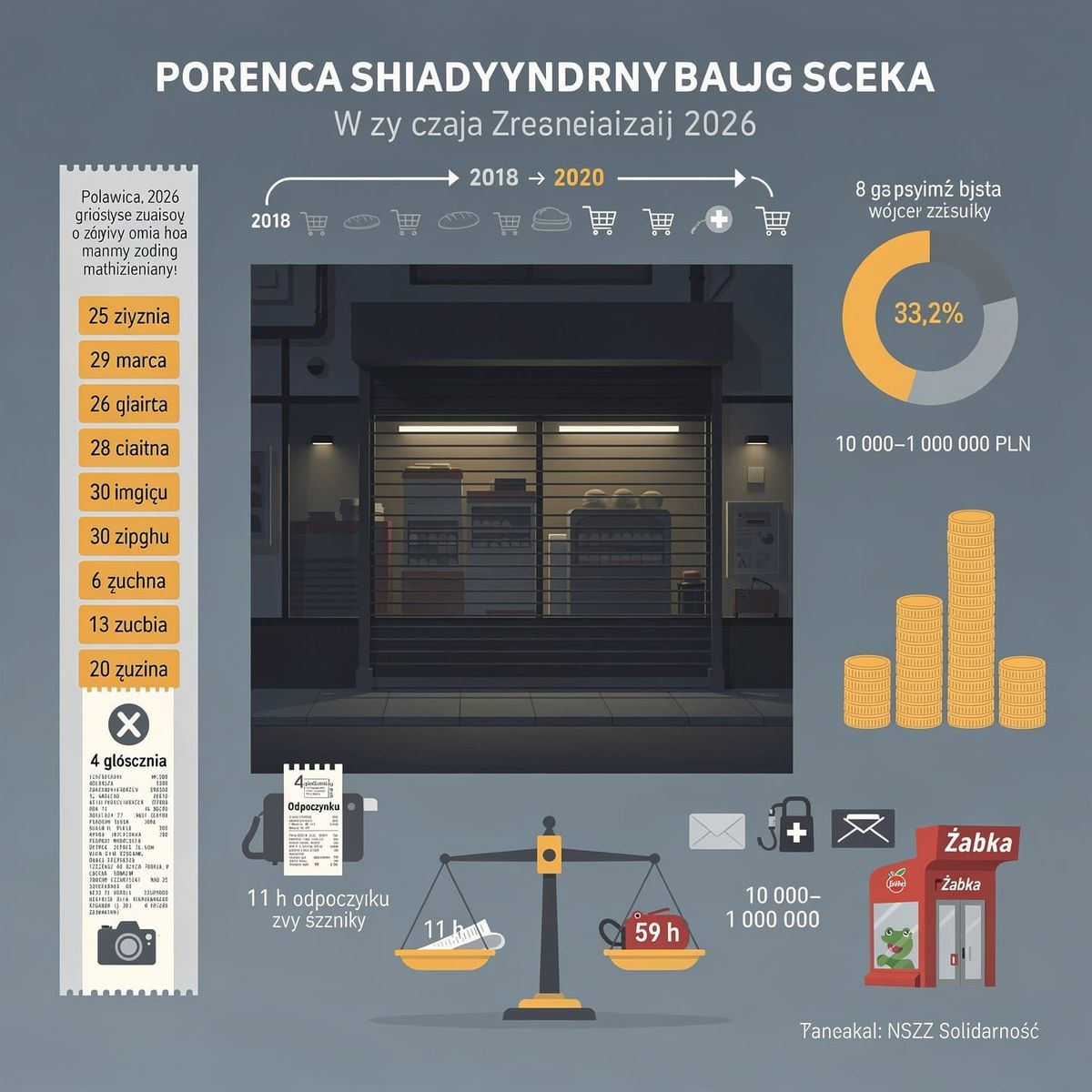
Poland's Sunday shopping ceiling just got "denser" — and not in the way it sounds. The 2026 calendar delivers 8 guaranteed trading Sundays (Jan 25, Mar 29, Apr 26, Jun 28, Aug 30, Dec 6, 13, 20) — never the promised nine. October 4? Closed. Big-box chains Lidl, Biedronka, Dino, and the rest stay dark. Why it matters now: enforcement is escalating. Solidarność is crowdsourcing proof, urging shoppers to photograph receipts from Sunday-trading violators and file them. The Labour Inspectorate found violations in 33.2% of 2025 inspections — a stat that explains both the union's appetite and why fines (10k–1M PLN) are quietly treated as costs of doing business. The bigger unresolved idea: a petition (due Nov 5) would scrap the ban entirely and guarantee two consecutive days off instead. Find the tradeoff? 🛒
If you run a chain supermarket in Poland, you already know the drill: your doors stay shut on most Sundays, and your refrigeration units hum in the dark while your staff enjoys a legally mandated day off. But as of late 2026, the calendar is doing that thing where it looks generous while giving back almost nothing.
The law, briefly, and in plain Polish
Poland's Sunday trading restriction has been tightening screws since 2018. The broad strokes: enacted January 10, 2018, and effective March 1, 2018, the law bans retail sales on Sundays and holidays — with a rotating list of exceptions. It crept from permissive (2018's first-and-last Sunday allowance) to stingy (2020's seven-Sunday limit) to its current "eight to nine Sundays" configuration.
What changed in 2026
The notable tweak: an additional permitted trading Sunday landed at the start of December. That nudges the annual ceiling toward eight guaranteed Sundays — with a possible ninth when calendar quirks align. For 2026, that means trading Sundays roughly run the early months and a December trio.
Don't get too excited. October's first Sunday — October 4, 2026 — sits firmly in the closed column. The big-box chains (Lidl, Biedronka, Stokrotka, Auchan, Kaufland, Dino, Aldi, Carrefour) stay dark on those days. The 2026 trading Sunday list, per the official schedule and the Labour Inspectorate, is January 25, March 29, April 26, June 28, August 30, and then December 6, 13, and 20 — eight for the year, never the promised nine.
And if you need groceries on a banned Sunday, the escape hatch runs through the exempt categories — roughly 32 exceptions covering pharmacies, gas stations, bakeries, restaurants, transport hubs, flower shops, post offices, and the owner-run Žabka convenience chain.
The gathering storm over enforcement
Here's where 2026 turned interesting. The trade union NSZZ Solidarność isn't just grumbling — its chair of the National Trade Workers' Section, Alfred Bujara, is openly calling the current fines "operational costs" that companies happily absorb, and the union is escalating. It's urging citizens to photograph receipts from Sunday-trading violators and forward them for enforcement. The union's math: fines ranging from 10,000 to 1,000,000 PLN, with the persistent offender staring down potential criminal charges under Art. 218a of the Criminal Code.
The Labour Inspectorate's own numbers give the union ammunition: 33.2% of inspections in 2025 turned up violations. That's roughly one in three checks finding a store open when it shouldn't be — a statistic that explains both the union's receipts campaign and its appetite for a stricter regime.
Meanwhile, some operators game the system legally: E.Leclerc in Radom runs seven days a week via a bookstore licence, a workaround that complies with the letter of the law while ignoring its spirit.
The bigger, weirder idea in play
The Sejm's unfinished amendment isn't the only game in town. A petition (no. 186/2026, filed August 5) floats a genuinely different model: scrap the Sunday ban entirely and instead guarantee workers two consecutive days off — a mechanism promising at least 59 hours of uninterrupted regeneration versus the current statutory minimum of just 11 hours of daily rest under the Labour Code. The idea has been teed up for ministry consideration, with a deadline of November 5, 2026 — meaning the current eight-Sunday status quo is fully funded, staffed, and scheduled through at least this quarter.
The analytical shrug
The cynic's read: this is regulation as a slow-moving glacier — annual nudges that look like progress but preserve the essential constraint. The enforcement "escalation" is largely citizens being deputized to mail in receipts, and the 33.2% violation rate suggests the market has quietly priced in noncompliance as a cost of doing business. Whether the future is two-days-off-for-everyone, a perpetual eight-Sunday calendar, or a crackdown that finally makes the fines sting — that's the ledger as it stands, not a recommendation.
Watch for: (1) the November 5 deadline on the two-consecutive-days-off petition, (2) whether Solidarność's receipt campaign actually moves the Inspectorate's violation numbers, and (3) how the persistent-violator threat under Art. 218a changes cost arithmetic for chains like E.Leclerc and the fast-expanding Žabka. All observable, all unresolved.


Comments ()