Family of woman killed by ICE agent sues US under 1871 Klan Act
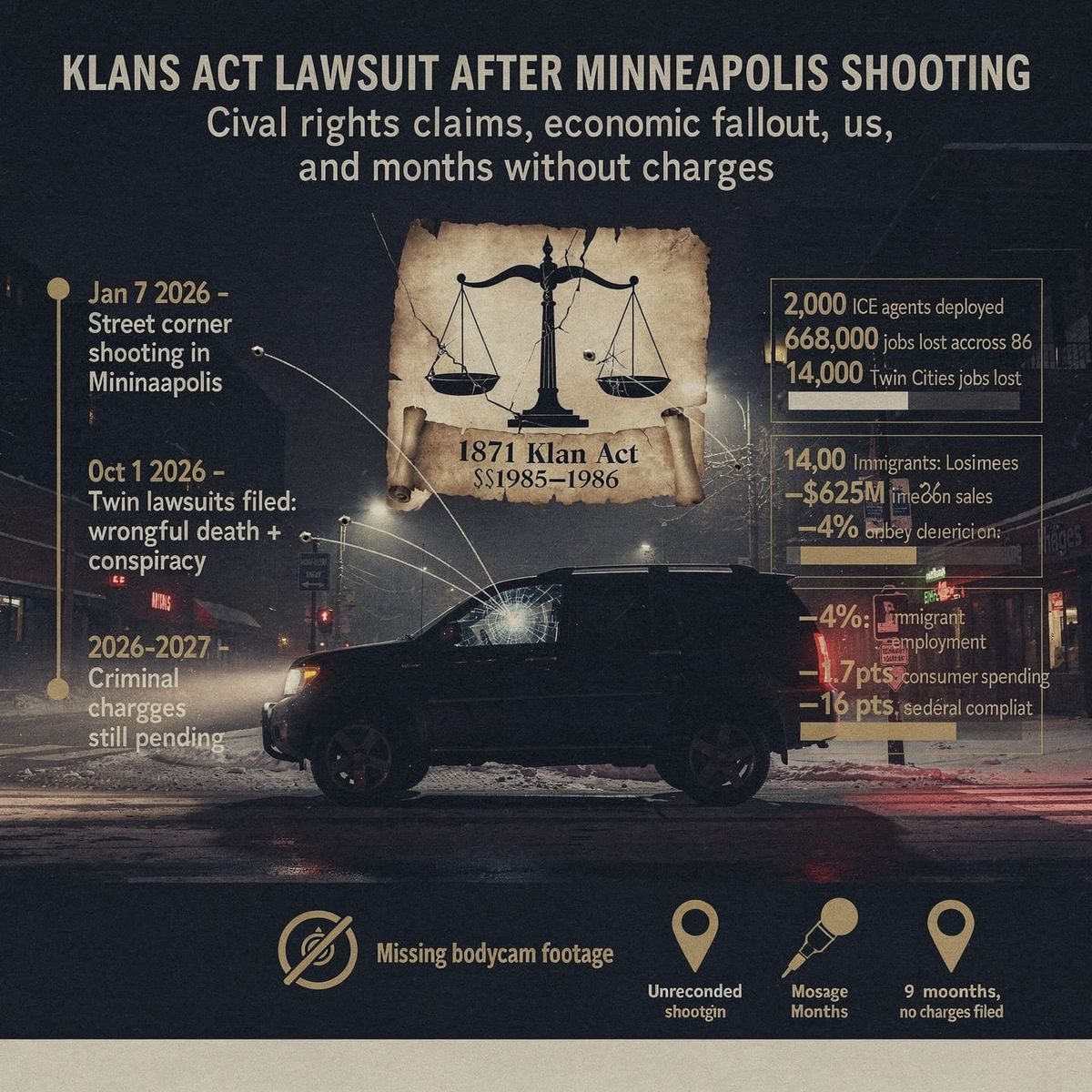
The family of Renee Nicole Good — a 37-year-old mother of three killed by an ICE agent in Minneapolis in January — has filed two federal lawsuits. The first is a wrongful-death action under the Federal Tort Claims Act. The second is the attention-getter: it invokes the 1871 Ku Klux Klan Act, alleging senior administration officials conspired to deprive Minnesota's Somali and Hispanic communities of equal protection during Operation Metro Surge — the largest immigration enforcement sweep in US history. The economic toll is documented: Brookings found 668,000 job losses across 86 metros in Jan–Feb, with a 4% drop in immigrant employment. No charges have been filed against the agent in nine months. A real question hangs over both the case and the broader debate about federal enforcement power.
Here's a sentence you don't read every day: the family of a woman killed by an ICE agent is now suing the United States government — and, rather conspicuously, the people who run it — for a conspiracy that, in their telling, dates back to the Reconstruction era.
Let's rewind, because the facts here are doing a lot of heavy lifting.
On January 7, 2026, Renee Nicole Good, a 37-year-old mother of three from Minneapolis, was sitting in her SUV near 34th Street and Portland Avenue in South Minneapolis when ICE agent Jonathan Ross fired two rounds through the driver's-side window. One struck her in the left temple. She died at the scene. Ross has said the shooting was self-defense. A private autopsy, supported by video analysis from the Associated Press, tells a different story — suggesting the shots came at close range into the car, not through any imminent threat.
Good wasn't a suspect in anything. She was unarmed. She was, by all accounts, a bystander — caught up in a moment when Operation Metro Surge, the largest immigration enforcement sweep in U.S. history, had descended on Minneapolis. The numbers are worth sitting with: 2,000 ICE agents deployed to the city in January 2026, part of a wave that cost the Twin Cities metro more than 14,000 jobs and nearly 668,000 positions across 86 U.S. cities between January and February — a 4% drop in immigrant employment and a 1.7-point slide in consumer spending in affected states.
That's not the administration's spin, either. It's the broad consensus of independent researchers: a Brookings study released in June confirmed 668,000 job losses across 86 metros, with Los Angeles alone shedding $625 million in sales after a major operation caused a 20–25% spending drop in immigrant-heavy neighborhoods. The NBER reached the same uncomfortable conclusion in May: mass deportations don't protect native workers so much as gut the complementary labor that holds local economies together. The raids targeted Somali and Hispanic communities who were, at the time, protesting the mass enforcement.
That was nine months ago. In all that time, no charges have been filed.
The Lawsuits, in Two Acts
On October 1, Renee's widow, Becca Good, stood before cameras flanked by the family's lawyers at Romanucci Blandin and announced not one but two federal lawsuits.
The first is a straightforward wrongful-death action under the Federal Tort Claims Act, naming the United States as the sole defendant. Negligence, assault, battery, false imprisonment, emotional distress. The basics, legally speaking — a family seeking compensation and, more pointedly, a trial where a jury decides who's liable.
The second is the attention-getter: a 149-page complaint that dusts off the Ku Klux Klan Act of 1871 — specifically 42 U.S.C. §§ 1985 and 1986 — to allege that senior Trump administration officials conspired to deprive Minnesota's Somali and Hispanic residents of equal protection under the law. Named defendants include White House Deputy Chief of Staff Stephen Miller, former Homeland Security Secretary Kristi Noem, border czar Tom Homan, then-acting ICE director Corey Lewandowski, ICE head Todd Lyons, Border Patrol commander Gregory Bovino, agent Jonathan Ross, Palantir Technologies, and a journalist, Nick Shirley, plus ten unidentified federal agents — identities DHS has conspicuously declined to release.
That's an electoral roadmap in human form, and the timing is not subtle: the filings land roughly a month before the midterms.
The Klan Act, Dragged Into the 21st Century
Using an 1871 statute designed to fight the Klan is an aggressive legal play. The theory is that Operation Metro Surge wasn't just a heavy-handed enforcement action but a coordinated scheme to intimidate, surveil, and suppress a targeted community — aided, the suit claims, by data-mining contractors like Palantir and Clearview AI. The family's attorney, Antonio Romanucci, was blunt about it: "The death of Renee was not an accident."
The administration, predictably, calls the lawsuits baseless. The Hennepin County Attorney's Office, meanwhile, is weighing possible state charges against Ross — a decision that has been pending, seven months and counting, with no filing.
What's Left to Account For
Here's the uncomfortable part the press conference couldn't tidy away. Becca Good didn't just talk about legal strategy. She talked about Halloween costumes and school drop-offs — the ordinary landmarks of a household that lost its mother to a federal operation.
And here's where the record gets genuinely murky. ICE's own announced fix arrived too late to help. In early August, after a string of unrecorded shootings — a Missouri teen, a Houston construction worker, a man killed in Maine — ICE ordered body cameras for all officers by August 31. On August 9, Border Patrol detained a protester after a fatal shoot-out — and no bodycam captured the incident, despite that looming deployment deadline. It was the third such case that month tied to unrecorded lethal force, with policy permitting delayed footage release post-death citing "agency best interest." Transparency gap, meet your poster child.
The DOJ's civil rights division, meanwhile, declined to investigate — a call Attorney General Todd Blanche has made before in shootings where agents "stood in front of" a vehicle and the target "attempted to run them over." The department instead reportedly focused its probe on Good's partner, Becca, and her ties to protest groups. A magistrate, notably, refused a search warrant for criminal charges against her.
But the video, reportedly filmed by bystanders, cut against the official account — an agent approaching a driver's side and firing at close range into a car whose occupant had just told him she wasn't angry. Judicial scrutiny appears to be arriving anyway: prosecutors are charging some in the broader federal push, and the suits themselves are a court's chance to say whether the archive of what happened ends with the government's word.
The suits ask for compensation and a day in court. Whether they succeed is anyone's guess. What they've already accomplished is putting a name, a face, and a date on a footnote in a much larger debate about how far federal enforcement power can reach. Nine months on, the investigation grinds on, and the only thing the record clearly shows is this: a 37-year-old mom went to a protest zone and never came home.
Nobody has been held to account yet. The lawsuits, at minimum, make sure the question stays loud.
Comments ()