Trump signs secondary sanctions law hitting top Russian energy buyers
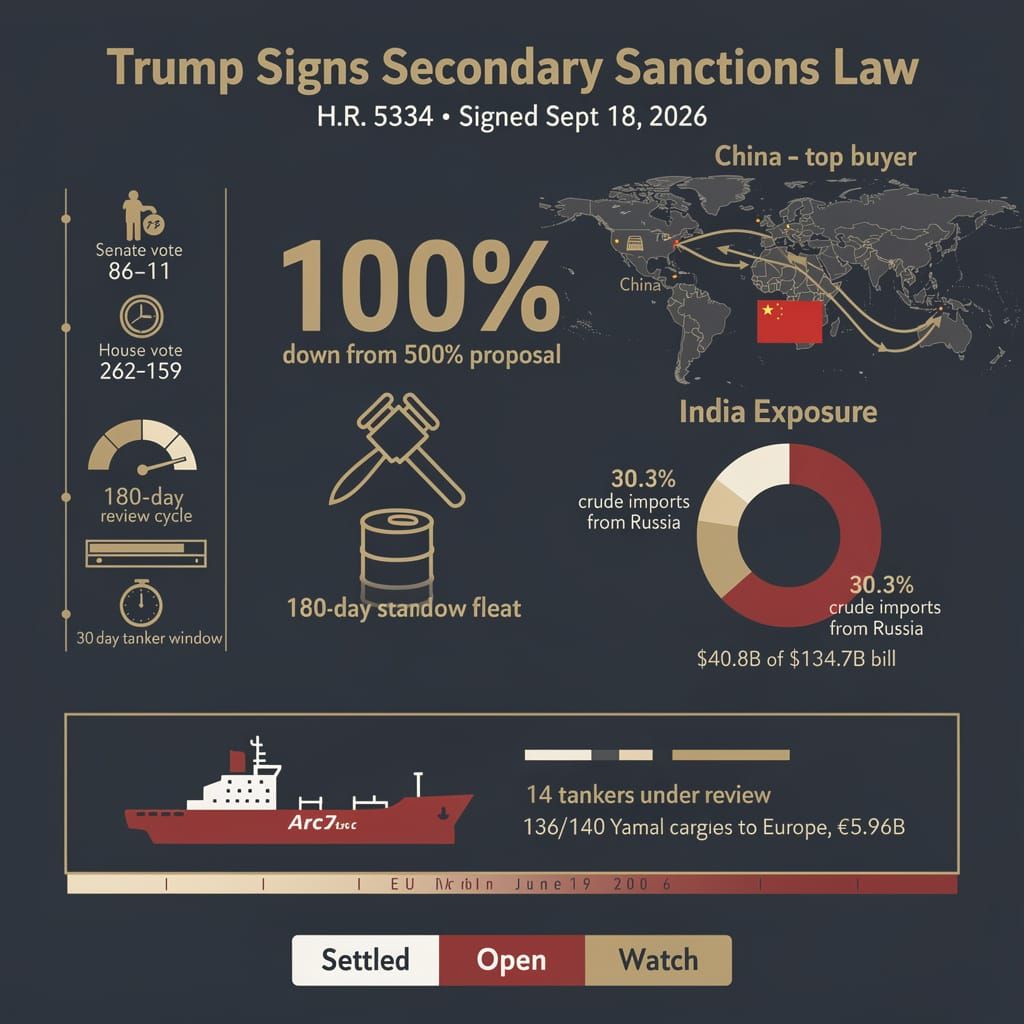
Russia's top oil and gas buyers now face up to 100% tariffs — covering roughly the entire value of Moscow's energy trade with China and India. 🛢️ Signed into law Sept 18, H.R. 5334 lets Washington target the 5 largest importers and LNG shadow-fleet vessels. India, which took 30.3% of its crude from Russia last fiscal year, could lose a discount that saved refiners $12.6B since 2022 — but implementation is discretionary. Is imposing tariffs on energy buyers a decisive check on Russia, or a risk to your fuel prices? 🇺🇸🌏
The Lindsey O. Graham Sanctioning Russia and Iran Act of 2026 lets the US president impose up to 100% tariffs on the largest foreign buyers of Russian crude oil and gas. China and India, top importers, face near-term exposure that depends on White House implementation.
Authority, Action, and Status
President Donald Trump signed H.R. 5334, the Lindsey O. Graham Sanctioning Russia and Iran Act of 2026, on September 18, 2026, making it final law. The Senate passed the measure 86–11 in August; the House approved it 262–159 on September 16. The law authorizes—but does not mandate—secondary sanctions on the five largest foreign buyers of Russian crude oil and natural gas and on major evasion facilitators. A separate provision extends the Iran Sanctions Act of 1996 through 2031.
Scope and Timeline
The statute caps applicable tariffs at 100%, down from the 500% ceiling in the original proposal advanced by Senators Lindsey Graham and Richard Blumenthal in April 2025. Covered energy buyers are not named in the legislation. The law requires the executive branch to review covered countries every 180 days. Presidential discretion permits waivers or suspensions when deemed in the national interest, meaning tariff application is conditioned on subsequent implementation decisions rather than automatic.
Transmission Path to Affected Operators
The primary transmission channel runs from secondary tariffs on importers to higher delivered cost of Russian barrels. If the president applies the ceiling, buyers in China and India—two of the largest Russian purchasers—would absorb added duty costs, likely reflected in negotiated crude pricing or diverted cargo flows. India received 30.3% of its crude imports from Russia in fiscal 2026, at roughly $40.8 billion of a $134.7 billion import bill, and replaced Russian supplies would raise crude, shipping, and insurance costs amid limited spare capacity among alternative suppliers (UAE, Saudi Arabia, Iraq, Brazil).
The law's secondary provisions target Russia's LNG shadow fleet. The Senate-passed legislation mandates the president to review up to 14 specialized Arc7 tankers serving the Yamal LNG project and designate qualifying vessels as blocked property within 30 days of enactment. European ports handled 136 of 140 Yamal LNG cargoes in H1 2026, worth about €5.96 billion, as the EU prepares to fully ban Russian LNG imports. That backdrop is itself shifting: on June 19, 2026, the EU implemented an indefinite global ban on Russian LNG, halting transportation, trading, and commercial activity involving Russian-originated cargoes—Greek Dynagas reported a loss of €2.3 billion in annual revenues within four weeks, Novatek incurred $1.1 billion in cargo repositioning costs, and SEFE faced shipment-delay penalties exceeding £500 million. However, the EU's 21st sanctions package (reported August 21, 2026) introduced a one-year exemption permitting European companies to purchase and transfer Russian LNG to third countries, applicable to contracts concluded before February 24, 2022 and valid until July 25, 2027.
Settled Versus Open
Settled: The statute is enacted with the specified ceiling, review cadence, discretionary waiver authority, and the tanker-review mandate. The 500% figure is no longer operative. Separately, the EU's staggered policy is now three-layered: the June 19 global ban, the standing January 2027 phaseout, and the temporary third-country transfer exemption set to lapse July 25, 2027 unless renewed by the Council.
Open: Whether the president exercises the tariff authority, on which countries and at what rate; Treasury's enforcement posture toward existing and new sanctions; and which of the 14 Yamal-linked tankers are designated within the 30-day window. Also open is whether the EU Council renews the third-country exemption when it expires.
Near-Term, Contingent, and Watch Conditions
- Near term: Presidential issuance of any tariff rate, waiver, or covered-country designation; the 30-day tanker-review designation; the EU exemption's status as it runs toward July 2027.
- Contingent: Application of the 100% ceiling to China or India would raise delivered costs and likely trigger further reciprocal measures; India's exposure is heightened by freight, insurance, and compliance costs that erode the discount that saved refiners roughly $12.6 billion since 2022. A lapse in the EU exemption would reactivate transfer hurdles for Yamal volumes bound for Asia.
- Watch: Kremlin spokesman Dmitry Peskov stated the law "cannot have a positive effect" on peace talks, signaling potential diplomatic friction; the EU's June 19 ban already forced carriers such as Dynagas to cease Arctic LNG services, with UK-sanctioned vessels Orion, Merkuriy, Kosmos, and Luch diverted to Chinese buyers.
Three Unresolved Questions
- Which named countries or entities will be designated as the five largest buyers under the 180-day review, and which of the 14 Yamal Arc7 tankers will be blocked within 30 days?
- Will the president exercise waiver authority, and for which jurisdictions, before any tariff takes effect?
- Will the EU Council renew the third-country LNG-transfer exemption upon its July 2027 expiry, and how will the June 2026 ban interact with the shorter US tanker-designation window?
This article is reporting and analysis, not legal advice. Sanctions law carries significant compliance obligations for affected entities.
Comments ()