UN's Secretary-General Race Is Stuck in Neutral
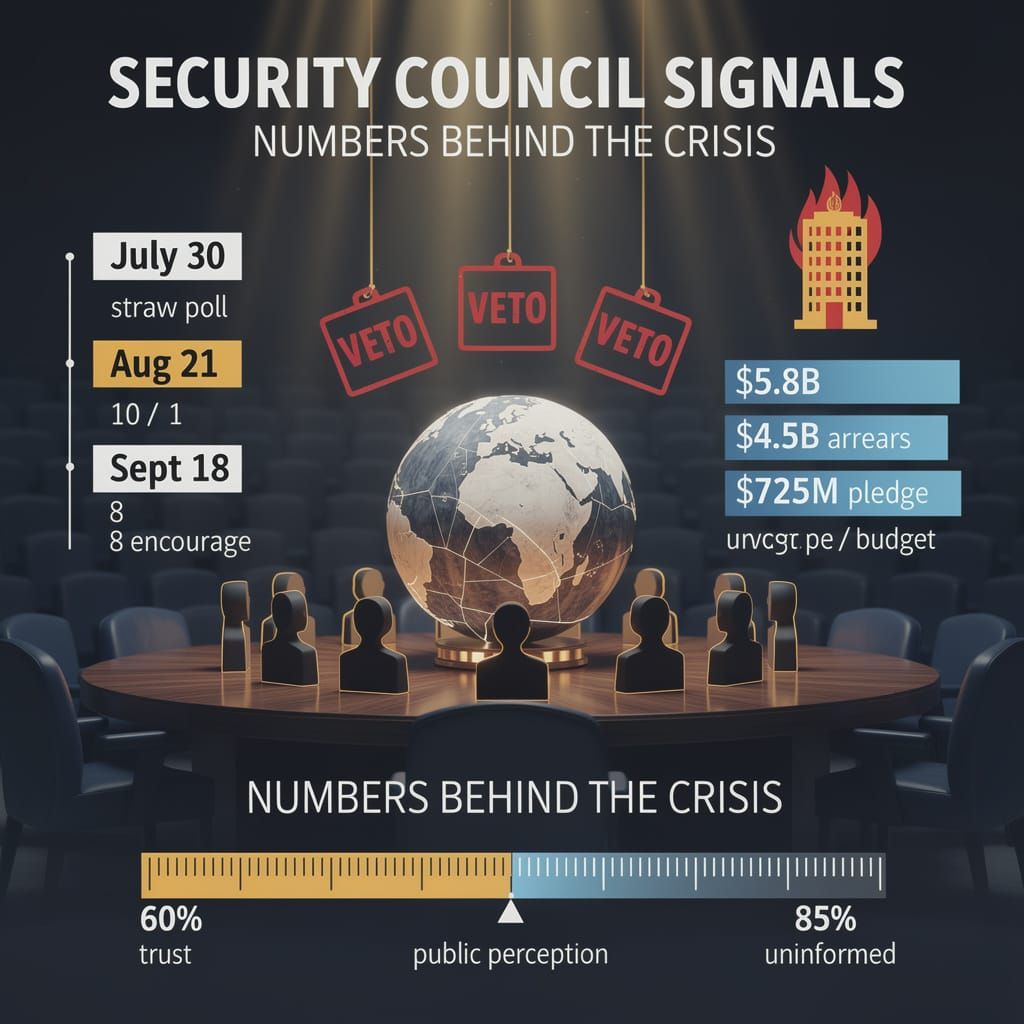
8 candidates. 5 vetoes. $4.5B+ short of cash. 🇺🇳 The UN's race to replace Guterres just hit round three of secret straw polls — and nobody's emerged as a frontrunner. Costa Rica's Rebeca Grynspan and Guyana's Carolyn Rodrigues-Birkett are trading the lead. All while the UN faces a $4.5B hole in unpaid US dues and a $5.8B funding gap threatening 8.3 million refugees. The new boss inherits a burning building in January. A woman could finally take the top job for the first time since 1945. Who would you back to fix a UN that can't even pick its own leader?
There's a job opening at the United Nations, and if you think your office politics are toxic, try this one: eight candidates, a multi-billion-dollar hole in the budget, five grumpy veto-wielding members, and the world's biggest donor refusing to pay its tab.
On September 18, the Security Council ran its third informal straw poll behind closed doors — and, per the increasingly leak-prone tradition of this process, nobody emerged as a clear frontrunner. Secretary-General António Guterres' successor drama is officially stuck in neutral. The system that picks the world's top diplomat is, by design, opaque, clubhanded, and essentially rigged in favor of the same five countries that have run the joint since 1945. Which is to say: it's exactly the kind of process that inspires confidence in absolutely no one.
Wait, who's even running?
Eight candidates are circling the throne. The leaked first tally (July 30) showed Costa Rica's Rebeca Grynspan leading with 10 "encourage" votes against a single "discourage." But here's where it gets messy: by the second round poll on August 21, Grynspan had actually fallen behind Guyana's Carolyn Rodrigues-Birkett, who led the field with eight "encourage" votes. Grynspan's numbers sagged to nine encourage, five discourage, and one no-opinion by her own July tally — hardly the runaway we were promised.
She's up against IAEA chief Rafael Grossi, former Chilean president Michelle Bachelet, ex-Senegalese leader Macky Sall, Guyana's Rodrigues-Birkett, Uganda's Olara Otunnu, Ecuador's Ivonne A-Baki, and former Ecuadorian foreign minister María Fernanda Espinosa. Five of the eight are women — which, if Grynspan or one of her colleagues takes the top job, would be a first since 1945. And yes, in case you were wondering, FIFA's Gianni Infantino keeps being floated as a "disruptive" option, which tells you exactly how seriously this process treats itself.
The fine print nobody reads
Here's how it actually works: the 15-member Security Council votes in secret ballots, round after round, until someone clears the bar — nine votes with zero vetoes from the P5 (US, UK, France, Russia, China). Three rounds in, there's no obvious winner, and the horse-trading is reportedly boiling down to US–China negotiations over who's acceptable. It's less an election than a hostage negotiation with better suits.
And the timing is brutal. Guterres is out by December 31. Meanwhile, UNHCR warned on September 29 that a $5.8 billion funding shortfall endangers 8.3 million refugees across Afghanistan, Syria, Sudan, and beyond — a separate $1.28 billion deficit already gutting the Sudan–Chad border response. The UN is short roughly $4.5 billion in total US arrears alone, with Washington pledging $725 million in regular dues and $125 million for peacekeeping "very soon" — a number that barely dents the pile.
So what actually happens next?
Let's not sugarcoat it. The new leader takes office in January during a cost-cutting overhaul, and whoever wins inherits a burning building with no fire insurance. The stakes got starker on September 22, when the 81st General Assembly opened under Bangladeshi president Khalilur Rahman — whose theme, "restoring trust," lands with the thud of a man asked to fix a plane mid-flight. If the P5 can't agree — and why would they, when they're actively fighting each other in Ukraine, Sudan, and everywhere else — the UN risks full procedural paralysis. That's not hyperbole; that's the institutional equivalent of a car running out of gas in the middle of a highway.
A UN that can't pick a leader is a UN that can't function
The deeper problem isn't the candidates — it's the machine. GeoPoll data says 60% of people trust the UN to deliver, but 85% couldn't tell you how the selection works. The US is openly hostile, big powers are waging wars over each other's heads, and the budget cuts are so sharp they'd make a finance minister wince. You can't reform a broken system if the people running it won't admit it's broken — and Washington's not exactly leading that charge, since it's the one refusing to pay the bill.
So here we are: eight candidates, five vetoes, four-plus billion dollars short, and a planet in various states of on fire. The new secretary-general has roughly three months to figure out what to do with a mandate that's about as useful as a screen door on a submarine.
If you're looking for reassurance, keep looking. Because the outlines of the next crisis are already visible — and the UN, for now, can't even agree on who's supposed to answer the phone.
Comments ()