Pentagon's 20% 'Less Generals' Cuts Spark Wartime Leadership Fears
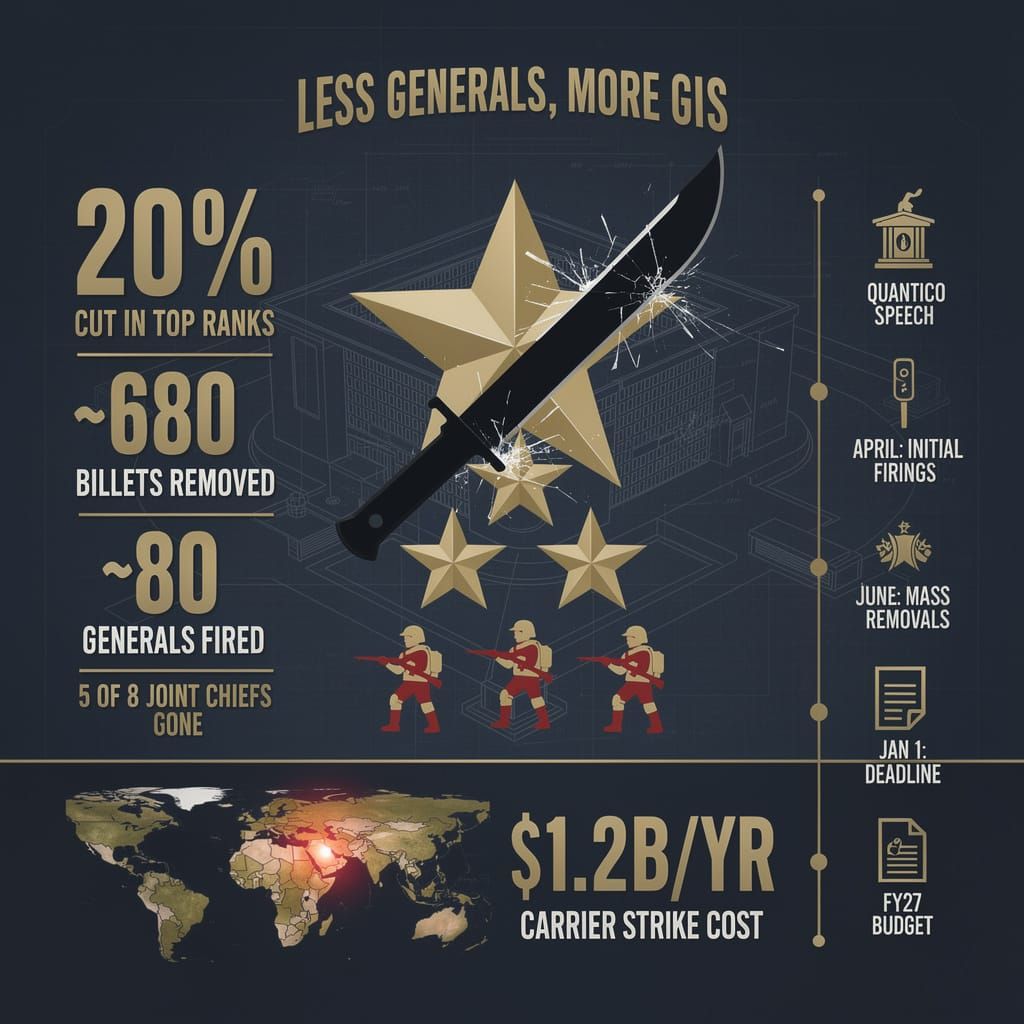
The Pentagon is cutting 20% of general and flag officer billets — nearly 680 senior officials — as the Iran war rages. ⚔️ Hegseth calls it "Less Generals, more GIs," funneling cash to warfighters. But over 80 officers already fired, an Army with no Senate-confirmed Secretary since Driscoll quit, and five Joint Chiefs members gone in under a year. The modernization backers being shown the door are exactly the ones who could push new tech through Congress — now orphaned mid-flight while a $1.2B-a-year regional strain boils. Is this a nimbler Pentagon — or decapitation right when experienced hands are needed most? Your take?
It's Wednesday at a Marine Corps base in Quantico, Virginia, and Defense Secretary Pete Hegseth is about to deliver what's being billed as his "State of the Force" address. The theme, previewed by a Pentagon official: another round of trims to the top of the Pentagon's org chart. Except this isn't a diet plan — it's a machete, and the blade has already been sharpened on dozens of senior officers who stood in the way.
Twenty Percent Off the Top Brass
The headline number is a 20% cut to general and flag officer billets across the Army, Navy, Air Force, and the joint pool — essentially doubling last year's 10% reduction. Run the math, and we're looking at roughly 680 senior officials shown the door, downgraded, or retired into the ether. All service branches have until January 1 to make the numbers work.
The internal branding is catchy: "Less Generals, more GIs." The logic, as Hegseth frames it, is that resources parked in "bloated headquarters" should flow to actual warfighters in the field. Push authority down the chain, lean out the bureaucracy, and let O-6s shoulder what colonels and captains can handle. Plausible on a PowerPoint.
But the track record suggests the meter is running well past slogan territory. Since taking office, Hegseth has fired or blocked promotions of more than 80 generals and admirals, mandated at least 20% cuts to four-star positions starting May 2025, and seen five of the eight Joint Chiefs members he inherited walk out the door. At least 45 officers tapped for promotion in 2026 were struck from the lists. The June removals of seven Navy officers — including two women and two Black men — and an earlier blockout of nine one-star admiral candidates (disproportionately hitting women and Black officers) drew sharp Senate rebukes from the likes of Jack Reed and questions about whether the moves track merit or ideology.
A Wartime Leadership Vacuum
That context matters, because the timing is, to put it mildly, suboptimal. The Army is operating without a Senate-confirmed Secretary after Daniel Driscoll resigned in frustration — reported days ago, after months of friction with Hegseth over blocked modernization initiatives and the chaotic firing of senior figures like Army Chief of Staff Gen. Randy George. Driscoll, Trump's "drone guy" and the youngest-ever Army secretary, was lauded by the White House even as it declined to explain his exit.
Pull the thread on that one and you find the real story. Driscoll announced his resignation to the President back on September 1 — reporting that Trump received the resignation report Monday — leaving the Army airborne mid-war with no confirmed civilian leader. Acting Secretary Michael Obadal may step in, the same administration tells us, but Obadal isn't confirmed by anyone but a vacancy sign. And Driscoll's exit was never a surprise to anyone watching the April firing of George or the June retirement of General Christopher Donahue. Three senior Army leaders, gone inside a year, all under the same roof.
Oh, and did we mention the small matter of the Iran war? On July 8, U.S. strikes killed eight Iranian personnel near Bandar Abbas in an alleged ceasefire breach. By late July, Iran hit six countries plus U.S. territory in simultaneous attacks, and Tehran is now threatening multi-target missile barrages exploiting gaps in U.S. interceptor capacity across the Gulf. The Strait of Hormuz is boiling. Estimated global cost of the regional military strain: $1.2 billion a year. And presiding over this hot war, the department is trimming its command bench with no one at the top of the Army's civilian chain.
The Unmanned Irony
Here's the part that should make strategists wince. The entire rationale for these purges is to move faster — specifically, toward cheaper, unmanned systems and speedier technology adoption, which the department badly needs against coordinated pressure from China and Russia. Yet the warriors being shown the door — like Driscoll's modernization backers — are precisely the ones with the institutional muscle to push procurement through Congress and the acquisition maze.
Driscoll's own legacy is instructive: the Army Transformation Initiative, drone and counter-drone marketplaces, and "Operation Jailbreak" — his attempt to blow up the traditional prime-contractor grip on Army buying. Whatever you think of the man, that's a modernization agenda now orphaned mid-flight, handed off to an acting placeholder while Hegseth pursues a purge.
The result could be the opposite of the stated goal: a leaner top deck, sure, but a risk-averse, talent-starved one, exactly when a hot war and a stretched interceptor network demand experienced hands at the helm.
What Happens Next
Look at the calendar. Reductions land January 1, Hegseth has been in office less than a year, and the FY 2027 budget cycle looms. Senators like Thom Tillis and Susan Collins have been visibly rattled, and with Iran's escalation projected to run into September and beyond, the strained Pentagon-Congress relationship isn't exactly primed for smooth confirmations.
The administration calls it overdue housecleaning; critics see decapitation mid-war. Either way, the next few months tell us whether "less generals" means a nimbler Pentagon — or just a quieter, emptier one when the generals needed most are suddenly unavailable. Count us skeptical, but watching closely.


Comments ()