EU's greenwash crackdown makes certification mandatory
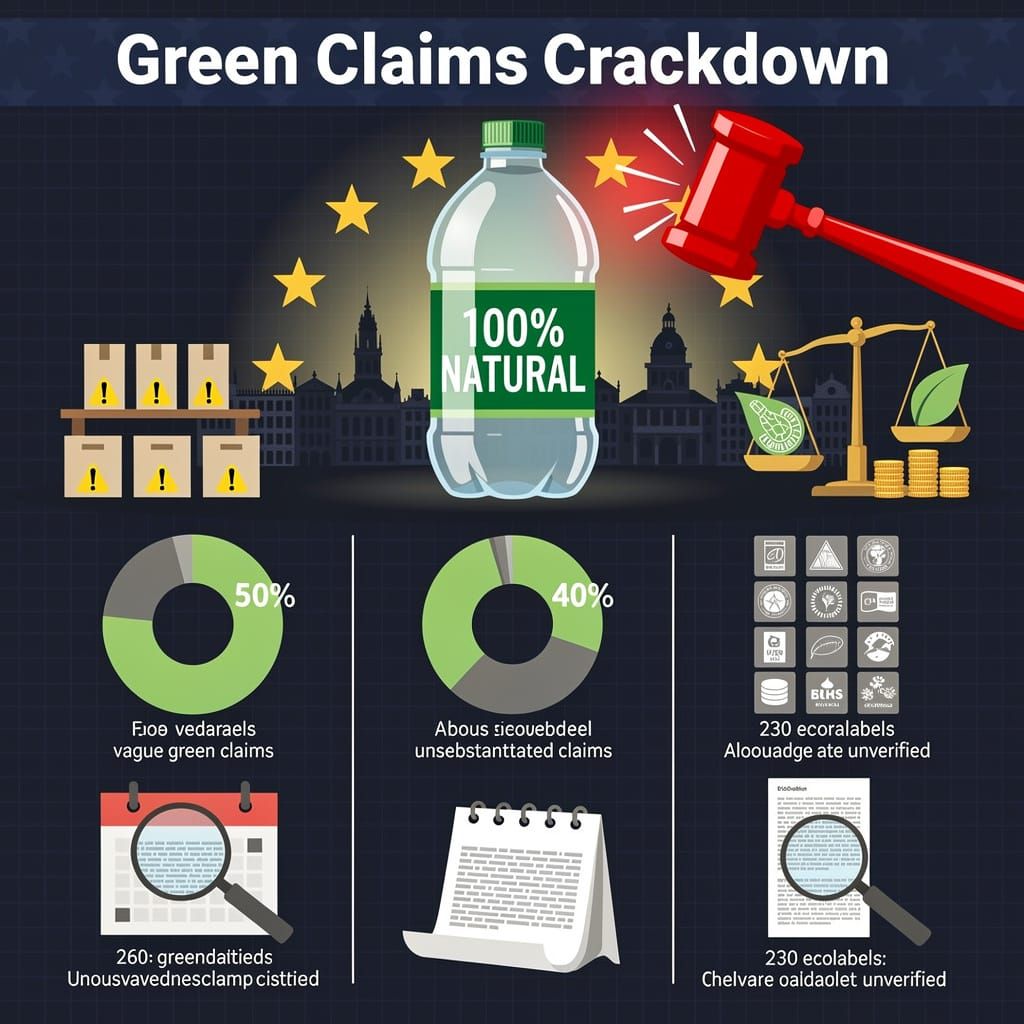
Half of all EU green claims are vague or unsubstantiated — and as of Sunday, they're also illegal. 🏷️ Directive (EU) 2024/825 just landed: generic "eco" and "climate neutral" labels now require recognized certification or public authority backing. No more offset-only claims. Fines up to 4% of annual turnover, plus marketing bans. New "LEGAL GUARANTEE" notices with strict 95x100mm artwork hit every EU point of sale, while "GARAN" stays a voluntary badge for durability overachievers. Stock made before 27 Sep gets a phased pass; anything newer can be pulled from shelves. The verification cost just became a line item — not a slogan. Are your labels in the clear?
Brussels has decided that "100% natural" printed on a plastic bottle is no longer a vibe, but a legal finding.
On Sunday, 27 September 2026, Directive (EU) 2024/825 — the Empowering Consumers for the Green Transition (ECGT) — formally entered into application across the single market. This is not the EU's separate Green Claims legislative file; in fact, that latter file was scrapped, and its stricter soul now lives inside this amendment to existing consumer law, which is a live, enforceable rule rather than a proposal.
Here is the blunt transmission path for anyone selling anything in the Union: if your product carries a sustainability label that is not backed by a recognized certification scheme or public authority approval, you now hold a liability you did not hold on Saturday. Generic claims like "eco," "green," and "environmentally friendly" are restricted unless the product is demonstrably greener and certified under a trusted scheme — the EU Ecolabel being the safest ticket. The old standby of slapping "climate neutral" on a box because you bought offsets somewhere is now explicitly banned. Offsets do not make a product climate neutral; the regulation says so, in so many legally binding words. And the fines — up to 4% of annual turnover, plus marketing bans — are designed to get your attention.
In other words, self-labeled green claims are no longer an option for the ambitious brand; third-party certification is effectively mandatory, for anyone from Lisbon to Tallinn and for international businesses selling inside the bloc.
The Shelf-Level Reckoning
The scale of the problem the law is chasing is worth sitting with. The European Commission's own data shows that more than half of all green claims on the EU market are vague, misleading, or unfounded — and roughly 40% are completely unsubstantiated. Of the 230 ecolabels floating around the Union, more than half have weak or essentially nonexistent verification procedures. That's the unregulated background noise this directive just turned into civil and regulatory risk.
For retailers and brands, the operational consequence is immediate and concrete. Products manufactured or ordered before 27 September 2026 get a phased transition so they can be cleared from inventory — good news for warehouses. But anything arriving after that date with an unsubstantiated label can be pulled from shelves, and the products may need removal or relabeling. Every environmental claim on a product now needs a paper trail to either a recognized certification mark or a public authority's blessing.
The Fine Print That Bites
Two adjacent provisions deserve your attention precisely because nobody is talking about them.
First, the durability rules. The directive takes aim at hidden product obsolescence — premature failure by design — and mandates visibility of guarantee information. That's where the gear actually got specific. Commission Implementing Regulation (EU) 2025/1960, which kicks in the same 27 September, requires a mandatory legal guarantee notice at every EU point of sale — with strict artwork standards, including a minimum 95x100mm print size and specific Pantone colors. The "LEGAL GUARANTEE" banner isn't a suggestion; it's fixed and mandated.
Second, the "GARAN" label. Under the same implementing regulation, producers offering durability or guarantees beyond two years can display the GARAN label complementing the mandatory notice. It's voluntary — an add-on for extra-credit durability offers, not a universal requirement. So the earlier chatter about "GARAN" being a blanket new sticker on every box was overstated: it's a voluntary badge for the overachievers, not a forced accessory.
The Fine Print That Really Bites
The ECGT also takes after forward-looking climate pledges. If your brand makes a "net zero by 2035" promise, that now requires a detailed implementation plan with third-party verification. A promise without a plan is now legally distinguishable from a promise with a plan, and only one of those is lawful to make. The rule also covers timelines for the beleaguered data-center crowd: with the U.S. House passing the Ratepayer Protection Act to cap energy-cost pass-through to consumers, and EU carbon pricing climbing, energy-hungry operators are getting squeezed on both sides of the pond — a reminder that environmental liability is a cost line item, not a slogan.
Watch Items
- Transitional inventory: The phased enforcement for pre-27 September stock is real but narrow. Moving product between warehouses doesn't grandfather it; manufacturing and ordering dates do.
- Certification scramble: Expect a rush toward EU Ecolabel and other verified marks. Certification fees move from "nice-to-have" to "cost of doing business."
- National enforcement divergence: Member-state regulators have coordinated a common approach to old stock, but individual authorities retain discretion, so compliance posture can still vary by market.
The Realist's Scoreboard
The directive is in force, the blacklist is live, and the certification requirement is binding as of this week. Full system implementation is expected to take about two years, during which the enforcement edifice will get tested in practice rather than in the abstract. Whether the Commission pauses parts of it again amid small-business lobbying — as it has flirted with doing — remains an open question, not a settled answer.
Unresolved questions worth watching: How aggressively will member states pursue first-wave violations? Will the certification backlog become a de facto barrier to market entry for smaller brands that can't queue up for the EU Ecolabel in time? And will the separate regulatory threads — carbon-capture subsidies, data-center energy caps — collide with this consumer-claims rule in ways the Commission hasn't fully costed?
What this week delivers is straightforward: a named rule, an effective date, and a direct transfer of verification cost and legal risk to every operator with a label to print. That's not speculation — it's the regulatory invoice arriving in your inbox. As reporting, not advice: check your labels, and mind the dates.
Comments ()