Synopsys' AI agents compress chip verification 50×, cutting the final human gate
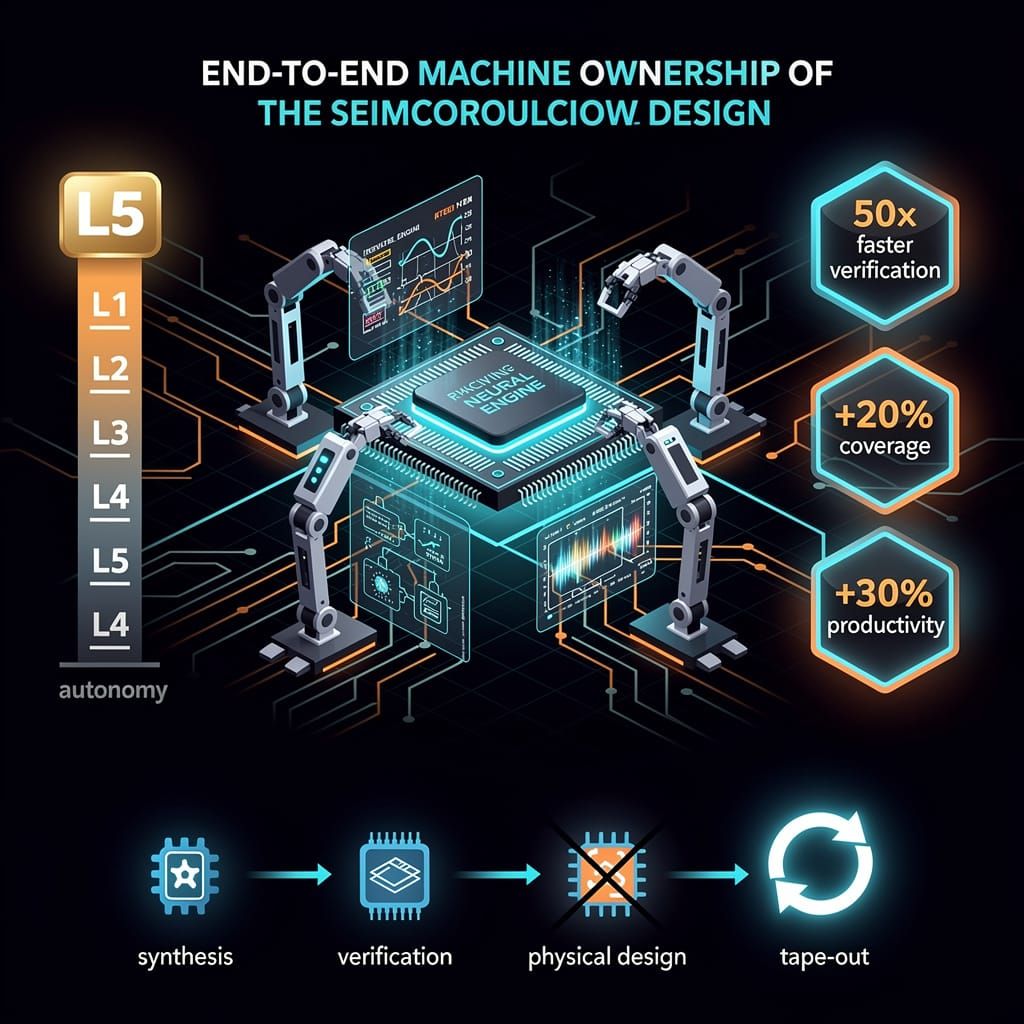
50× faster chip verification closure. ⚡ Synopsys' AgentEngineer—long-horizon AI agents atop NVIDIA infrastructure—now owns the full design flow, cutting months to hours and boosting coverage 20% while raising productivity 30%. The catch: the final human approval gate is gone. Trust at volume is the real test. For designers and fabs facing a two-decade labor bottleneck—does removing that last check earn your trust?
On September 28, 2026, Synopsys unveiled AgentEngineer, a portfolio of domain-specific, long-horizon AI agents built on the Autopilot Platform that treat an entire chip design flow as something a machine can own end to end. The launch is not a gentle incremental step in EDA automation. It compresses a verification closure cycle that routinely consumed months into what Synopsys restates as a 50× speedup, and it demonstrates what happens when an AI agent stops waiting for a human hand-off at every gate.
The architectural break
AgentEngineer runs on NVIDIA's agent infrastructure and pairs two capabilities that previously did not coexist. First, an automated execution platform lets agents form faster feedback loops across multiple design areas at once. Second, open LLM integrations—Synopsys allows customers to bring commercial, open-source, or fine-tuned models—provide predictive guidance without requiring a pre-defined goal at each step: the agent reasons about what a correct outcome looks like rather than checking boxes against a fixed specification.
That infrastructure is exactly where NVIDIA has been concentrating its own effort. In July 2026 NVIDIA added PhysicsNeMo and CUDA-X libraries to its Agent Toolkit, embedding generative AI directly into CAD and test-flow stages so autonomous agents can run closed-loop hardware design validation. By August the toolkit had been upgraded again, pairing physics-aware surrogate modeling with GPU-native linear algebra to propose designs, run rapid surrogates, select few cases for high-fidelity solves, and iteratively refine to sign-off—delivering up to twentyfold multiphysics acceleration in early silicon-development loops.
The decisive shift sits in what Synopsys characterizes as "L5" on its L1-to-L5 autonomy framework: fully autonomous execution with complexity held within human-defined guardrails, while critical approval checkpoints remain human-driven. Traditional flows keep a final human approval gate over the output. AgentEngineer removes that gate, allowing the agent to adaptively correct its own work—a root-cause analysis agent reads logs, clusters errors, forms hypotheses, inspects waveforms, makes local RTL rewrites, and produces a bug fix manifest. That removed bottleneck is the single largest source of labor in conventional RTL development: the hand-off between synthesis, verification, and physical design.
Measured against reality
The headline figures were first shown in July, in work run against NVIDIA and its own verification workflows—not marketing slideware—and restated at launch: up to 50× faster verification closure, 20% higher coverage, 30% productivity boost relative to human experts, and 2× better token efficiency. The 30% productivity figure lands inside the 10%–30% range Fujitsu separately reported for RTL code generation. In one cited example, verification loop mechanics convert plan-to-orchestrate-to-check into autonomous adjustment when intermediate results fall short.
The same closed-loop pattern shows up across NVIDIA's broader agent push. PhysicsNeMo-based surrogate modeling cuts thermal-design evaluation time dramatically by replacing full-scale simulators during early iterations; on the inference side, kernel optimizations from llama.cpp and vLLM collaborations—speculative decoding, faster prefill, and new XQA attention kernels—push real-time local processing onto consumer hardware. These are not isolated benchmarks; they are the shared substrate AgentEngineer now sits on.
Ravi Subramanian, who leads the effort, frames the rollout in terms of what the agents actually replace. They are not coding assistants that suggest snippets. They are long-horizon agents spanning six named domains—verification, system validation, implementation, analog and mixed-signal design, manufacturing, and simulation and analysis—that begin with an architecture intent and carry it through synthesis, verification closure, and signoff. More than 50 customer engagements are underway, with endorsements from Intel, MediaTek, and Samsung and a deployment reference at AheadComputing that cut manual effort from RTL handoff through signoff. These signals point to production rather than lab rails.
Pressure on the flow
The implications ripple through the semiconductor process flow in specific, traceable ways:
- Design rule checking and compliance shift from human-interpreted standards toward machine-verified conformance, because the agent holds the full constraint set in memory across the entire run.
- Fabric yield prediction improves in accuracy, since the agent can simulate and rework iteratively before tape-out rather than after a failed manufacturing run.
- Simulation fidelity rises as verification cycles that once sampled sparsely now run near-exhaustively at lower marginal cost.
- Toolchain integration reliability becomes the new bottleneck—the humans are no longer the slow part; the interfaces between tools are.
The trajectory
Synopsys targets general availability for end of 2026, with the deployment phase running through the fall. The gap between deployment and general availability is where the interesting work happens: real fabs and real tape-outs will expose where the L5 framework's adaptive correction holds and where it drifts. Cadence claims a level-5 milestone of its own at Computex in June and expects early access in H2 2026; NVIDIA's Bill Dally notes a 10-month, 8-engineer GPU library porting task cut to a single night—while cautioning that full end-to-end AI chip design remains distant.
The open question is not whether long-horizon agents can design chips. July's verification figures answer that. The question is whether removing the final gate—the last human check on a manufactured product—earns trust at volume. NVIDIA's own governance stance underscores this: its agent toolkit demands strict audit trails and keeps regulatory compliance risk unchanged through mandatory human oversight. If AgentEngineer's verification runs hold up across those 50-plus engagements—with humans still defining guardrails and approving critical checkpoints—the hand-off labor bottleneck that has governed semiconductor design economics for two decades stops being a constraint at all.

Comments ()