Meta Turns $100B AI Bet Into Enterprise Business
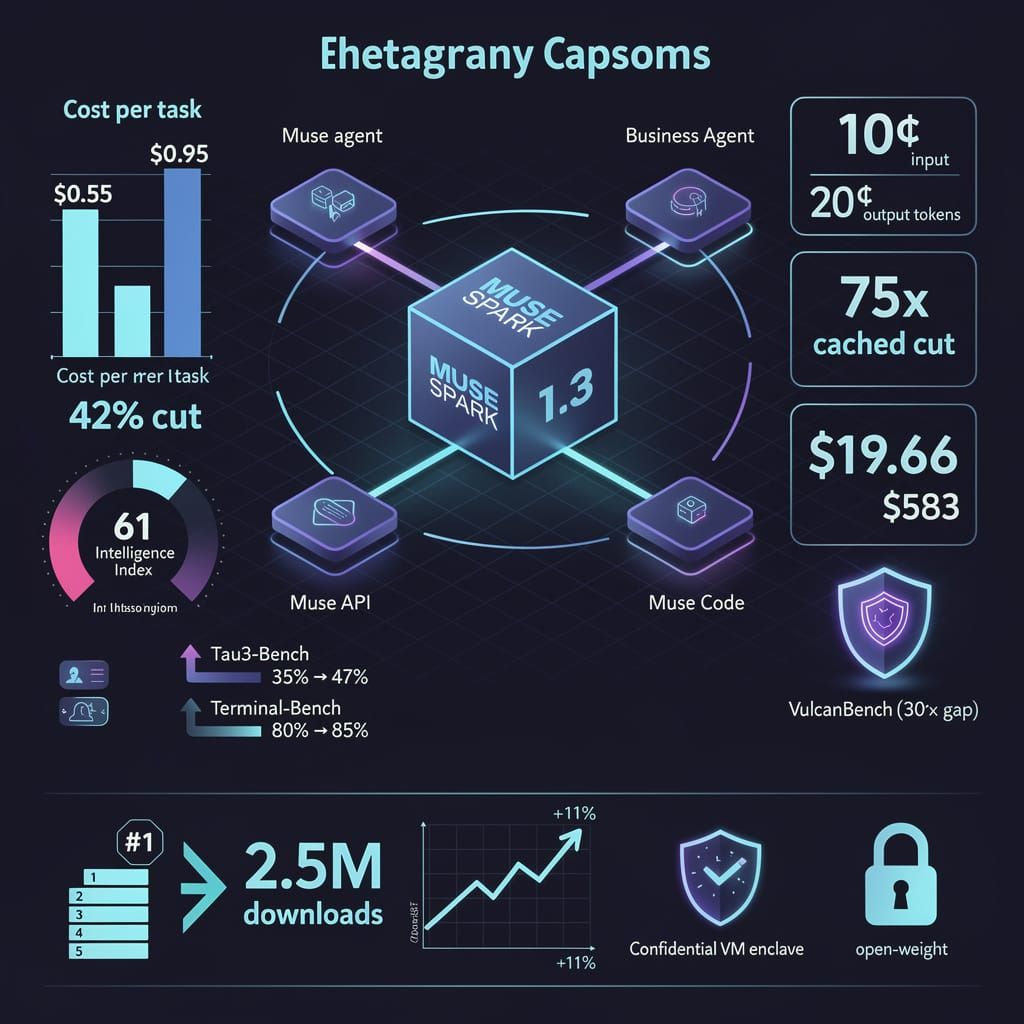
Meta just turned its biggest bet into a business — selling its AI stack directly to enterprises after a $100B infrastructure spend. 💰 The hook: Muse Spark 1.3 costs just $0.55 per task vs GPT-5.6 Sol's $0.95 — a 42% reduction in cost for high-volume agentic work ⚡ The catch: benchmark wins are real but messy. KingBench scores actually regressed, and independent tests found rival models shipping more complete output. Meta's best mode stays gated pending safety testing. The stakes: Meta's stock jumped 11%+ after launch, and an open-weight release would pressure every premium API in the market. Enterprise revenue vs. the infrastructure bill — which arrives first? Even if you're not a dev, does a cheaper, capable model change which AI you'd bet on? 🤔
On the morning of September 28, Mark Zuckerberg did something Meta has resisted for years: he pressed the button on selling the company's internal AI muscle directly to business customers. The launch of the Meta Enterprise Platform, led by newly appointed Chief Enterprise Platform Officer Chirantan "CJ" Desai — poached from MongoDB — marks a structural shift in how the social giant intends to make money beyond advertising.
The strategy is straightforward. Meta spent more than $100 billion on AI infrastructure this year. Now it wants enterprises to help pay that bill.
The Product Stack
The platform ships with four anchored offerings:
- Muse agent — the assistant that topped App Store charts this month
- Meta Business Agent — AI tools for small businesses to manage Instagram, Facebook, Ads, and Meta Stores
- Muse API — model access for third-party developers
- Muse Code — developer-focused coding assistance
Underneath sits Muse Spark 1.3, released on September 2. On the Artificial Analysis Intelligence Index, its xhigh mode scored 61, tying the top models, while hitting a cost per task of just $0.55 versus $0.95 for GPT-5.6 Sol — a 42% reduction. It out-scores OpenAI's flagship on AutomationBench and ranks higher across five coding benchmarks. That efficiency is real: version 1.3 improved Tau3-Bench Banking from 35% to 47% and Terminal-Bench 2.1 from 80% to 85%, with tool-call use down about 20% and token count down roughly 25% versus the prior release.
The pricing math is legible too. Meta launched a Contributor tier at 10¢ per million input tokens (versus $0.15 standard) and 20¢ output (versus $4.25), and cut cached-input pricing by 75×, to $0.002 per million. On VulcanBench, Muse Spark 1.3's best functional score of 76.87 came at an API-equivalent cost of roughly $19.66 versus $583 at standard rates — a 30× gap that changes which model enterprises choose for high-volume agentic work.
The Messy Benchmark Picture
The numbers, however, cut both ways. On KingBench 3, Muse Spark 1.3 scored 71.25% (57/80) — a regression from 1.2's 76.25% — while Google's Gemini 3.8 Flash posted 81.25% (65/80). Independent evaluators flagged Opus 5's inconsistency (75.4% on one platform, 68.3% on another), and hands-on coding tests found Muse Spark 1.3 produced only a basic cube-shooter game while lower-ranked models shipped more complete output.
The efficiency claim also has real regressions on the books: two evaluations slipped against 1.2 (AA-LCR from 83% to 79%, and AA-Omniscience accuracy down 3 points). Meta's own max reasoning mode, which scores 62 on the Intelligence Index, remains locked behind partner access pending safety testing — an admission that the top-end capability is still gated.
Security as a Differentiator
For enterprise buyers, Meta leads with Muse Confidential VM, which isolates customer instances in hardware-backed enclaves, plus continuous audit sharing for compliance teams. The positioning targets the lingering trust gap around AI data handling — a practical answer to the objection that LLMs in the cloud are black boxes, and to the mounting toll of unmanaged API spend that has produced documented six-figure billing shocks.
The Consumer Rocket Behind It
The enterprise push rides on real consumer momentum. Muse took the App Store's top slot earlier this month, logged over 2.5 million downloads last week (3.1 million total), and out-downloaded Anthropic's Claude and xAI's Grok. It still trails OpenAI's ChatGPT, but the gap is narrow enough that Wall Street is paying attention — Meta's stock jumped more than 11% after launch. Meta also shipped its first agent-built hardware device: the Muse Charm, a pocket gadget.
The Competitive Field
Desai reporting directly to Zuckerberg signals how seriously Meta treats the enterprise lane. The ambition collides with existing players — Microsoft, Google, Anthropic, and OpenAI all hold enterprise contracts. Analysts noted the most telling detail from the announcement: Meta is conflating "AI tools" with "outcomes," a move toward account-level governance and outcome measurement that rivals have so far avoided. Notably, Meta plans to open-weight Muse Spark 1.3 — a move that would pressure every premium API in the market.
Outlook
The near-term risk is closing deals, not building products. Long term, the play extends beyond software: reported July plans point toward AI-powered infrastructure services. Meta is positioning Muse not as a chatbot but as a platform — and it is willing to spend five figures per device and nine figures per quarter to make that stick.
The ad business is no longer the only engine. The question is whether enterprise revenue arrives before the infrastructure bill does — and whether the inflated benchmark claims survive contact with real enterprise workloads.



Comments ()