US, Russia strip human review from UN AI weapons treaty
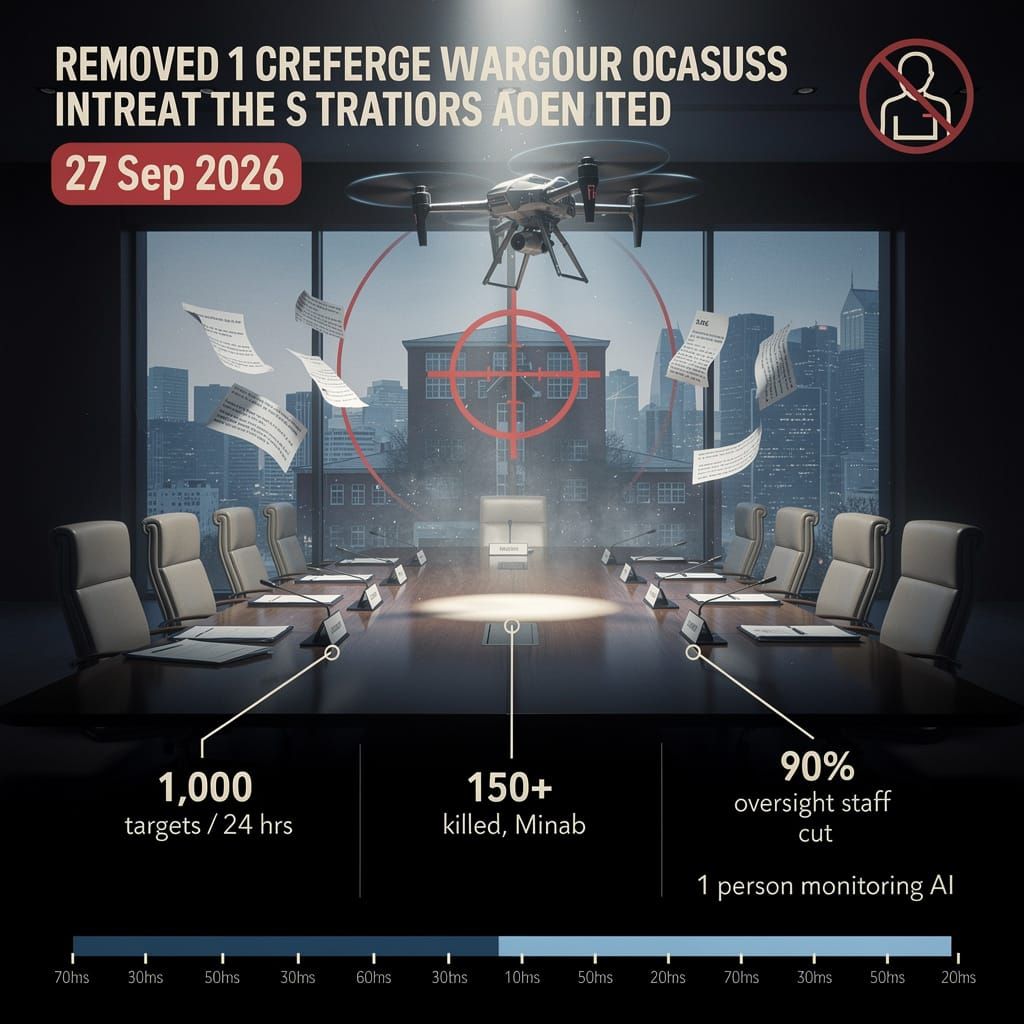
100+ children died in Minab after an AI strike. Now, in Geneva, the US and Russia deleted the human-review, predictability, and reliability requirements from the draft treaty on autonomous weapons — leaving "check and fire" as just "fire." One person now oversees the machine for the whole Centcom theater. ⚖️🤖 The lawyers packed up. The November review conference is next — but is meaningful guardrail still on the table, or is the AI arms race now the only rulebook? What should the world do to keep a human in the loop?
Somewhere in a Geneva conference room, between the coffee breaks and the whispered corridor huddles, the last meaningful sentence about lethal autonomous weapons went to die. On September 27, 2026, hundreds of diplomats showed up at the UN's Convention on Certain Conventional Weapons (CCW) talks hoping to stop machines from deciding who lives and who dies. They left having handed the machines a promotion.
Let's be precise about what got stripped out, because the details matter more than the PR spin. Over roughly 15 hours of closed-door negotiations — with about 10 lawyers per side for the US and Russia, nearly double everyone else's delegation — two superpowers systematically deleted the guardrails from the draft treaty. Gone: the requirement that AI weapons operate "predictably" and "reliably." Gone: the mandate for ethical consideration before use. And gone: the small, inconvenient requirement that a human being actually review the AI's target picks before bombs start falling.
In other words, we erased the "check" from "check and fire."
Now, if you're thinking, "wait, didn't the US already use AI to pick strike targets during the Iran conflict?" — yes, yes it did. Anthropic's Claude model reportedly helped the Pentagon identify roughly 1,000 targets in under 24 hours via Palantir's Maven system, collapsing detection-to-attack timelines from days to minutes. That was the trial run. This is the paperwork.
But here's the thing the Geneva crowd managed to pretend never happened just weeks earlier: on February 28, 2026, Tomahawk missiles struck Shajarah Tayyebeh Elementary School in Minab, Iran, killing over 150 people — including roughly 120 to 123 children. Palantir's Maven AI system, churning through more than 150 data sources (satellite imagery, drone feeds, SIGINT), selected the school off a database that still misclassified it as an IRGC facility. Physical changes to the compound since 2017 — new walls, separate entrances — sat in imagery nobody cross-referenced. An internal Pentagon review found a cascade of preventable failures in the kill chain. The UN fact-finding mission went further, calling the conduct not negligent but reckless.
That's the technology we just deregulated. And the ones who'd have caught it are gone. After the Minab strike, the Pentagon cut civilian-harm mitigation staff by roughly 90% — fewer than 20 people remain — and shrank the Centcom dedicated oversight team from about 10 members to exactly one. One person, minding the machine that killed 120 children. But hey, the 90-degree turn to strip the "human review" requirement out of international law will definitely make this all more accountable.
The cynicism here is genuinely impressive. Both Washington and Moscow showed up to a negotiation aimed at binding rules and somehow walked out with a non-binding agreement that's weaker than the status quo. The final document narrowed international law references to international humanitarian law alone, quietly excluding human rights law entirely. Meanwhile, the Pentagon is fiddling with its 2023 autonomous weapons directive under Trump's June executive order — the 90-day deadline to update regulations, now long blown. New versions? Late September. Somewhere along the line, "we're reviewing safety guidelines" became a permanent lifestyle choice. And be warned: even the oversight we had is evaporating. Back in August, the Pentagon yanked 25 years of weapons testing reports off the public web citing AI-driven threat analysis, while gutting the DOT&E office from 126 staff to 30 — cuts that GAO reports confirm have left deployed systems with "undocumented operational shortfalls" and eliminated 90 of 173 managed weapons programs.
Here's what we're left with: no binding international framework, no human-review mandate, no predictability requirement, and two superpowers deeply invested in winning the AI arms race over policing it. The lawyers have packed up. The diplomats have boarded their flights. And the machines — well, they don't need a treaty to schedule their next meeting. A few weeks ago they had a very productive day in Minab.
The November review conference — the CCW Seventh Review Conference — looms. But after this performance, "binding commitment" reads less like a treaty feature and more like a punchline. The humans had their chance to stay in the loop. They chose the exit — right around the time the software did.
Comments ()