Korea Proposes Ejecting Repeat Cartelists From 17 Sectors
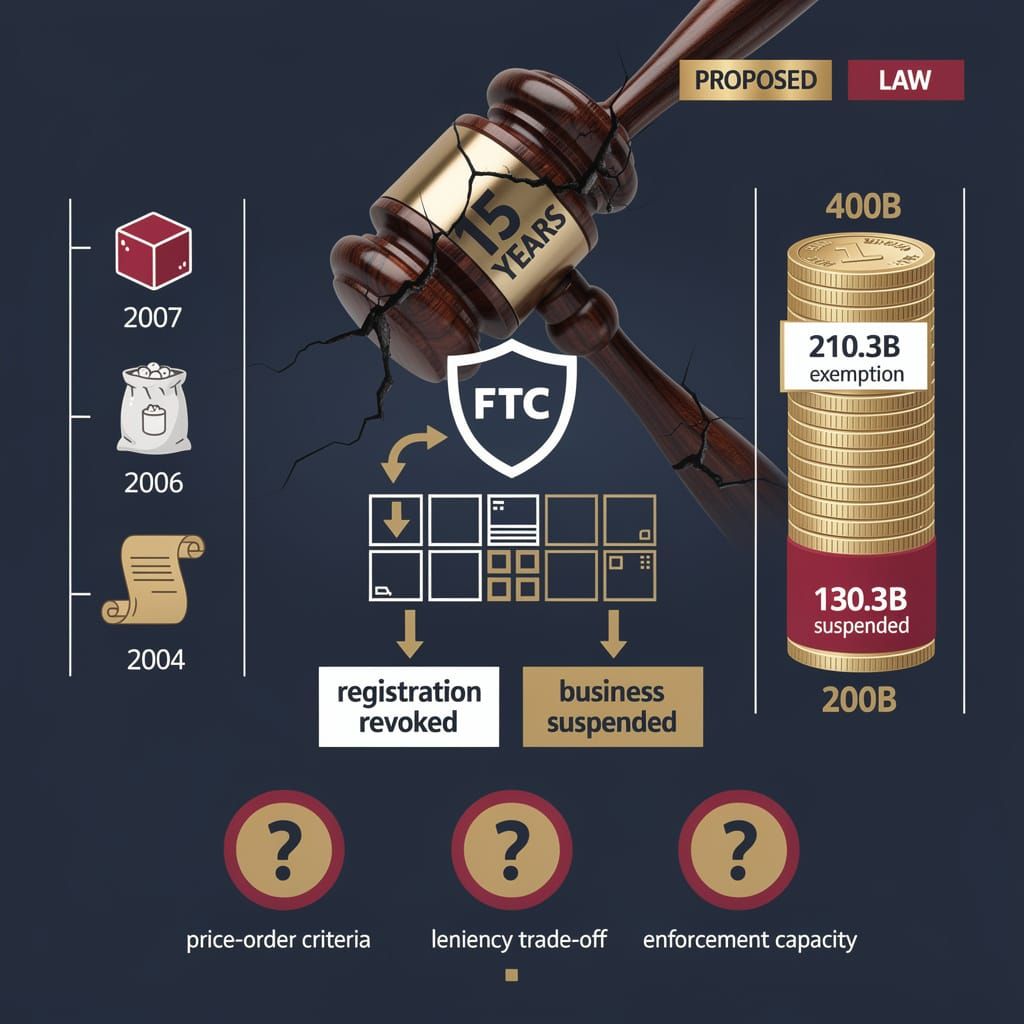
400B+ KRW in fines. Samyang still pays — for now. 🇰🇷 South Korea's new anti-repeat cartel bill goes existential: revoke business registrations and suspend operations across 17 industrial sectors — replacing fine-based penalties with a one-way ticket out of the market. But the hammer isn't law yet. It's a party-government proposal heading to the National Assembly, with a proposed 15-year window for repeat offenses still pending amendment. Price re-determination orders would force retroactive pricing rollbacks. Catch: reduced leniency may shrink self-reporting — making detection harder even as penalties grow. Is ejection better than fines for deterring collusion?⚖️
Some corporate habits apparently die harder than mergers. On September 28, 2026, government officials and the ruling Democratic Party convened to announce a legislative package aimed squarely at repeat cartelists — the kind that treat price-fixing the way other people treat annual flu shots. FTC head Park Jeong-kyung fronted the event, and the plan is unambiguous about intent: eject chronic offenders from the market.
But before we salute the hammer, let's check the handle. This is a proposal, not a final rule — a party-government agreement to pursue legal amendments, not a law on the books. What actually happened Monday: both sides agreed to introduce systems that can revoke business registrations or suspend operations of companies found guilty across 17 industrial sectors, and to amend the Fair Trade Act plus 17 related sector-specific laws. The timeline from agreement to statute runs through the National Assembly, so treat the effective date as open.
The Recidivism File, Annotated
The case for escalation draws on a real, if brief, archive. The sugar sector saw three companies sanctioned in 2007 for a 15-year string of coordinated pricing. Flour took penalties in 2006 across seven firms. Paper has cycled through enforcement rounds since 2004. It didn't take.
The "20 trillion KRW" and "106.5 billion KRW" figures floating around the coverage should be treated as rough aggregates, not audited tallies — the enforcement archive behind them runs through a single recent quarter's large-scale cartels in sugar, flour, starch, and paper.
The Transmission Path to Operators
Here's the part operators actually feel, and the signals give it concrete weight. Consider Samyang Corp.: facing over 400 billion KRW in total cartel fines across sugar, flour, and starch, it has been managing the damage with partial fine exemptions (210.3 billion KRW) and a suspended 130.3 billion KRW sugar fine held over until December 31. That's the current system's teeth — fines that can be whittled down by exemptions and court suspensions.
The new stick is different. Registration cancellation and business suspension are existential, not financial. Lose your registration and you don't pay a fine — you leave the market. The agreement also revives price re-determination orders, a tool regulators say they'll use to force prices back to competitive levels — a retroactive pricing override on your revenue stream, distinct from a fine.
Status Check: What's Agreed vs. What's Law
Be precise about the machinery. The statute of limitations extension — reported as a 15-year window for repeat offenses — remains part of a proposed amendment to the Fair Trade Act, not enacted law. The current statutory limit under which the FTC has been operating is what the existing enforcement cases, like Samyang's, have run through. The suspension and registration-revocation authority similarly needs the legislative package to pass to become operational.
Also new: the reduced leniency trade-off. Self-reporters who come forward early will no longer automatically dodge corrective measures — report early, still get corrected. And tender data gets wired into the Bid-Rigging Indicator Analysis System, one of the few parts of the package that doesn't require new statutory authority.
Meanwhile, the FTC's parallel life goes on. The same week's separate platform enforcement — the Coupang ownership-designation case and the proposed Naver-Dunamu combination, which Chair Ju Biung-ghi defended on September 21 as applying to domestic and foreign firms alike — reminds us the agency can pursue new stick-shaped objects without new statutory wood. Enforcement capacity, as the FIU's 25 referrals (23 shelved by police) demonstrates, is not the same thing as statutory authority.
Open Questions and Watch Conditions
Three items remain unresolved:
- Application criteria for price orders — the food industry has flagged unclear standards for when a normal price adjustment becomes a cartel-correction trigger. Regulator discretion is wide.
- The leniency trade-off — reduced self-reporting benefits may shrink the pipeline of voluntary disclosures, paradoxically making detection harder even as penalties grow.
- Enforcement capacity — Korea's own experience elsewhere (the FIU's 25 referrals, 23 shelved by police) suggests new authority and working enforcement are two different things. The FTC's posture on the 17-sector rollout will be the tell.
None of this is advice — it's the regulatory weather report. The near-term watch item is the legislative push post-Audit Committee; the 15-year extension and five-year suspension triggers are the conditions to monitor once the bill moves. Whether the hammer reduces collusion or just makes the next swing bigger remains, as ever, the experiment in progress.
Comments ()